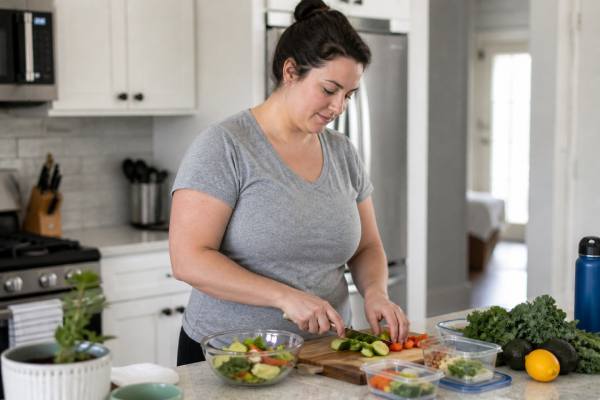
Trying to lose weight while managing children, work, meals, appointments, school schedules, errands, and interrupted sleep is not a simple willpower problem. The plan has to fit real life, not an imaginary week with quiet mornings and unlimited prep time.
The most effective approach is usually not the most intense one. It is a repeatable system built around filling meals, modest calorie reduction, short movement opportunities, realistic recovery, and backup plans for days when everything changes. The goal is to make healthy choices easier when time, energy, and patience are limited.
Table of Contents
- What Realistic Progress Looks Like
- Build a Low-Effort Food Routine
- Quick Meals That Keep You Full
- Exercise When Time Is Fragmented
- Sleep, Stress, and Evening Hunger
- Postpartum, Breastfeeding, and Medical Factors
- Track Progress Without Obsessing
- Make Your Home Routine Sustainable
What Realistic Progress Looks Like
A realistic plan for a busy mom should reduce friction before it reduces calories aggressively. Most people do better with a steady, moderate approach that protects energy, mood, strength, and family life.
A common safe target for adults is about 1 to 2 pounds per week, but many busy moms do best aiming for the lower end, especially during stressful seasons, postpartum recovery, breastfeeding, shift work, or poor sleep. A half-pound per week can still be meaningful if the plan is sustainable. Losing weight more slowly while keeping routines stable often beats losing quickly and burning out after three weeks.
The foundation is a calorie deficit, which means taking in less energy than your body uses over time. That does not require a perfect diet or daily calorie counting. It can come from smaller portions, higher-protein meals, more vegetables and fruit, fewer liquid calories, planned snacks, simpler dinners, and more daily movement. For a practical starting point, it helps to think in “repeatable defaults” rather than constant decision-making. A good busy-schedule weight loss plan should answer what you will eat on normal days, what you will do on chaotic days, and how you will recover after a missed workout or takeout night.
A useful goal is not “be perfect Monday through Friday.” It is “make the next choice easier.” That may look like:
- Keeping two quick breakfasts on rotation.
- Packing a lunch that does not require morning cooking.
- Taking a 10-minute walk after school drop-off or dinner.
- Having one planned evening snack instead of grazing through the pantry.
- Ordering a higher-protein takeout meal without turning the whole day into a write-off.
Expect normal weight fluctuations. Salt, carbohydrates, menstrual cycle changes, constipation, sore muscles, late meals, and poor sleep can all move the scale without reflecting fat gain. For many women, the scale may jump before or during a period and settle later. This is why it is better to look at trends over several weeks, not one morning.
The strongest mindset is flexible consistency. You are not trying to win every meal. You are trying to build a week where most meals, snacks, and movement choices point in the same direction.
Build a Low-Effort Food Routine
The easiest food plan is one that removes repeated decisions. Busy moms usually need fewer complicated recipes and more reliable meal formulas.
Start with a simple plate structure: protein, produce, a high-fiber or starchy carbohydrate, and a small amount of fat or flavor. This keeps meals satisfying without requiring strict rules. A practical version might be chicken, frozen vegetables, rice, and avocado; eggs, berries, toast, and yogurt; or beans, salsa, salad greens, cheese, and a tortilla.
Protein matters because it helps with fullness and supports muscle while weight is coming down. It does not need to be perfect or extreme. Many women do well by including a solid protein source at each meal, such as eggs, Greek yogurt, cottage cheese, chicken, turkey, fish, tofu, tempeh, lentils, beans, lean beef, edamame, or protein-rich leftovers. If you want a more structured approach, a high-protein plate formula can make meals easier to assemble without tracking every gram.
Fiber is the other quiet workhorse. Vegetables, fruit, beans, lentils, oats, whole grains, chia seeds, and potatoes with the skin can make meals feel larger and more satisfying. Fiber also helps with digestion, which matters when busy days lead to irregular meals, low fluid intake, or constipation.
The best food routine is built around what actually happens in your house. If mornings are hectic, do not build a breakfast plan that requires chopping vegetables and washing a pan. If evenings are unpredictable, do not rely on a dinner that needs 45 minutes of calm cooking. Stocking the basics from a beginner-friendly weight loss grocery list can help you keep fast, filling options available when the day goes sideways.
A low-effort routine usually includes three layers:
| System | What it does | Examples |
|---|---|---|
| Default meals | Reduces daily decisions | Greek yogurt bowl, egg wrap, rotisserie chicken salad, turkey sandwich |
| Backup foods | Prevents drive-through decisions when plans fall apart | Frozen meals with added vegetables, canned tuna, microwave rice, bagged salad |
| Planned snacks | Reduces grazing and “kid snack” eating | Cheese and fruit, yogurt, hummus and vegetables, protein smoothie, boiled eggs |
| Flexible takeout rules | Keeps eating out from becoming all-or-nothing | Protein-focused entrée, sauce on the side, water or unsweetened drink, half saved for later |
A helpful rule is to prepare ingredients, not just recipes. Cooked chicken, washed fruit, hard-boiled eggs, chopped vegetables, roasted potatoes, and a pot of chili can turn into several meals. This is often more useful than prepping five identical containers that you may be tired of by Wednesday.
Also watch the “small bites” pattern. Finishing a child’s sandwich crust, eating from the pan while cleaning up, tasting dinner repeatedly, and grabbing a handful of crackers can add up without feeling like a meal. You do not need to become anxious about every bite, but it helps to pause and ask, “Am I eating because I am hungry, or because food is in front of me?”
Quick Meals That Keep You Full
Fast meals can support weight loss when they include enough protein, fiber, and volume. The problem is not speed; it is relying on quick foods that leave you hungry again an hour later.
Breakfast is often the first place to simplify. A good breakfast does not have to be large, but it should help you avoid midmorning grazing. If you are not hungry early, a later protein-rich breakfast is fine. If skipping breakfast leads to overeating later, make it easier, not fancier. Options from high-protein breakfast meal prep can be especially useful for school mornings and workdays.
Good busy-mom breakfasts include:
- Greek yogurt with berries, granola, and chia seeds.
- Eggs or egg bites with fruit and whole-grain toast.
- Cottage cheese with pineapple or berries.
- A protein smoothie with milk, fruit, spinach, and nut butter.
- Overnight oats made with Greek yogurt or protein-rich milk.
- A breakfast wrap with eggs, beans, salsa, and cheese.
Lunch should be easy enough that you do not skip it. Skipped lunches often lead to afternoon snacking, caffeine dependence, and intense evening hunger. Leftovers are ideal, but if that is not reliable, build two or three lunch templates you can repeat. Try a turkey and avocado wrap with fruit, a tuna salad bowl with crackers and vegetables, a bean and rice bowl, a salad kit with added chicken, or soup with Greek yogurt and a piece of fruit.
Dinner needs to work for adults and children without turning into separate cooking projects. This does not mean every family member has to eat the same plate in the same way. You can use “modular meals,” where the base ingredients are shared and each person assembles their own version. Taco bowls, pasta with added protein and vegetables, sheet-pan meals, baked potato bars, omelets, rice bowls, and stir-fries all work well.
For especially busy evenings, 15-minute weight loss meals can help you avoid the trap of waiting too long, getting overly hungry, and then eating whatever is fastest.
A useful dinner formula is:
- Choose a protein: chicken, fish, tofu, eggs, beans, turkey, lean beef, shrimp, lentils, or cottage cheese on the side.
- Add produce: bagged salad, frozen vegetables, roasted carrots, cucumber slices, salsa, fruit, or steamed broccoli.
- Add a satisfying carbohydrate: rice, potatoes, pasta, tortillas, oats, quinoa, beans, lentils, or whole-grain bread.
- Add flavor: sauce, avocado, cheese, olive oil, herbs, spices, yogurt dip, or dressing.
Snacks are not a failure. For many busy moms, planned snacks prevent overeating later. The most useful snacks combine protein or fiber with something enjoyable: apple with peanut butter, yogurt with berries, hummus with carrots, cheese with whole-grain crackers, edamame, tuna packets, cottage cheese, protein smoothies, or a small treat paired with a filling food.
Try not to keep “mom food” and “kid food” completely separate. Children can eat many of the same basics: fruit, yogurt, cheese, eggs, sandwiches, rice bowls, pasta, beans, potatoes, vegetables with dip, and simple proteins. You do not have to turn your home into a diet environment. You are building a household rhythm where nourishing food is easy to reach.
Exercise When Time Is Fragmented
Exercise works best for busy moms when it is broken into small, repeatable pieces. You do not need a perfect hour at the gym to improve fitness, support fat loss, or feel stronger.
Movement helps weight loss in several ways. It burns some calories, helps preserve muscle, improves blood sugar control, supports mood, and can reduce stress. But the biggest benefit for many moms is identity: you start seeing yourself as someone who moves, even during demanding seasons.
Start with walking and daily movement. A 10-minute walk counts. So does walking during sports practice, pushing a stroller, pacing during a phone call, parking farther away, taking stairs, or doing a playground loop while kids play. These small actions increase non-exercise activity, which can make a meaningful difference over a week. A practical busy-day step habit is often more realistic than waiting for a long workout window.
Strength training is worth including because it protects muscle as weight decreases. Muscle matters for function, metabolism, posture, injury prevention, and long-term maintenance. You do not need a full gym setup. Two short full-body sessions per week can be enough to start.
A simple home strength session might include:
- Squats to a chair.
- Incline push-ups on a counter.
- Dumbbell or backpack rows.
- Glute bridges.
- Step-ups.
- Dead bugs or heel taps.
- Farmer carries with grocery bags or dumbbells.
Do 1 to 3 sets of each exercise, stopping with good form. The goal is not to destroy yourself. It is to practice strength consistently. When it gets easier, add repetitions, slow the movement down, use heavier weights, or add another set.
Cardio can be flexible. Brisk walking, cycling, dancing, swimming, incline treadmill walking, jogging, rowing, and low-impact intervals all count. If you only have a short window, 15-minute workouts can be useful, especially when they are planned instead of improvised.
The most sustainable weekly structure is often:
- Two short strength sessions.
- Three to five walking or cardio sessions of any length.
- Daily light movement when possible.
- One or two intentional recovery days.
If you are exhausted, sore, newly postpartum, injured, or not sleeping, choose lower intensity. More is not always better. A short walk after dinner may support your plan more than a hard workout that leaves you ravenous, irritable, or too sore to move the next day.
Sleep, Stress, and Evening Hunger
Sleep and stress affect weight loss because they change hunger, cravings, energy, and decision-making. For busy moms, the solution is not simply “sleep more,” but to protect the parts of recovery you can control.
Poor sleep can make high-calorie foods feel more appealing and reduce the energy available for planning, cooking, and movement. It can also make normal hunger feel urgent. If your nights are interrupted by babies, children, work, caregiving, or anxiety, perfection is not realistic. Instead, focus on stabilizing the edges of sleep.
Useful sleep supports include:
- Keeping a consistent wake time when possible.
- Getting outdoor light early in the day.
- Limiting caffeine later in the day.
- Creating a short wind-down routine.
- Reducing late-night scrolling when it delays sleep.
- Preparing tomorrow’s breakfast, lunch, or clothes before fatigue peaks.
If sleep is a major barrier, guidance on sleep needs for weight loss can help you set expectations without blaming yourself for a hard season.
Stress eating is also common, especially after bedtime routines, work pressure, conflict, overstimulation, or a day spent meeting everyone else’s needs. Food can become the first quiet moment of the day. That does not mean you lack discipline. It means the habit is serving a purpose.
The goal is to build a pause between stress and eating. Try asking:
- “Am I physically hungry?”
- “Would a real snack or meal help?”
- “Am I looking for comfort, quiet, or a reward?”
- “What would still feel good 20 minutes from now?”
If you are hungry, eat something satisfying. If you are depleted, pair food with another form of recovery: tea, a shower, stretching, journaling, a short walk, a phone call, or 10 minutes alone. Tools for stress-related cravings can help you respond before the habit becomes automatic.
Evening hunger often has a daytime cause. If breakfast was coffee, lunch was bites of leftovers, and the afternoon was fueled by kids’ snacks, it makes sense that nighttime hunger feels intense. Before cutting evening food, check whether you need more protein, fiber, and planned meals earlier in the day.
A planned evening snack can be better than unplanned grazing. Try Greek yogurt, cottage cheese, fruit with peanut butter, a small protein smoothie, eggs and toast, or a portioned dessert with tea. The point is not to ban nighttime eating. It is to make it intentional.
Postpartum, Breastfeeding, and Medical Factors
Moms in different life stages need different weight loss plans. Postpartum recovery, breastfeeding, pregnancy, perimenopause, medications, and medical conditions can all change what is safe and realistic.
If you are pregnant, weight loss should not be your goal unless your clinician specifically advises a medical plan. Pregnancy is a time to focus on appropriate weight gain, blood sugar support, nutrient intake, and safe movement. If you recently gave birth, your body is healing, even if you feel pressure to “bounce back.” Early weight changes include fluid shifts, uterine changes, blood volume changes, and recovery from delivery, not just fat loss.
After an uncomplicated birth, many people can start gentle movement when they feel ready, such as walking, pelvic floor exercises, and light mobility. If you had a C-section, significant tearing, heavy bleeding, pelvic pain, prolapse symptoms, severe anemia, infection, or other complications, get individualized guidance before increasing intensity. High-impact exercise, heavy lifting, and intense core training may need a slower return.
If you are breastfeeding, avoid aggressive dieting. Lactation increases energy and nutrient needs, and some women notice milk supply changes when they cut calories too sharply, skip meals, dehydrate, or lose weight quickly. A gradual approach with balanced meals, enough fluids, and adequate protein is safer than rapid restriction. For more specific guidance, see weight loss while breastfeeding.
Medical factors deserve attention when progress feels unusually hard or symptoms are changing. Talk with a healthcare professional if you have:
- Rapid or unexplained weight gain.
- New swelling, shortness of breath, chest pain, or severe headaches.
- Heavy or persistent postpartum bleeding.
- Fever, worsening pain, or signs of incision infection.
- Severe fatigue beyond expected sleep loss.
- Hair loss with other symptoms such as cold intolerance, constipation, or low mood.
- Irregular periods, acne, excess facial hair, or symptoms of PCOS.
- Excessive thirst, frequent urination, or blurred vision.
- Depression, anxiety, panic, intrusive thoughts, or thoughts of harming yourself or your baby.
- A history of eating disorder symptoms or feeling unable to eat flexibly.
Medications can also affect appetite, energy, fluid retention, or weight. Examples may include some antidepressants, antipsychotics, steroids, insulin or certain diabetes medications, beta blockers, anticonvulsants, and hormonal treatments. Do not stop a medication on your own. Ask whether alternatives, dose changes, monitoring, or additional support are appropriate.
Perimenopause can add another layer. Sleep disruption, cycle changes, increased stress sensitivity, and shifts in body composition may make old strategies less effective. The basics still matter, but strength training, protein, fiber, sleep support, and realistic calorie targets become even more important.
Track Progress Without Obsessing
Tracking should help you make decisions, not make you feel watched by your own plan. The best method is the least stressful method that still gives useful feedback.
Some moms like calorie tracking because it provides clarity. Others find it time-consuming, triggering, or unrealistic. Both responses are valid. You can lose weight with calorie counting, portion awareness, plate methods, meal templates, food photos, protein targets, or structured meal plans. What matters is whether the method helps you repeat helpful behaviors.
Simple tracking options include:
- Weighing yourself a few times per week and watching the trend.
- Measuring your waist every 2 to 4 weeks.
- Taking progress photos monthly.
- Tracking protein at meals.
- Checking off habits such as water, walks, planned lunch, or bedtime routine.
- Keeping a short food log for three days when progress stalls.
- Rating hunger and energy to spot under-eating or poor meal timing.
If daily weigh-ins make you anxious or affect your mood, use another method. If the scale is useful and emotionally neutral, it can be a good data point. Either way, do not judge progress from one weigh-in.
A good review rhythm is once per week. Ask:
- Did I eat enough protein most days?
- Did I include fruits, vegetables, beans, or whole grains regularly?
- Did I have planned meals, or did I rely on grazing?
- Did I move in some way most days?
- Did weekends erase the weekday deficit?
- Was my plan too strict for my actual life?
- What is one change that would make next week easier?
If weight has not changed after 3 to 4 weeks and you have been consistent, adjust gently. You might reduce portions slightly, add a walk, change a snack, limit liquid calories, increase protein, or plan weekend meals more carefully. Avoid the common mistake of cutting too hard. For busy moms, an overly aggressive deficit often leads to fatigue, cravings, skipped workouts, and rebound eating.
Also track wins that are not scale-based. Better energy, improved strength, fewer cravings, more regular meals, looser clothes, better blood pressure, improved blood sugar, and feeling more in control around food are all meaningful signs that your system is working.
Make Your Home Routine Sustainable
A sustainable plan fits the household instead of fighting it every day. Weight loss becomes easier when your environment, schedule, and family routines support the default choice.
Start by changing what is easiest to reach. Put fruit, yogurt, cheese sticks, chopped vegetables, boiled eggs, sparkling water, and leftovers where you can see them. Move easy-to-overeat snacks out of direct view or portion them into smaller containers. You do not need to ban foods from the house, but visibility matters when you are tired.
Plan for the hardest time of day. For many moms, that is late afternoon into evening. Children are hungry, everyone is tired, and dinner decisions become urgent. A “minimum viable dinner” list can save the day:
- Scrambled eggs, toast, and fruit.
- Rotisserie chicken, bagged salad, and microwave rice.
- Turkey sandwiches with vegetables and yogurt.
- Bean and cheese quesadillas with salsa and salad.
- Frozen meatballs, pasta, and steamed vegetables.
- Tuna melts with fruit.
- Sheet-pan sausage or tofu with vegetables and potatoes.
- Soup plus a high-protein side.
Ask for practical support, not vague encouragement. Instead of “support my goals,” try “please handle bath time on Tuesdays so I can walk,” or “let’s keep two easy dinners in the freezer,” or “please do not offer me bites after I say I am done.” If your children are old enough, involve them in simple food prep: washing fruit, choosing vegetables, stirring yogurt bowls, packing snack boxes, or setting the table.
Social life still matters. Birthday cake, pizza night, holidays, and restaurant meals can fit. A sustainable plan does not require you to be the parent who never eats the fun food. It means you choose intentionally, enjoy the food, and return to your normal routine at the next meal.
Use “good enough” rules. A grocery store prepared meal with added vegetables is good enough. A 12-minute walk is good enough. A protein bar and fruit during a chaotic day is good enough. A week with three solid dinners, two short workouts, and fewer evening snacks is progress.
Most importantly, avoid making weight loss the center of your identity at home. Children notice how adults talk about bodies, food, and guilt. Focus family language on strength, energy, health, fullness, cooking skills, and taking care of yourself. You can pursue weight loss without criticizing your body or teaching your children to fear food.
Long-term success usually comes from a small set of repeatable habits: protein at meals, produce most days, planned snacks, simple movement, enough sleep when possible, flexible tracking, and quick resets after disruptions. Busy motherhood may not allow perfection, but it does allow systems. Systems are what carry you when motivation is low.
References
- Dietary Guidelines for Americans, 2025–2030 2025 (Guideline)
- Steps for Losing Weight 2025 (Government Guidance)
- Maternal Diet and Breastfeeding 2026 (Government Guidance)
- Navigating Postpartum Weight Loss: Evidence and Interventions 2024 (Review)
- A systematic review on the effectiveness of diet and exercise in the management of obesity 2023 (Systematic Review)
- WHO guidelines on physical activity and sedentary behaviour 2020 (Guideline)
Disclaimer
This article is for general educational purposes only and is not a substitute for professional medical advice, diagnosis, or treatment. If you are pregnant, postpartum, breastfeeding, taking weight-affecting medications, managing a medical condition, or experiencing unusual symptoms, ask a qualified healthcare professional for guidance that fits your situation.
If this article was helpful, consider sharing it on Facebook, X, or your preferred platform so other busy moms can find practical support too.