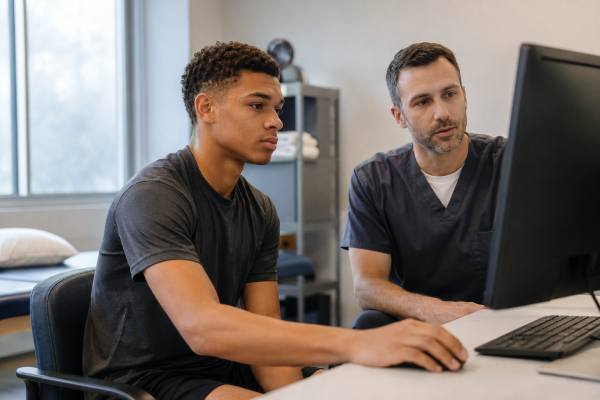
A concussion can affect thinking speed, memory, reaction time, symptoms, balance, vision, sleep, mood, and tolerance for school or work. Because those changes are not always visible on a scan or obvious during a brief conversation, clinicians often use several tools together. The ImPACT test is one of the best-known computerized tools used in concussion care, especially in sports medicine.
ImPACT can provide useful information about cognitive performance after a suspected concussion, particularly when results are compared with a valid preseason baseline. It is not, however, a stand-alone concussion diagnosis, a return-to-play clearance, or a substitute for a clinical evaluation. Its value depends on how it is administered, who interprets it, and how well it fits with the person’s symptoms, exam findings, history, and recovery pattern.
Table of Contents
- What the ImPACT Test Measures
- How ImPACT Fits Into Concussion Assessment
- Baseline vs Post-Injury ImPACT Testing
- What Happens During ImPACT Testing
- How ImPACT Scores Are Interpreted
- Accuracy, Limitations, and Common Confounders
- ImPACT Results and Return-to-Activity Decisions
- When Urgent or Specialist Care Is Needed
What the ImPACT Test Measures
The ImPACT test measures selected areas of cognitive functioning that can be affected after concussion, including memory, processing speed, attention, reaction time, and symptom reporting. It is a computerized neurocognitive test battery, not a brain scan and not a direct measurement of brain injury.
ImPACT stands for Immediate Post-Concussion Assessment and Cognitive Testing. The standard version is generally used for people ages 12 to 59, while ImPACT Pediatric is designed for younger children. In sports settings, it is often used before a season as a baseline test and again after a suspected concussion to look for meaningful changes.
The test is designed to give clinicians objective data in several areas:
- Verbal memory: how well a person learns, remembers, and recognizes words or verbal information.
- Visual memory: how well a person remembers shapes, patterns, or visual information.
- Visual motor speed: how quickly and accurately the person can process visual information and respond.
- Reaction time: how quickly the person responds to prompts.
- Impulse control or validity indicators: whether the test pattern suggests rushed, inconsistent, or invalid performance.
- Symptom reporting: the number and severity of symptoms such as headache, dizziness, nausea, fogginess, light sensitivity, sleep problems, irritability, or trouble concentrating.
These areas matter because concussion often affects speed and efficiency more than basic intelligence. A student or athlete may be able to answer questions correctly but need more time, make more errors under pressure, or feel much worse after mental effort. That is why a test that looks only at whether someone “knows the answer” can miss part of the problem.
The ImPACT test fits within the broader category of computerized cognitive testing. Like other computerized tools, it can standardize tasks, capture response times precisely, and make serial testing easier. But it also has limits. Scores can be influenced by sleep, pain, motivation, language, ADHD, learning disorders, anxiety, migraine, medication effects, screen tolerance, and the testing environment.
A key point is that ImPACT does not “see” a concussion. It estimates how a person is performing on specific cognitive tasks at that moment. A normal result does not automatically rule out concussion, and an abnormal result does not prove concussion by itself. The test becomes most useful when it is interpreted alongside the person’s injury details, symptoms, neurological exam, vestibular and ocular findings, balance testing, school or work tolerance, and clinical course over time.
How ImPACT Fits Into Concussion Assessment
ImPACT is best understood as one piece of a multidimensional concussion assessment. A clinician should not use it as the only basis for diagnosing a concussion or clearing someone to return to sport, school, work, driving, or high-risk activity.
A proper concussion evaluation starts with the event itself: how the injury happened, whether there was a blow to the head or body, whether symptoms began immediately or evolved later, and whether there were red flags such as worsening confusion, repeated vomiting, seizure, or weakness. The clinician also asks about prior concussions, migraine, ADHD, learning disability, mental health history, sleep problems, medications, and other factors that can affect both symptoms and test performance.
ImPACT adds information about cognitive performance. It can help answer questions such as:
- Is the person’s reaction time slower than expected?
- Has verbal or visual memory dropped compared with baseline?
- Are symptoms increasing with cognitive effort?
- Does the performance pattern look valid and interpretable?
- Are cognitive scores improving, worsening, or staying the same over time?
In many clinical settings, the test is paired with other concussion tools. These may include symptom checklists, balance testing, vestibular and ocular motor screening, neurological examination, exertional testing, and a review of school or work function. For a broader look at tools commonly used after mild traumatic brain injury, see concussion assessment tests.
The timing also matters. Very early after injury, symptoms and exam findings may be more useful than a single cognitive score. Over the next days or weeks, repeated assessment can help show whether recovery is moving in the right direction. If symptoms persist or the picture is complicated, a clinician may recommend a more detailed evaluation, such as neuropsychological testing after concussion, especially when school accommodations, work demands, complex symptoms, or multiple prior injuries are involved.
The most important clinical use of ImPACT is not to label someone as “fine” or “not fine.” Its better use is to add objective cognitive data to a careful clinical judgment. For example, an athlete may say they feel symptom-free but still show slowed reaction time and poor visual memory compared with baseline. That result may prompt more rest, a slower activity progression, or repeat testing. On the other hand, a person may have normal cognitive scores but persistent dizziness, headaches, light sensitivity, or worsening symptoms with exertion. That person still needs appropriate concussion management.
Baseline vs Post-Injury ImPACT Testing
Baseline testing gives clinicians a pre-injury comparison point, while post-injury testing shows how the person performs after a suspected concussion. The comparison can be helpful, but only when the baseline was valid, current, and interpreted carefully.
A baseline ImPACT test is usually completed before the sports season or before participation in activities where concussion risk is higher. It records the person’s usual performance on the test when they are not recovering from a concussion. If the person is later injured, the post-injury score can be compared with that baseline rather than relying only on population averages.
This can be useful because people differ widely in their usual cognitive speed and memory. A high-performing athlete may still score within an average range after concussion even though the score is low for them. Conversely, someone with ADHD, a learning disorder, limited English proficiency, or test anxiety may have baseline scores that look lower than expected but are normal for that individual. In both cases, a valid personal baseline can add context.
However, baseline testing is not perfect. A baseline can be misleading if the person rushed, did not understand directions, was tired, was distracted, had a headache, was using a phone nearby, was not wearing needed glasses or contacts, or intentionally underperformed. Younger athletes may also change cognitively from year to year, so an old baseline may not reflect current ability.
Good baseline testing usually requires:
- A quiet, supervised environment.
- Clear instructions before testing begins.
- No phones, talking, or multitasking during the test.
- Appropriate glasses, contacts, hearing devices, or other needed supports.
- Attention to sleep, illness, medication effects, and recent headaches.
- Review of validity indicators before the baseline is accepted.
The limits of baseline testing are one reason baseline concussion testing is most useful when it is part of a larger concussion program rather than a one-time formality. A baseline should not create false confidence, and the absence of a baseline should not prevent proper concussion care. Clinicians can still interpret post-injury ImPACT scores using age-based norms, symptom reports, physical exam findings, and serial recovery patterns.
Post-injury testing is often performed after the person has been removed from play and evaluated. It may be repeated during recovery if symptoms, cognitive performance, or school and sport demands are changing. The best timing varies. Testing too soon, when the person has severe headache, nausea, light sensitivity, or sleep deprivation, may produce results that are hard to interpret. Waiting too long may miss a useful window for tracking early recovery. The clinician’s job is to choose timing that answers a practical question rather than testing simply because a protocol says to.
What Happens During ImPACT Testing
ImPACT testing usually takes about 20 to 30 minutes and is completed on a computer or approved digital platform. The person answers background and symptom questions, then completes several timed cognitive tasks that require attention, memory, speed, and accuracy.
Before the test begins, the person may be asked about age, education, sport, concussion history, learning or attention diagnoses, medications, and current symptoms. This background matters because it helps the clinician interpret the score. For example, a person with ADHD or dyslexia may have a different baseline pattern than someone without those conditions.
The standard ImPACT battery includes several task types. The exact presentation may vary by version, but the tasks are designed to measure related cognitive domains. A person may be asked to remember words, recognize designs, respond quickly to symbols, complete matching tasks, or hold information in mind while responding under time pressure. Some tasks are intentionally repetitive or fast-paced because concussion-related slowing can show up more clearly when attention and speed are challenged together.
The testing process should feel structured and focused, not casual. A valid test requires the person to read or hear instructions carefully, work independently, and avoid interruptions. A poor testing environment can create a misleading result. Testing in a noisy locker room, classroom full of other students, busy athletic training area, or home setting with distractions can reduce confidence in the score.
The person should tell the clinician before testing if they:
- Have a severe headache, nausea, dizziness, or visual symptoms.
- Are unusually sleep-deprived.
- Forgot glasses or contacts needed for screen use.
- Took medication that makes them drowsy or unusually alert.
- Do not understand the instructions or language used.
- Feel pressured to pass the test to return to play.
- Have symptoms that worsen quickly with screen use.
None of these factors automatically means the test cannot be used. They simply need to be considered. Sometimes the clinician may delay testing, modify the environment, document the issue, or interpret the result with extra caution.
After the test, the person should not try to interpret the report alone. The score report is designed for trained clinical interpretation. It may include composite scores, symptom totals, percentile comparisons, change indicators, and validity flags. These numbers are meaningful only in context. A slightly lower score may be clinically important for one person and not for another. A large change may reflect concussion, but it may also reflect poor sleep, pain, distraction, or invalid effort. The test report is a clinical aid, not a final answer.
How ImPACT Scores Are Interpreted
ImPACT scores are interpreted by looking for patterns, not by treating one number as a pass-or-fail result. Clinicians compare the person’s post-injury performance with their own baseline when available, with age-based norms when needed, and with the rest of the concussion evaluation.
A clinician usually looks first at whether the test appears valid. If validity indicators suggest the person misunderstood instructions, clicked randomly, responded too impulsively, or did not give consistent effort, the result may not be clinically useful. Invalid does not necessarily mean the person was trying to “fake” the test. It may mean they were confused, in pain, distracted, anxious, fatigued, or too symptomatic to test well.
If the test is valid, the clinician reviews the main cognitive domains and symptom ratings. The goal is to see whether the pattern fits the injury and the recovery picture.
| Result area | What it reflects | How clinicians may use it |
|---|---|---|
| Verbal memory | Learning and recall of word-based information | May help identify difficulty with classroom learning, instructions, or verbal recall after injury |
| Visual memory | Learning and recall of visual patterns or designs | May show problems with visual learning, spatial information, or visual concentration |
| Visual motor speed | Speed and accuracy while processing visual information | May help detect slowed cognitive efficiency during timed work |
| Reaction time | Speed of response to prompts | May be relevant for sport, driving, work safety, and return-to-activity decisions |
| Impulse control or validity markers | Consistency, accuracy, and response pattern | Helps determine whether the test can be interpreted confidently |
| Symptom score | Number and severity of reported symptoms | Helps track recovery and symptom provocation over time |
A single low score may not be enough to change management if the rest of the evaluation is reassuring and the baseline comparison is weak. But a consistent pattern of slowed reaction time, reduced memory, high symptom burden, and symptom worsening with activity can support a more cautious plan.
Clinicians also look at change over time. Improvement across repeated assessments can be reassuring, especially when symptoms and physical exam findings are also improving. Lack of improvement may suggest the need to look for other contributors such as migraine, neck injury, vestibular dysfunction, anxiety, sleep disruption, vision problems, or academic stress.
The symptom score deserves special attention. Some people underreport symptoms because they want to play, avoid missing school, or fear disappointing a team. Others may report many symptoms because concussion has triggered migraine, anxiety, sleep problems, or mood changes. Neither pattern should be dismissed. Symptoms are subjective, but they are clinically important, especially when they worsen with cognitive or physical exertion.
A practical interpretation usually asks: Does this result fit the story? Does it match the exam? Does it match school, work, and activity tolerance? Does it show safe recovery, incomplete recovery, or a need for more evaluation? Those questions are more useful than asking whether the person “passed” ImPACT.
Accuracy, Limitations, and Common Confounders
ImPACT can add useful objective data, but it has important limitations. It should not be used alone to diagnose concussion, rule out concussion, prove recovery, or override symptoms and clinical findings.
The main limitation is that computerized cognitive performance is influenced by many factors besides concussion. Sleep deprivation can slow reaction time. Migraine can affect visual memory and processing speed. ADHD can affect attention and impulsivity. Learning disabilities can affect baseline scores. Anxiety can interfere with speed and accuracy. Depression, pain, medication side effects, dehydration, illness, and screen sensitivity can also change performance.
Common confounders include:
- Poor sleep before testing.
- Headache, migraine, dizziness, or nausea during testing.
- ADHD, learning disability, dyslexia, or language differences.
- Anxiety about results or pressure to return to sport.
- Low effort, rushed effort, or misunderstanding instructions.
- Testing in a distracting environment.
- Outdated baseline scores.
- Vision problems or missing corrective lenses.
- Medication, caffeine, alcohol, cannabis, or other substances.
- Recent intense exercise or physical exhaustion.
Another limitation is that ImPACT focuses on selected cognitive domains. It does not fully assess balance, neck injury, vestibular function, eye tracking, mood, sleep, headache disorders, exercise tolerance, or the person’s ability to manage a real school or work day. A person can do well on the computer test and still have clinically significant concussion symptoms.
The reverse can also happen. A person may perform poorly for reasons not directly caused by the concussion. That is why an abnormal ImPACT result should prompt thoughtful interpretation, not automatic conclusions.
False reassurance is a real concern. A normal or improved ImPACT score should not be used to send someone back into contact sport if they still have headaches, dizziness, fogginess, visual symptoms, poor balance, symptom worsening with exertion, or abnormal exam findings. A concussion recovery decision should consider the whole person.
There are also fairness and accessibility issues. Test norms may not fit every population equally. Language, culture, educational background, disability status, and neurodevelopmental differences can all affect interpretation. For athletes with ADHD or learning disorders, ImPACT may be less reliable as a stand-alone discriminator of concussion status. That does not mean the test is useless for those athletes; it means clinicians should interpret it with added caution and place more weight on a multidimensional evaluation.
The best use of ImPACT is as a structured signal. It may show that cognition is slower than expected, that symptoms remain high, or that a person is improving. It should not be treated as a verdict. A careful clinician uses the score to refine decisions, not replace judgment.
ImPACT Results and Return-to-Activity Decisions
ImPACT results can inform return-to-school, return-to-work, and return-to-sport planning, but they should not be the only clearance tool. Safe return depends on symptoms, examination findings, exertion tolerance, cognitive recovery, and the demands of the activity.
After a suspected concussion, the first step is removal from risk. An athlete should not return to play the same day if concussion is suspected. Continuing to play while symptomatic can worsen symptoms, prolong recovery, and increase the risk of another injury before the brain has recovered.
Current concussion care generally avoids both extremes: immediate full activity and prolonged complete rest. Many people benefit from a short period of relative rest, followed by gradual return to light cognitive and physical activity as tolerated. The pace should be individualized. A person who develops worsening headache, dizziness, nausea, fogginess, or visual symptoms after activity may need to reduce intensity and progress more slowly.
Return to learning often comes before full return to sport. A student may need temporary adjustments such as reduced screen time, rest breaks, shorter assignments, postponed tests, limited bright or noisy environments, or partial school days. These supports are usually reduced as tolerance improves. Cognitive testing may help show whether memory, reaction time, or processing speed has returned close to baseline, but real-world school tolerance still matters.
For sport, return is usually stepwise. A typical progression moves from regular daily activities, to light aerobic activity, to moderate activity, to heavy non-contact activity, to practice with contact when appropriate, and finally to competition. Each stage generally requires monitoring for symptom return. If symptoms come back, the person usually stops, rests, and resumes at a lower stage after medical guidance.
ImPACT may be especially helpful near the later stages of recovery. If symptoms have resolved but cognitive scores remain clearly below baseline, a clinician may delay contact activity and retest later. If symptoms, exam findings, exertion tolerance, and ImPACT scores have all normalized, the result may support progression. Still, clearance should come from a qualified healthcare professional following the relevant school, sport, state, or organizational rules.
Persistent symptoms need a broader plan. Headaches, dizziness, neck pain, light sensitivity, sleep problems, mood changes, or brain fog lasting longer than expected may require targeted treatment rather than simply waiting. For more detail on lingering symptoms, see post-concussion symptoms. Vestibular therapy, cervical physical therapy, headache management, sleep treatment, school accommodations, and graded aerobic exercise may be considered depending on the symptom pattern.
The goal is not simply to “pass ImPACT.” The goal is a safe, durable return to normal activity without symptom relapse, avoidable risk, or unnecessary restriction.
When Urgent or Specialist Care Is Needed
Urgent medical evaluation is needed when symptoms suggest a more serious brain or neurological injury. ImPACT testing should never delay emergency care, imaging decisions, or hands-on medical assessment when warning signs are present.
Seek urgent care or emergency evaluation after a head injury if any of the following occur:
- Worsening or severe headache.
- Repeated vomiting.
- Seizure or convulsion.
- Loss of consciousness, especially if prolonged.
- Increasing confusion, agitation, unusual behavior, or inability to recognize people.
- Weakness, numbness, poor coordination, or trouble walking.
- Slurred speech.
- One pupil larger than the other.
- Trouble waking up or unusual drowsiness.
- Neck pain after significant trauma.
- Clear fluid or blood from the nose or ears after injury.
- Symptoms that rapidly worsen instead of gradually improving.
Children, older adults, people taking blood thinners, people with bleeding disorders, and anyone with high-force trauma may need a lower threshold for medical evaluation. A computerized test is not designed to detect bleeding, skull fracture, spinal injury, or other urgent conditions.
Specialist care may be appropriate when symptoms persist, recovery is not following the expected pattern, or the person has complicating factors. Referral may involve a sports medicine clinician, neurologist, neuropsychologist, vestibular therapist, physical therapist, occupational therapist, ophthalmology or optometry specialist, psychologist, or a multidisciplinary concussion clinic.
Consider asking about specialist evaluation when there are:
- Symptoms lasting more than a few weeks.
- Repeated concussions or decreasing force needed to trigger symptoms.
- Significant dizziness, balance problems, or visual motion sensitivity.
- Persistent headaches or migraine-like symptoms.
- Major sleep disruption.
- Mood changes, panic, depression, irritability, or emotional swings.
- Academic decline or inability to tolerate schoolwork.
- Work safety concerns, driving concerns, or high-risk job demands.
- A confusing mismatch between symptoms, ImPACT results, and exam findings.
It is also important to seek help if symptoms are affecting mental health. Concussion can worsen anxiety, depression, irritability, sleep problems, and emotional regulation. These symptoms are real and treatable, even when cognitive scores look normal. For a practical discussion of warning signs after head injury, see concussion symptoms that need medical attention.
ImPACT can be a useful tool in this process, but it should stay in its proper role: an assessment aid. The safest concussion care combines objective testing with careful clinical judgment, symptom monitoring, graduated return to activity, and timely referral when recovery is not straightforward.
References
- Consensus statement on concussion in sport: the 6th International Conference on Concussion in Sport–Amsterdam, October 2022 2023 (Consensus Statement)
- Pediatric Sport-Related Concussion: Recommendations From the Amsterdam Consensus Statement 2023 2024 (Position Statement)
- Returning to Sports 2025 (Guideline)
- De Novo Classification Request for ImPACT and ImPACT Pediatric 2016 (Regulatory Summary)
- Sensitivity and Specificity of the ImPACT Neurocognitive Test in Collegiate Athletes and US Military Service Academy Cadets with ADHD and/or LD: Findings from the NCAA-DoD CARE Consortium 2023 (Clinical Study)
Disclaimer
This content is for general educational purposes only and is not a substitute for professional medical advice, diagnosis, or treatment. A suspected concussion, worsening symptoms, abnormal neurological signs, or uncertainty about return to sport, school, work, or driving should be evaluated by a qualified healthcare professional.
Please share this article on Facebook, X (formerly Twitter), or any platform where it may help someone understand concussion testing more clearly.