Wildfire smoke does not just make the air look hazy. It changes what your lungs, airways, eyes, and immune system have to handle minute by minute. Many people notice the immediate effects first: scratchy throat, burning eyes, cough, chest tightness, or a strange heaviness after being outside. But the deeper story is that smoke can irritate protective barriers, trigger inflammation, and make some people more vulnerable to flare-ups and infections than they expected.
That is why wildfire smoke often feels worse than ordinary dirty air. It is a dense, shifting mix of fine particles and gases that can travel far from the fire itself and reach communities that never see flames. This article explains how smoke affects immune defenses, who gets hit hardest, what symptoms deserve attention, and the most practical ways to reduce exposure at home, at work, and during smoky outdoor days.
Essential Insights
- Wildfire smoke can inflame the airways, stress immune defenses, and worsen breathing problems even in people who are usually healthy.
- Children, older adults, pregnant people, outdoor workers, and people with asthma, heart disease, or diabetes are more likely to have stronger effects.
- Cleaner indoor air, reduced exertion, and well-fitted respirators can meaningfully lower smoke exposure during bad air days.
- Breathing irritation from smoke is common, but chest pain, severe shortness of breath, confusion, or worsening asthma symptoms need prompt medical attention.
- The most useful day-to-day habit is to check local air quality early, then match your plans, ventilation, and filtration to the smoke level.
Table of Contents
- Why wildfire smoke feels different
- How smoke affects immune defenses
- Who gets hit hardest
- What you can do indoors
- How to protect yourself outside
- When symptoms need medical attention
Why wildfire smoke feels different
Wildfire smoke often feels harsher than everyday air pollution because it is not one simple exposure. It is a changing mixture of fine particulate matter, gases, volatile compounds, and whatever else happened to burn. That may include trees, brush, soil, buildings, vehicles, plastics, treated wood, and household materials. The result is a complex cloud that can irritate the eyes and throat quickly while also sending microscopic particles deep into the lungs.
The most important pollutant in many smoke events is fine particulate matter, often called PM2.5. These particles are small enough to bypass many of the body’s normal filtering defenses in the nose and upper airway. Instead of stopping at the throat, they can travel deeper into the bronchi and alveoli, where gas exchange occurs. That matters because the farther particles go, the more likely they are to trigger inflammation and interfere with normal barrier function.
Wildfire smoke also behaves differently from the air many people think of as “smog.” It can rise and spread across large regions, which means exposure is not limited to neighborhoods near visible flames. A person may wake up hundreds of miles away from an active fire and still face unhealthy air. Because smoke can change hour by hour with wind and weather, people also tend to underestimate it. The sky may look only mildly hazy while particle levels are already high enough to cause symptoms.
Another reason it feels different is that smoke often arrives during heat, stress, disrupted sleep, evacuation risk, and closed-window living. These conditions amplify the physical burden. Hot indoor spaces can make it harder to keep windows shut. Poor sleep can lower tolerance for irritation. Anxiety and repeated exposure can make cough, headache, and shortness of breath feel even more draining.
Wildfire smoke also challenges several protective systems at once. The eyes water. The nose dries out or runs. The throat becomes raw. The lungs become irritated. People with asthma may notice quicker tightening than they would with ordinary seasonal triggers. People who already struggle with chronic inflammation or airway sensitivity may feel that their reserve disappears fast. That overlap is one reason wildfire smoke belongs in the same broader conversation as air pollution and immune stress and the role of airway barrier health in keeping irritants out.
The practical takeaway is that wildfire smoke is not just “bad air.” It is a concentrated biologic stressor that can irritate, inflame, and overwhelm normal defenses more quickly than people expect, especially when exposure lasts for days rather than hours.
How smoke affects immune defenses
Your immune system does not begin deep in the body. It begins at the surfaces that meet the outside world: the eyes, nose, throat, and lungs. Wildfire smoke affects these front-line defenses first, which is one reason even short exposure can make you feel off balance. The smoke dries, irritates, and inflames the tissues that normally trap particles, move mucus, and coordinate an early response to invaders.
Fine particles and chemical irritants can disrupt the airway lining and create oxidative stress, which means the body has to use antioxidant defenses to neutralize damage. When that stress is repeated, the immune response can become less orderly. Some cells become more inflammatory. Local tissues become more permeable and reactive. Mucus clearance may work less efficiently. In plain language, the system meant to protect the airway can become irritated enough that it no longer performs as smoothly.
That helps explain why people often report more than cough and eye irritation during smoke events. They may notice throat pain, increased phlegm, chest tightness, fatigue, headaches, or a sense that a usual cold or allergy pattern has become harder to control. For people with asthma or chronic airway disease, smoke can lower the threshold for a flare. For others, it may not cause disease directly but can make the respiratory tract less resilient in the short term.
Researchers are also paying closer attention to how wildfire smoke may alter immune signaling more broadly. Some components appear to increase inflammatory responses, while others may blunt parts of normal host defense. That mix matters because a system that is overinflamed is not necessarily well protected. Irritation and immune efficiency are not the same thing. A noisy response can still be a less effective one.
The airway barrier is especially important here. The lining of the respiratory tract is not just a passive wall. It is an active defense layer that coordinates mucus, immune cells, and antimicrobial signals. When smoke repeatedly injures that layer, it becomes easier to see why infections, asthma symptoms, and lingering inflammation may follow. This is closely related to the broader idea of mucosal immunity and why epithelial barrier dysfunction can make the body more reactive to environmental triggers.
This does not mean every smoky day causes lasting immune harm. Healthy people often recover once exposure drops. But it does mean wildfire smoke is not a trivial nuisance. Repeated or heavy exposure can stress the same surfaces your body relies on to screen out pathogens and control inflammation. That is why protection is not only about comfort. It is also about preserving the normal function of tissues that help keep you well.
Who gets hit hardest
Wildfire smoke can bother almost anyone, but it does not affect everyone equally. The people who feel the strongest effects usually fall into one of three groups: those with more sensitive airways, those with less physiologic reserve, and those with higher exposure.
Children are high on the list because their lungs and immune systems are still developing, they breathe faster than adults, and they often spend more time being active outdoors. They may not describe symptoms clearly either. Instead of saying, “My chest feels tight,” a child may just become tired, irritable, or reluctant to play. Older adults can also be hit harder because aging lungs and cardiovascular systems tend to tolerate inflammation and low-grade stress less well.
People with chronic conditions deserve special attention. Asthma, COPD, heart disease, diabetes, chronic kidney disease, and some immune-related illnesses all make smoke exposure harder to handle. Pregnancy adds another layer because breathing changes, cardiovascular demands increase, and there is less margin for prolonged exposure to polluted air. Outdoor workers face a different challenge: they may be relatively healthy but have repeated exposure they cannot fully avoid.
There are also people who may not think of themselves as high risk but still struggle during smoke events. Someone with seasonal allergies can have more irritated airways to begin with. A person recovering from a viral infection may have reduced airway resilience. People with poor sleep, high stress, or dehydration may feel more wiped out and symptomatic. Even the nose and mouth matter more than most people realize. When smoke dries the upper airway, the body loses some of its normal ability to trap and clear irritants, which connects directly to the problems described in dry mucosal surfaces and mouth breathing during airway irritation.
Social and environmental factors matter too. People without access to air conditioning, good filtration, stable housing, paid time off, or a place to make a clean-air room often get heavier exposure. So do those who must commute, work, or care for others regardless of air quality alerts. In other words, smoke is not only a biological stressor. It is also a practical and economic one.
A useful way to think about risk is not “Am I healthy or unhealthy?” but “How much reserve do I have, and how much exposure am I getting?” A fit person working outdoors in dense smoke may be under more acute strain than a less active person inside with good filtration. A child with mild asthma may need more protection than an adult without lung disease. The overlap of vulnerability and exposure is what usually determines who gets hit hardest.
What you can do indoors
For most people, the best protection during wildfire smoke is not a supplement, a breathing trick, or a home remedy. It is better indoor air. Since smoke can infiltrate homes surprisingly easily, the goal is to reduce how much outdoor pollution gets inside and to clean the air that does enter.
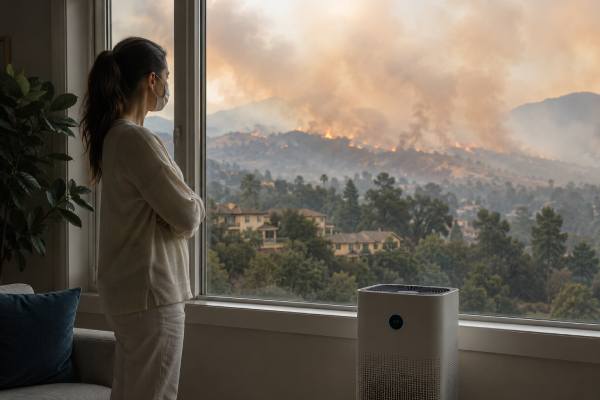
Start with the basics. Keep windows and doors closed when outdoor air is smoky, unless local officials advise otherwise for heat or safety reasons. Set central air systems to recirculate if that option exists, and use the highest-efficiency compatible filter your system can handle. Portable air cleaners with HEPA filtration can meaningfully reduce particle levels in bedrooms and common rooms. If smoke lasts for days, create a cleaner-air room where household members spend the most time.
That cleaner-air space works best when it is simple:
- Close windows and doors
- Avoid candles, smoking, and vacuuming that stirs particles
- Minimize frying or other smoky cooking
- Run a portable air cleaner continuously if available
- Keep the room cool enough to stay inside safely
A common mistake is assuming indoor air is automatically safe. It often is not. Smoke seeps in through doors, leaks, vents, and frequent trips outside. Homes with poor sealing or no cooling can become especially difficult because people must choose between heat and smoke protection. That is why staying indoors is useful only if the indoor air is actually cleaner.
This is where filtration choices matter. If you are deciding between options, it helps to understand what HEPA air purifiers can and cannot do. Wildfire smoke protection is one of the clearest use cases for effective filtration. By contrast, devices that sound impressive but lack solid filtration performance may not meaningfully reduce fine particle exposure. The same caution applies to gadgets covered in discussions of air ionizers and their limits.
Humidity and hydration also play a supporting role. Dry smoky air can leave the nose and throat more irritated, so drinking fluids and avoiding excessive indoor dryness may help comfort, though they do not replace filtration. If you use a fan, use it in a way that supports cooling rather than pulling in outdoor smoke from an open window.
The indoor strategy is really about dose reduction. You may not be able to avoid exposure completely during a regional smoke event, but reducing the concentration you breathe for 12 to 20 hours per day can make a major difference in symptoms and cumulative burden. A cleaner bedroom alone can improve how people feel by protecting sleep, which is one of the body’s most important recovery tools during environmental stress.
How to protect yourself outside
Sometimes staying indoors is not realistic. People still have to commute, work, care for children, attend appointments, or evacuate. When outdoor exposure cannot be avoided, the goal shifts from avoidance to reduction.
The first step is to check the local air quality rather than relying on appearance alone. Smoke can be hazardous even when the sky does not look dramatic, and conditions can worsen quickly over a few hours. Planning around the cleaner part of the day can help. So can shortening outdoor tasks, postponing vigorous exercise, or breaking errands into smaller blocks.
Activity level matters because the harder you breathe, the more smoke you pull into your lungs. A brisk run, yard work, or heavy lifting during smoke can multiply exposure compared with a slow walk. For that reason, one of the simplest protective moves is to cut back on exertion when air quality is poor. That does not mean complete inactivity for everyone. It means matching effort to conditions. On a smoky day, a hard workout outdoors is usually the wrong call. This is a useful extension of the broader principle behind exercise and immune balance, where stress from exertion only helps when the body can recover from it.
Respirators can help too, but only if they are the right kind and fit well. A properly fitted N95 or similar respirator can reduce inhaled particles far better than a loose cloth face covering. The catch is fit, comfort, and practicality. If the seal is poor, protection drops. If someone has severe lung disease, breathing through a tight respirator may be difficult and should be discussed with a clinician. Children are a special case because high-quality fit is harder to achieve consistently.
A few practical outdoor rules go a long way:
- Check air quality before leaving home.
- Postpone intense exercise when smoke levels are elevated.
- Wear a well-fitted respirator if you must be outside in heavy smoke.
- Keep car windows closed and use recirculated air.
- Shower and change clothes after prolonged smoke exposure if possible.
People often focus only on the lungs, but outdoor smoke protection is really about total load. Less time outside, lower exertion, better filtration in the car, and cleaner indoor recovery time all add up. If wildfire smoke is lasting for days, it can also help to think ahead the same way you would for any repeated exposure risk: prepare supplies, protect sleep, stay hydrated, and keep essential medicines close. Those basics are often more protective than trying to “offset” smoke with wellness products or generic immune boosters.
When symptoms need medical attention
Many wildfire smoke symptoms are unpleasant but temporary. Burning eyes, mild cough, sore throat, mild headache, and a sense of chest irritation are common. The challenge is knowing when symptoms have moved beyond expected irritation and into something that needs medical attention.
Seek urgent care promptly if there is severe shortness of breath, chest pain, blue lips, confusion, fainting, or a significant drop in alertness. Those are not routine smoke symptoms to wait out at home. People with asthma should take worsening wheeze, chest tightness, nighttime symptoms, or increased rescue inhaler use seriously, especially if their usual plan is not working. A child who is breathing fast, pulling in at the ribs, unusually sleepy, or unable to keep up with normal activity needs quick evaluation.
There are also quieter warning signs that matter. Smoke exposure can worsen dehydration because people stay in hot closed spaces, reduce activity but not fluid needs, and breathe through irritated airways. Headache, dizziness, dry mouth, dark urine, or unusual fatigue may reflect that compounding effect, especially during heat. If that pattern sounds familiar, it overlaps with the same warning signs described in dehydration during illness.
People with heart disease, lung disease, pregnancy, or complex chronic illness should also have a lower threshold for asking for help. Smoke exposure may not produce dramatic symptoms at first, but a steady worsening over several days is important. The same goes for fever, productive cough, or symptoms that suggest infection rather than simple irritation. Wildfire smoke can inflame the airways, but it should not become an excuse to ignore other possible causes.
A good rule is to think in trends, not moments. A one-time scratchy throat after stepping outside may be expected. A pattern of worsening breathlessness, reduced exercise tolerance, repeated coughing at night, or inability to carry out usual tasks deserves more attention. So does any flare that is not improving once exposure drops.
It is also reasonable to contact a clinician before symptoms become urgent if you already know you are vulnerable. Ask in advance how to adjust asthma medications during smoke, when to use rescue inhalers, whether you need extra refills, and what symptoms should trigger same-day care. Preparedness matters because smoke events often stretch healthcare access and pharmacy routines.
The larger point is that wildfire smoke is real exposure, not just annoyance. Respecting it does not mean panicking. It means recognizing when self-protection is enough and when the body is signaling that irritation has become something more serious.
References
- Immune Impacts of Fire Smoke Exposure 2025 (Review)
- Wildfire smoke and health impacts: a narrative review 2024 (Review)
- How Wildfire Smoke Affects Your Body 2024 (Government Guidance)
- Wildfire Smoke: A Guide for Public Health Officials 2021 (Public Health Guide)
- Create a Clean Room to Protect Indoor Air Quality During a Wildfire 2025 (Government Guidance)
Disclaimer
This article is for educational purposes only and does not replace medical advice, diagnosis, or treatment. Wildfire smoke can worsen asthma, heart disease, pregnancy-related risks, and other chronic conditions, and symptoms may become serious quickly during prolonged exposure. Seek prompt medical care for chest pain, severe trouble breathing, confusion, fainting, blue lips, or worsening symptoms that do not improve after reducing exposure. If you have a chronic lung or heart condition, ask your clinician in advance how to adjust your plan during smoke events.
If this article helped you, please share it on Facebook, X, or another platform you use.