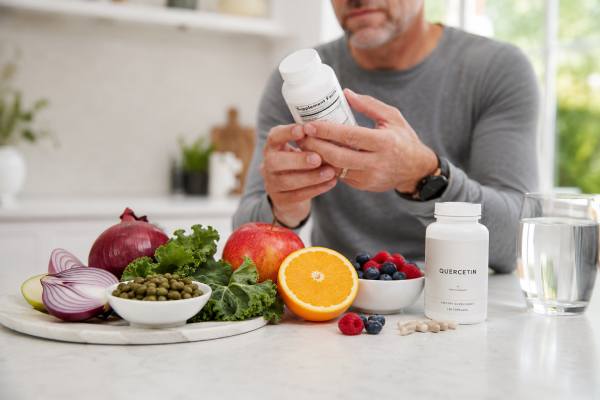
Quercetin is one of those supplements that seems to show up everywhere once cold season starts. It is sold for “immune support,” often paired with vitamin C or bromelain, and promoted as if it can do everything from calm inflammation to block viruses. The reality is more nuanced. Quercetin is a plant flavonoid found in foods like onions, apples, berries, and tea. In lab and animal research, it shows antioxidant, anti-inflammatory, and immune-modulating effects that make it scientifically interesting. But promising mechanisms are not the same as proven benefits in people.
That gap matters. If you are considering quercetin, the most useful questions are not whether it sounds impressive on a label, but what the human evidence actually shows, what dose makes sense, how well it is absorbed, and which medications it could affect. This article walks through those answers in a practical, balanced way.
Quick Facts
- Quercetin has plausible anti-inflammatory and immune-modulating effects, but human evidence for preventing or shortening respiratory infections is still limited and mixed.
- Most supplement studies use about 500 to 1,000 mg per day, but there is no established immune-health dose that clearly works for everyone.
- Better absorption formulas may raise blood levels, yet higher absorption does not automatically mean better real-world immune outcomes.
- Quercetin can interact with some medicines, including certain immunosuppressants, allergy medicines, statins, blood pressure drugs, and anticoagulants.
- A sensible starting point is to use food sources first and reserve supplements for a targeted trial after checking your medication list.
Table of Contents
- What Quercetin Is and Why It Gets Attention
- What the Human Evidence Actually Shows
- How Quercetin May Affect Immunity
- Dosage, Timing, and Absorption
- Interactions, Side Effects, and Red Flags
- When a Supplement Trial Makes Sense
What Quercetin Is and Why It Gets Attention
Quercetin is a flavonol, a type of polyphenol naturally present in many plant foods. It is especially associated with onions, apples, capers, berries, grapes, leafy vegetables, and tea. That matters because quercetin did not begin as a supplement trend. It began as part of the normal chemistry of plant foods, which is one reason it often appears in conversations about broader polyphenol intake rather than as a stand-alone miracle ingredient.
So why does it attract so much attention in immune health? Mostly because its biological profile looks compelling on paper. It has antioxidant activity, influences inflammatory signaling, and appears to affect pathways involved in cytokine production, histamine release, and cellular stress responses. In basic science models, those features make it look like a useful support compound, especially during inflammatory stress.
That scientific plausibility has turned into supplement marketing. Quercetin is now sold as an “immune support” ingredient, often alongside vitamin C, zinc, bromelain, or elderberry. The language on labels can make it sound more settled than it is. But quercetin is not an essential nutrient, there is no recommended daily allowance for it, and there is no universally accepted immune-support dose. Those details are easy to miss when a product is marketed with phrases like “advanced defense” or “daily immunity.”
Another reason quercetin gets attention is that it sits at the intersection of several popular health narratives. It is discussed in relation to inflammation, recovery, allergy symptoms, exercise stress, and respiratory infections. That broad appeal can make it seem more proven than it really is. In reality, quercetin is best understood as a biologically active plant compound with interesting but still incomplete human evidence.
It also helps that quercetin sounds familiar to people who already care about diet quality. Unlike obscure proprietary blends, it is linked to foods people recognize. That food connection is a strength, because it keeps the conversation grounded. For many people, the better starting point is not a capsule but a more varied eating pattern built around foods that support immune health overall.
The key mindset shift is this: quercetin is not a shortcut to a stronger immune system. It is one potentially useful compound inside a much larger picture that includes sleep, protein intake, vaccination, stress regulation, movement, and a plant-rich diet. When seen in that context, it becomes easier to evaluate honestly. It may have a role. It just should not be asked to do more than the evidence can support.
What the Human Evidence Actually Shows
This is where expectations need to become more precise. Quercetin has a long list of promising laboratory findings, but human evidence for immune support is still mixed. That does not mean it has no value. It means the strongest claims being made online run ahead of what clinical studies can currently show.
Most of the immune-focused human data center on respiratory infections and exercise-related immune stress. A few randomized trials suggest quercetin may reduce upper respiratory symptoms or sick days in certain subgroups, especially after heavy exertion or in older, fitter adults. But those signals are not consistent across all participants. In larger community settings, the average benefit has often been small or absent. That is an important distinction because it means the supplement may not do much for the average healthy person taking it casually “just in case.”
It is also important to separate respiratory-infection interest from stronger claims about direct antiviral action in humans. Quercetin has shown antiviral effects in cell and animal work, and that helped fuel interest during the COVID-19 era. But studies in people have not established it as a clearly effective preventive or treatment tool for viral respiratory illness. At best, the current picture is “promising but unproven.”
That mixed record is actually common in supplement research. Small differences in dose, duration, formulation, baseline diet, age, stress level, and outcome measurement can all change the result. In quercetin trials, another complication is that some products combine quercetin with vitamin C and nicotinamide. When a study shows benefit, it is not always possible to know how much came from quercetin itself versus the combination.
This is one reason the language of “immune boosting” is not very helpful. The immune system is not a muscle you simply turn up. More activity is not always better. Better regulation, better barrier function, and better recovery from stress are often more realistic goals. That is why the idea of immune resilience fits quercetin better than the usual marketing claims do.
A fair summary of the evidence looks like this:
- Quercetin has biologically plausible mechanisms that could support immune function.
- Human studies suggest possible benefits in some contexts, but not robust, universal effects.
- Evidence for preventing or treating common respiratory infections remains limited.
- Evidence for COVID-specific benefit is not strong enough to make confident recommendations.
- Real-world outcomes are likely to be modest, not dramatic.
That means quercetin belongs in the “maybe useful, not clearly proven” category. For some readers, that will be enough to rule it out. For others, it may still justify a cautious, time-limited trial. What it should not justify is relying on quercetin as a substitute for the basics or assuming that a mechanistic story guarantees clinical benefit.
How Quercetin May Affect Immunity
Quercetin’s appeal comes largely from mechanism. Even when human outcome data are mixed, the underlying biology is still worth understanding because it explains why researchers keep studying it.
One major theme is inflammation. Quercetin appears to influence signaling pathways involved in the production of inflammatory mediators, including pathways linked to NF-κB and certain cytokines. In plain terms, it seems to help dial down some of the cellular messaging that keeps inflammation going. That does not mean it shuts off the immune response. The more accurate idea is that it may help reduce unnecessary inflammatory intensity in certain settings.
That matters because immune health is not only about resisting pathogens. It is also about keeping the response proportionate. A system that overreacts or stays inflamed too long can create its own problems. This is part of why broader strategies aimed at lowering background inflammatory load, such as an anti-inflammatory eating pattern, often make more practical sense than focusing on one compound alone.
Quercetin is also discussed for its antioxidant role. During infection, hard training, pollution exposure, or chronic stress, the body generates more oxidative stress. Quercetin can neutralize reactive molecules directly and may influence internal antioxidant defenses indirectly. That gives it a plausible role in recovery from stressors that tax the immune system, even if the effect in people is less dramatic than lab models suggest.
A third area is allergy-related immune signaling. Quercetin is often described as a mast-cell stabilizer, meaning it may help reduce the release of histamine and other mediators involved in allergic reactions. That does not make it a replacement for allergy medication, but it helps explain why it is commonly marketed to people with seasonal flare-ups. The connection is real enough to be interesting, though it still sits on much firmer ground mechanistically than clinically.
Researchers also care about absorption and metabolism because quercetin’s effects depend on what reaches circulation and tissues after digestion. The parent compound is not the whole story. The body rapidly transforms quercetin into metabolites, and those metabolites may contribute to whatever biological effects occur. That makes the supplement story more complex than “take X milligrams and your cells receive X milligrams.”
The most useful practical insight is that quercetin’s likely role is supportive and regulatory rather than dramatic. It may be more relevant in situations of elevated inflammatory stress, hard training, allergy-related irritation, or a poor-quality diet than in a healthy person already doing the basics well. It also fits best as part of a broader pattern that may include sleep improvement, exercise balance, and a diet richer in colorful plant foods.
So yes, quercetin has believable immune-related mechanisms. But mechanisms are the beginning of the conversation, not the end. They explain why interest exists. They do not by themselves prove that a supplement will noticeably change how often you get sick or how quickly you recover.
Dosage, Timing, and Absorption
If you look at quercetin labels, you will see everything from 250 mg capsules to multi-ingredient formulas that deliver 1,000 mg a day. That range reflects a real uncertainty: quercetin has been studied at several doses, but there is no established “best” dose for immune support.
In human studies related to respiratory health and immune stress, the most common doses tend to fall around 500 to 1,000 mg per day. Some protocols use 500 mg once daily, while others use 500 mg twice daily. Trials have also varied in duration, ranging from short periods around intense exercise to longer runs of about 8 to 12 weeks. That makes it hard to pin down one ideal approach.
A practical way to interpret the dosing literature is this:
- 250 mg per day: a conservative entry point for testing tolerance
- 500 mg per day: a common everyday supplement dose
- 1,000 mg per day: the upper end of many immune-focused studies, often split into two doses
More is not automatically better. Quercetin’s poor oral bioavailability is a central issue. Standard quercetin is absorbed inconsistently, and blood levels can remain modest even with fairly large doses. This is why supplement brands emphasize phytosome, liposomal, micellar, or other enhanced-delivery forms. Some of these formulations do appear to raise blood levels compared with standard quercetin, but better absorption should not be confused with proven better outcomes. A higher lab value does not guarantee fewer infections or faster recovery.
Timing matters less than consistency, though taking quercetin with food can make it easier to tolerate. Splitting higher doses into morning and evening may also reduce stomach upset. If a product is combined with vitamin C, bromelain, or other ingredients, the blend may change both tolerability and how you interpret results. A simpler product is usually easier to evaluate.
Quality matters too. With supplements, “contains quercetin” is not the same as “well made.” Look for a transparent label, clearly stated milligram amount, and preferably a product that meets basic quality checks. This is especially important for higher-dose formulas, which is why guidance on choosing third-party tested supplements can be useful.
For most people curious about quercetin, a reasonable trial looks something like this:
- Start with a single-ingredient product.
- Begin at the low end of the label range.
- Take it daily for a defined period, such as two to six weeks.
- Track whether anything meaningful changes.
- Stop if side effects show up or if the goal remains vague.
That last point matters. If your goal is “support my immune system somehow,” you may never know whether it did anything. Quercetin makes the most sense when the purpose is specific, the dose is defined, and the trial has a clear endpoint. Otherwise, it can easily become another supplement that sounds purposeful but adds very little.
Interactions, Side Effects, and Red Flags
Quercetin is often presented as a gentle plant compound, and in many short-term studies it appears reasonably well tolerated. That said, “natural” does not mean interaction-free. This is the part of the conversation that deserves more attention than it usually gets.
Mild side effects are the most common issue. Some people report stomach upset, reflux, nausea, headache, tingling, or loose stools, especially at higher doses or when taking multiple ingredients together. These effects are usually not dangerous, but they are a sign that more is not always better. Long-term high-dose use also has less reassuring data than short-term use, which is another reason to avoid treating quercetin like a daily essential.
Interactions are the bigger concern. Quercetin may affect how certain drugs are transported or metabolized, and some interaction signals come from laboratory data, small studies, or case reports rather than large clinical trials. Even so, they matter because the possible downside is not trivial.
Extra caution is sensible if you take:
- immunosuppressive medicines
- anticoagulants or other medicines that affect bleeding risk
- blood pressure medicines
- pravastatin or possibly other cholesterol-lowering drugs
- fexofenadine or other medicines where absorption and transport matter
- chemotherapy or other specialist-prescribed therapies
This is exactly why the broader topic of supplement and medication interactions should come before enthusiasm about “immune support.” A supplement can sound helpful and still be the wrong choice because of what else you take.
There are also a few groups who should be more cautious even without a known interaction. Pregnancy and breastfeeding are common examples because safety data are limited. People with significant kidney disease, complex chronic illness, or upcoming surgery should also be more careful with nonessential supplements unless a clinician says otherwise.
A good rule is to pause quercetin and ask questions if:
- you take prescription medicines daily
- you bruise easily or use blood thinners
- you are trying to manage transplant, autoimmune, or cancer treatment
- you notice dizziness, GI symptoms, or unusual bleeding after starting it
- you are already taking a crowded stack of immune supplements
That last issue matters more than people realize. Quercetin is often layered onto vitamin C, zinc, elderberry, medicinal mushrooms, and other products with overlapping promises. The problem is not only cost. It is that a crowded stack increases the chance of side effects, duplication, and confusion about what is helping or hurting. In many cases, the better question is not “What else should I add?” but “Which part of this stack is actually worth keeping?” That is also the logic behind being cautious about too many supplements at once.
Quercetin may be low drama, but it is not no drama. Used thoughtfully, it may be reasonable. Used casually on top of medications and multiple other supplements, it becomes much harder to call low risk.
When a Supplement Trial Makes Sense
Quercetin is most useful when it is approached like a trial, not like a permanent health identity. That means defining why you are considering it, deciding what would count as success, and being willing to stop if the result is unclear.
A supplement trial may make sense if you are dealing with a specific pattern such as repeated heavy training blocks, seasonal periods of higher exposure and stress, or a goal related to allergic inflammation that has made quercetin interesting to you. It may also be reasonable if your diet is improving but still thin and you want a short-term, low-drama addition while you fix larger habits.
A trial makes less sense when it is used as a stand-in for basics. If sleep is poor, meals are low in plant foods, protein is inconsistent, stress is high, and you are hoping quercetin will smooth all of that out, the return is likely to be small. Most of the real leverage still comes from foundational behaviors, including a more plant-rich pattern such as a Mediterranean-style diet and a more consistent approach to evidence-based immune habits overall.
Food first remains the strongest default. Quercetin-rich foods bring more than quercetin alone. They also add fiber, potassium, vitamin C, and other polyphenols that work together in ways supplements cannot fully copy. A diet richer in onions, apples, berries, leafy vegetables, legumes, herbs, and tea supports immune health through multiple pathways at once. That broader pattern is more likely to matter than isolating a single flavonoid.
If you do choose a supplement, make the trial structured:
- Pick one product, not a five-ingredient blend.
- Use the lowest sensible dose first.
- Keep the duration defined.
- Avoid starting it during medication changes.
- Watch for side effects, not just hoped-for benefits.
It also helps to be honest about what a good result would look like. Quercetin is unlikely to create a dramatic “I never get sick now” outcome. A more realistic best case is modest support: less inflammatory spillover during stressful periods, slightly better tolerance of seasonal challenges, or no clear downside during a time-limited trial.
In that sense, quercetin belongs in the same practical category as many other nutrition tools: potentially useful, situationally reasonable, but easy to oversell. Its strongest use is not as a headline supplement. It is as a carefully chosen adjunct for someone who already understands the bigger picture and wants to experiment without pretending the evidence is stronger than it is.
That mindset keeps expectations realistic, protects you from interaction problems, and helps you spend your effort where it counts most. Quercetin may deserve a place on the list. It just does not deserve the whole conversation.
References
- A Systematic Review: Quercetin—Secondary Metabolite of the Flavonol Class, with Multiple Health Benefits and Low Bioavailability 2024 (Systematic Review)
- Anti-inflammatory potential of quercetin: From chemistry and mechanistic insight to nanoformulations 2025 (Review)
- The effect of quercetin on the prevention or treatment of COVID-19 and other respiratory tract infections in humans: A rapid review 2020 (Rapid Review)
- Dietary Supplements in the Time of COVID-19 – Consumer 2025 (Government Guidance)
- Quercetin | Memorial Sloan Kettering Cancer Center 2023 (Clinical Reference)
Disclaimer
This article is for educational purposes only and is not medical advice. Quercetin supplements are not a substitute for diagnosis, treatment, vaccination, or prescribed medicines. Because quercetin may interact with certain medications and has limited human evidence for immune outcomes, speak with a qualified clinician or pharmacist before using it if you take prescription drugs, are pregnant or breastfeeding, have kidney disease, or are being treated for a chronic medical condition.
If this article helped you, consider sharing it on Facebook, X, or another platform your audience uses.