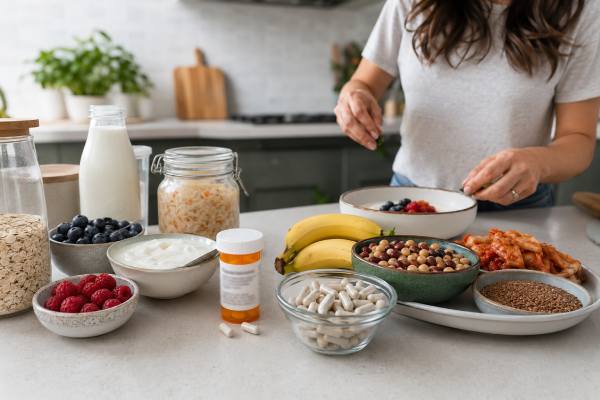
Antibiotics can be necessary and even lifesaving, but they rarely act with perfect precision. Along with the bacteria causing an infection, they often reduce beneficial microbes that help with digestion, gut barrier function, and immune signaling. That is why many people finish a course of antibiotics and then wonder whether a probiotic will actually help, when to start it, and how long recovery should take.
The honest answer is more nuanced than many supplement labels suggest. Some probiotics seem to lower the risk of antibiotic-associated diarrhea, especially when used early and when the product contains well-studied strains. But probiotics do not instantly “rebuild” the microbiome, and not every person or product gets the same result. Understanding the difference between realistic benefits and marketing claims makes it much easier to choose wisely. This guide explains what antibiotics change, when probiotics make the most sense, which strains have the best evidence, and what to expect during recovery.
Key Insights
- Starting a probiotic during antibiotics or within the first 1 to 2 days appears more useful than waiting until the course is over.
- The clearest benefit is a lower chance of antibiotic-associated diarrhea, not a guaranteed full microbiome reset.
- Strain matters more than the word “probiotic” on the label; yeast and certain Lactobacillus and Bifidobacterium products have the best track record.
- Mild gas or bloating can happen at first, and people who are critically ill or severely immunocompromised should not self-prescribe live probiotics.
- A practical approach is to separate bacterial probiotics from the antibiotic by about 2 hours and continue for about 1 to 2 weeks after the last dose.
Table of Contents
- What antibiotics change
- Best timing for probiotics
- Strains worth looking for
- Benefits and realistic limits
- Foods, supplements, and duration
- Safety and when to call
What antibiotics change
Antibiotics do not only affect the infection you are treating. They also change the ecology of the gut, sometimes quickly. In practical terms, that can mean fewer beneficial bacteria, less diversity, temporary shifts in fermentation, and more room for hardier organisms to take over. For some people, that change is barely noticeable. For others, it shows up as loose stools, bloating, cramping, constipation after diarrhea, or a general sense that digestion feels “off” for days or weeks.
This helps explain why the question is not just whether a probiotic is good or bad. The better question is what problem you are trying to solve. If your main concern is diarrhea during or right after antibiotics, probiotics may help in a modest but meaningful way. If your goal is complete microbiome restoration, the picture is less impressive. Current research suggests that probiotics can be useful for some clinical outcomes, but they do not reliably preserve overall microbiome diversity during antibiotic treatment.
The antibiotic itself also matters. Broad-spectrum drugs tend to create more collateral disruption than narrow-spectrum ones. The length of treatment matters too: five days is different from fourteen, and one short course is different from repeated treatment over months. Your starting point matters as well. People with older age, recent hospitalization, a history of antibiotic-associated diarrhea, inflammatory bowel disease, a restricted diet, or an already fragile gut may notice a much bigger aftereffect than someone who was healthy and symptom-free beforehand.
It also helps to remember that the gut usually does recover over time. Recovery is rarely instant, and it is not identical from person to person. Some microbial patterns begin trending back toward baseline within several weeks, while other changes may linger longer. That is one reason a broader recovery plan often works better than relying on a single supplement. A probiotic can be one tool, but so can hydration, adequate protein, sleep, and gradual reintroduction of fiber-rich foods. If you want a wider view of how antibiotics affect the gut and immune system, gut disruption after antibiotics and the broader gut-immune connection provide useful context.
The biggest takeaway from this first step is simple: antibiotics can temporarily disturb the gut in real ways, but the goal after treatment is not perfection. It is usually to reduce symptoms, lower the chance of complications, and support the gut’s normal recovery without expecting overnight transformation.
Best timing for probiotics
Timing is one of the most practical parts of this topic, and it is also where the advice is fairly consistent. If you decide to use a probiotic, starting it early tends to make more sense than waiting until the antibiotic course is finished. In many studies and clinical summaries, the benefit is strongest when probiotics are started during the antibiotic course or within the first 1 to 2 days after the first antibiotic dose. Waiting until symptoms have already developed may still help some people, but it is usually less strategic.
That does not mean you need to swallow the probiotic at the exact same minute as the antibiotic. In fact, most clinicians recommend spacing bacterial probiotics away from the antibiotic by about 2 hours. The logic is simple: if the antibiotic is active in the gut at the same time, it may reduce some of the live bacteria you are paying for. This spacing advice matters most for bacterial probiotics such as Lactobacillus or Bifidobacterium products. It matters less for Saccharomyces boulardii, which is a yeast rather than a bacterium, though it would not make sense to pair that with an antifungal medication.
A practical schedule can be very simple:
- Start the probiotic on the same day as the antibiotic, or as soon as possible after.
- Take it about 2 hours after each antibiotic dose if it is a bacterial probiotic.
- Continue through the antibiotic course.
- Keep going for about 1 to 2 weeks after the last antibiotic dose if your goal is digestive recovery.
That final step is more convention than hard law. Trials vary widely in duration, and there is no universal “correct” number of days after antibiotics. Still, one to two weeks is a common middle ground: long enough to cover the transition period, but not so long that you are taking it indefinitely without a reason. Some people choose closer to 2 to 4 weeks if they are prone to loose stools, have taken broad-spectrum antibiotics, or are recovering slowly, but that is best treated as individualized judgment rather than a proven rule.
Two common mistakes are worth avoiding. The first is starting late and expecting the same result as early use. The second is thinking more is always better. A huge dose is not automatically superior if the strains are poorly chosen or the product quality is weak. Timing and strain selection usually matter more than chasing the highest number on the label. If you are considering a yeast-based option, this guide on Saccharomyces boulardii can help clarify where it fits.
In short, the simplest timing plan is also the most evidence-aligned: start early, separate bacterial probiotics from the antibiotic by a couple of hours, and continue a bit beyond the last dose instead of stopping the same day the prescription ends.
Strains worth looking for
The most important thing to know about probiotic shopping is that “probiotic” is not a single intervention. It is a category, and results are strain-specific. A product can look impressive on the front of the bottle and still have little relevance to the outcome you care about. That is why choosing by brand promise alone is not enough.
For antibiotic-associated digestive symptoms, the best-studied options usually fall into three groups:
- Saccharomyces boulardii, especially the CNCM I-745 strain, which has a long record of study for antibiotic-associated diarrhea.
- Lactobacillus rhamnosus GG, often written as LGG, another commonly studied option.
- Multi-strain blends that combine selected Lactobacillus and Bifidobacterium strains, which may be helpful in some trials, especially at higher doses.
When you read a label, look for more than the genus and species. The ideal label gives the full strain designation, not just “Lactobacillus acidophilus” or “Bifidobacterium blend.” It should also state the number of live organisms expected at the end of shelf life, not just at manufacture. In many studies, doses vary widely, but products in the billions of CFU per day are common. Bigger numbers are not always better, but very low numbers in a vague formula are usually not reassuring.
This is also where expectations need a reality check. Some analyses suggest that certain Lactobacillus and Bifidobacterium species and higher-dose products are associated with better protection from antibiotic-associated diarrhea. Other reviews show that probiotics do not clearly preserve overall gut diversity during antibiotic treatment. Both can be true at the same time. A probiotic may help with one symptom or risk while still not recreating a normal post-antibiotic microbiome.
If you tolerate dairy and prefer food-based support, yogurt or kefir with live cultures can be part of the picture, but they are not interchangeable with a well-studied supplement. Food products often do not specify strain details clearly, and the live count can vary. That does not make them useless. It just means they are better viewed as a gut-friendly food habit than as a precision tool. If labels feel confusing, this guide to live cultures and CFUs can make them easier to interpret.
One more point matters: different strains have different strengths. A product that is helpful for antibiotic-associated diarrhea may not be the one you would choose for constipation, irritable bowel symptoms, or upper respiratory support. The strongest way to choose is to match the strain to the outcome, not the other way around. That is less exciting than broad marketing claims, but it is much more useful when you are trying to recover well after antibiotics.
Benefits and realistic limits
For most adults, the most realistic reason to use probiotics after antibiotics is to reduce the risk of antibiotic-associated diarrhea or to make the digestive transition a bit smoother. That benefit is meaningful, but it is not dramatic in every setting. Some studies show a modest reduction in diarrhea risk, with the effect looking stronger in people who have a moderate or higher baseline risk. In lower-risk situations, the benefit may be small enough that some people will not notice much at all.
That distinction matters because it keeps the conversation honest. A probiotic is not an antidote to antibiotics. It does not guarantee that your bowel habits will stay normal. It does not guarantee protection from Clostridioides difficile infection. And it does not guarantee that your microbiome will bounce back quickly. In fact, one of the more useful lessons from newer research is that probiotics may improve a clinical outcome such as diarrhea without clearly preserving overall microbiome diversity during treatment.
So what should you expect in real life? A reasonable range looks like this:
- You may notice less loose stool, less urgency, or less cramping during the antibiotic course.
- You may notice nothing obvious, especially if you were low-risk to begin with.
- You may still have several days of bloating or irregularity even if the probiotic is helping.
- You should not expect a “detox,” a deep cleanse, or a dramatic surge in energy.
Recovery also depends on what happened during the antibiotic course. A short prescription that causes mild stool changes is very different from severe diarrhea, fever, or ongoing abdominal pain. If symptoms are escalating rather than settling, that is not the time to keep guessing with supplements. Persistent watery diarrhea, blood, severe pain, dehydration, or symptoms continuing well after the antibiotic ends deserve medical evaluation.
There is also a temptation to overinterpret gut symptoms and overtest. A few days of digestive change after antibiotics is common and often self-limited. That is not the same as permanent damage. At the same time, prolonged symptoms should not be dismissed. If someone is thinking about commercial stool testing during recovery, it helps to understand what those tests can and cannot tell you before spending money on them; this overview of microbiome stool tests is helpful for that reason.
The best mental model is to think of probiotics as one support measure with a fairly narrow lane. They can be worth using when chosen well, started early, and matched to the goal. But they work best alongside basics that support gut recovery: regular meals, enough fluids, gradual fiber intake, sleep, and not repeating antibiotics unnecessarily. That quieter, less marketable approach is often what helps the most.
Foods, supplements, and duration
Many people wonder whether food is enough or whether they need a capsule. The answer depends on your goal. If you want a gentle way to support digestion after antibiotics and you already tolerate fermented foods well, foods can be a good foundation. Yogurt with live cultures, kefir, and some fermented vegetables can add useful microbes and often feel easier to work into daily life. They also come with protein, calcium, and other nutrients that a capsule does not provide.
But foods and supplements do different jobs. Fermented foods are broad lifestyle support. Supplements are the better choice when you want a specific, studied strain and a more predictable dose. If your priority is lowering the odds of antibiotic-associated diarrhea during a prescription, a supplement usually gives you more control. If your priority is long-term gut support after the antibiotic course ends, using fermented foods plus a generally fiber-rich diet may be just as important as the probiotic itself.
That leads to an underappreciated point: the microbes you take in matter, but the microbes already in your gut also need fuel. Once the worst GI upset settles, increasing prebiotic and fiber-containing foods often matters more for long-term recovery than staying on a probiotic indefinitely. Oats, beans, lentils, cooked and cooled potatoes, bananas, onions, garlic, and a wider range of plant foods help create conditions where beneficial bacteria can return and make useful compounds such as short-chain fatty acids. If you want a deeper look, prebiotic fibers and fermented foods without GI upset are both practical next steps.
A simple recovery plan often works best:
- Use a well-chosen supplement during the antibiotic course if you are trying to reduce diarrhea risk.
- Keep it going for roughly 1 to 2 weeks after the last dose.
- Add fermented foods only as tolerated.
- Rebuild your regular fiber intake gradually instead of forcing a huge salad or supplement on day one.
- Prioritize variety over perfection.
People often do too much, too fast after antibiotics. If your gut feels irritated, starting with lower-fiber cooked foods and then building up is often more comfortable than jumping straight into very high-fiber eating. Likewise, taking multiple probiotic products at once usually creates more confusion than benefit. One product, one schedule, and a clear reason for using it is usually enough.
If your digestion is mostly normal after the antibiotic course, you may not need anything beyond food and time. If you are prone to diarrhea, a targeted probiotic is more reasonable. The key is matching the intensity of the intervention to the size of the problem.
Safety and when to call
For healthy adults, probiotics are usually well tolerated. The most common side effects are mild and temporary: gas, bloating, a sense of fullness, or a short adjustment period in bowel habits. Those effects often settle within a few days. Even so, “usually safe” is not the same as “safe for everyone,” and that difference matters more after antibiotics than many people realize.
Caution is especially important if you are critically ill, severely immunocompromised, in the ICU, have a central venous catheter, have severe pancreatitis, or have major bowel disease with impaired barrier function. In these settings, there have been rare but serious cases of bloodstream infection or fungemia linked to probiotic organisms. That risk remains low, but it is meaningful enough that self-prescribing a live probiotic is not a good idea in medically fragile situations. This is also one reason broad statements such as “everyone on antibiotics should take probiotics” are too simplistic.
A few more safety points are easy to miss:
- Saccharomyces boulardii is a yeast, so it may not be appropriate if you are taking antifungal medication.
- People with severe lactose intolerance may react to some dairy-based probiotic foods even if the microbes themselves are not the issue.
- Supplement quality varies, so third-party testing and reputable storage practices matter.
- If you are on multiple medications, it is worth reviewing possible supplement issues; this guide to supplement and medication interactions may help frame that conversation.
It is also important to know when probiotics are the wrong question. Contact a clinician promptly if you develop:
- severe or worsening diarrhea,
- blood in the stool,
- fever,
- intense abdominal pain,
- signs of dehydration,
- diarrhea that continues for days after the antibiotic stops,
- or recurrent episodes after repeated antibiotic courses.
Those patterns raise concern for complications such as C. difficile or another problem that needs diagnosis rather than trial-and-error supplementation. Likewise, if you keep needing antibiotics or keep getting infections, the larger issue may not be your probiotic choice. At that point, it can be more useful to step back and look at the bigger picture around recurrent illness and recovery patterns, including when immune testing makes sense.
The safest bottom line is this: probiotics can be a reasonable short-term tool after antibiotics for many otherwise healthy people, especially when started early and chosen carefully. But they are not routine for everyone, and they should never delay evaluation when symptoms are severe, persistent, or out of proportion to a typical post-antibiotic recovery.
References
- Probiotics for the prevention of antibiotic-associated diarrhoea: a systematic review and meta-analysis 2021 (Systematic Review and Meta-Analysis)
- Probiotic supplementation during antibiotic treatment is unjustified in maintaining the gut microbiome diversity: a systematic review and meta-analysis 2023 (Systematic Review and Meta-Analysis)
- Probiotic use reduces the incidence of antibiotic-associated diarrhea among adult patients: a meta-analysis 2025 (Meta-Analysis)
- ACG Clinical Guidelines: Prevention, Diagnosis, and Treatment of Clostridioides difficile Infections 2021 (Guideline)
- Probiotics – Health Professional Fact Sheet 2025 (Government Fact Sheet)
Disclaimer
This article is for general educational purposes and does not replace medical advice, diagnosis, or treatment. Probiotics can be appropriate after antibiotics for some people, but the right choice depends on your symptoms, medical history, medications, and level of infection risk. Seek medical care promptly for severe diarrhea, blood in the stool, fever, dehydration, or symptoms that continue or worsen after an antibiotic course.
If this guide helped you, consider sharing it on Facebook, X, or your preferred platform so it can reach someone else trying to recover well after antibiotics.