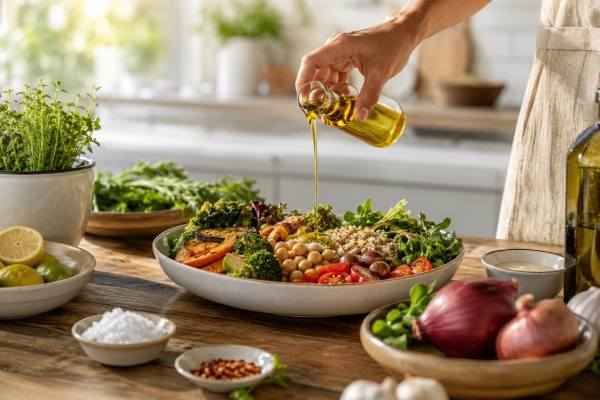
Olive oil often gets praised in broad, almost automatic terms. It is called heart healthy, anti-inflammatory, and central to the Mediterranean pattern of eating. But those benefits do not come from olive oil in a generic sense. They depend a great deal on whether the oil still contains its fragile minor compounds, especially the polyphenols that survive in extra virgin olive oil, or EVOO. That is where compounds such as oleuropein derivatives, hydroxytyrosol, and related phenolics become important.
For immune health, the interest is not that EVOO acts like a medicine or a fast fix for colds. It is that its polyphenols may help shape the body’s inflammatory tone, oxidative stress response, barrier function, and metabolic environment over time. Those are all relevant to immune resilience. This article explains what olive oil polyphenols are, why extra virgin olive oil matters more than refined oil, what human studies actually show, and how to use EVOO in a practical, evidence-aware way.
Essential Insights
- Extra virgin olive oil keeps far more polyphenols than refined olive oil, which is one reason the health effects of the two are not interchangeable.
- Hydroxytyrosol, oleuropein-related compounds, and other EVOO phenolics may help support a less inflammatory immune environment.
- Human evidence is stronger for oxidative stress and inflammation markers than for directly preventing colds or infections.
- Olive polyphenol supplements and olive leaf extracts are not the same thing as daily EVOO, and higher-dose products are not clearly better.
- A practical way to apply the evidence is to use one to two tablespoons of fresh EVOO daily in place of more refined fats when it fits your overall diet.
Table of Contents
- What Olive Oil Polyphenols Actually Are
- Why EVOO Matters More
- How They May Influence Immunity
- What Human Studies Really Show
- How to Use EVOO Practically
- Safety, Supplements, and Limitations
What Olive Oil Polyphenols Actually Are
Olive oil is mostly fat, but the part that drives much of its scientific interest is the much smaller fraction made up of phenolic compounds. These are often called olive oil polyphenols, though the term covers a mixture rather than a single ingredient. In extra virgin olive oil, the main players include hydroxytyrosol-related compounds, tyrosol-related compounds, oleuropein derivatives, oleocanthal, oleacein, lignans, and several other phenolic molecules that vary with olive variety, harvest timing, climate, storage, and processing.
Hydroxytyrosol is one of the best-known olive phenolics because it has strong antioxidant activity and is widely used as a marker when researchers discuss olive oil’s protective potential. Oleuropein is another familiar name, though it is often more abundant in olive leaves and olive fruit than in bottled oil itself. By the time olives are crushed and oil is produced, oleuropein is transformed into related secoiridoid compounds and breakdown products that still matter biologically. So when people talk about oleuropein in EVOO, they are often talking indirectly about the larger family of compounds it helps generate or represent.
This is where a lot of confusion begins. Many readers understandably assume that all olive-derived products sit on one continuum: olive oil, olive leaf extract, hydroxytyrosol capsules, and oleuropein supplements all being versions of the same thing. They are not. They may share certain compounds, but they differ in concentration, food matrix, absorption pattern, and overall effect. A spoonful of EVOO brings fat, polyphenols, minor plant compounds, and a whole dietary context. A supplement gives a narrower, more isolated input.
That difference matters for two reasons. First, the health benefits associated with olive oil-rich eating patterns are usually based on foods, not isolated extracts. Second, the biological behavior of these phenolics seems to depend partly on the matrix in which they are consumed. This is one reason the discussion around olive oil polyphenols often overlaps with the broader case for the Mediterranean diet, where EVOO appears as a daily food rather than as a targeted supplement.
It also helps to define what polyphenols are not. They are not essential nutrients in the way vitamin C or iron are. There is no standard “polyphenol deficiency” diagnosis. And they are not a direct immune stimulant. Their likely value is more subtle: shaping redox balance, inflammatory signaling, endothelial function, and possibly aspects of mucosal and metabolic health in ways that make the body less prone to chronic low-grade stress. That does not make them minor. It simply makes them different from the way people often imagine “immune support.”
The practical takeaway is that olive oil polyphenols are a diverse group of biologically active compounds, and when people discuss the immune value of olive oil, these are usually the compounds doing most of the work.
Why EVOO Matters More
If olive oil polyphenols are the interesting part, then extra virgin olive oil matters because it is the form that preserves them best. EVOO is produced by mechanical extraction under conditions that avoid the heavy refining steps used for standard refined olive oil. That gentler process helps retain the bitter, peppery, and often slightly green-tasting compounds that give high-quality EVOO its character. Refined olive oil, by contrast, loses much of that phenolic fraction during processing, even if the final product still contains useful monounsaturated fat.
This is why “olive oil” and “extra virgin olive oil” are not interchangeable in health discussions. Refined olive oil can still be a better choice than many highly processed fats in some contexts, but it does not deliver the same phenolic profile. When studies compare high-polyphenol EVOO with low-polyphenol or refined olive oil, the more phenol-rich oil often shows stronger effects on oxidative stress markers or inflammatory measures. That difference is one of the clearest reasons EVOO matters in any serious discussion of olive oil and immunity.
Taste can offer a clue, but it is not a perfect test. Strong bitterness and throat pepperiness often signal higher phenolic content, especially in early-harvest oils, but flavor alone cannot tell you the exact level. Storage also matters. Heat, light, oxygen, and time gradually degrade phenolics. A fresh, well-stored EVOO is more likely to deliver a meaningful phenolic dose than an old bottle sitting in a warm kitchen for months. This is one reason people sometimes buy olive oil for health and still get inconsistent results: the label says olive oil, but the phenolic content may be modest or already declining.
The idea that EVOO is different also helps explain why olive oil is not the same as olive leaf products. Olive leaf extracts often contain far more oleuropein than olive oil, but that does not mean they automatically reproduce the effects of daily EVOO. The food matrix, dose pattern, and types of compounds differ. Readers trying to sort out those differences often find it useful to compare olive leaf and olive oil as separate strategies rather than versions of the same one.
There is also a practical regulatory angle. The best-known formal health claim for olive oil polyphenols in Europe is tied to the protection of blood lipids from oxidative damage, and it applies when the oil provides a minimum amount of hydroxytyrosol and related compounds in a standard serving. That does not make every EVOO bottle equally potent, but it reinforces the larger point: the value depends on phenolic content, not on the word “olive” alone.
So why does EVOO matter? Because when people talk about olive oil’s anti-inflammatory or immune-supportive potential, they are usually talking about an oil that still behaves like a living food rather than a stripped-down fat. The closer the oil stays to that natural, polyphenol-rich form, the stronger the case for its unique benefits.
How They May Influence Immunity
Olive oil polyphenols do not appear to “boost” the immune system in the simplistic, marketing-heavy sense of making every immune response stronger. A better way to frame their role is that they may help support immune balance. That includes moderating oxidative stress, shaping inflammatory signaling, supporting vascular function, and influencing the environment in which immune cells operate. In practice, that may matter more than trying to force the immune system upward indiscriminately.
One major pathway is inflammation control. Hydroxytyrosol, oleuropein-related compounds, oleocanthal, and other EVOO phenolics have been studied for their effects on inflammatory mediators such as NF-kB-related pathways, cytokine signaling, and oxidative stress responses. These are not minor details. Chronic, low-grade inflammation can distort immune function over time, making the body less resilient and more reactive. A diet pattern that consistently lowers inflammatory strain may support immune health even if it does not act like an acute infection treatment.
A second pathway is oxidative stress. Immune responses create reactive oxygen species as part of normal defense, but chronic excess oxidative stress can damage tissues, worsen endothelial dysfunction, and help sustain inflammatory cycles. Olive oil phenolics appear to participate in redox protection in ways that may help preserve healthier cell signaling. This is part of why they are often discussed alongside broader strategies for lowering chronic inflammation rather than as a cold-season shortcut.
There may also be effects on immune cell behavior. Some human and mechanistic studies suggest EVOO or its phenolics can influence monocyte function, cytokine release, and other aspects of immune-inflammatory activity. But this is where nuance matters. “Influence” does not always mean “lower everything.” The immune system works by context. In one setting, a change may look beneficial because it reduces unnecessary inflammatory tone. In another, the effect may be small, mixed, or not clearly helpful. That is one reason a more mature framework is immune resilience instead of immune boosting.
A fourth likely pathway is indirect. EVOO fits into food patterns associated with better metabolic health, better endothelial function, and more stable cardiometabolic signaling. Because metabolic dysfunction and immune dysfunction often travel together, improving the metabolic environment may be one of the quiet ways olive oil polyphenols support immunity. This is particularly relevant in people whose inflammatory burden is tied to abdominal adiposity, processed food intake, insulin resistance, or poor vascular health.
There is also early interest in interactions with the gut microbiome and mucosal immunity. Polyphenols from many foods can shape gut microbial metabolism, and olive phenolics may be part of that story. The field is still developing, but it aligns with the broader logic of gut health and immunity: foods that improve the internal environment may help immune function through several indirect routes at once.
The biggest caution is not to overtranslate mechanisms into promises. Olive oil polyphenols plausibly support immune balance, but that is not the same as proving they prevent infections outright. Their value is likely cumulative, environmental, and long term rather than dramatic and immediate.
What Human Studies Really Show
Human research on olive oil polyphenols is encouraging, but it is narrower than many marketing claims suggest. The strongest evidence does not show that EVOO prevents colds in a direct, clinically dramatic way. Instead, the human data mainly point toward effects on oxidative stress, inflammatory markers, lipid oxidation, cardiometabolic risk, and selected immune-related signals. That may sound less exciting, but it is actually more useful because it tells people where the evidence is real.
Some clinical studies comparing high-polyphenol EVOO with lower-polyphenol olive oil have found improvements in markers such as C-reactive protein, LDL oxidation, or ex vivo cytokine behavior. These findings matter because they show that polyphenol content can change biologic outcomes even when the fat source looks similar on the surface. In other words, the “extra virgin” part is not just culinary branding. It can affect what the oil does in the body.
At the same time, not every human study is strongly positive. A six-month pilot study looking at extra virgin olive oil and monocyte cytokine secretion in dyslipidemic and post-infarct patients found a more mixed picture than some readers might expect. Certain changes were seen, but the intervention did not produce broad, clean reductions in all inflammatory cytokines. That kind of result is important because it keeps the discussion honest. Olive oil polyphenols are not magic switches. Their effects depend on population, dose, baseline health, and the outcome being measured.
Research on hydroxytyrosol and oleuropein supplementation is also mixed. Systematic review data suggest potential benefits in cardiometabolic, bone, joint, and cognitive domains, but the trials differ in form, dose, duration, and quality. That makes it hard to turn the literature into a precise supplement recommendation. It also means that food-based EVOO and capsule-based olive phenol products should not be treated as equally proven.
This is the right place to separate immune relevance from immune proof. Olive oil polyphenols appear relevant to immune health because they influence inflammation, oxidative damage, vascular function, and perhaps some immune cell behavior. But direct trials showing that EVOO polyphenols lower infection frequency or clearly improve vaccine responses are still limited. Readers looking for that kind of endpoint need to know the difference between plausible pathways and fully established outcomes.
In practical terms, the current human evidence supports a sentence like this: high-quality EVOO appears to be a credible food-based way to support a less inflammatory internal environment. It does not yet support a sentence like this: hydroxytyrosol or oleuropein guarantees stronger immune defense against routine infections.
That distinction also helps place EVOO in a realistic hierarchy. It is a helpful daily food, not a replacement for the basics. Sleep, activity, vaccinations, overall food quality, protein adequacy, and lower exposure to ultra-processed patterns still matter tremendously. In fact, EVOO probably works best inside the kind of dietary pattern described in an anti-inflammatory diet, not as a lone ingredient expected to do all the work by itself.
How to Use EVOO Practically
The most practical way to use olive oil polyphenols for immune support is not through a short, high-dose protocol. It is through regular inclusion of fresh EVOO as a staple fat in a meal pattern built around whole foods. That makes sense because the evidence for olive oil is strongest when it is consumed as food, not when it is treated like a rescue product.
For many adults, one to two tablespoons daily is a realistic range. This roughly matches the kind of intake seen in many clinical studies and Mediterranean-style eating patterns, while still fitting into normal meals. The point is not that everyone needs the same dose. It is that the amount should be enough to replace less helpful fats, not just sit on top of an already high-energy diet.
Where you use EVOO matters less than whether you use it consistently. Good options include:
- Drizzling it over beans, lentils, vegetables, or soups
- Using it in dressings for salads and grain bowls
- Finishing cooked vegetables or fish with it after heating
- Pairing it with tomatoes, leafy greens, and legumes in mixed meals
- Using it in place of refined fats in everyday cold dishes
If the goal is phenolic exposure, freshness and storage matter. Choose bottles that protect the oil from light, buy sizes you will actually finish, and store the bottle away from heat. Peppery bitterness can be a useful sensory clue that the oil is polyphenol-rich, but it is not a laboratory measurement. Early-harvest, well-sourced oils often have stronger flavor for a reason, but taste should be treated as a hint rather than a guarantee.
Many people also ask about cooking. In practice, EVOO can be used for everyday cooking, though prolonged very high heat is more likely to reduce some phenolic content. A sensible compromise is to use EVOO for low- to moderate-heat cooking and as a finishing oil when you want to preserve flavor and potentially more of its minor compounds. This keeps the advice grounded rather than rigid.
It is also worth remembering that EVOO is a food, not a free add-on. It is calorie-dense, so the goal is substitution, not automatic addition. Replacing more processed fats and dressings with EVOO makes more sense than pouring it on everything without changing anything else.
From an immune-health perspective, EVOO works best when it sits inside a broader food pattern rich in plants, legumes, nuts, seafood, and minimally processed staples. That is why it pairs naturally with ideas such as best foods for immune support rather than with isolated supplement logic. In real life, its strength is that it is repeatable. You do not need a special protocol or a wellness ritual. You need a bottle you use often enough for the pattern to matter.
Safety, Supplements, and Limitations
For most people, extra virgin olive oil is a safe food. The main practical caution is not toxicity but context. EVOO is energy-dense, so large amounts can quietly push calorie intake higher if it is added without replacing anything else. People with very specific digestive limitations, gallbladder issues, or fat malabsorption may also need a more individualized approach. But for the average adult, the safety profile of using EVOO as a daily fat is strong.
The bigger gray area appears when olive polyphenols are taken as supplements. Hydroxytyrosol capsules, olive leaf extracts, and blended “olive phenol” products are increasingly marketed for inflammation, infection defense, and healthy aging. These products are not necessarily unsafe, but they are not interchangeable with EVOO. Their doses vary, their forms differ, and their clinical evidence is not as mature as the food-based evidence. This is one reason readers deciding between food and supplement approaches often need to separate EVOO from olive leaf extract, even though both come from the same tree.
There is also the question of expectation. Some supplement users want olive phenols to act like anti-infective agents or direct immune enhancers. That is not where the strongest evidence lies. The clearest case is still for long-term support of oxidative and inflammatory balance, mostly through food patterns. Once olive phenols are isolated into capsules, questions about dose, absorption, matrix effects, and real-world outcomes become much more important.
Human bioavailability research suggests that hydroxytyrosol behaves differently depending on whether it is consumed within EVOO or in a supplement form. That matters because the matrix may help explain why the health claim for olive oil polyphenols is tied to olive oil itself rather than freely extended to every capsule containing hydroxytyrosol. In simple terms, swallowing a supplement is not always the same biologic event as eating the food.
The limitations of the evidence are worth saying plainly:
- Direct infection outcomes are not well established.
- Most trials are small or focused on biomarkers rather than illness frequency.
- Supplement studies vary widely in dose and formulation.
- More is not clearly better.
- Food-based patterns remain more convincing than extract-based shortcuts.
That is why olive oil polyphenols should be seen as one part of a bigger immune-support picture rather than a stand-alone strategy. They fit best alongside lower processed-food intake, adequate sleep, exercise, and a dietary pattern that keeps inflammatory load down. People who are already using multiple supplements should be especially thoughtful, because this is exactly the territory where immune supplement hype can outpace real benefit.
The bottom line is reassuring but modest. EVOO is a strong food choice with a credible biologic rationale. Its polyphenols matter, and they likely contribute to the health value of Mediterranean-style eating. But the smartest use of that information is to choose better oil and use it consistently, not to expect olive phenols to function like a guaranteed immune therapy.
References
- Olive Polyphenols: Antioxidant and Anti-Inflammatory Properties 2021 (Review)
- Effects of Oleuropein and Hydroxytyrosol on Inflammatory Mediators: Consequences on Inflammaging 2022 (Review)
- The Immunomodulatory Effects of a 6-Month Extra Virgin Olive Oil Intervention on Monocyte Cytokine Secretion and Plasma Cytokine Levels in Dyslipidemic and Post-Infarct Patients: A Clinical Pilot Study 2023 (Clinical Pilot Study)
- Systemic Health Effects of Oleuropein and Hydroxytyrosol Supplementation: A Systematic Review of Randomized Controlled Trials 2024 (Systematic Review)
- Hydroxytyrosol Bioavailability: Unraveling Influencing Factors and Optimization Strategies for Dietary Supplements 2025 (Review)
Disclaimer
This article is for educational purposes only and is not medical advice or a substitute for individualized care. Extra virgin olive oil can be a useful part of an immune-supportive diet, but it is not a treatment for infections, autoimmune disease, or chronic inflammatory illness on its own. Olive polyphenol supplements and olive leaf extracts may behave differently from EVOO and can vary in dose, quality, and clinical evidence. Seek medical advice if you have significant digestive disease, are using multiple supplements or medications, or are trying to manage a chronic inflammatory or immune-related condition.
If this article helped you understand why extra virgin olive oil matters more than ordinary olive oil, please share it on Facebook, X, or another platform where it may help someone else make a more informed food choice.