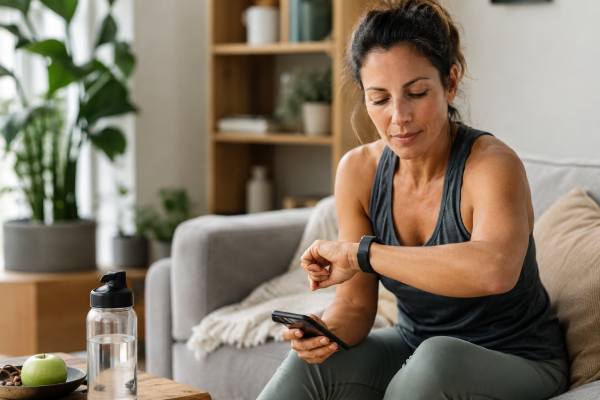
Heart rate variability, or HRV, has moved from sports science into everyday health tracking. Watches, rings, and bands now turn overnight physiology into readiness scores, recovery warnings, and “something may be off” alerts. That is appealing, especially when people want earlier clues that they are getting run down, overreaching, or coming down with an illness. But HRV is easy to misunderstand. A lower-than-usual score does not mean you are definitely getting sick, and a normal score does not prove that your immune system is in the clear.
What wearables can sometimes do well is spot deviation. They may notice that your usual pattern has shifted before you feel fully unwell. The catch is that infection is only one reason that happens. Sleep loss, stress, alcohol, hard training, travel, and even algorithm quirks can move the same signals. The real value of HRV is not prediction in isolation. It is context, trend, and timing.
Key Takeaways
- HRV can sometimes drop before obvious symptoms, but it signals stress on the system rather than a specific infection.
- Wearables work best when they compare you with your own baseline instead of a generic “good” score.
- False alarms are common after poor sleep, emotional stress, hard exercise, alcohol, and travel.
- A practical approach is to watch for a 2 to 3 day pattern across HRV, resting heart rate, sleep, and how you feel.
- Wearables can support decisions about recovery and testing, but they cannot diagnose infection or replace medical care.
Table of Contents
- What HRV actually measures
- Why illness can change HRV early
- What wearables are good at
- Why false alerts happen
- How to use HRV more wisely
- When to trust your body more than your device
What HRV actually measures
HRV is the variation in time between one heartbeat and the next. Despite the name, it is not a sign that the heart is beating erratically in a dangerous way. In most healthy settings, it reflects how flexibly the autonomic nervous system is responding to the body’s needs. That system balances sympathetic drive, which helps you mobilize, and parasympathetic activity, which supports rest, digestion, and recovery. HRV is one indirect window into that balance.
This is why HRV attracts so much interest in recovery, performance, and illness readiness. When the body is handling stress well, HRV often stays closer to a person’s usual range. When the system is under strain, HRV may fall. But the key phrase is “a person’s usual range.” HRV is highly individual. A number that looks low for one person may be normal for another. That is one reason generic score comparisons are often less helpful than people expect.
Wearables add another layer of complexity. They do not all measure HRV the same way. Some use optical sensors and photoplethysmography, especially during sleep, while others rely on ECG-style measurements or proprietary algorithms. Some metrics are more reliable than others. Global markers and lower-frequency trends may compare reasonably well with reference methods under the right conditions, but short-term or rapidly shifting HRV measures can be less dependable. This is not a reason to ignore HRV. It is a reason to avoid treating every decimal point as precise.
A better way to think about HRV is as a stress-responsive signal, not a diagnosis. It can move when you are fighting infection, but it can also move after poor sleep, heavy training, emotional strain, pain, alcohol, dehydration, or travel disruption. In that sense, HRV often fits better with the idea of immune resilience than with the idea of detecting one specific disease. It is telling you how taxed the system may be, not naming the exact source of the load.
Circadian timing matters too. Many wearables use nighttime data because daytime readings are noisier. That makes sense. During sleep, movement is lower, routines are more stable, and comparison to prior nights is easier. Still, even nighttime HRV is affected by when you ate, how late you trained, how much you drank, how long you slept, and whether your schedule has shifted. This is why HRV often belongs in the same conversation as circadian rhythm and immunity.
The most important point is simple: HRV is a meaningful physiologic signal, but it is not a laboratory test. It is most useful when you interpret it as a pattern inside a wider story, not as a stand-alone answer.
Why illness can change HRV early
When the body begins responding to infection or inflammatory stress, several physiologic systems shift before symptoms become obvious. Resting heart rate may rise, respiratory rate may drift up, skin temperature may change, sleep may become lighter, and HRV may fall from baseline. Wearables sometimes capture these shifts because they are watching continuously, especially overnight when signal quality is cleaner.
That possibility is one reason HRV has become so interesting in illness readiness. A person may not yet feel “sick,” but their overnight physiology can already look less settled than usual. Inflammation, fever development, autonomic changes, and altered recovery signals can all affect beat-to-beat variability. In broad terms, the body moves from flexible regulation toward a more guarded, energy-redirecting state. HRV may reflect part of that shift.
Still, the immune story is not the whole story. The same physiology that changes with infection also changes with non-infectious stress. Sleep restriction is a classic example. Even a short period of poor sleep can reduce recovery quality, increase sympathetic load, and alter HRV enough to look like something is off. That is why a drop in HRV often belongs next to a question about sleep and immunity rather than being treated as infection by default.
Psychological stress can do something similar. A demanding week, emotional conflict, travel, illness anxiety, or high work strain can all change autonomic tone. This is one reason many people first notice “bad readiness” during stressful periods even when they do not get sick at all. The physiology is still real. It is simply responding to a different kind of burden. The link between stress and immunity helps explain why wearables struggle to separate emotional and inflammatory stress cleanly.
Illness timing also matters. The early phase of an infection may produce subtle changes for some people and almost none for others. COVID-era research helped show that wearables can sometimes flag presymptomatic changes, but the signal is not uniform. Some users show clear drops in HRV or rises in resting heart rate days before testing positive. Others show a mixed or delayed pattern. Baseline health, age, training status, sleep regularity, vaccination status, device type, and the illness itself all affect how visible the change becomes.
This is why “immune stress” is a better phrase than “infection detection” for many wearable use cases. A wearable may notice that your system is under more strain than usual before you can name the cause. That is useful. It can encourage lighter training, more sleep, better hydration, or earlier testing if symptoms begin. But it cannot tell whether the trigger is viral, inflammatory, behavioral, or emotional without other information.
The most realistic model is this: illness can change HRV early, but early does not always mean specific. A wearable may detect that something is shifting before symptoms fully register, yet it still needs context to make that shift meaningful.
What wearables are good at
Wearables are often better at noticing deviation than at explaining it. That distinction is the heart of this topic. A device that tracks your physiology every night can become fairly good at recognizing when your recent pattern is different from your usual one. In some studies, that has been enough to identify respiratory infections or generate alerts before users felt clearly unwell. But the practical strength of these devices is less about diagnosis and more about surveillance.
That is useful in real life. If your HRV drops for two nights, your resting heart rate rises, your sleep becomes fragmented, and you also feel slightly off, that cluster is more informative than any one signal on its own. A wearable can help surface the cluster earlier than intuition alone, especially in people who are busy, highly trained, or used to pushing through fatigue. This does not make the device smarter than the body. It simply means the device is good at remembering your baseline consistently.
Wearables are also useful because they are passive. Most people will not do daily ECGs, temperature logs, or symptom ratings for months. Many will wear a ring or watch. That makes longitudinal tracking possible at scale. It also helps explain why wearables became relevant for early illness detection research during the pandemic. They could collect millions of hours of real-world data without changing daily life very much.
Another strength is trend stacking. The best signals rarely come from HRV alone. Readiness becomes more believable when HRV shifts at the same time as sleep, resting heart rate, respiratory rate, or temperature. In practical terms, that means a wearable becomes more helpful when you stop asking “What does today’s HRV mean?” and start asking “What changed together over the last 48 to 72 hours?” That kind of multi-signal view often fits better with how illness develops.
This is also where wearables become useful for daily adjustment. A sudden drop in HRV does not require panic, but it might justify backing off a hard workout, delaying alcohol, prioritizing an earlier bedtime, or watching for symptoms more closely. That makes them relevant to the broader question of what weakens your immune system, because many of the same exposures that strain immune recovery also distort wearable recovery signals.
What wearables do less well is certainty. They are not good at telling you whether the cause is infection, overreaching, psychological stress, or poor sleep unless the surrounding clues make that obvious. They are also limited by proprietary algorithms, changing firmware, sensor noise, and adherence problems. A device can only learn your baseline if you wear it regularly enough for that baseline to be real.
The most honest answer is that wearables can sometimes spot immune stress early, especially when several signals move together. Their advantage is pattern recognition over time. Their limitation is specificity. They can raise a flag. They cannot tell you exactly what the flag means without help from the rest of the picture.
Why false alerts happen
False alerts happen because the body only has so many ways to show strain. A wearable may register lower HRV, higher resting heart rate, lighter sleep, or elevated temperature-like signals, but those changes are not reserved for infection. They can appear after a hard training block, a poor night of sleep, a long-haul flight, emotional stress, alcohol, heavy meals late at night, dehydration, or even inconsistent device wear.
Exercise is one of the clearest examples. A hard interval session or a long endurance effort can lower HRV temporarily as part of normal recovery demand. That does not mean you are getting sick. It may simply mean the training load exceeded what your body had fully absorbed by the next morning. The overlap becomes confusing when people who care most about wearables are also the people most likely to train hard. This is why wearable illness alerts often need to be interpreted alongside overtraining and immunity rather than separated from them.
Alcohol is another frequent confounder. Even one heavy social evening can disturb sleep structure, alter autonomic tone, raise resting heart rate, and lower HRV enough to make a device label the next day as poor recovery. Again, the signal is not false in the sense of being imaginary. The body is under strain. It is just not necessarily under infectious strain. That is why people who track readiness carefully often learn as much about alcohol and immunity as they do about infections themselves.
Stress, especially when paired with reduced sleep, can be even harder to spot because it may not feel dramatic. A week of deadlines, caregiving strain, exam pressure, or travel logistics can shift physiology just as reliably as a minor illness in some users. Devices also vary in how they smooth, label, and summarize these changes. A readiness score is not the raw truth of the body. It is the output of an algorithm deciding what that truth probably means.
There are also technical causes of false alarms. Optical sensors are sensitive to motion, fit, skin contact, and signal quality. Firmware updates can subtly change how a platform defines baseline or recovery. Missing nights, irregular wear, late charging habits, and switching wrists or devices can all reduce consistency. The more the data collection shifts, the less trustworthy the trend becomes.
A useful rule is to assume that one bad reading means little. A short run of changes, especially with a believable reason, means more. A trend with no obvious reason means even more. The wearable is most helpful when it prompts questions, not conclusions. If you slept badly, trained hard, drank alcohol, and got a poor recovery score, the device may simply be confirming what the body already knows.
In other words, the biggest weakness of wearables is not that they miss stress. It is that they often catch stress without being able to label the source. That is why interpretation matters more than the alert itself.
How to use HRV more wisely
The smartest way to use HRV is to make it less dramatic. People often get into trouble when they treat a single low score as a warning siren or a single high score as permission to ignore fatigue. HRV works better as one part of a repeatable review process. That process should emphasize personal baseline, recent trend, and cross-checking with symptoms and behavior.
Start with consistency. Wear the same device the same way for long enough to build a meaningful baseline. Overnight measurements are usually more stable than random daytime checks, so many people do best relying on sleep-based data rather than spot readings. Once a baseline is established, compare your current trend with your own prior weeks, not with someone else’s “ideal” number.
Next, look for clustering. A lower HRV reading becomes more meaningful when it arrives with at least one or two other changes: rising resting heart rate, disturbed sleep, more fatigue, reduced exercise tolerance, sore throat, or a higher-than-usual respiratory rate. This is also where context matters. A red flag on a calm week is more informative than the same red flag the day after a wedding, all-night project, or maximal workout.
A simple approach can look like this:
- Notice whether HRV is down relative to your own recent baseline.
- Check whether resting heart rate, sleep, temperature-like signals, or respiratory rate also changed.
- Review the last 24 to 48 hours for obvious confounders such as alcohol, travel, sleep debt, illness exposure, or hard training.
- Adjust behavior before symptoms force the adjustment for you.
For many people, that means lighter training, more fluid intake, earlier bedtime, less alcohol, and a lower threshold for testing if symptoms begin. Used this way, HRV can support prevention by helping you respond sooner, not by telling you exactly what disease you have. It is closer to a readiness mirror than a diagnostic instrument.
This approach also helps reduce health anxiety. A device should guide calm decisions, not constant checking. If looking at HRV every few hours makes you feel worse without changing your behavior meaningfully, the tool is no longer serving you well. In that case, fewer check-ins may be healthier than more data.
Finally, HRV is most useful when it supports recovery fundamentals rather than replacing them. That includes regular sleep timing, manageable training load, consistent meals, better light exposure, and not treating every low score as a call for supplements. In many cases, the best response to a dip in readiness is not a product. It is better sleep, lower load, and fewer hits to the system.
In short, use HRV to improve decisions, not to chase certainty. It is a good early nudge when it points you back toward behaviors that support recovery. It becomes a poor tool when it turns into a substitute for judgment.
When to trust your body more than your device
Wearables are best at adding information, not overruling lived experience. If you feel clearly unwell, a normal-looking HRV score should not reassure you out of common sense. If you have fever, chest symptoms, severe fatigue, or escalating illness signs, your body is already telling you more than the algorithm can. The same applies in the other direction. A low readiness score without symptoms does not automatically mean you are about to get sick. It may simply mean recovery needs attention.
This is especially important because device alerts are not diagnoses. They can support earlier awareness, but they cannot tell you whether the issue is viral, bacterial, inflammatory, allergic, medication-related, or behavioral. They also cannot judge severity well on their own. A mild dip in HRV can coexist with trivial illness, and a person can occasionally develop significant illness without a dramatic wearable change at all.
There are times when the next step is not more tracking but real evaluation. If you repeatedly seem “off” for weeks, if HRV remains suppressed alongside fatigue and exercise intolerance, or if you are getting sick unusually often, the question may no longer be readiness. It may be whether there is something worth checking more formally. In that situation, clinicians may use history, examination, and sometimes tests such as those discussed in common immune blood tests to look for infection, inflammation, anemia, thyroid problems, or other explanations.
There are also clear red-flag situations where a wearable should not delay care:
- shortness of breath or chest pain
- fainting, severe palpitations, or persistent dizziness
- high fever, dehydration, or confusion
- a cough or sore throat that is worsening sharply
- repeated illnesses or recovery that seems unusually slow
In those cases, the question is not whether the wearable was right. The question is what needs attention now.
One of the best uses of wearable data is retrospective learning. Over time, many users notice that certain patterns tend to precede feeling run down: two nights of short sleep, a late alcohol-heavy evening, hard training on low calories, intense work stress, or travel disruption. That lesson can be more valuable than trying to use the device as an illness detector in the narrow sense. The device helps you learn your own early-warning language.
So can wearables spot immune stress early? Sometimes yes, especially when they are tracking your own baseline and when several signals shift together. But they are best viewed as awareness tools, not diagnostic tools. Their real strength is catching deviation early enough for you to respond with better recovery, more caution, or earlier testing if symptoms follow.
Trust the device when it helps you notice patterns. Trust your body when symptoms are real, persistent, or escalating. The best decisions usually come from using both together.
References
- Clinical Evidence of Wearable-Derived Heart Rate Variability for Detecting Systemic Inflammation: A Systematic Review 2026 (Systematic Review)
- Wearable Devices to Diagnose and Monitor the Progression of COVID-19 Through Heart Rate Variability Measurement: Systematic Review and Meta-Analysis 2023 (Systematic Review and Meta-Analysis)
- Detection of Common Respiratory Infections, Including COVID-19, Using Consumer Wearable Devices in Health Care Workers: Prospective Model Validation Study 2024 (Prospective Validation Study)
- Smartwatch-derived heart rate variability: a head-to-head comparison with the gold standard in cardiovascular disease 2023 (Validation Study)
- A caveat to using wearable sensor data for COVID-19 detection: The role of behavioral change after receipt of test results 2022 (Observational Study)
Disclaimer
This article is for educational purposes only and should not be used to diagnose infection, inflammation, heart rhythm disorders, or immune problems. HRV and wearable readiness scores can provide useful context, but they are indirect measures influenced by sleep, stress, exercise, alcohol, illness, device quality, and algorithm design. Seek medical care for chest pain, fainting, severe shortness of breath, persistent palpitations, high fever, dehydration, or symptoms that are worsening or not improving. If you are repeatedly getting sick or recovering unusually slowly, a clinician can help determine whether further evaluation is appropriate.
If this article was helpful, please share it on Facebook, X, or another platform where thoughtful health information can help someone use wearable data more wisely.