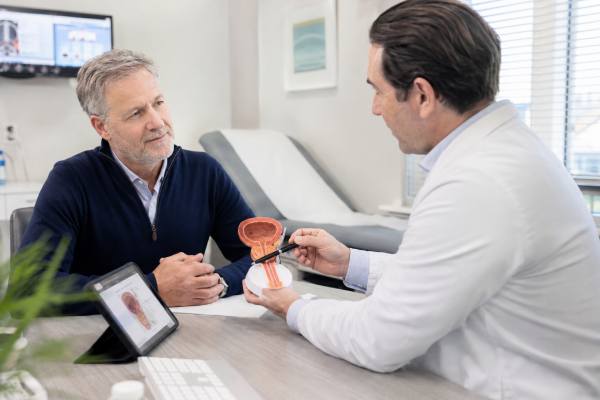
UroLift is a minimally invasive procedure for urinary symptoms caused by an enlarged prostate, also called benign prostatic hyperplasia or BPH. It does not cut, burn, or remove prostate tissue. Instead, small permanent implants hold prostate tissue away from the urethra, the tube that carries urine out of the bladder. The goal is to open the channel so urine can pass more easily.
Men usually consider UroLift when symptoms such as a weak stream, slow starting, frequent urination, urgency, or nighttime bathroom trips are bothersome enough that lifestyle changes or medications are not working well. Its biggest appeal is faster recovery and a lower risk of sexual side effects than many tissue-removing prostate procedures. Its main tradeoff is durability: some men need another BPH treatment later. The best results depend heavily on prostate size, prostate shape, symptom type, and careful evaluation before treatment.
Table of Contents
- What UroLift Does for an Enlarged Prostate
- Who Is a Good Candidate for UroLift?
- What Happens Before the Procedure
- How the UroLift Procedure Is Done
- UroLift Recovery Timeline
- Benefits, Limits, and How Results Compare
- Risks and Side Effects to Discuss
- When to Call Your Doctor After UroLift
- Questions to Ask Before Choosing UroLift
What UroLift Does for an Enlarged Prostate
UroLift treats a blockage problem, not prostate cancer and not every cause of urinary symptoms. In BPH, the prostate grows in a way that can press on the urethra. The bladder then has to work harder to push urine through a narrowed channel. Over time, this can cause slow flow, hesitancy, stopping and starting, dribbling, urgency, and the feeling that the bladder does not fully empty.
UroLift is the brand name for prostatic urethral lift. During the procedure, a urologist places tiny implants through the urethra. Each implant works like a small tissue-retaining device. One side anchors outside the prostate capsule, the other side holds the inner prostate tissue back, and a suture connects them. Several implants are usually placed to create a more open passage.
Unlike TURP or laser surgery, UroLift does not remove the middle of the prostate. Unlike Rezum water vapor therapy, it does not use heat to shrink tissue. That difference explains both its advantages and its limits. Because there is no cutting or heating, recovery can be faster and sexual side effects are less common. Because tissue remains in place, symptom relief may be less powerful than with procedures that remove more obstruction.
BPH symptoms can overlap with other urinary problems, so the diagnosis matters. A man with a weak urine stream from prostate blockage may be a better candidate than a man whose main problem is an overactive bladder, diabetes-related bladder dysfunction, or a urethral stricture. A urologist’s exam and testing help sort this out.
Who Is a Good Candidate for UroLift?
The best candidate is usually a man with bothersome urinary symptoms from BPH, a prostate in the small-to-moderate size range, and a strong desire to reduce medication use or avoid sexual side effects linked with more invasive procedures.
Many studies and guidelines focus on men with prostate volumes around 30 to 80 mL, though exact limits vary by guideline, surgeon, insurance policy, and local practice. Some recommendations are narrower, especially when the prostate has a prominent middle lobe that bulges into the bladder. Certain specialists treat selected middle-lobe anatomy, but this should be discussed carefully because results and coverage may differ.
UroLift may fit well when:
- Symptoms are moderate to severe and clearly bothersome.
- The prostate is not very large.
- The main blockage comes from the side lobes of the prostate.
- The man wants to preserve ejaculation if possible.
- Medication causes dizziness, sexual side effects, fatigue, or poor symptom control.
- A quick return to normal activity is important.
It may be a poor fit when:
- The prostate is very large.
- There is severe urinary retention or heavy bladder damage.
- The bladder is weak and cannot squeeze well.
- There are repeated urinary tract infections, bladder stones, or kidney problems from obstruction.
- The prostate shape is not suitable for implants.
- Symptoms are mostly urgency and frequency without clear blockage.
A man with frequent urination at night should be especially careful about assuming BPH is the only cause. Nocturia can come from evening fluid intake, sleep apnea, leg swelling, diabetes, diuretics, alcohol, or overactive bladder. UroLift may help if nighttime urination is driven by poor bladder emptying, but it may disappoint if the main cause is outside the prostate.
What Happens Before the Procedure
A good pre-procedure evaluation protects against choosing the wrong treatment. UroLift works best when the urologist confirms that the prostate is the main source of obstruction and that the anatomy is suitable.
The evaluation often starts with symptom scoring. Many urologists use the International Prostate Symptom Score, often called IPSS. It asks about incomplete emptying, frequency, intermittency, urgency, weak stream, straining, nighttime urination, and quality of life. The score helps measure how bad symptoms are before treatment and whether they improve afterward.
Common checks before UroLift may include:
- Urinalysis to look for blood, infection, or sugar in the urine.
- A prostate exam.
- PSA testing when appropriate for age and risk.
- A bladder scan after urination to measure leftover urine.
- Urine flow testing to measure how strong the stream is.
- Cystoscopy, where a small camera checks the urethra, prostate channel, and bladder.
- Ultrasound or another measurement of prostate size.
PSA can rise for reasons other than cancer, including BPH, infection, recent ejaculation, catheter use, and prostate procedures. Men who are unsure why PSA is being checked can review how the PSA test is used before making decisions about prostate treatment.
Medication review is also important. Blood thinners, aspirin, anti-inflammatory drugs, diabetes medicines, sedatives, and prostate medications may need special instructions. Do not stop a prescribed blood thinner on your own; the urologist and prescribing clinician should decide what is safe.
Men should also ask what problem they are trying to solve. UroLift may improve flow and emptying symptoms. It may not fully solve urgency, bladder spasms, nighttime urination from sleep problems, or leakage from causes unrelated to obstruction.
How the UroLift Procedure Is Done
UroLift is usually done through the urethra using a cystoscope, so there is no external incision. Depending on the patient, practice setting, and anatomy, it may be done in an office, ambulatory surgery center, or hospital outpatient unit.
The procedure commonly follows this sequence:
- The patient receives local anesthesia, sedation, spinal anesthesia, or general anesthesia.
- The urologist inserts a cystoscope through the tip of the penis into the urethra.
- The prostate channel is inspected.
- The UroLift delivery device is positioned where prostate tissue is blocking the channel.
- Implants are placed to pull the obstructing tissue outward.
- The urologist checks whether the channel is adequately opened.
- The patient urinates before going home, unless a temporary catheter is needed.
The number of implants depends on prostate anatomy. Some men need only a few. Others need more to create a stable open channel. More implants do not automatically mean a better result; placement matters.
The procedure itself is usually short, but the full appointment takes longer because of preparation, anesthesia, recovery observation, and the need to confirm urination afterward. Some men go home without a catheter. Others need one for a short time, especially if there is swelling, bleeding, urinary retention, or difficulty voiding right away.
UroLift implants are intended to stay in place permanently. They are not meant to be felt during daily life, urination, sex, or exercise once healing is complete. In uncommon cases, an implant may need to be removed or another procedure may be needed later.
UroLift Recovery Timeline
Most men recover faster from UroLift than from tissue-removing prostate surgery, but recovery is not always symptom-free. Burning, urgency, pelvic aching, light blood in the urine, and frequent urination are common early complaints.
| Time after procedure | What many men notice | Common instructions |
|---|---|---|
| First day | Burning when urinating, urgency, mild blood in urine, pelvic pressure, possible catheter | Hydrate as instructed, rest, take prescribed medicines, avoid driving if sedated |
| Days 2–7 | Symptoms often fluctuate; some days feel better than others | Avoid heavy lifting, hard workouts, cycling, and straining unless cleared |
| Weeks 1–2 | Burning and blood usually improve; urinary flow may start to feel easier | Return gradually to normal activity; ask when sex is safe to resume |
| Weeks 2–6 | Many men see clearer symptom improvement | Attend follow-up and report persistent pain, infection signs, or poor emptying |
| Months 2–3 | Results are easier to judge; urgency may continue improving if bladder irritation settles | Review whether prostate medicines can be reduced or stopped |
Desk work may be possible within a few days for some men, but this varies. Jobs that involve lifting, long driving, climbing, or physical labor may require a longer pause. Exercise should restart gradually. Cycling, rowing, heavy squats, and activities that put pressure on the perineum may need extra caution early on.
Sexual activity is usually paused for a short period after the procedure. The exact timing depends on bleeding, pain, catheter use, and the urologist’s instructions. Ejaculation may feel different during early healing because the prostate and urethra are irritated. Persistent painful ejaculation, heavy bleeding after sex, fever, or worsening pelvic pain should be reported.
Men taking alpha blockers, 5-alpha-reductase inhibitors, or daily tadalafil should not stop them without a plan. Some urologists keep medicines in place during early healing and then reassess. Others taper sooner if urination improves. For men comparing medicine options, daily tadalafil for urinary symptoms is discussed separately in Cialis for BPH, while prostate-shrinking therapy is covered in finasteride for BPH.
Benefits, Limits, and How Results Compare
UroLift’s strongest benefits are speed, simplicity, and preservation of sexual function. Many men choose it because they want symptom relief without committing to a more invasive surgery and without the higher risk of retrograde ejaculation seen with several prostate procedures. Retrograde ejaculation means semen goes backward into the bladder instead of out through the penis during orgasm.
The main benefits include:
- No cutting, heating, or removal of prostate tissue.
- Often no overnight hospital stay.
- Lower risk of new erectile or ejaculatory problems than many surgical options.
- Faster return to usual activity for many men.
- Possible reduction or stopping of BPH medications.
- Symptom improvement that can begin within weeks.
The limits matter just as much. UroLift may not open the channel as strongly as TURP or HoLEP. It may not be ideal for very large prostates or certain prostate shapes. Some men still need medication afterward. Others need repeat treatment after symptoms return.
| Option | Main advantage | Main tradeoff |
|---|---|---|
| Medications | No procedure; easy to start and stop under medical guidance | Side effects, daily use, and incomplete relief for some men |
| UroLift | Fast recovery and low sexual side-effect risk | Less tissue removal and higher chance of later retreatment than some surgeries |
| Rezum | Minimally invasive and can treat some prostate anatomy UroLift may not fit | Irritative symptoms and catheter use may last longer for some men |
| TURP | Stronger flow improvement for many men | More invasive, more recovery time, and higher ejaculation side-effect risk |
| HoLEP | Very effective for larger prostates and durable tissue removal | Requires specialized surgical skill and has a different recovery profile |
A man who wants the most powerful, durable opening may prefer TURP surgery for BPH or HoLEP for an enlarged prostate. A man who wants a minimally invasive option and accepts the possibility of future retreatment may prefer UroLift or Rezum water vapor therapy.
There is no single “best” BPH procedure for every man. The right choice depends on symptom severity, prostate size, median lobe anatomy, bladder emptying, sexual priorities, anesthesia risk, recovery needs, and willingness to accept possible retreatment.
Risks and Side Effects to Discuss
UroLift is less invasive than many BPH surgeries, but it is still a prostate procedure. The urethra, bladder neck, and prostate can be irritated during placement, and the implants remain in the body.
Common short-term side effects include:
- Burning or stinging with urination.
- Blood in the urine.
- Urgency or frequency.
- Pelvic discomfort.
- Temporary difficulty urinating.
- Urinary tract infection.
- Temporary leakage or bladder irritation.
These symptoms are often mild to moderate and improve within days to weeks. Still, “common” does not mean harmless. A man who cannot urinate, develops fever, passes clots, or has worsening pain needs prompt medical advice.
Less common risks include:
- Need for a temporary catheter.
- Persistent pain or urinary irritation.
- Implant misplacement, encrustation, or removal.
- Symptoms that do not improve enough.
- Later need for repeat UroLift, TURP, HoLEP, Rezum, or another BPH treatment.
- Trouble interpreting some future prostate imaging because implants can affect MRI quality in certain areas.
Sexual side effects are less common with UroLift than with many tissue-removing procedures, but they are not impossible. Men should still ask directly about erectile function, ejaculation, orgasm changes, pain with ejaculation, and what the urologist has seen in their own practice.
Retreatment is one of the most important tradeoffs. Some men do well for years. Others have symptoms return because the prostate continues to grow, the original blockage was not fully corrected, the bladder has other problems, or the implants do not provide enough long-term opening. A realistic conversation should include both early recovery and what may happen three to five years later.
Men with a history of urinary retention should ask whether UroLift is likely to make them catheter-free. The answer depends on how long retention has been present, bladder strength, prostate shape, and how much urine remains after voiding. Severe or repeated urinary retention may call for a different approach.
When to Call Your Doctor After UroLift
Early irritation is expected, but certain symptoms are not normal recovery. Clear instructions from the urologist should come before going home, including who to call after hours.
Call the urologist promptly or seek urgent care for:
- Inability to urinate.
- Fever, chills, or feeling very ill.
- Heavy bleeding or large clots.
- Severe pelvic, abdominal, back, or testicular pain.
- Burning that is getting worse instead of better.
- Foul-smelling urine or symptoms of infection.
- A catheter that stops draining.
- New confusion, weakness, or dizziness after anesthesia or pain medication.
Some blood in the urine can happen after activity, dehydration, or bowel straining. Light pink urine that clears with fluids may be expected. Bright red urine that persists, thick clots, or blockage is different.
Constipation is an underappreciated recovery problem. Straining can worsen pelvic pressure and urinary symptoms. Many men are told to use fluids, fiber, stool softeners, or gentle laxatives if needed, especially when taking pain medicine.
Follow-up is not just a formality. The urologist may check symptom score, urine flow, leftover urine, medication use, and side effects. If urgency remains high but flow is better, bladder-directed treatment may be needed. If flow stays weak, the urologist may look for persistent obstruction, swelling, urethral narrowing, or another cause.
Questions to Ask Before Choosing UroLift
A short office visit can leave out details that matter later. Bring a written list and ask for answers specific to your prostate, not just the average patient.
Useful questions include:
- What is my prostate size?
- Do I have a median lobe or bladder-neck shape that makes UroLift less suitable?
- Is my bladder emptying well?
- Are my symptoms mainly blockage, overactive bladder, or both?
- How many UroLift procedures have you done?
- How many implants do you expect to place?
- Will I likely need a catheter?
- How soon can I return to work, exercise, driving, and sex?
- Should I keep taking my prostate medicines after the procedure?
- What result would count as success in my case?
- What are my options if UroLift does not work or wears off?
- Will the implants affect future MRI, prostate cancer evaluation, or later prostate surgery?
Cost and coverage also matter. Insurance rules may require documentation of symptom severity, prostate size, failed medication, flow testing, cystoscopy, or absence of certain anatomy. Ask the office what is required before the procedure is scheduled.
UroLift can be a good choice for the right man: someone with confirmed BPH obstruction, suitable anatomy, moderate prostate size, and a strong preference for faster recovery and ejaculation preservation. It is less ideal when the prostate is large, the bladder is weak, retention is severe, or the goal is the most durable tissue-removing result. The best decision comes from matching the treatment to the anatomy, not from choosing the newest or least invasive option by default.
References
- EAU Guidelines on the Management of Non-neurogenic Male LUTS – DISEASE MANAGEMENT 2026 (Guideline)
- Management of Lower Urinary Tract Symptoms Attributed to Benign Prostatic Hyperplasia (BPH): AUA Guideline Amendment 2023 2024 (Guideline)
- Prostatic Urethral Lift 2024 (Review)
- UroLift for Treating Lower Urinary Tract Symptoms of Benign Prostatic Hyperplasia: A NICE Medical Technology Guidance Update 2022 (Review)
- A Systematic Review and Meta-analysis of Prostatic Urethral Lift for Male Lower Urinary Tract Symptoms Secondary to Benign Prostatic Hyperplasia 2020 (Systematic Review)
- Five year results of the prospective randomized controlled prostatic urethral L.I.F.T. study 2017 (RCT)
Disclaimer
This article is for educational purposes only and does not replace care from a qualified clinician. BPH symptoms can overlap with urinary infection, bladder problems, medication effects, and prostate cancer evaluation, so diagnosis and treatment choices should be made with a urologist. Seek urgent medical care if you cannot urinate, have fever with urinary symptoms, pass heavy blood or clots, or develop severe pelvic or abdominal pain.