Testosterone replacement therapy can help men with confirmed low testosterone, but breathing problems during sleep need attention before treatment starts. Obstructive sleep apnea causes repeated drops in airflow and oxygen overnight. That can leave a man tired, foggy, irritable, and less interested in sex — the same symptoms that often lead men to ask about TRT.
The concern is not that every man with snoring or sleep apnea must avoid testosterone forever. The concern is untreated or severe sleep apnea. TRT may worsen nighttime breathing in some men, and it can also raise red blood cell levels, which may already be higher when oxygen drops during sleep. A safer plan starts with the right testing, a clear diagnosis, and a follow-up schedule that checks both hormone response and sleep-related risk.
Table of Contents
- Why Sleep Apnea Changes the TRT Conversation
- Symptoms That Overlap With Low Testosterone
- How TRT May Affect Nighttime Breathing
- Who Should Be Screened Before Starting TRT
- What Testing and Treatment Usually Look Like
- Starting or Restarting TRT After Sleep Apnea Treatment
- Warning Signs After TRT Begins
- Common Mistakes That Make Treatment Riskier
Why Sleep Apnea Changes the TRT Conversation
Sleep apnea changes the TRT conversation because it can cause the same complaints that men often blame on low testosterone: poor energy, low mood, weaker erections, morning headaches, and reduced drive. When breathing repeatedly slows or stops during sleep, oxygen dips and the brain keeps waking the body enough to reopen the airway. The person may not remember these awakenings, but the body feels them the next day.
Obstructive sleep apnea is the most common form. The airway narrows or collapses during sleep, often because of anatomy, weight gain, alcohol use, nasal blockage, or reduced muscle tone during deeper sleep. Men are at higher risk than women, and risk rises with age, neck size, belly fat, and metabolic problems.
TRT matters here for two reasons. First, testosterone can affect breathing control, airway muscle behavior, and fluid balance in ways that may worsen sleep-disordered breathing in some men. Second, TRT can increase hematocrit, the percentage of blood volume made up by red blood cells. Sleep apnea can also push red blood cell production upward when oxygen levels drop often enough. When both issues happen together, blood can become thicker than desired, which is one reason monitoring is important.
This does not mean testosterone replacement therapy is automatically unsafe for every man who snores. It means untreated moderate or severe sleep apnea should be taken seriously before starting. If sleep apnea is diagnosed and treated well, many men can still discuss TRT with their clinician if they truly have testosterone deficiency.
The safest approach is not “TRT first and see what happens.” It is “find out whether sleep apnea is part of the problem, treat it when present, then decide whether testosterone is still needed.”
Symptoms That Overlap With Low Testosterone
A man who wakes up unrefreshed after seven or eight hours may feel like his hormones are low, even when the main problem is poor sleep quality. Testosterone rises during sleep, especially during deeper sleep. Fragmented sleep can blunt that normal pattern and make the next day feel like a hormone problem.
Common symptoms that can appear in both low testosterone and sleep apnea include:
- Low energy or heavy afternoon fatigue
- Brain fog and poor concentration
- Irritability or depressed mood
- Low sex drive
- Erectile problems
- Reduced motivation to exercise
- Increased belly fat or weight gain
- Morning headaches
- Poor recovery after workouts
The overlap is why symptoms alone are not enough. A man can have true testosterone deficiency, sleep apnea, depression, thyroid disease, medication side effects, or several of these at once. Treating only one piece may leave the others untouched.
Snoring is a useful clue, but it is not required. Some men with sleep apnea do not notice snoring because they sleep alone or because their breathing events are quieter. A partner may notice choking, gasping, long pauses, restless sleep, or frequent position changes. Men who want a deeper symptom breakdown can compare their pattern with common sleep apnea symptoms in men before discussing testing.
Low testosterone also needs a proper lab diagnosis. A single low value, especially one drawn late in the day, after poor sleep, during illness, or after heavy alcohol use, can be misleading. Testing usually starts with early morning total testosterone, often repeated on a separate day. Depending on the result, clinicians may also check free testosterone, sex hormone-binding globulin, luteinizing hormone, prolactin, thyroid markers, blood count, and metabolic labs.
Men with clear low testosterone symptoms should not ignore sleep. If the worst symptoms are morning headache, daytime sleepiness, loud snoring, or falling asleep during quiet activities, a sleep evaluation may explain more than a hormone panel alone.
How to tell which problem may be driving symptoms
Sleep apnea is more likely to be a major driver when the man wakes up choking, has loud snoring, feels sleepy while driving, has high blood pressure, or has a large neck size. Low testosterone is more likely when there is persistent low libido, reduced morning erections, loss of body hair, infertility concerns, low bone density, or clearly low repeated morning labs.
Many men have both. In that case, treating sleep apnea first may improve energy, mood, blood pressure, and sexual function enough to make the TRT decision clearer.
How TRT May Affect Nighttime Breathing
TRT may worsen sleep apnea in some men, especially when sleep apnea is already untreated or severe. The effect is not the same for everyone, and research is mixed, but the concern is strong enough that major guidelines advise caution.
Several possible mechanisms are discussed in medical literature. Testosterone may change how the brain responds to oxygen and carbon dioxide during sleep. It may affect upper-airway stability. It may also increase oxygen demand or contribute to fluid shifts that make the airway narrower at night. Higher doses or rapid rises in testosterone may be more concerning than stable, carefully monitored replacement.
The pattern also matters. A man who starts high-dose injections and feels wired, sleeps lighter, gains water weight, and develops worse snoring is different from a man using a stable dose while his sleep apnea is already well controlled. TRT is not one uniform exposure. Dose, delivery method, blood levels, timing, body weight, alcohol use, sedatives, and existing airway anatomy all matter.
Another important issue is hematocrit. TRT can stimulate the bone marrow to make more red blood cells. Mild increases can be expected, but excessive increases require action. Sleep apnea can add to this problem because repeated oxygen dips may also encourage red blood cell production. This is why a blood count is usually checked before TRT and again after treatment begins.
Men reading about TRT side effects often focus on acne, mood changes, fertility, or hair loss. Sleep apnea and hematocrit deserve the same level of attention because they can affect heart and vascular risk.
TRT may still be reasonable for a man with confirmed hypogonadism and treated sleep apnea. The risk is higher when treatment is rushed, dosing is excessive, or symptoms of sleep apnea are ignored because the man feels stronger or more sexually driven during the first few weeks.
Who Should Be Screened Before Starting TRT
A sleep apnea screen is especially important before TRT when a man has loud snoring, daytime sleepiness, witnessed breathing pauses, obesity, resistant high blood pressure, or a history of heart rhythm problems. Screening does not always mean an overnight lab study for every man. It means asking the right questions and deciding who needs formal testing.
A clinician may ask about:
- Loud snoring heard through a closed door
- Gasping, choking, or pauses in breathing during sleep
- Morning headaches or dry mouth
- Daytime sleepiness, especially while driving
- High blood pressure or needing multiple blood pressure medicines
- Neck size, weight gain, and waist circumference
- Alcohol use near bedtime
- Sedatives, opioids, or sleep medications
- Prior sleep study results
- CPAP use, mask problems, or stopped treatment
Men with snoring with daytime fatigue should be screened carefully because fatigue can easily be mislabeled as “low T.” So should men who say they sleep enough hours but never feel restored.
Risk is also higher when several health issues cluster together. Belly fat, prediabetes, high blood pressure, fatty liver, and low testosterone often travel together. Sleep apnea can sit in the middle of that cluster, worsening insulin resistance, blood pressure, and fatigue. For some men, the best hormone plan begins with treating the airway, improving sleep, and reducing visceral fat.
Screening is also useful for men already diagnosed with sleep apnea but not using treatment. A man who owns a CPAP machine but rarely wears it should not be considered “treated” in any meaningful way. The same applies when the mask leaks badly, the pressure feels intolerable, or device data show very low use.
When TRT should usually wait
TRT usually needs to wait when sleep apnea is severe and untreated, when daytime sleepiness is dangerous, when oxygen levels are dropping significantly at night, or when hematocrit is already high. It may also need to wait when blood pressure is uncontrolled. Men who already need blood pressure monitoring on TRT have even more reason to address sleep apnea early.
Waiting is not the same as refusing treatment. It is often a safer sequence: diagnose the breathing problem, start therapy, confirm improvement, then return to the testosterone question with better information.
What Testing and Treatment Usually Look Like
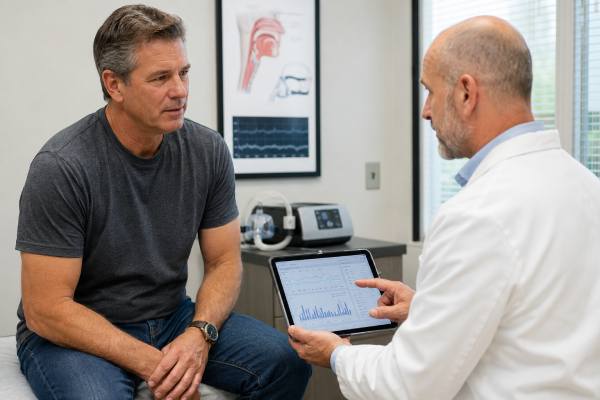
Sleep apnea testing usually happens in one of two ways: a home sleep apnea test or an in-lab sleep study. A home test may be enough for men with a high chance of straightforward obstructive sleep apnea and no major complicating conditions. An in-lab study gives more detail and may be preferred when the diagnosis is unclear, symptoms are severe, oxygen drops are concerning, other sleep disorders are suspected, or heart and lung disease complicate the picture.
A sleep report often includes the apnea-hypopnea index, or AHI. This estimates how many breathing pauses or shallow-breathing events occur per hour of sleep. Mild sleep apnea is often described as 5 to fewer than 15 events per hour, moderate as 15 to fewer than 30, and severe as 30 or more. The oxygen numbers also matter. AHI alone does not tell the whole story if oxygen levels drop deeply or stay low for long periods.
Treatment depends on severity, anatomy, symptoms, and what the man can realistically use. Common options include:
| Treatment | How it helps | Best fit |
|---|---|---|
| PAP therapy | Uses air pressure to keep the airway open during sleep | Moderate to severe sleep apnea, significant symptoms, oxygen drops |
| Oral appliance | Moves the lower jaw forward to reduce airway collapse | Mild to moderate cases, CPAP intolerance, selected anatomy |
| Weight loss | Reduces pressure around the airway and improves metabolic risk | Men with overweight, obesity, or central weight gain |
| Positional therapy | Reduces back-sleeping when apnea is position-dependent | Men whose events are much worse on their back |
| Surgery or airway procedures | Targets anatomic blockage or selected airway patterns | Selected cases after specialist evaluation |
PAP therapy includes CPAP and related devices. It is often the first-line treatment for moderate or severe obstructive sleep apnea. The main challenge is comfort. Mask leaks, dry nose, pressure discomfort, and claustrophobia are common early problems, but many can be fixed with mask changes, humidification, pressure adjustment, or coaching.
Weight loss can help, especially when central weight gain is part of the problem. It should not be used as the only plan when apnea is severe and oxygen drops are significant. Men working on obesity-related men’s health risks often improve sleep, blood pressure, insulin resistance, and testosterone signaling at the same time.
A testosterone workup can proceed alongside sleep testing, but treatment decisions should respect both results. For example, a man with borderline testosterone and severe untreated sleep apnea may be advised to treat sleep apnea first and repeat hormone testing after sleep improves. A man with clearly low repeated testosterone due to pituitary or testicular disease may still need hormone treatment, but the sleep plan becomes part of the safety plan.
Starting or Restarting TRT After Sleep Apnea Treatment
TRT is safer to consider when sleep apnea is treated, symptoms are improving, and follow-up data show the airway problem is controlled. For a man using PAP therapy, that may mean he wears the device most nights, has fewer breathing events on device reports, and wakes with better energy. For an oral appliance, it may mean symptoms improve and repeat testing confirms the appliance is working.
The TRT decision should still be based on confirmed testosterone deficiency, not fatigue alone. Proper morning testosterone testing helps avoid treating a temporary dip caused by poor sleep, illness, stress, or late-day testing.
A careful restart plan may include:
- Confirm symptoms and repeat testosterone labs under good testing conditions.
- Review sleep apnea severity and current treatment use.
- Check baseline hematocrit, blood pressure, PSA when age-appropriate, and cardiovascular risk.
- Choose a TRT form and dose that aims for physiologic replacement, not bodybuilding-level peaks.
- Recheck blood count and testosterone level after starting.
- Watch for worsening snoring, morning headaches, sleepiness, or oxygen problems.
- Adjust dose, delivery method, or sleep therapy if problems appear.
Men who use injections may experience higher peaks depending on dose and schedule. Some clinicians split doses to reduce swings. Gels or other daily options may create steadier levels for some men, but they have their own drawbacks, including skin transfer risk and variable absorption. The “best” form depends on labs, symptoms, cost, preference, fertility goals, and side effect risk.
Fertility deserves special attention. TRT can reduce sperm production by suppressing the hormone signals that drive the testicles. Men who want children soon should discuss alternatives before starting, not after sperm count drops. That issue is separate from sleep apnea but often comes up in the same visit.
Sleep can also improve testosterone naturally when poor sleep is a major driver. Men interested in the hormone-sleep connection can review how sleep and low testosterone interact before assuming medication is the only path.
Warning Signs After TRT Begins
New or worsening sleep symptoms after TRT starts should not be brushed off as adjustment. Some early changes may feel positive, such as more energy or libido, but worsening nighttime breathing can quietly raise risk.
Call the prescribing clinician or sleep specialist if any of these appear after starting or increasing TRT:
- Louder snoring than usual
- Waking up gasping or choking
- Morning headaches that are new or worse
- Daytime sleepiness despite enough sleep
- Drowsy driving or near-miss accidents
- Higher blood pressure readings
- New palpitations or irregular heartbeat symptoms
- Swelling, rapid weight gain, or fluid retention
- CPAP pressure suddenly feeling inadequate
- A rising hematocrit on blood tests
A repeat sleep study is not always needed for every symptom, but it may be appropriate if breathing appears worse, oxygen levels are concerning, or PAP device data show more residual events. Some men may need TRT dose adjustment. Others may need better sleep apnea treatment. Sometimes both are needed.
Blood count follow-up is especially important. If hematocrit rises too high, clinicians may lower the dose, change the delivery method, pause therapy, evaluate sleep apnea control, or look for other causes such as smoking, lung disease, dehydration, or high-altitude exposure. Simply donating blood repeatedly without fixing the reason may miss the underlying problem.
Mood and sleep should be watched together. TRT can sometimes improve well-being in men with true deficiency, but poor sleep can keep irritability and anxiety active. Men with anger, depression, or burnout symptoms may need a broader plan that includes sleep, mental health, medication review, alcohol use, and physical conditioning.
Common Mistakes That Make Treatment Riskier
The riskiest TRT plans often fail before the first dose because the evaluation is too narrow. A testosterone number is important, but it does not replace a full picture of sleep, breathing, blood pressure, blood count, fertility goals, medications, and metabolic health.
One common mistake is treating fatigue with testosterone before asking why sleep is poor. A man who snores heavily, wakes up with headaches, and fights sleep during the day needs a sleep apnea evaluation even if his testosterone is mildly low. Poor sleep may be the cause of the hormone dip, not just a separate problem.
Another mistake is assuming CPAP failure after one bad mask. PAP therapy often needs adjustment. Mask style, humidity, pressure settings, nasal congestion, beard fit, and sleeping position can all affect comfort. Quitting after three nights may leave a treatable problem untreated.
A third mistake is chasing very high testosterone levels. TRT is meant to restore low levels into an appropriate range, not push the body beyond normal physiology. Higher levels can increase side effects without improving the original problem. Men who feel best only at unusually high levels may be masking untreated sleep apnea, depression, stimulant overuse, or poor recovery habits.
Alcohol is another overlooked factor. Evening alcohol can worsen snoring and airway collapse, reduce sleep quality, and make next-day fatigue worse. Sedatives, opioids, and some sleep medications can also worsen breathing during sleep. These should be reviewed before TRT and again if sleep symptoms change.
Finally, many men forget that follow-up is part of treatment. TRT without lab monitoring is not a safe long-term plan. Sleep apnea treatment without checking whether symptoms and device data improve is also incomplete. The strongest plan connects both sides: hormone monitoring and breathing monitoring.
A good question to ask the clinician is simple: “Do my sleep symptoms change how we should diagnose, start, or monitor testosterone treatment?” That question keeps the focus where it belongs — not on choosing between sleep care and hormone care, but on making sure one does not make the other more dangerous.
References
- The complex relation between obstructive sleep apnoea syndrome, hypogonadism and testosterone replacement therapy 2023 (Review)
- Obstructive Sleep Apnea and Testosterone Therapy 2021 (Review)
- Update to the Testosterone Guideline 2024 (Guideline Update)
- Management of Adverse Effects in Testosterone Replacement Therapy 2025 (Review)
- Clinical Practice Guideline for Diagnostic Testing for Adult Obstructive Sleep Apnea 2017 (Guideline)
- Treatment of Adult Obstructive Sleep Apnea with Positive Airway Pressure 2019 (Guideline)
Disclaimer
This article is educational and should not replace care from a qualified clinician. Men with suspected sleep apnea, low testosterone symptoms, high hematocrit, heart disease, uncontrolled blood pressure, or fertility goals should get individualized medical advice before starting or changing TRT. Seek urgent help if sleepiness affects driving, breathing pauses are severe, chest pain occurs, or new neurologic symptoms appear.