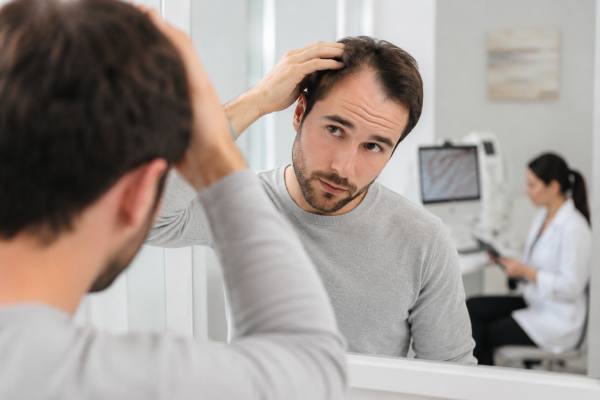
A receding hairline usually starts quietly. The corners above the temples creep back, the forehead looks a little taller in photos, or the front edge of the hair no longer sits where it used to. For many men, this is the first visible sign of male pattern hair loss, also called androgenetic alopecia. It can begin in the late teens or 20s, but it may also show up later and move slowly over years.
A changing hairline is not always an emergency, and it is not always permanent. Shedding after illness, weight loss, stress, medications, scalp inflammation, or tight hairstyles can sometimes mimic early balding. The pattern, speed, scalp condition, and family history all matter. Treatment works best when there are still active follicles in the thinning area, so noticing the change early gives you more options.
Table of Contents
- What a Receding Hairline Looks Like
- Why the Hairline Recedes
- When Hairline Changes Need a Checkup
- Treatment Options for a Receding Hairline
- How to Choose a Treatment Plan
- Results Timeline and How to Track Progress
- Daily Habits That Protect Existing Hair
- Common Mistakes Men Make
What a Receding Hairline Looks Like
A receding hairline often begins as a change in shape, not a sudden bald patch. The classic early pattern is thinning at both temples, creating a mild M shape. The center front may stay lower for a while, while the corners move back first.
Some men notice it only when comparing old photos. Others see more scalp at the front when their hair is wet, under bright bathroom light, or after a haircut. Shorter haircuts can make the change easier to spot because there is less length to cover the temples.
Early signs include:
- A higher forehead than before
- Thinner hair at the temples
- A sharper M-shaped hairline
- More scalp showing when hair is wet or styled upward
- Short, fine, wispy hairs along the front edge
- Less density at the front compared with the sides and back
- More shedding than usual, especially if the hair also looks thinner over time
The key detail is miniaturization. In male pattern hair loss, some hairs do not simply fall out and disappear at once. They become thinner, shorter, softer, and less pigmented over repeated growth cycles. A hairline may still contain hair, but the hairs no longer provide the same coverage.
A mature hairline is different from a receding hairline. Many men move from a rounded teenage hairline to a slightly higher adult hairline after puberty. This can be stable and may not keep moving. A receding hairline keeps changing, especially at the temples or front edge.
A cowlick, widow’s peak, or naturally high forehead can also be mistaken for hair loss. The best clue is change. If the hairline has looked the same for years, it may simply be your natural shape. If the corners have moved back compared with older photos, or the front hairs are becoming finer, early male pattern hair loss is more likely. For a broader look at the condition behind this pattern, see male pattern hair loss stages and treatment timing.
Why the Hairline Recedes
The most common cause is inherited sensitivity to dihydrotestosterone, usually shortened to DHT. DHT is made from testosterone by an enzyme called 5-alpha reductase. In men who are genetically sensitive to it, DHT can shrink certain scalp follicles over time.
The front, temples, and crown are more vulnerable. The sides and back of the scalp are usually more resistant, which is why many men keep a rim of thicker hair even after major hair loss.
Hairline recession is influenced by several factors.
Genetics
Family history is one of the strongest clues. Hair loss can come from either side of the family, not only the mother’s side. A father, brother, uncle, or grandfather with early temple recession can raise the odds, but the pattern may not match exactly.
Some men inherit a slow pattern that changes over decades. Others inherit a more aggressive pattern that begins in the late teens or 20s. Early onset often deserves earlier attention because more follicles may be at risk over time.
Hormone sensitivity
Most men with a receding hairline do not have “too much testosterone.” The issue is usually how sensitive certain follicles are to DHT. This is why treatments that lower DHT activity, such as finasteride, can slow hair loss in many men.
Men using anabolic steroids or certain hormone-related drugs may notice faster thinning if those substances increase androgen activity. If hair loss begins after starting a hormone, bodybuilding, or “testosterone boosting” product, that timing matters. Steroid-related hair loss can be part of a wider set of risks; anabolic steroid side effects in men can include hormone, fertility, mood, liver, and heart concerns.
Age
Hairline changes become more common with age, but age alone does not explain everything. Some men keep a dense hairline into older adulthood. Others see temple recession soon after puberty. Age mainly gives genetic and hormonal influences more time to show.
Shedding triggers
Temporary shedding can make the hairline look worse, even when it is not the main cause. Common triggers include fever, major illness, surgery, rapid weight loss, crash dieting, severe stress, low iron, thyroid problems, and some medications.
This type of shedding, called telogen effluvium, often appears 1 to 3 months after the trigger. It usually affects the whole scalp more than just the temples, but it can reveal an underlying pattern that was already developing.
Scalp inflammation and skin conditions
Dandruff, seborrheic dermatitis, psoriasis, fungal infection, or inflamed follicles can increase shedding and make hair look thinner. Scalp itching, heavy flaking, redness, soreness, or crusting suggests that skin inflammation may be part of the picture. For men with persistent flakes and scalp irritation, dandruff and seborrheic dermatitis are worth understanding because treating inflammation may improve shedding and comfort.
Traction and grooming damage
Tight braids, buns, dreadlocks, glued hair systems, tight hats worn with friction, harsh bleaching, and aggressive brushing can damage the front hairline. Traction hair loss is more likely when thinning follows the exact area under tension. Early traction may improve if the pulling stops. Long-term traction can scar follicles and become permanent.
When Hairline Changes Need a Checkup
A slow, symmetrical temple recession with a family history often fits male pattern hair loss. Still, a checkup is wise when the pattern is unusual, the change is fast, or the scalp looks irritated.
See a dermatologist or qualified clinician if you notice:
- Sudden shedding in handfuls
- Patchy bald spots
- Pain, burning, itching, crusting, or pus
- Scaling that does not improve with dandruff treatment
- Hair loss after a new medication
- Thinning of eyebrows, beard, or body hair
- Fatigue, weight changes, cold intolerance, or other thyroid-like symptoms
- Hair loss after rapid weight loss, major illness, or surgery
- A family history of autoimmune disease
- Scarring, shiny skin, or loss of follicle openings on the scalp
A clinician may examine the scalp, review medications, ask about family history, and look at the hair under magnification. Dermoscopy, a simple magnified scalp exam, can show miniaturized hairs typical of androgenetic alopecia.
Blood tests are not needed for every man with a classic receding hairline. They may be useful when shedding is diffuse, sudden, or linked with other symptoms. Tests may include thyroid function, iron stores, blood count, vitamin D, or other labs based on the history.
A scalp biopsy is uncommon but may be used if the diagnosis is unclear or scarring hair loss is suspected. Scarring hair loss needs prompt care because the goal is to stop inflammation before follicles are permanently destroyed.
A checkup is also helpful before starting prescription treatment. Finasteride, dutasteride, and oral minoxidil can be useful, but they are not casual supplements. They have side effects, interactions, and monitoring issues that should be matched to your health history.
Treatment Options for a Receding Hairline
Treatment is most effective when the goal is to keep existing hair and thicken miniaturized hairs. Regrowing a completely bald temple is harder. Once follicles are gone or scarred, medication cannot reliably bring them back.
Topical minoxidil
Minoxidil is an over-the-counter treatment applied to the scalp as foam or liquid. It does not block DHT. It helps some follicles stay in the growth phase longer and can improve thickness over time.
For men, 5% minoxidil is commonly used. It is often applied once or twice daily depending on the product and clinician advice. Foam may be less irritating for some men because it avoids propylene glycol, an ingredient in some liquid formulas that can cause itching or flaking.
Minoxidil can help early hair loss, but it takes patience. Some men shed more during the first several weeks. This can happen when older resting hairs are pushed out as follicles shift cycles. It is frustrating, but it does not always mean the treatment is failing.
Expect visible changes closer to 6 to 12 months, not 2 weeks. Stopping minoxidil usually means losing the benefit over the following months. For more detail on formulas and timing, see minoxidil foam, liquid, results, and side effects.
Oral finasteride
Finasteride is a prescription medicine that lowers DHT by blocking type 2 5-alpha reductase. For male pattern hair loss, the usual dose is 1 mg daily.
Finasteride is often better at slowing further loss than rebuilding a dense juvenile hairline. Some men get visible thickening, especially at the crown. The front hairline may improve less, but keeping it from moving back can still be a good result.
Possible side effects include lower libido, erection problems, lower semen volume, breast tenderness or enlargement, mood changes, and testicular discomfort. Some sexual or mood symptoms have been reported to continue after stopping, though the frequency and cause are debated. Men who notice depression, suicidal thoughts, major sexual changes, breast lumps, nipple discharge, or persistent side effects should contact a clinician promptly.
Finasteride can also lower PSA, a blood marker used in prostate screening. Men having PSA testing should tell their clinician they take finasteride so results are interpreted correctly. A deeper discussion of benefits, fertility issues, and safety is covered in finasteride for hair loss.
Topical finasteride
Topical finasteride is applied to the scalp and aims to reduce DHT activity locally. Some men consider it when they want to avoid or reduce systemic exposure. However, topical versions can still be absorbed into the body, and side effects are still possible.
Compounded topical products vary in dose, vehicle, and instructions. This matters because too much medication or poor labeling can increase risk. Men using topical finasteride should know the exact concentration and amount applied per dose. For a closer look, see topical finasteride benefits and risks.
Dutasteride
Dutasteride blocks both type 1 and type 2 5-alpha reductase and lowers DHT more strongly than finasteride. It is used for enlarged prostate and is sometimes used off-label for hair loss.
Because it is stronger and stays in the body longer, side effect discussions are important. It may be considered when finasteride does not work well enough, but it is not the right first step for every man. More information is available in dutasteride for hair loss.
Low-dose oral minoxidil
Oral minoxidil is a prescription option used off-label for hair loss. It may be considered when topical minoxidil causes irritation, is too messy, or is hard to use consistently.
Because minoxidil was originally a blood pressure medicine, oral use requires more caution than topical use. Possible side effects include extra facial or body hair, ankle swelling, dizziness, fast heartbeat, headache, and rarely more serious fluid-related problems. Men with heart, kidney, blood pressure, or swelling problems should be especially careful. For dosing concepts and monitoring issues, see oral minoxidil for men.
Combination treatment
Many men use more than one treatment because hair loss has more than one pathway. A common plan is finasteride to reduce DHT activity plus minoxidil to support growth. This pairing may work better than either approach alone for some men.
Combination treatment also increases the need for consistency. Missing doses often, switching products every month, or stopping as soon as shedding appears can make it hard to know what is working.
Low-level laser therapy
Laser caps, combs, and helmets use low-level light to stimulate follicles. Evidence is mixed but promising for some men with mild to moderate thinning. These devices require regular use for months, and quality varies. They may be reasonable for men who want a non-drug add-on, but they are rarely the strongest option for aggressive recession.
Platelet-rich plasma
Platelet-rich plasma, or PRP, uses a sample of your blood that is processed and injected into thinning scalp areas. It may improve hair density in some men with androgenetic alopecia. Results vary because preparation methods, injection schedules, and patient selection differ among clinics.
PRP usually requires several sessions, often monthly at first, then maintenance treatments. It is not a one-time cure and is usually paid out of pocket.
Hair transplant surgery
A hair transplant moves DHT-resistant follicles from the back or sides of the scalp into thinning areas. It can improve the hairline when medical therapy cannot restore enough density.
The two main approaches are follicular unit transplantation, which removes a strip of scalp, and follicular unit extraction, which removes individual follicular units. A transplant depends on donor hair supply, hair caliber, scalp health, surgeon skill, and a realistic design. A very low, sharp teenage hairline may look unnatural later if hair loss continues behind it. For costs, recovery, and risks, see hair transplant planning for men.
How to Choose a Treatment Plan
The best plan depends on how far the hairline has moved, how fast it is changing, how much risk you accept, and whether your goal is prevention, regrowth, or cosmetic restoration.
| Situation | Reasonable options to discuss | Important tradeoff |
|---|---|---|
| Mild temple recession with good density | Monitoring, topical minoxidil, finasteride discussion | Waiting is reasonable, but early treatment may preserve more hair. |
| Clear progression over 6 to 12 months | Finasteride, minoxidil, combination therapy | Consistency matters more than changing products often. |
| Scalp irritation or dandruff with shedding | Treat scalp condition first or alongside hair-loss therapy | Irritation can make topical products harder to tolerate. |
| Topical minoxidil is messy or irritating | Foam minoxidil, different vehicle, oral minoxidil discussion | Oral minoxidil needs medical screening and monitoring. |
| Advanced temple recession with stable donor hair | Hair transplant plus maintenance medication | Surgery moves hair but does not stop future hair loss. |
| Concern about sexual or mood side effects | Minoxidil, laser therapy, PRP, careful discussion of finasteride alternatives | Non-DHT options may not slow the root hormonal process as well. |
A useful first step is deciding whether you are treating loss, appearance, or both.
If your main goal is to stop progression, DHT-focused treatment is often central. If your main goal is thicker-looking hair, growth stimulants, styling, fibers, or PRP may help. If your main goal is rebuilding a lowered front edge, a transplant may eventually be needed.
You should also think about daily behavior. A treatment that works on paper may fail if you cannot stick with it. A once-daily pill may be easier than twice-daily liquid. A foam may be easier than a greasy solution. A procedure may be appealing, but it still requires aftercare and long-term planning.
Cost matters too. Minoxidil is usually less expensive than procedures. PRP and transplants can be costly and are often not covered by insurance. Prescription costs vary by formulation, brand, dose, and pharmacy.
Results Timeline and How to Track Progress
Hair grows slowly, so early judgment is often wrong. Many men quit too soon because they expect the hairline to fill in within a month. A better timeline is measured in seasons.
In the first 1 to 2 months, some shedding can happen with minoxidil. Scalp irritation may also appear if the formula does not suit you. With finasteride, you may not see visible change yet, even if the medication is starting to reduce DHT activity.
By 3 to 4 months, shedding may slow for some men. Finasteride may begin to show early stabilization, but visible regrowth is still often limited.
By 6 months, you may see less hair in the shower, thicker miniaturized hairs, or better coverage under the same lighting. This is a reasonable checkpoint, not the final result.
By 9 to 12 months, treatment response is easier to judge. Photos may show whether the temples have stabilized, whether the front looks thicker, or whether hair loss is continuing despite treatment.
To track progress:
- Take photos before starting treatment.
- Use the same room, lighting, angle, hair length, and styling each time.
- Photograph the front, both temples, crown, and top.
- Repeat every 4 weeks, not every day.
- Keep notes on shedding, itching, side effects, missed doses, and product changes.
- Compare 3-month and 6-month blocks instead of daily mirror checks.
Wet-hair photos can be useful because they reveal density. Dry styled photos show cosmetic appearance. Both matter.
Do not judge only by shed hairs in the sink. Shedding can fluctuate normally. Density, miniaturization, and hairline position over time give a better picture.
If treatment is clearly failing after 12 months of good adherence, the next step may be adjusting the plan, confirming the diagnosis, adding another therapy, or discussing surgery. If side effects appear earlier, do not wait a year to ask for help.
Daily Habits That Protect Existing Hair
Daily habits usually cannot reverse genetic hair loss by themselves, but they can reduce avoidable damage and make treatment easier to tolerate.
Use gentle hair care. Avoid aggressive towel rubbing, tight pulling, and brushing wet hair harshly. Wet hair stretches and breaks more easily. Use a wide-tooth comb if tangling is a problem.
Choose hairstyles that do not hide the hairline by creating more tension. Tight buns, braids, or pulled-back styles can stress the front edge. A textured crop, side part, or slightly shorter style may make thinning less obvious without adding traction.
Treat scalp inflammation. Heavy flakes, itching, redness, or greasy scale can worsen comfort and make topical medication harder to use. Anti-dandruff shampoos with ketoconazole, selenium sulfide, zinc pyrithione, or similar ingredients may help some men, depending on the cause.
Eat enough protein and calories. Crash dieting can trigger shedding. Hair is not the body’s top priority during stress or undernutrition. A balanced diet with enough protein, iron, zinc, and vitamin D supports normal growth, but megadosing supplements does not create extra hair when levels are already normal.
Be cautious with supplements marketed as hair “boosters.” Some contain high doses of biotin, vitamin A, selenium, or other nutrients. Too much of certain nutrients can be harmful, and biotin can interfere with some lab tests. Supplements are most useful when a true deficiency is found.
Protect the scalp from sunburn. Thinning areas burn more easily. Sunburn can irritate the scalp and make shedding look worse. Use a hat, sunscreen made for the scalp, or hairstyles that provide coverage when outdoors.
Sleep and stress management also matter, but not because stress alone causes every receding hairline. Poor sleep, chronic stress, illness, and major life strain can increase shedding and make grooming habits worse. They can also make appearance concerns feel heavier. Treating hair loss works better when the rest of your health is not being ignored.
Common Mistakes Men Make
One common mistake is waiting until the temples are completely bare before asking about treatment. Medications work best on miniaturized follicles that are still alive. Smooth, long-bald skin is much harder to improve without surgery.
Another mistake is switching treatments too quickly. Hair cycles are slow. Changing from one product to another every few weeks creates confusion and may cause repeated shedding without giving anything a fair trial.
Many men also apply topical minoxidil to the hair instead of the scalp. The medication needs contact with the scalp in the thinning area. Using too much does not guarantee better results and may increase irritation.
Some men stop treatment as soon as shedding improves. This is understandable, but male pattern hair loss is chronic. Treatments that work usually need to be continued. Stopping often leads to gradual loss of the hair that treatment helped maintain.
Another mistake is assuming “natural” means safe. Oils, herbal blockers, scalp devices, and supplement stacks can irritate the skin, waste money, or delay proven treatment. A product can be natural and still cause dermatitis, allergic reactions, or medication interactions.
A different problem is ignoring side effects out of embarrassment. Sexual changes, breast tenderness, mood changes, dizziness, swelling, rapid heartbeat, or persistent scalp irritation deserve attention. Adjusting the dose, changing the product, or stopping treatment may be appropriate depending on the situation. Men with persistent symptoms after finasteride sometimes search for answers around post-finasteride syndrome, but new or severe symptoms should be discussed with a qualified clinician rather than managed alone online.
Finally, some men pursue a transplant before stabilizing ongoing hair loss. Surgery can create a stronger front hairline, but it does not protect native hair behind it. If hair loss continues, the result can look patchy later. Good clinics plan for future loss, donor limits, age, medication tolerance, and realistic density.
A receding hairline is easier to manage when you treat it as a long-term condition rather than a one-week problem. Early photos, a correct diagnosis, steady treatment, and realistic goals can preserve more options than panic-buying products after every bad mirror day.
References
- Hair loss: Diagnosis and treatment 2022 (Official Organization)
- Androgenetic Alopecia 2024 (Review)
- Oral Minoxidil vs Topical Minoxidil for Male Androgenetic Alopecia: A Randomized Clinical Trial 2024 (RCT)
- Characterization and Management of Adverse Events of Low-Dose Oral Minoxidil Treatment for Alopecia: A Narrative Review 2025 (Review)
- Hair Transplantation 2025 (Review)
- Patient Information PROPECIA (Pro-pee-sha) (finasteride) 2024 (FDA-Approved Patient Information)
Disclaimer
This article is educational and should not replace care from a dermatologist, primary care clinician, or other qualified health professional. Hair loss can have several causes, and treatment choice depends on the pattern, scalp findings, medical history, medications, side effect risks, and personal goals. Seek prompt medical care for sudden shedding, painful or inflamed scalp changes, patchy hair loss, mood changes, sexual side effects, swelling, dizziness, or other concerning symptoms during treatment.