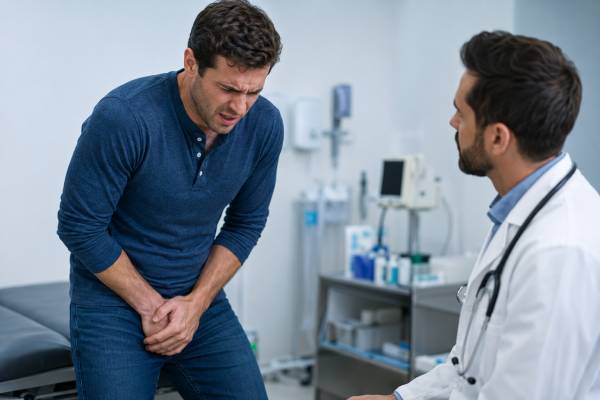
Pain in one testicle is not something to “wait out” when it starts suddenly, feels severe, or comes with nausea, vomiting, swelling, or an abnormal testicle position. Epididymitis and testicular torsion are two common reasons men search this topic, but they need very different care. Epididymitis is usually inflammation or infection around the epididymis, the coiled tube behind the testicle. Testicular torsion happens when the testicle twists and cuts off its blood supply.
The key difference is urgency. Epididymitis usually needs same-day medical care, testing, and antibiotics when infection is likely. Testicular torsion is a surgical emergency, and delays can lead to loss of the testicle. Symptoms overlap enough that self-diagnosis is risky. The safest approach is to treat sudden or severe testicular pain as torsion until an emergency clinician or urologist proves otherwise.
Table of Contents
- The Safest Rule: Sudden Testicle Pain Needs Emergency Care
- What Epididymitis and Testicular Torsion Mean
- Symptom Differences That Matter Most
- Clues That Change the Odds
- How Doctors Tell Them Apart
- Treatment: Antibiotics for Infection, Surgery for Torsion
- What to Do While Getting Care and After Symptoms Improve
The Safest Rule: Sudden Testicle Pain Needs Emergency Care
The most useful rule is simple: sudden, severe, one-sided testicular pain should be treated as testicular torsion until proven otherwise. This is especially true if the pain starts over minutes, wakes you from sleep, follows exercise or sex, or comes with nausea, vomiting, or a testicle sitting higher than usual.
Torsion is dangerous because twisting blocks blood flow. The best chance of saving the testicle is early surgery, often within the first few hours. Waiting to see whether pain settles can waste the window when the testicle is most likely to survive. Even if several hours have already passed, emergency care still matters. Doctors may still be able to untwist and save the testicle, and they also need to protect the other side from future twisting.
Epididymitis can also be painful, but it usually builds more gradually. It often causes tenderness behind the testicle, swelling, warmth, urinary burning, discharge from the penis, or fever. Still, these clues are not perfect. Some infections hurt sharply. Some torsion cases start with discomfort that comes and goes. A normal-looking scrotum early on does not rule out a serious problem.
Go to the ER now if any of these are present:
- Sudden testicular or scrotal pain, especially on one side
- Severe pain that does not clearly improve within a short time
- Nausea, vomiting, dizziness, or feeling faint with scrotal pain
- A testicle that looks higher, sideways, or pulled up compared with usual
- New swelling, redness, or tightness of the scrotal skin
- Pain after groin injury, sports, heavy activity, or sex
- Scrotal pain in a teen or young adult, even without urinary symptoms
Same-day urgent care is appropriate for milder pain that develops slowly, especially with urinary symptoms or STI risk, but do not choose a walk-in clinic if the pain is sudden or severe. Emergency departments are better set up for urgent ultrasound, pain control, and immediate urology consultation.
If you are unsure, choose the ER. A missed infection is usually still treatable. A missed torsion can become permanent testicular loss.
What Epididymitis and Testicular Torsion Mean
Epididymitis and torsion both cause pain near the testicle, but the problem starts in different places. Understanding that difference helps explain why one is treated with medicine and the other with surgery.
Epididymitis means the epididymis is inflamed. The epididymis is a soft, curved tube along the back of each testicle where sperm mature and pass through. When it becomes infected or irritated, pain often begins at the back or upper part of the testicle and spreads across the scrotum. The testicle itself can also become inflamed; this is often called epididymo-orchitis.
In younger sexually active men, epididymitis is often linked to sexually transmitted infections such as chlamydia or gonorrhea. In older men, or men with urinary tract problems, it is more often linked to bacteria from the urinary tract. Recent catheter use, prostate procedures, bladder problems, or trouble emptying the bladder can raise that risk. A fuller guide to epididymitis symptoms and treatment explains these causes in more detail.
Testicular torsion is different. The testicle twists around the spermatic cord, which carries blood vessels, nerves, and the vas deferens. When the cord twists enough, blood flow drops sharply. This causes sudden pain and swelling. Without fast treatment, the tissue can die.
Torsion is more common in teens and young men, but adults can get it too. It can happen during sleep, after activity, after minor trauma, or without an obvious trigger. Some men are born with a “bell clapper” anatomy, where the testicle is less firmly attached inside the scrotum and can rotate more freely. A focused guide to testicular torsion warning signs is useful if you want a separate emergency-focused overview.
There are also other causes of scrotal pain, including kidney stones, hernias, varicocele, hydrocele, injury, torsion of a small testicular appendage, and testicular cancer. That is why doctors do not rely on a single symptom. They look at the whole pattern, examine the scrotum, and use urine tests, STI tests, ultrasound, and sometimes surgery when torsion is strongly suspected.
Symptom Differences That Matter Most
The comparison below gives practical clues, not a home diagnosis. When signs point in different directions, urgency wins. Sudden pain, vomiting, or an abnormal testicle position should be treated as torsion even if another symptom seems to suggest infection.
| Feature | Epididymitis | Testicular torsion |
|---|---|---|
| Pain onset | Often gradual over hours to days | Often sudden over minutes |
| Pain intensity | Mild to severe, usually worsening steadily | Often severe early, sometimes comes in waves |
| Location | Often starts behind or above the testicle | Often deep testicular pain on one side |
| Nausea or vomiting | Less typical unless pain or infection is severe | Common and concerning |
| Urinary burning or frequency | Common when infection involves the urinary tract | Usually absent, but absence does not prove torsion |
| Penile discharge | Suggests urethritis or STI-related infection | Not typical |
| Fever | Can occur | Usually absent early |
| Testicle position | Usually normal position, though swelling may distort appearance | May sit high or sideways |
| Urgency | Same-day evaluation; emergency care if severe | ER immediately |
Pain that starts suddenly is the biggest warning sign
Torsion often begins with a dramatic change: one testicle suddenly hurts badly. The pain may spread to the lower belly or groin, which can confuse the picture. Some men first think they have stomach cramps, a groin strain, or a kidney stone.
Epididymitis usually has a slower build. You may notice a dull ache, then tenderness, then swelling. It may hurt more when walking, sitting, or touching the back of the testicle. The pain can become intense, but the ramp-up is often less abrupt than torsion.
The tricky part is intermittent torsion. In this pattern, the testicle twists and untwists. Pain may come on suddenly, improve, then return later. Do not ignore repeated attacks of one-sided testicular pain just because one episode went away. That pattern needs urgent medical review.
Nausea and vomiting push concern toward torsion
Severe pain anywhere can cause nausea, but vomiting with sudden scrotal pain is a classic emergency clue. It happens because testicular pain shares nerve pathways with the abdomen and groin. This is why torsion can feel like belly pain before the scrotum looks very swollen.
Epididymitis can make a person feel unwell, especially with fever or a spreading infection, but urinary symptoms and tenderness behind the testicle are more typical than sudden vomiting.
Urinary symptoms point toward infection, but they do not rule out torsion
Burning when peeing, frequent urination, urgency, cloudy urine, or pelvic discomfort make epididymitis more likely, especially in older men or men with known prostate or bladder issues. If urinary symptoms are part of the pattern, your doctor may also consider UTI symptoms in men or prostatitis.
Still, urinary symptoms do not completely rule out torsion. A man can have more than one issue, and early torsion can be mistaken for infection. If pain is sudden or the testicle sits abnormally, the ER is still the right choice.
Clues That Change the Odds
Doctors look at the full story. Age, sexual exposure, urinary history, and timing all matter. These clues help guide testing and treatment, but none is strong enough to safely replace an exam when torsion is possible.
In sexually active men under about 35, epididymitis is often linked to chlamydia or gonorrhea. Clues include urethral discharge, burning urination, new or multiple partners, recent condomless sex, or a partner with an STI. Rectal exposure can change the bacteria doctors need to cover because gut bacteria can be involved along with STI organisms. If discharge or exposure timing is part of your concern, a separate guide to penile discharge and STI testing can help you understand what testing usually includes.
In men over 35 or 40, epididymitis is more often tied to urinary tract bacteria. Risk rises with enlarged prostate symptoms, incomplete bladder emptying, urinary retention, recent catheter use, cystoscopy, prostate biopsy, or other urinary procedures. Pain may come with fever, chills, cloudy urine, or lower urinary tract symptoms.
Torsion is most common in adolescents and young adults, but age should never be used to dismiss it. Adult torsion is less common, which is one reason it can be missed. If a 45-year-old has sudden severe testicular pain and vomiting, he still needs emergency evaluation.
What pain relief does and does not mean
A common myth says epididymitis feels better when the testicle is lifted, while torsion does not. This is called Prehn’s sign. It is not reliable enough for decisions. Some infections do not improve with lifting. Some torsion cases may feel temporarily better with position changes, especially if twisting is incomplete or intermittent.
Another commonly discussed sign is the cremasteric reflex. This is the normal reflex where the testicle pulls upward when the inner thigh is stroked. An absent reflex can support concern for torsion, but a present reflex does not rule it out. Do not let one bedside sign override the bigger picture.
Swelling can appear in both conditions
Scrotal swelling is not specific. Epididymitis can cause swelling from inflammation and fluid around the testicle. Torsion can also cause swelling as blood flow is blocked and tissue becomes congested. Early torsion may have little visible swelling, while later torsion may look red, tight, and very tender.
A lump or swelling that remains after pain improves needs follow-up. Infection, cysts, fluid collections, varicocele, hernia, and tumors can all create changes that a clinician should check. Persistent or painless changes are especially important because testicular cancer symptoms are not always painful.
How Doctors Tell Them Apart
A good evaluation starts with urgency. If torsion is strongly suspected, the priority is not a long office workup. The priority is fast urology involvement. Testing should support the decision, not delay it.
The clinician will ask when pain started, how fast it became severe, whether it has happened before, and whether nausea, vomiting, urinary symptoms, fever, discharge, injury, or recent sex are involved. They will examine both testicles, compare position, check tenderness, look for swelling, and examine the groin and lower abdomen for hernia or referred pain.
Urine testing helps when infection is possible. A urine dip or microscopy can show white blood cells, which suggest inflammation or infection. A urine culture can identify urinary bacteria and guide antibiotics. STI testing usually uses a nucleic acid amplification test, often from urine in men, to look for chlamydia and gonorrhea.
Ultrasound with Doppler blood-flow testing is often used when the diagnosis is uncertain. In epididymitis, ultrasound may show increased blood flow around the epididymis because the area is inflamed. In torsion, ultrasound may show reduced or absent blood flow to the affected testicle, abnormal position, or twisting of the spermatic cord.
The important limitation: ultrasound is helpful but not perfect. A normal or unclear ultrasound does not always end the concern if the story strongly suggests torsion. Blood flow can be partly preserved in early or intermittent torsion. In high-risk cases, urologists may recommend surgical exploration even without a perfectly confirmatory scan.
Why doctors may act before every result is back
Infection testing takes time. If epididymitis is likely, doctors often start treatment before all lab results return because delaying antibiotics can worsen symptoms and increase transmission risk when an STI is involved.
Torsion is even more time-sensitive. If the story and exam are highly concerning, surgery may happen quickly. This can feel alarming, but it is done because the cost of waiting can be much higher than the cost of exploring.
Other conditions doctors consider
Not every painful scrotum is epididymitis or torsion. Doctors also think about:
- Torsion of a testicular appendage: painful but usually less dangerous than true testicular torsion, more common in boys.
- Inguinal hernia: groin or scrotal bulge, worse with lifting or straining, urgent if trapped and painful.
- Kidney stone: flank pain that moves toward the groin, often with blood in urine.
- Trauma: pain after a direct hit, with concern for rupture if swelling is severe.
- Varicocele or hydrocele: heaviness, swelling, or dragging discomfort, usually less sudden.
- Tumor: a firm lump, heaviness, or swelling that persists, sometimes without pain.
This wider list is another reason to get checked instead of guessing. A guide to common causes of testicular pain can help after urgent causes have been ruled out.
Treatment: Antibiotics for Infection, Surgery for Torsion
Treatment depends on the cause. The wrong treatment wastes time. Antibiotics do not fix torsion. Surgery is not the usual treatment for straightforward epididymitis, but it may be needed for abscess, severe complications, or when torsion cannot be ruled out.
For suspected epididymitis, doctors choose antibiotics based on the likely source. If an STI is likely, treatment usually covers chlamydia and gonorrhea. If urinary tract bacteria are more likely, the antibiotic choice is different. If both STI and gut bacteria are possible, such as after insertive anal sex, treatment may need broader coverage. The exact regimen should come from a clinician because local resistance patterns, allergies, weight, kidney function, and other medications matter.
Supportive care also helps. Scrotal support, rest, anti-inflammatory medicine when safe, and cold packs wrapped in cloth can reduce discomfort. Symptoms often start improving within a few days, but swelling and tenderness can take longer to fully settle. If symptoms do not improve within about 72 hours after treatment starts, the diagnosis and antibiotic choice need reassessment.
If STI-related epididymitis is suspected or confirmed, partners need testing and treatment. Sex should wait until treatment is completed, symptoms have resolved, and partners have been treated as directed. Otherwise, reinfection is common.
For torsion, the treatment is urgent detorsion and fixation. The surgeon untwists the affected testicle and checks whether it is still viable. If it can be saved, it is fixed in place with stitches, a procedure called orchiopexy. The other testicle is usually fixed as well because the same anatomy often exists on both sides. If the affected testicle is no longer viable, removal may be necessary, but surgeons still fix the other side to prevent future torsion.
Manual detorsion may be attempted by trained clinicians while waiting for surgery or transfer. This is not a home maneuver. Doing it incorrectly can worsen twisting or delay definitive care. Even if manual untwisting relieves pain, surgery is still needed because the testicle can twist again.
What recovery usually feels like
After epididymitis, pain should gradually ease with the right treatment, but mild soreness can linger. Finish the full antibiotic course unless a clinician changes it. Return promptly for worsening pain, fever, vomiting, spreading redness, inability to pee, or no improvement after a few days.
After torsion surgery, recovery depends on how quickly treatment happened and whether the testicle was saved. Expect soreness, swelling, activity restrictions, and follow-up with urology. Avoid sports, heavy lifting, and sex until cleared. Ask when to return if swelling worsens, the incision drains, fever develops, or pain suddenly increases.
What to Do While Getting Care and After Symptoms Improve
If you are heading to the ER for sudden testicular pain, do not spend time trying to diagnose yourself at home. Do not wait for an appointment later in the week. Do not take leftover antibiotics. Do not assume pain is from exercise, sex, “blue balls,” or a minor strain when the testicle itself hurts.
Practical steps:
- Go now if torsion is possible. Severe sudden pain, vomiting, or a high-riding testicle should go to the ER.
- Avoid food and drink on the way if surgery seems possible. Anesthesia is safer when the stomach is empty, but follow medical instructions if you are told otherwise.
- Use support, not pressure. Supportive underwear or a folded towel under the scrotum may reduce movement during transport.
- Bring key information. Note the exact time pain began, medications, allergies, recent sexual exposures, urinary symptoms, injuries, and prior episodes.
- Do not let embarrassment delay care. ER teams evaluate scrotal pain often. Speed matters more than comfort with the conversation.
After the urgent issue is handled, follow-up matters. If you were treated for epididymitis, make sure STI results, urine culture results, and partner treatment instructions are clear. If urinary symptoms were part of the problem, ask whether prostate enlargement, urinary retention, stones, or another urinary issue needs evaluation. Recurrent infections in men deserve a closer look.
If you had torsion, ask the urologist what was found, whether both sides were fixed, what activity restrictions apply, and whether fertility or hormone follow-up is needed. Many men recover well with one healthy testicle, but follow-up is still important.
Once pain has settled, get familiar with your normal anatomy. A monthly self-check helps you notice persistent lumps, size changes, heaviness, or swelling. It is not a tool for diagnosing emergencies during severe pain, but it is useful for spotting non-urgent changes early. A step-by-step guide to testicular self-exams can help you learn what is normal for you.
The main takeaway is not to perfectly memorize every symptom. It is to act on the right threshold. Gradual pain with urinary or STI symptoms needs prompt medical care. Sudden testicular pain needs emergency care. When the pattern is mixed, treat it as urgent until a clinician confirms it is not torsion.
References
- Epididymitis – STI Treatment Guidelines 2021 (Guideline)
- High risk and low prevalence diseases: Testicular torsion 2023 (Review)
- Diagnostic accuracy of point-of-care ultrasound for paediatric testicular torsion: a systematic review and meta-analysis 2023 (Systematic Review and Meta-analysis)
- Testicular Torsion 2023 (Review)
- EAU Guidelines on Urological Infections 2024 (Guideline)
Disclaimer
This article is for education and cannot diagnose the cause of testicular or scrotal pain. Sudden, severe, or one-sided testicular pain should be treated as an emergency because testicular torsion needs rapid surgical care. For personal diagnosis, testing, antibiotic choice, STI partner management, or surgery decisions, seek care from an emergency clinician, urologist, or qualified healthcare professional.