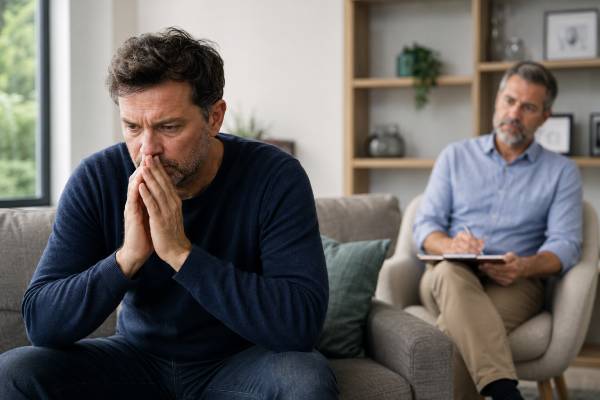
Anxiety in men is often easier to feel in the body than to name in the mind. It might show up as chest tightness, stomach trouble, poor sleep, tension headaches, racing thoughts at night, sudden panic, or a short fuse that seems out of proportion to the situation.
That matters because many men do not first describe anxiety as “worry.” They might say they feel stressed, wired, restless, distracted, burned out, angry, exhausted, or unable to switch off. Some push through it until work, relationships, sex, sleep, or health starts to suffer.
Anxiety is treatable. The first step is recognizing the pattern, ruling out medical problems when symptoms are intense or new, and choosing treatment that fits the type of anxiety, the severity, and the man’s daily life.
Table of Contents
- What Anxiety Looks Like in Men
- Physical Symptoms Men Often Notice First
- Panic Attacks vs Heart or Medical Warning Signs
- Irritability, Anger, and Shutdown
- Common Triggers That Keep Anxiety Going
- What to Do When Anxiety Spikes
- Treatment Options That Actually Help
- When to Get Professional Help
What Anxiety Looks Like in Men
Anxiety is not just nervousness. It is a repeated alarm response that becomes too strong, too frequent, or too hard to control. The mind starts scanning for danger, the body prepares for action, and everyday problems begin to feel urgent even when there is no immediate threat.
In men, this pattern often hides behind practical complaints. A man might not say, “I feel anxious.” He might say, “I can’t relax,” “I’m always on edge,” “I snap over small things,” “My chest feels tight,” or “I keep thinking something bad is going to happen.”
Common signs include:
- Constant overthinking or worst-case planning
- Trouble falling asleep because the mind keeps running
- Muscle tension in the jaw, neck, shoulders, chest, or back
- Irritability, impatience, or sudden anger
- Avoiding calls, bills, social plans, driving, travel, sex, or work tasks
- Needing reassurance but not feeling reassured for long
- Difficulty concentrating
- Feeling restless, keyed up, or unable to sit still
- Using alcohol, cannabis, gambling, porn, gaming, food, or overwork to numb stress
The pattern matters more than one symptom. Everyone feels tense before a difficult conversation or a medical test. Anxiety becomes a problem when the alarm stays on, returns quickly, changes behavior, or starts shrinking life.
There are different forms. Generalized anxiety is ongoing worry about work, money, health, family, safety, or performance. Panic attacks are sudden waves of intense fear with strong body symptoms. Social anxiety centers on being judged or embarrassed. Health anxiety focuses on interpreting normal body sensations as signs of serious disease. Trauma-related anxiety often involves hypervigilance, nightmares, or feeling unsafe after past events.
Men also commonly experience anxiety alongside other issues. Depression, ADHD, insomnia, sleep apnea, alcohol use, chronic pain, and relationship stress can all overlap. When anxiety comes with low mood, loss of interest, guilt, hopelessness, or emotional numbness, it is worth reading more about depression in men, because the two often feed each other.
Physical Symptoms Men Often Notice First
Anxiety activates the body’s threat system. Adrenaline rises, breathing changes, muscles tighten, digestion slows or speeds up, and the heart works harder. That is why anxiety can feel like a medical problem before it feels emotional.
Physical symptoms may include:
| Symptom | How anxiety can feel in real life | What else may need checking |
|---|---|---|
| Chest tightness | Pressure, squeezing, burning, or a band-like feeling during stress | Heart disease, reflux, asthma, muscle strain |
| Fast heartbeat | Pounding, skipped beats, racing pulse, awareness of every beat | Arrhythmia, thyroid problems, stimulant use, dehydration |
| Shortness of breath | Feeling unable to get a full breath or needing to sigh often | Asthma, lung disease, heart problems, anemia |
| Stomach symptoms | Nausea, cramps, diarrhea, appetite changes, “pit in the stomach” | Reflux, IBS, infection, medication side effects |
| Dizziness or tingling | Lightheadedness, numb fingers, tingling around the mouth | Low blood sugar, blood pressure changes, neurological symptoms |
| Muscle tension | Tight jaw, clenched fists, neck pain, headaches, back tightness | Injury, posture strain, dental grinding, inflammatory conditions |
A key clue is timing. Anxiety symptoms often rise during conflict, deadlines, health worries, public speaking, driving, crowded places, financial stress, or after too much caffeine. They may improve when the situation passes, after exercise, after a calm conversation, or when attention shifts.
Still, do not assume every intense body symptom is anxiety. New chest pain, fainting, one-sided weakness, coughing blood, severe shortness of breath, sudden confusion, or symptoms during physical exertion need urgent medical evaluation. Anxiety is common, but it should not be used as a shortcut explanation before dangerous causes are ruled out.
Sleep is another major body clue. Men with anxiety often wake at 3 a.m. with a racing mind, clench their jaw, sweat at night, or feel tired despite spending enough time in bed. Poor sleep then increases next-day anxiety. If snoring, choking, morning headaches, or daytime sleepiness are part of the picture, sleep apnea symptoms deserve attention because untreated breathing problems during sleep can worsen mood, energy, blood pressure, and concentration.
Panic Attacks vs Heart or Medical Warning Signs
A panic attack is a sudden surge of fear or physical alarm that peaks quickly. It can feel terrifying because the body reacts as if something life-threatening is happening. Many men first seek help for panic in an emergency setting because symptoms can mimic a heart attack.
During a panic attack, a man may feel:
- A racing or pounding heart
- Chest tightness or chest pain
- Sweating, shaking, chills, or hot flashes
- Shortness of breath or a choking feeling
- Nausea or stomach distress
- Dizziness or feeling faint
- Tingling or numbness
- A sense of unreality
- Fear of dying, losing control, or “going crazy”
Panic attacks often peak within minutes, then gradually ease. Afterward, the body can feel drained for hours. A major problem is fear of the next attack. Men may start avoiding workouts, driving, sex, meetings, restaurants, travel, or being alone because those situations feel unsafe.
Panic disorder is different from a single panic attack. It means repeated unexpected attacks plus ongoing worry about having more or behavior changes meant to prevent them. Avoidance keeps panic powerful because the brain never relearns that the sensations are uncomfortable but not dangerous.
When to treat it as urgent
Get emergency care for chest pain or breathing symptoms when they are new, severe, occur with exertion, or come with sweating, nausea, fainting, pain spreading to the arm or jaw, blue lips, confusion, or a strong sense that something is medically wrong. Men with heart disease risk factors should be especially careful: smoking, high blood pressure, diabetes, high cholesterol, obesity, or a family history of early heart disease.
It is also urgent if panic-like symptoms happen after drug use, medication changes, heavy alcohol withdrawal, or stimulant use. Energy drinks, high-dose caffeine, decongestants, some ADHD medications, thyroid medication excess, and recreational stimulants can all intensify palpitations and anxiety-like symptoms. Men who rely on pre-workouts or high-caffeine drinks may benefit from reviewing energy drink effects on anxiety and heart rate.
What makes panic less scary over time
Panic improves when a man learns to stop treating the body sensations as proof of danger. That does not mean pretending symptoms are pleasant. It means learning the pattern: adrenaline rises, symptoms peak, the body clears the surge, and the attack passes.
Avoidance gives short-term relief but long-term control to panic. Recovery usually involves gradually returning to avoided situations, practicing calm breathing without obsessively checking the body, and learning how to tolerate sensations like a fast heartbeat, warmth, or dizziness without escalating into catastrophic thoughts.
Irritability, Anger, and Shutdown
Anxiety in men often comes out sideways. Instead of tears or visible fear, it may look like impatience, sarcasm, criticism, road rage, controlling behavior, withdrawal, or explosive reactions to small problems.
This does not mean anger is “just anxiety” or that hurtful behavior gets excused. It means anxiety can load the nervous system until the next demand feels like a threat. A small interruption then lands on top of hours, days, or months of internal pressure.
A common pattern looks like this:
- Stress builds quietly.
- The man keeps functioning and says he is fine.
- Sleep worsens, caffeine increases, and patience drops.
- A partner, child, coworker, or driver does something minor.
- The reaction is much bigger than the trigger.
- Shame follows, but the cycle repeats because the underlying anxiety was never addressed.
Some men also shut down instead of blowing up. They go silent, avoid texts, stay late at work, disappear into screens, or refuse to talk because they feel overwhelmed. To others, it may look like indifference. Internally, it may feel like overload.
A useful question is: “What was I feeling right before I got angry?” The answer is often fear, pressure, embarrassment, uncertainty, rejection, or feeling trapped. Naming that earlier emotion gives more control than only focusing on the outburst.
Men who notice repeated anger, impatience, and tension may also find it useful to compare anxiety with other causes of irritability, including sleep problems, depression, hormones, and stress. A deeper guide to anger and irritability in men can help separate those patterns.
What helps in the moment
The first goal is to stop escalation. A short timeout works better than continuing a conversation while the body is in fight mode. The timeout should be clear, not punitive: “I’m getting too worked up. I’m taking 20 minutes and I’ll come back.”
During that break, avoid rehearsing the argument. Walk, breathe slowly, stretch, drink water, or write down the fear under the anger. Returning matters. Leaving without coming back teaches the relationship that hard topics are unsafe.
What helps long term
Long-term change requires lowering the baseline level of stress. That usually means better sleep, fewer stimulants, more movement, direct conversations before resentment builds, and treatment for anxiety if self-management is not enough.
It also means replacing “I’m just angry” with more specific language: “I’m overwhelmed,” “I feel cornered,” “I’m worried I’ll fail,” “I’m embarrassed,” or “I need time to think.” Specific words reduce pressure because they point toward a solvable problem.
Common Triggers That Keep Anxiety Going
Anxiety rarely has one cause. It usually comes from a mix of temperament, stress load, habits, health issues, past experiences, and current pressure. In men, the trigger is often not one dramatic event but a long stretch of carrying too much without enough recovery.
Common triggers include work pressure, money problems, relationship conflict, fatherhood stress, caregiving, divorce, grief, health scares, legal problems, loneliness, and feeling stuck in a role where weakness does not feel allowed.
The body can also push anxiety higher. Poor sleep, chronic pain, low fitness, heavy alcohol use, cannabis withdrawal, high caffeine intake, dehydration, and skipped meals can all make the nervous system more reactive.
Alcohol deserves special attention. It may calm anxiety for a few hours, but it often worsens sleep, increases next-day worry, raises irritability, and can create a rebound effect as it leaves the body. Men using alcohol to shut off racing thoughts may find the cycle becomes stronger over time. The broader effects of alcohol on men’s health are worth considering when anxiety, sleep, blood pressure, or mood are already concerns.
Cannabis is similar for some men. It may feel relaxing in the moment, but higher-potency products, frequent use, withdrawal, or using it to avoid problems can worsen anxiety, panic, motivation, and sleep quality. Some men notice panic attacks begin after a stronger edible or concentrate. Others feel anxious when they try to stop. The connection between cannabis and anxiety in men is not the same for everyone, but it should not be ignored.
Hormones are another area where men often wonder what is happening. Low testosterone can overlap with low mood, fatigue, reduced libido, poor sleep, weight gain, and lower confidence. But anxiety alone does not prove a testosterone problem. Testing is most useful when symptoms fit and blood work is done correctly, usually with a morning level and repeat confirmation when needed. When mood, energy, and motivation are the main concerns, it helps to compare low testosterone and depression symptoms before assuming hormones are the root cause.
What to Do When Anxiety Spikes
When anxiety surges, the goal is not to force instant calm. The goal is to stop feeding the alarm. Panic and anxiety grow when the mind adds danger stories to body sensations: “This is a heart attack,” “I’m going to pass out,” “I’ll lose control,” “Everyone can tell,” or “I can’t handle this.”
Use a simple sequence.
1. Label the pattern
Say, silently or out loud: “This is an anxiety spike. My body is in alarm mode.” Labeling does not make the symptoms fake. It gives the brain a more accurate explanation.
2. Slow the breathing without over-controlling it
Try breathing out longer than you breathe in. For example, inhale gently for 3 seconds and exhale for 5 or 6 seconds. Do this for two minutes. Avoid huge breaths, because over-breathing can increase dizziness and tingling.
3. Drop the safety behaviors
Common safety behaviors include repeatedly checking pulse, searching symptoms online, asking for reassurance, sitting near exits, avoiding all exertion, or carrying medication “just in case” without a plan from a clinician. These actions feel helpful, but they teach the brain that the situation was dangerous and escape was necessary.
4. Move the body
A short walk, slow squats, stretching, or shaking out the arms can help use the adrenaline. During panic, some men fear movement because the heart is already racing. If a clinician has ruled out heart problems and the symptoms fit panic, gentle movement can help rebuild trust in the body.
5. Do the next normal action
Return to the meeting, finish the email, stay in the store, continue the drive if safe, or rejoin the conversation after a short pause. The message to the brain is: “This felt bad, but I did not need to escape.”
For daily anxiety, use a different approach: reduce the number of open loops. Write down the top three worries, then separate them into “action today,” “schedule later,” and “not controllable.” Anxiety loves vague threats. It weakens when problems become specific tasks.
Also protect the basics. Eat regularly, hydrate, get morning light, move daily, and keep sleep and wake times consistent. These steps sound simple, but they lower the body’s threat sensitivity. Men dealing with racing thoughts at night may need more focused strategies for insomnia linked to stress and anxiety.
Treatment Options That Actually Help
The best treatment depends on severity, anxiety type, medical history, personal preference, and access to care. Many men do best with a combination of therapy skills, lifestyle changes, and medication when symptoms are moderate to severe.
Cognitive behavioral therapy
Cognitive behavioral therapy, often called CBT, is one of the best-studied treatments for anxiety disorders. It focuses on the loop between thoughts, body sensations, emotions, and behavior.
CBT is practical. A man learns to spot threat-based thinking, reduce avoidance, test feared predictions, and face situations in a planned way instead of waiting until life forces the issue.
For panic, CBT often includes interoceptive exposure. That means safely practicing feared body sensations, such as a faster heartbeat or mild dizziness, so the brain learns they are not dangerous. For generalized worry, CBT may focus on uncertainty tolerance, problem-solving, worry scheduling, and reducing reassurance loops.
Therapy is not just “talking about feelings.” Good anxiety treatment should include skills, practice between sessions, and measurable goals.
Medication
Medication can be helpful when anxiety is persistent, severe, causing panic attacks, disrupting sleep, or making therapy too hard to use. Selective serotonin reuptake inhibitors, known as SSRIs, and serotonin-norepinephrine reuptake inhibitors, known as SNRIs, are common first-line options for several anxiety disorders.
These medicines usually take several weeks to show full benefit. Early side effects can include nausea, headache, sleep changes, sexual side effects, or temporary jitteriness. Starting low and increasing gradually can reduce problems for some men. Do not stop suddenly without medical guidance, because withdrawal symptoms can occur.
Benzodiazepines can reduce anxiety quickly, but they carry risks: sedation, impaired driving, tolerance, dependence, withdrawal, and dangerous interactions with alcohol or opioids. They are usually best reserved for short-term or specific situations under careful supervision, not as the main long-term strategy.
Beta-blockers may help performance-related physical symptoms such as tremor or pounding heartbeat before public speaking, but they do not treat the thinking patterns behind generalized anxiety or panic disorder. They are not appropriate for everyone, especially men with certain asthma, heart rhythm, or blood pressure issues.
Exercise, sleep, and daily structure
Exercise is not a cure-all, but it is one of the most useful supports. Aerobic activity helps burn off stress chemistry, improves sleep pressure, and rebuilds confidence in body sensations. Strength training can also help men feel more grounded, especially when anxiety has made them feel weak or out of control.
The target does not need to be extreme. Start with 20 to 30 minutes of brisk walking most days, then add two or three strength sessions per week if health allows. Consistency matters more than intensity.
Daily structure also helps. Anxiety worsens with too much unplanned time, constant phone checking, late-night work, and avoiding difficult tasks. A simple routine with fixed sleep times, movement, meals, work blocks, and recovery time gives the nervous system fewer surprises.
Reducing avoidance
Avoidance is anxiety’s fuel. Avoiding one meeting, drive, workout, or conversation brings relief, but the brain learns: “I survived because I avoided it.” Next time, the fear is stronger.
A better approach is graded exposure. Choose one avoided situation and break it into smaller steps. For example, a man avoiding driving after a panic attack might start by sitting in the parked car, then driving around the block, then driving with a trusted person, then driving alone on a familiar route.
Each step should be uncomfortable but doable. The goal is not perfect calm. The goal is learning: “I can feel anxious and still act.”
Relationship and sex-related anxiety
Anxiety often affects sex through distraction, performance pressure, low desire, premature ejaculation, or erection problems. One difficult experience can create a cycle of monitoring, pressure, and avoidance. The more a man checks whether he is performing, the harder it becomes to stay present.
When erection problems appear mainly during partnered sex but not during masturbation or morning erections, performance anxiety may be part of the picture. A practical comparison of ED and performance anxiety can help men decide whether the next step is medical testing, anxiety treatment, relationship work, or a combination.
When to Get Professional Help
Get help when anxiety is changing how you live. That includes avoiding normal activities, missing work, losing sleep, snapping at people often, drinking more to cope, having repeated panic attacks, or feeling unable to control worry even when life is objectively stable.
A primary care clinician is a good starting point when physical symptoms are prominent. They may check blood pressure, heart rhythm, thyroid function, anemia, medication effects, sleep, alcohol use, and other health factors. A mental health professional can assess the anxiety pattern and recommend therapy, medication, or both.
Bring specific examples instead of trying to summarize everything. Useful notes include when symptoms started, what triggers them, what you avoid, sleep patterns, caffeine and alcohol intake, panic symptoms, current medications, and any family history of anxiety, depression, bipolar disorder, substance use, or suicide.
Seek urgent mental health support now if anxiety comes with thoughts of suicide, feeling unsafe, violent impulses, hallucinations, severe agitation, or inability to function. Men sometimes minimize crisis signs until the situation becomes dangerous. If thoughts of death, self-harm, or “everyone would be better off without me” appear, treat that as a medical emergency, not a private weakness. Learn the warning signs of suicide risk in men and contact emergency services or a crisis line in your country if there is immediate danger.
Anxiety is not a character flaw, and it is not solved by simply “manning up.” It is a treatable health problem that affects the nervous system, habits, thoughts, relationships, and the body. The sooner the pattern is addressed, the easier it is to stop anxiety from becoming the default setting.
References
- Men’s anxiety: A systematic review 2021 (Systematic Review)
- Anxiety Disorders: A Review 2022 (Review)
- Generalised anxiety disorder and panic disorder in adults: management 2011, last reviewed 2024 (Guideline)
- Cognitive Behavior Therapy for Mental Disorders in Adults: A Unified Series of Meta-Analyses 2025 (Meta-Analysis)
- Screening for Anxiety Disorders in Adults: US Preventive Services Task Force Recommendation Statement 2023 (Recommendation Statement)
- Drug treatment for panic disorder with or without agoraphobia: systematic review and network meta-analysis of randomised controlled trials 2022 (Systematic Review and Network Meta-Analysis)
Disclaimer
This article is for educational purposes and does not diagnose anxiety, panic disorder, heart disease, hormone problems, or any other condition. New, severe, or unusual physical symptoms such as chest pain, fainting, shortness of breath, or neurological changes should be assessed urgently. Treatment decisions, including medication, therapy, supplements, and testing, should be made with a qualified healthcare professional who knows your medical history.