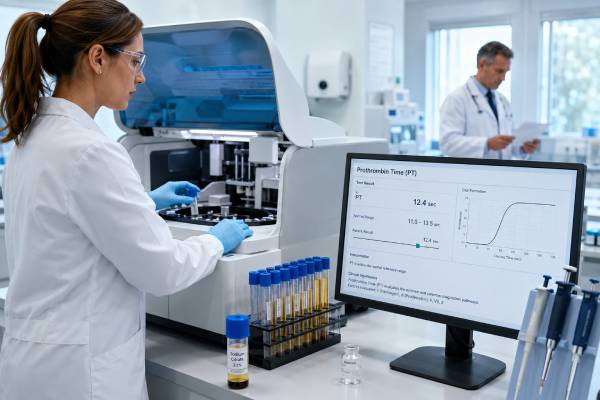
Prothrombin time, or PT, is a blood test that measures how long plasma takes to form a clot after a laboratory reagent starts the clotting process. It mainly checks the extrinsic and common clotting pathways, which depend on clotting factors I, II, V, VII, and X. PT is often reported with INR, a standardized number used especially for people taking warfarin. A normal PT usually means this part of clotting is working as expected, while a prolonged PT means the blood sample clotted more slowly than expected. The result is most useful when it is interpreted with your INR, medications, liver tests, vitamin K status, bleeding symptoms, and other coagulation tests. A mildly abnormal PT does not always mean dangerous bleeding, but a clearly high PT or INR needs prompt medical review when bleeding, liver disease, anticoagulant use, or an upcoming procedure is involved.
- Typical PT normal range: about 11 to 13.5 seconds, although each lab sets its own reference interval.
- Typical INR without warfarin: about 0.8 to 1.1; some labs report “normal” as 1.1 or below.
- High PT or high INR: blood is clotting more slowly than expected, which raises concern for bleeding risk, warfarin effect, liver disease, vitamin K deficiency, or clotting factor problems.
- Low PT or low INR: blood is clotting faster than expected; in people on warfarin, this often means the dose is not providing enough anticoagulation.
- Warfarin target INR: commonly 2.0 to 3.0 for many conditions, with higher targets for some mechanical heart valves.
- No fasting is usually needed: tell your clinician about warfarin, antibiotics, liver disease, supplements, alcohol use, and major diet changes before testing.
Table of Contents
- What Prothrombin Time Measures
- PT Normal Range and INR Reference Values
- How to Read PT Results
- High Prothrombin Time Causes
- Low Prothrombin Time Causes
- PT, INR, and Warfarin Monitoring
- PT Test Preparation and Blood Sample Collection
- What Happens After an Abnormal PT Result
What Prothrombin Time Measures
Prothrombin time measures the speed of clot formation through a specific part of the clotting system. The test starts with plasma, which is the liquid part of blood after blood cells are removed. The lab adds calcium and tissue factor, then measures how many seconds the sample takes to clot.
PT mainly reflects the extrinsic pathway and the common pathway of coagulation. In practical terms, it checks whether several clotting proteins are present and working well enough to create a fibrin clot. These proteins include:
- Factor I, also called fibrinogen
- Factor II, also called prothrombin
- Factor V
- Factor VII
- Factor X
Factor VII has the shortest half-life among the vitamin K–dependent clotting factors, so PT often becomes abnormal early when vitamin K is low or warfarin is too strong. That is one reason PT and INR are central to warfarin monitoring.
PT does not measure every part of clotting. It does not directly measure platelet number, platelet function, von Willebrand factor, or the intrinsic pathway checked by aPTT. Because of this, a normal PT does not rule out every bleeding disorder. A person with easy bruising, heavy menstrual bleeding, frequent nosebleeds, or bleeding after dental work still needs a broader evaluation when symptoms are convincing.
PT is often ordered as part of a broader coagulation panel, especially when clinicians need a wider view of clotting. PT and INR are commonly paired with aPTT, fibrinogen, D-dimer, platelet count, liver tests, and sometimes specific factor assays. PT and aPTT reference values together help narrow which part of the clotting system is affected.
PT has several common uses:
- Checking warfarin effect
- Evaluating unexplained bleeding
- Investigating abnormal bruising
- Assessing clotting before selected procedures
- Helping evaluate liver synthetic function
- Looking for vitamin K deficiency
- Screening for certain clotting factor deficiencies
- Supporting evaluation for disseminated intravascular coagulation, or DIC
The key point: PT is not a general “blood thickness” test. It is a timed clotting test that answers a narrower question: how quickly plasma clots under PT test conditions.
PT Normal Range and INR Reference Values
A normal PT is usually around 11 to 13.5 seconds, but the exact reference range must come from the lab that performed the test. Some laboratories use a range close to 10 to 13 seconds. The difference happens because PT results vary by reagent, instrument, calibration method, and local reference population.
INR helps standardize PT results. INR stands for international normalized ratio. It adjusts the PT result for the sensitivity of the lab reagent so results are easier to compare across laboratories. INR is especially important for people taking warfarin because warfarin dosing decisions require a standardized result.
| Result type | Common reference value | Main meaning |
|---|---|---|
| PT in adults not taking warfarin | About 11–13.5 seconds | Clotting time falls within the expected lab range |
| INR in adults not taking warfarin | About 0.8–1.1 | Standardized clotting result is typical |
| INR on warfarin for many indications | Often 2.0–3.0 | Anticoagulation is usually in the intended treatment range |
| INR for some mechanical heart valves | Often higher than 2.0–3.0 | Target is individualized by valve type and clot risk |
| PT above the lab range | Prolonged | Blood sample clotted more slowly than expected |
| PT below the lab range | Shortened | Blood sample clotted faster than expected |
The PT result in seconds is most useful when compared with the lab’s own reference interval. A PT of 13.2 seconds might be normal in one lab and slightly high in another. INR reduces this problem but does not remove all variation, especially when results come from different point-of-care devices or unusual clinical situations.
For people not taking warfarin, an INR around 1.0 is expected. For people taking warfarin, an INR around 1.0 usually means the medication effect is too low unless the medication was recently stopped or the treatment goal changed. For a deeper explanation of INR itself, see INR normal range and meaning.
PT reference intervals also differ in newborns, infants, and young children. Pediatric clotting systems mature with age, so adult ranges do not always apply. Pregnancy, severe illness, liver disease, anticoagulant use, and major transfusion also change interpretation.
A “normal” result should always answer two questions:
- Is the result normal for this laboratory?
- Is the result appropriate for this person’s clinical situation?
A normal INR is reassuring for someone not taking anticoagulants. The same INR is usually too low for someone who needs warfarin protection after a blood clot, atrial fibrillation, or certain valve replacements.
How to Read PT Results
PT results are best read in patterns, not as isolated numbers. The most useful pattern includes PT, INR, aPTT, platelet count, fibrinogen, liver tests, kidney function, medication list, and symptoms.
A PT report usually includes:
- PT in seconds
- INR, especially when warfarin monitoring is involved
- The lab’s reference range
- Sometimes a flag such as high, low, abnormal, or critical
A normal PT means the tested pathway clotted within the expected time. It suggests that factors I, II, V, VII, and X are adequate under test conditions. It does not prove that clotting is perfect in the body.
A prolonged PT means the sample took longer than expected to clot. In everyday terms, blood is clotting more slowly in the part of the system measured by PT. The most common practical reasons are warfarin effect, vitamin K deficiency, liver disease, clotting factor deficiency, DIC, or interference from certain anticoagulants.
A shortened PT means the sample clotted faster than the reference interval. This result is usually less helpful in diagnosing clotting disorders. In a person taking warfarin, however, a low INR has clear meaning: anticoagulation is below the intended range, which raises concern for clot risk.
The PT and aPTT pattern gives stronger clues:
| PT result | aPTT result | Common interpretation |
|---|---|---|
| High PT, normal aPTT | Often points toward factor VII deficiency, early vitamin K deficiency, early warfarin effect, mild liver-related changes, or test interference | |
| High PT, high aPTT | Suggests broader clotting factor problems, stronger warfarin effect, severe liver disease, DIC, massive transfusion effect, or multiple factor deficiencies | |
| Normal PT, high aPTT | Points away from the PT pathway and toward intrinsic pathway problems, heparin effect, lupus anticoagulant, or factors VIII, IX, XI, or XII | |
| Normal PT, normal aPTT | Does not rule out platelet disorders, mild factor deficiencies, von Willebrand disease, or local causes of bleeding |
Symptoms change the urgency. A mildly prolonged PT in a stable person with no bleeding is not the same as a prolonged PT in someone with black stools, vomiting blood, a severe headache after a fall, heavy uncontrolled bleeding, or liver failure.
A result just outside the range often needs confirmation, especially when the person feels well and has no bleeding history. Small abnormalities come from specimen problems, recent medication changes, alcohol use, antibiotics, poor nutrition, or temporary illness. A clearly abnormal value or a rising trend deserves faster review.
The safest reading rule is simple: the higher the PT or INR, the more important it is to connect the result with bleeding symptoms, anticoagulant use, liver function, and the reason the test was ordered.
High Prothrombin Time Causes
A high PT means clot formation took longer than expected. This is also called a prolonged PT. When INR is reported, the INR is usually high as well. A detailed explanation of this pattern is covered in high prothrombin time causes, but the main causes fall into a few practical groups.
Warfarin or other anticoagulant effect
Warfarin is one of the most common reasons for a high PT and high INR. Warfarin blocks vitamin K recycling, which lowers functional activity of clotting factors II, VII, IX, and X. PT rises because factors II, VII, and X strongly affect the pathway measured by the test.
A high INR in someone taking warfarin means the medication effect is stronger than intended. This raises bleeding risk, especially when the INR is far above target or the person also takes aspirin, clopidogrel, nonsteroidal anti-inflammatory drugs, certain antibiotics, antifungal medicines, amiodarone, or alcohol in excess.
Direct oral anticoagulants, such as apixaban, rivaroxaban, edoxaban, and dabigatran, are not reliably monitored by PT/INR. Some of them prolong PT in certain labs, while others show little effect. A normal PT does not prove that a direct oral anticoagulant is absent.
Vitamin K deficiency
Vitamin K is needed to activate clotting factors II, VII, IX, and X. When vitamin K is low, PT often rises before other clotting tests because factor VII drops quickly.
Common reasons include:
- Poor intake from severe malnutrition or very restricted diets
- Fat malabsorption from bile duct disease, pancreatic disease, celiac disease, inflammatory bowel disease, or bariatric surgery
- Prolonged antibiotic use, especially in people with poor intake
- Cholestatic liver disease, where bile flow problems reduce fat-soluble vitamin absorption
- Long periods without oral nutrition
- Warfarin therapy or accidental exposure to vitamin K antagonists
A separate vitamin K blood test is not always the first step. Clinicians often look at diet, medications, liver tests, PT/INR response to treatment, and the full clinical picture.
Liver disease
The liver makes most clotting factors. When liver synthetic function declines, PT and INR often rise. PT is especially important in liver disease because it reflects the liver’s ability to produce clotting proteins, not just liver cell irritation.
A high PT with abnormal bilirubin, albumin, AST, ALT, alkaline phosphatase, or platelet count raises concern for liver-related clotting changes. PT is also used in some liver severity scores. Still, INR in advanced liver disease does not perfectly predict bleeding risk because both pro-clotting and anti-clotting proteins fall. That means a person with cirrhosis can have an elevated INR and still form clots.
When liver disease is suspected, clinicians often review a broader liver function test panel along with imaging, medical history, alcohol use, viral hepatitis testing, and medication exposure.
Clotting factor deficiency
PT becomes prolonged when one or more clotting factors in the PT pathway are low or not working. These include factors I, II, V, VII, and X.
An isolated prolonged PT with a normal aPTT often points toward factor VII deficiency, early vitamin K deficiency, or early warfarin effect. A specific factor VII activity test helps confirm factor VII deficiency when the pattern fits.
Broader deficiencies affecting factors II, V, X, or fibrinogen tend to prolong both PT and aPTT once severe enough. Inherited deficiencies are uncommon, while acquired deficiencies from liver disease, vitamin K deficiency, DIC, anticoagulants, or severe illness are more common.
DIC, severe illness, and major bleeding
Disseminated intravascular coagulation, or DIC, is a serious condition where clotting becomes activated throughout the body and clotting factors get consumed. PT often rises, aPTT can rise, fibrinogen can fall, platelets often drop, and D-dimer often rises. DIC occurs in settings such as sepsis, major trauma, cancer complications, severe obstetric complications, and shock.
Major bleeding, massive transfusion, or large-volume fluid resuscitation can also dilute clotting factors and prolong PT. In these settings, PT is interpreted with fibrinogen, platelet count, calcium, temperature, acid-base status, and the clinical bleeding picture.
Low Prothrombin Time Causes
A low PT means the sample clotted faster than the lab’s reference range. This is also called a shortened PT. In people not taking warfarin, a slightly low PT is often less clinically important than a high PT. It usually does not diagnose a clotting disorder by itself.
The meaning changes when INR is used for warfarin monitoring. A low INR in someone who needs warfarin often means the blood is not anticoagulated enough. That raises concern for blood clots, especially in people with atrial fibrillation, a previous deep vein thrombosis, pulmonary embolism, or a mechanical heart valve. A detailed discussion is available in low prothrombin time causes.
Possible reasons for a low PT or low INR include:
- Warfarin dose too low
- Missed warfarin doses
- Increased vitamin K intake, especially sudden large changes
- Supplements containing vitamin K
- Estrogen-containing medicines in some people
- Lab variation or specimen handling factors
- High levels of certain clotting factors during inflammation, pregnancy, or estrogen exposure
Diet matters most when the person takes warfarin. Leafy greens and other vitamin K–rich foods are not “bad.” The problem is sudden inconsistency. Eating spinach, kale, broccoli, and similar foods regularly is safer for warfarin control than eating very little one week and a large amount the next.
A low PT in someone not taking anticoagulants does not automatically mean dangerous clotting. Clot risk is judged from the full picture: previous clots, family history, cancer, surgery, immobility, pregnancy, estrogen therapy, smoking, inherited thrombophilia, inflammatory disease, and other test results.
PT is also not the best test for most clot-risk disorders. Protein C, protein S, antithrombin, antiphospholipid antibodies, factor V Leiden screening, and prothrombin gene mutation testing answer different questions. Those tests are ordered selectively because timing, anticoagulants, pregnancy, and acute clots can distort results.
The practical rule: a low INR matters most when a person is supposed to be anticoagulated. Outside that setting, the result usually needs context before it has clear medical meaning.
PT, INR, and Warfarin Monitoring
INR is the main result used to monitor warfarin. PT in seconds still appears on many reports, but warfarin dosing is usually based on INR because INR standardizes PT across different reagents and instruments.
Warfarin lowers the activity of vitamin K–dependent clotting factors. This helps prevent harmful clots but also raises bleeding risk when the effect is too strong. The goal is not to make blood “thin” as much as possible. The goal is to keep INR in a range that lowers clot risk without causing unnecessary bleeding.
Common INR targets include:
| Clinical situation | Common INR target |
|---|---|
| Atrial fibrillation treated with warfarin | 2.0–3.0 |
| Deep vein thrombosis or pulmonary embolism treated with warfarin | 2.0–3.0 |
| Many mechanical aortic valves | Often around 2.0–3.0, based on valve type and risk factors |
| Some mechanical mitral valves or high-risk valve situations | Often higher, such as 2.5–3.5 |
| Not taking warfarin | Usually about 0.8–1.1 |
The target range must come from the prescribing clinician. People with the same INR can need different action depending on why they take warfarin, whether they are bleeding, how fast the INR changed, and whether they recently changed medicines or diet.
Several factors shift INR:
- Missed or extra warfarin doses
- Antibiotics, antifungals, amiodarone, seizure medicines, and many other drugs
- Alcohol intake, especially heavier or inconsistent use
- Sudden changes in vitamin K intake
- Diarrhea, vomiting, or poor appetite
- Liver disease
- Heart failure flare-ups
- Fever or acute illness
- Supplements such as St. John’s wort, ginkgo, garlic, or high-dose vitamin E
- Lab or point-of-care device differences
People on warfarin should not change the dose based on a single result unless their anticoagulation clinic or clinician gives specific instructions. A high INR with bleeding, a fall, head injury, black stools, vomiting blood, severe headache, unusual weakness, or heavy menstrual bleeding needs urgent care. A very high INR without bleeding also needs same-day medical guidance because bleeding risk rises as INR climbs.
Consistency is the strongest daily habit for stable INR control. Take warfarin at the same time, use one medication list, report new prescriptions before starting them when possible, keep vitamin K intake steady, and attend scheduled INR checks.
PT Test Preparation and Blood Sample Collection
PT testing usually needs no fasting. Most people can eat and drink normally unless another test ordered at the same time has fasting instructions.
A PT blood sample is usually drawn from a vein in the arm into a light-blue-top tube containing sodium citrate. Citrate prevents clotting until the lab starts the test under controlled conditions. The tube must be filled correctly because the ratio of blood to citrate affects the result. Underfilled tubes, clotted samples, severe hemolysis, or delays in processing can produce misleading results.
Some people on long-term warfarin use fingerstick INR testing in a clinic or at home. Home INR testing requires training, quality checks, and clinician review. The convenience is useful, but unusual results still need confirmation or follow-up when they do not fit symptoms or recent dosing.
Before the test, tell the clinician or lab staff about:
- Warfarin or recent warfarin dose changes
- Heparin, direct oral anticoagulants, aspirin, or antiplatelet medicines
- Recent antibiotics or antifungal medicines
- Liver disease, bile duct disease, or malabsorption
- Heavy alcohol use or recent binge drinking
- Major diet changes, especially vitamin K intake
- Supplements, herbal products, and over-the-counter medicines
- Recent bleeding, bruising, surgery, trauma, or transfusion
People taking warfarin are sometimes told to delay the daily dose until after the blood draw, especially when testing occurs around the usual dosing time. Follow the local anticoagulation clinic’s instructions because routines differ.
The blood draw itself is low risk. Mild pain, bruising, or tenderness at the needle site is common and usually brief. People with a very high INR or platelet problems can bruise more easily, so applying firm pressure after the draw helps reduce bleeding under the skin.
Timing matters for trend interpretation. A single PT/INR result shows the clotting status at that moment. Trends show whether the situation is stable, improving, or worsening. A rising INR over several checks means something changed, even when the number has not yet reached a critical level.
What Happens After an Abnormal PT Result
The next step after an abnormal PT is to confirm the result, connect it to symptoms, and identify the cause. Clinicians do not treat the number alone unless the value is dangerous or the person is bleeding.
A typical follow-up plan starts with simple questions:
- Was the sample collected and processed correctly?
- Is the person taking warfarin or another anticoagulant?
- Is there active bleeding or a recent fall, injury, surgery, or procedure?
- Are liver tests abnormal?
- Has diet, alcohol intake, appetite, or antibiotic use changed?
- Is aPTT also prolonged?
- Are platelets, fibrinogen, or D-dimer abnormal?
- Is the abnormality new or long-standing?
If the PT is only slightly high and the person is well, the clinician often repeats the test and reviews medications. If the PT is clearly high, rising, or paired with bleeding symptoms, follow-up becomes more urgent.
Common follow-up tests include:
| Follow-up test | Why it helps |
|---|---|
| INR repeat test | Confirms the abnormal result and trend |
| aPTT | Shows whether the intrinsic pathway is also affected |
| Complete blood count | Checks anemia and platelet count |
| Fibrinogen | Helps detect low fibrinogen or DIC patterns |
| D-dimer | Supports evaluation for clot breakdown or DIC in the right setting |
| Liver panel | Looks for liver injury or impaired liver function |
| Albumin and bilirubin | Help assess liver synthetic and bile-processing function |
| Factor assays | Identify specific factor deficiencies |
| Mixing study | Helps separate factor deficiency from inhibitors |
| Vitamin K assessment | Supports evaluation when deficiency is suspected |
A mixing study for prolonged PT or aPTT is useful when the cause is unclear. In this test, the patient’s plasma is mixed with normal plasma. If the clotting time corrects, a factor deficiency is more likely. If it does not correct, an inhibitor or anticoagulant effect becomes more likely.
Urgent care is important when an abnormal PT or INR occurs with warning signs. Seek immediate medical help for heavy bleeding that will not stop, vomiting blood, black or bloody stools, blood in urine, severe headache, confusion, weakness on one side, chest pain, trouble breathing, severe abdominal pain, a major fall, or head injury. People taking warfarin should treat these symptoms as urgent even when the most recent INR was only mildly abnormal.
Before surgery or an invasive procedure, PT is interpreted according to the bleeding risk of the procedure, the person’s history, and medication use. Routine testing before every minor procedure is not always useful. A personal history of abnormal bleeding, liver disease, malnutrition, prolonged antibiotic use, anticoagulant therapy, or a high-risk procedure makes PT/INR more relevant.
The most useful takeaway is this: PT is a starting point, not a final diagnosis. A normal result is reassuring for the pathway it tests. A high result points toward slower clotting and needs context. A low result matters most during warfarin therapy. The right follow-up comes from the result pattern, the reason for testing, and the person’s real-world bleeding or clotting risk.
References
- Prothrombin Time Test and INR (PT/INR): MedlinePlus Medical Test 2024 (Official Patient Education)
- Prothrombin time test 2024 (Official Patient Education)
- Prothrombin Time 2025 (Review)
- International Normalized Ratio: Assessment, Monitoring, and Clinical Implications 2025 (Review)
- The assessment and management of bleeding risk prior to invasive procedures 2024 (Guideline)
- Guidelines on the laboratory aspects of assays used in haemostasis and thrombosis 2021 (Guideline)
Disclaimer
This article is for educational use and does not replace care from a qualified healthcare professional. PT and INR results need interpretation with your medications, symptoms, medical history, and other blood tests. Seek urgent medical care for abnormal bleeding, symptoms of a blood clot, head injury, or a very high INR, especially if you take warfarin.