Protein C, protein S, and antithrombin are natural anticoagulants, meaning they help keep normal clotting from going too far. When one of these proteins is truly deficient, the blood may have a higher tendency to form venous clots such as deep vein thrombosis or pulmonary embolism. These tests can be useful, but they are also easy to misread because levels change during illness, pregnancy, liver disease, acute clotting, and anticoagulant treatment.
A low result does not automatically mean an inherited thrombophilia. Many low results are temporary or medication-related. The result matters most when the test was done at the right time, the correct type of assay was used, and the finding fits the person’s clotting history and family history. Interpreting these tests well means asking not only “Is it low?” but also “Was this a reliable time to test, and would the result change care?”
- Protein C, protein S, and antithrombin are natural clot-control proteins; low activity can increase the risk of venous clots.
- Inherited deficiencies are uncommon; acquired low levels from warfarin, liver disease, pregnancy, inflammation, nephrotic syndrome, heparin, or acute thrombosis are more common.
- Activity tests are often used first, while antigen tests help show whether the protein amount is low or the protein is present but not working well.
- Testing during an acute clot or while taking anticoagulants can be misleading, especially with warfarin, heparin, and some direct oral anticoagulants.
- A true deficiency usually needs repeat confirmation when the person is clinically stable and medication interference has been addressed.
- Urgent care is needed for symptoms of a new clot, such as one-sided leg swelling, chest pain, shortness of breath, coughing blood, or sudden neurologic symptoms.
Table of Contents
- What These Tests Measure
- When Testing Is Useful
- How Results Are Reported
- Common Causes of Low Results
- Timing and Medication Effects
- Interpreting Result Patterns
- What Happens After an Abnormal Result
- Mistakes to Avoid
What These Tests Measure
Protein C, protein S, and antithrombin help prevent excessive clot formation. They do not stop useful clotting after an injury. Instead, they act as brakes in the clotting system, especially after the body has already started forming a clot.
Protein C is a vitamin K-dependent protein made mainly in the liver. Once activated, it helps turn off clotting factors Va and VIIIa. Protein S works as a helper, or cofactor, for activated protein C. Antithrombin blocks several activated clotting enzymes, especially thrombin and factor Xa. Heparin works largely by boosting antithrombin’s effect, which is why antithrombin deficiency can sometimes affect heparin response.
These proteins are part of a larger clotting picture. Basic screening tests such as PT, INR, and aPTT do not reliably detect inherited protein C, protein S, or antithrombin deficiency. A person can have normal results on a coagulation panel and still have one of these deficiencies.
The main clinical concern is venous thromboembolism, often shortened to VTE. VTE includes deep vein thrombosis, usually a clot in a deep leg vein, and pulmonary embolism, a clot that travels to the lungs. These deficiencies are less clearly linked to arterial events such as heart attack or most strokes, although unusual cases need specialist review.
| Protein | Main role | Common first-line test | Why a low result matters |
|---|---|---|---|
| Protein C | Helps inactivate factors Va and VIIIa | Protein C activity | Low function can reduce a major anticoagulant pathway |
| Protein S | Helps activated protein C work | Free protein S antigen and/or activity | Low free protein S can weaken protein C activity |
| Antithrombin | Inhibits thrombin and factor Xa | Antithrombin activity | Low activity can increase clot risk and affect heparin response |
Inherited deficiency usually follows an autosomal dominant pattern, meaning one altered gene copy can be enough to lower levels. Severe deficiency from two affected gene copies is rare and may appear in newborns with serious clotting problems such as purpura fulminans.
Most adults being tested are not in that severe category. They are usually tested after a clot at a young age, recurrent clots, a strong family history, or a clot in an unusual location. Even then, the result needs careful interpretation because many everyday clinical situations can lower these proteins temporarily.
When Testing Is Useful
Thrombophilia testing is most useful when the result could change a decision. Testing everyone after a clot may sound thorough, but it often creates confusing results without improving care. Many people with venous clots already need treatment based on the clot itself, the trigger, bleeding risk, and recurrence risk.
Testing may be considered when a person has:
- A venous clot before about age 50, especially without a clear trigger
- Recurrent deep vein thrombosis or pulmonary embolism
- A strong family history of VTE, especially in first-degree relatives
- VTE in an unusual site, such as cerebral, splanchnic, portal, or mesenteric veins
- A known high-risk thrombophilia in the family
- Pregnancy, estrogen therapy, or surgery decisions where a confirmed result would change prevention planning
Testing is less helpful when a clot had a strong temporary trigger, such as major surgery, trauma, prolonged hospitalization, or a central venous catheter. In those cases, the trigger may explain the event well enough, and the test may not change treatment duration.
A thrombophilia panel may also include factor V Leiden, prothrombin G20210A mutation, and antiphospholipid antibodies. Protein C, protein S, and antithrombin are different from those tests because they measure protein amount or function, not just a stable DNA variant. That makes timing much more important. For example, genetic tests for factor V Leiden are not changed by warfarin, pregnancy, or acute illness, while protein S results often are. A related screening test, activated protein C resistance, is mainly used to evaluate the factor V Leiden pathway rather than protein C deficiency itself.
Testing should also be more cautious in people who are simply curious about inherited risk. A low result can affect anxiety, insurance, family planning, and medical decisions. A normal result can also give false reassurance because many clots happen without one of these deficiencies.
The most productive question before testing is: “What decision will change if this result is abnormal or normal?” If the answer is unclear, waiting and discussing the plan with a clinician experienced in thrombosis often prevents unnecessary repeat testing and mislabeling.
How Results Are Reported
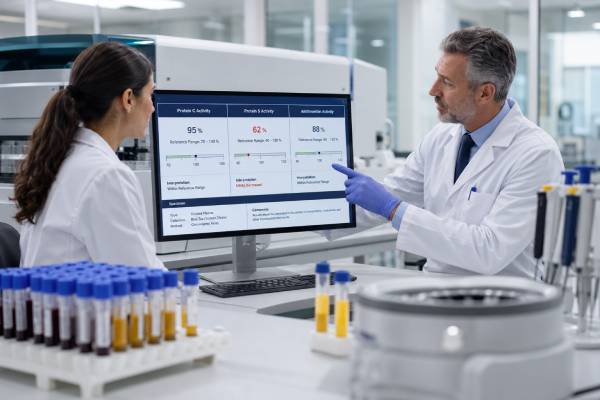
Protein C, protein S, and antithrombin results are commonly reported as activity percentages, antigen percentages, or both. A result may appear as “72%,” “0.72 IU/mL,” or a similar unit depending on the laboratory. Adult reference intervals vary, but many labs use approximate ranges around 65% to 150% or 70% to 130%. The specific reference interval printed on the report should be used.
An activity test asks whether the protein works. An antigen test asks how much protein is present. These are related, but they are not the same.
Activity versus antigen
A low activity result with a low antigen result suggests there may not be enough protein. A low activity result with a normal antigen result suggests the protein may be present but not functioning normally. This distinction can help classify inherited deficiencies, although classification is usually a specialist task.
Protein S is more complicated because it circulates in two main forms: bound and free. Only free protein S is readily available to help activated protein C. For that reason, free protein S antigen is often more useful than total protein S antigen. Total protein S can look acceptable while free protein S is low.
| Result type | What it tells you | Useful limitation |
|---|---|---|
| Activity | Whether the protein performs its clot-control function | Can be affected by anticoagulants and assay interference |
| Antigen | How much protein is present | May be normal when function is abnormal |
| Free protein S antigen | Amount of active, available protein S | Can fall with pregnancy, estrogen use, inflammation, and some illnesses |
| Genetic testing | Whether a known gene variant is present | Not always needed and may not fully predict clot risk |
For antithrombin, activity testing is usually the first step. If antithrombin activity is low, an antigen test may help distinguish a quantitative deficiency from a functional one. Antithrombin testing also depends on the assay type because direct thrombin inhibitors and factor Xa inhibitors can interfere with certain methods.
Borderline results deserve caution. A protein C activity of 62% when the lab’s lower limit is 65% does not carry the same weight as a repeated result of 35% in a stable person off interfering medication. Mildly low values are especially likely to be acquired, temporary, or assay-related.
Children need age-specific interpretation. Newborns and infants naturally have lower levels of several coagulation proteins than adults. Adult reference intervals should not be used for babies.
Common Causes of Low Results
A low protein C, protein S, or antithrombin result can be inherited, but acquired causes are common. The body changes clotting protein levels during acute illness, inflammation, pregnancy, liver disease, kidney protein loss, and anticoagulant treatment.
Protein C and protein S are vitamin K-dependent. Warfarin lowers both because it blocks vitamin K recycling. Vitamin K deficiency, severe malnutrition, cholestatic liver disease, and some antibiotic-related vitamin K problems can also lower them. This is one reason PT and INR results can be helpful context; a high INR from warfarin or vitamin K deficiency makes protein C and protein S results hard to interpret. For a broader explanation of how warfarin changes INR, see INR and warfarin monitoring.
Antithrombin can fall when the body loses protein through the kidneys, as in nephrotic syndrome. It can also fall with severe liver disease, disseminated intravascular coagulation, major thrombosis, surgery, sepsis, and heparin exposure. Because heparin depends on antithrombin, a person with true antithrombin deficiency may have a reduced response to unfractionated heparin or low molecular weight heparin in some settings.
Protein S is especially sensitive to hormones and inflammation. Pregnancy, the postpartum period, estrogen-containing birth control, hormone therapy, and inflammatory states can lower free protein S. This does not always mean the person has inherited protein S deficiency.
| Situation | Protein C | Protein S | Antithrombin |
|---|---|---|---|
| Warfarin therapy | Often low | Often low | Usually not lowered by warfarin |
| Pregnancy/postpartum | Usually less affected | Often low | May be mildly reduced in some settings |
| Estrogen therapy | Usually less affected | May be low | Usually less affected |
| Liver disease | May be low | May be low | May be low |
| Nephrotic syndrome | Variable | Variable | Often low from urinary protein loss |
| Acute thrombosis or severe illness | May be low | May be low | May be low |
| Heparin therapy | Usually less affected | Usually less affected | May be low or harder to interpret |
| DOAC therapy | Assay-dependent interference | Assay-dependent interference | Assay-dependent interference |
Liver disease deserves special attention because the liver makes many clotting and anticoagulant proteins. Low natural anticoagulants in advanced liver disease do not mean the same thing as a clean inherited deficiency. They reflect a broader rebalancing of clotting and bleeding forces. In that setting, albumin, bilirubin, platelet count, PT, and INR may all add context. The relationship between albumin and INR is discussed further in liver synthetic function testing.
Inflammation can also distort interpretation. A high factor VIII or high fibrinogen can point toward an inflammatory or acute-phase state that may coexist with clot risk. These findings do not prove inherited thrombophilia, but they can explain why testing during or soon after illness is difficult.
Timing and Medication Effects
The safest interpretation usually comes from testing when the person is clinically stable and the medication effect is understood. Testing during an acute clot, hospitalization, severe infection, major inflammation, or active liver or kidney deterioration can produce temporary abnormalities.
Many guidelines recommend avoiding natural anticoagulant testing during the acute clotting episode unless there is a specific urgent reason. If testing is needed after VTE, clinicians often wait until the initial treatment phase has passed and anticoagulant interference can be managed. This may mean testing after at least several weeks to months, depending on the clinical situation and the anticoagulant being used.
Warfarin strongly affects protein C and protein S. A low protein C or protein S result while taking warfarin should not be used by itself to diagnose inherited deficiency. Warfarin also creates a special treatment issue in severe protein C deficiency because protein C falls quickly when warfarin is started. Starting warfarin without adequate fast-acting anticoagulant coverage can contribute to warfarin-induced skin necrosis in susceptible patients.
Heparin can affect antithrombin interpretation. Unfractionated heparin, low molecular weight heparin, and fondaparinux work through antithrombin. Antithrombin levels or heparin-monitoring results may be harder to interpret when antithrombin is low. When heparin response is being monitored, anti-Xa testing and aPTT must be interpreted in context; the comparison is covered in anti-Xa and aPTT heparin monitoring.
Direct oral anticoagulants, often called DOACs, can interfere with some clot-based activity assays. Examples include apixaban, rivaroxaban, edoxaban, and dabigatran. The size and direction of interference depend on the drug and the assay. Some laboratories can use DOAC-neutralizing methods or choose assays less affected by these medications, but this should be planned rather than assumed.
Pregnancy is another common timing problem. Free protein S normally falls during pregnancy and may remain low for a period after delivery. Testing for inherited protein S deficiency during pregnancy often creates confusion. If testing affects pregnancy planning, it is usually better done before pregnancy or after the postpartum period, with specialist guidance.
A reliable testing plan often includes:
- Confirm why the test is being ordered.
- Review current and recent anticoagulants, estrogen exposure, pregnancy status, and major illness.
- Check for liver disease, kidney protein loss, DIC, inflammation, or vitamin K deficiency.
- Use the right assay for the clinical question.
- Repeat abnormal results when conditions are stable.
- Interpret the result with the person’s clot history and family history.
Interpreting Result Patterns
A true inherited deficiency is more likely when the result is clearly low, confirmed on repeat testing, found outside acute illness, and not explained by medication or another condition. Family history can strengthen the interpretation, especially if several relatives had VTE at young ages or if the same deficiency is confirmed in relatives.
A single mildly low result is weaker evidence. Mild protein S reductions are common in pregnancy, estrogen use, inflammation, and acute illness. Mild antithrombin reductions may occur with heparin exposure, protein loss, or liver disease. Mild protein C reductions may occur with warfarin, vitamin K deficiency, or liver dysfunction.
Protein C patterns
Low protein C activity can reflect inherited protein C deficiency, warfarin use, vitamin K deficiency, liver disease, DIC, severe infection, or recent thrombosis. If antigen is also low, the body may be producing less protein C. If antigen is normal but activity is low, a functional defect is possible.
Protein C deficiency is mainly associated with venous thrombosis. Severe inherited deficiency in newborns is rare and medically urgent. In adults, confirmed protein C deficiency may influence counseling around estrogen use, pregnancy, surgery, and long-term anticoagulation after VTE.
Protein S patterns
Protein S is the natural anticoagulant most often misread. Free protein S is the most clinically useful form in many cases because bound protein S is less available. Low free protein S with low activity supports deficiency, but acquired causes must be excluded.
Pregnancy, estrogen therapy, oral contraceptives, inflammation, liver disease, vitamin K deficiency, and warfarin can lower protein S. Results may also vary by sex, age, hormonal status, and assay. A diagnosis should not rest on one low protein S value in an unstable setting.
Antithrombin patterns
Low antithrombin activity can reflect inherited antithrombin deficiency, liver disease, nephrotic syndrome, DIC, acute thrombosis, heparin exposure, surgery, sepsis, or L-asparaginase therapy. Antigen testing helps distinguish low quantity from abnormal function.
Antithrombin deficiency is often considered one of the higher-risk inherited thrombophilias. It may matter during pregnancy, surgery, trauma, and acute VTE treatment. In selected cases, antithrombin concentrate may be used under specialist care, especially around high-risk situations.
| Pattern | Possible meaning | Next interpretation step |
|---|---|---|
| Low activity, low antigen | Reduced protein amount | Look for inherited deficiency and acquired loss or reduced production |
| Low activity, normal antigen | Protein present but function reduced | Consider functional variant or assay interference |
| Mild isolated low result | Often temporary or acquired | Repeat under stable conditions |
| Low result during warfarin | Expected for protein C and protein S | Do not diagnose inherited deficiency from this alone |
| Low protein S during pregnancy | Often physiologic | Recheck outside pregnancy/postpartum if needed |
| Low antithrombin with nephrotic syndrome | Possible urinary loss | Interpret with urine protein and kidney status |
Thrombophilia interpretation should also include other clotting tests when appropriate. A high D-dimer, for example, does not diagnose inherited thrombophilia, but it can support clot formation or breakdown in the right clinical context. A separate guide to the D-dimer blood test explains why this marker is sensitive but not specific. Antiphospholipid syndrome is another important acquired clotting disorder and is evaluated with a different set of tests, including lupus anticoagulant and anticardiolipin antibodies. It should not be confused with protein C, protein S, or antithrombin deficiency; see antiphospholipid panel interpretation for that pattern.
What Happens After an Abnormal Result
An abnormal result usually leads to review, not an instant lifelong diagnosis. The clinician first checks whether the result could be explained by timing, medication, pregnancy, liver disease, kidney disease, inflammation, DIC, or recent clotting. If the result remains suspicious, repeat testing is usually needed.
A confirmed deficiency may change counseling more often than it changes the first weeks of clot treatment. Acute DVT or pulmonary embolism still needs anticoagulation unless bleeding risk prevents it. The duration of treatment depends on whether the clot was provoked, whether it recurred, where it occurred, bleeding risk, patient preferences, and other risk factors.
Confirmed antithrombin deficiency may affect heparin-based treatment because heparin needs antithrombin to work. Confirmed protein C or protein S deficiency may affect warfarin initiation because warfarin lowers protein C and protein S early. Clinicians avoid warfarin loading doses and use proper overlap with a fast-acting anticoagulant when warfarin is chosen.
Family testing is selective. Testing relatives can be useful when a high-risk deficiency is clearly confirmed in the family and the result would change decisions about pregnancy, estrogen therapy, surgery, or thrombosis prevention. Broad testing of relatives without a clear plan can create anxiety and may not improve outcomes.
A confirmed result may influence prevention during high-risk periods. Examples include:
- Surgery or hospitalization
- Major trauma or prolonged immobilization
- Pregnancy and postpartum planning
- Estrogen-containing contraception or hormone therapy decisions
- Long-distance travel in someone with multiple risk factors
- Cancer treatment or chemotherapy situations in selected cases
Women with confirmed deficiency need individualized counseling before pregnancy or estrogen use. The absolute risk depends on the specific deficiency, personal clot history, family history, age, body weight, smoking status, other medical problems, and whether the situation includes added triggers.
Results may also be paired with broader clot-risk markers. High factor VIII and von Willebrand factor can rise with inflammation and may be associated with clot risk, although they are not the same as protein C, protein S, or antithrombin deficiency. Their interpretation is discussed in factor VIII and von Willebrand factor testing.
Mistakes to Avoid
The most common mistake is diagnosing inherited thrombophilia from one low result. Protein C, protein S, and antithrombin are dynamic proteins. They respond to illness, treatment, hormones, liver function, kidney protein loss, and clotting activity. A repeat result under better conditions can look very different.
Another mistake is testing when the result will not change care. A person with a clearly provoked clot after major surgery may not benefit from broad thrombophilia testing. A person who already needs long-term anticoagulation for recurrent unprovoked VTE may not need testing unless it would affect family counseling, drug choice, or management in special situations.
Do not use normal protein C, protein S, and antithrombin results to rule out all future clot risk. Many clots happen because of surgery, cancer, pregnancy, estrogen therapy, hospitalization, infection, immobility, age, obesity, smoking, or a combination of risk factors. A normal thrombophilia panel does not make these risks disappear.
Do not compare results across laboratories without checking the method and reference interval. Activity assays, antigen assays, clot-based methods, chromogenic methods, and DOAC interference policies differ. A value that is slightly below range in one lab may not be equivalent to the same number in another.
Do not assume arterial events are explained by these deficiencies. Heart attack, most ischemic strokes, and peripheral artery disease usually need a different evaluation. In young patients with stroke, unusual history, or pregnancy loss, clinicians may consider other causes, including antiphospholipid syndrome, heart rhythm problems, vessel disorders, and inherited or acquired risk factors.
Seek urgent medical care for symptoms that could represent a clot or serious bleeding. Concerning clot symptoms include one-sided leg swelling or pain, sudden shortness of breath, chest pain that worsens with breathing, coughing blood, fainting, or sudden weakness, numbness, speech trouble, or vision loss. Concerning bleeding symptoms include black stools, vomiting blood, severe headache on anticoagulants, heavy uncontrolled bleeding, or a large unexplained bruise with dizziness.
Well-interpreted thrombophilia testing can clarify risk for selected people. Poorly timed testing can create a misleading label. The most reliable interpretation combines the result, the test method, medication timing, personal clot history, family history, and the clinical decision that the result is meant to guide.
References
- American Society of Hematology 2023 guidelines for management of venous thromboembolism: thrombophilia testing 2023 (Guideline)
- Thrombophilia testing: A British Society for Haematology guideline 2022 (Guideline)
- Recommendations for clinical laboratory testing for antithrombin deficiency; Communication from the SSC of the ISTH 2020 (Guideline)
- Recommendations for clinical laboratory testing for protein C deficiency, for the subcommittee on plasma coagulation inhibitors of the ISTH 2020 (Guideline)
- Recommendations for clinical laboratory testing for protein S deficiency: Communication from the SSC committee plasma coagulation inhibitors of the ISTH 2021 (Guideline)
- The dos, don’ts, and nuances of thrombophilia testing 2023 (Review)
Disclaimer
Protein C, protein S, and antithrombin results should be interpreted by a qualified clinician, especially after a clot, during pregnancy, or while taking anticoagulants. Do not stop or change anticoagulant medication to prepare for testing unless your clinician specifically tells you to do so. Seek urgent care for symptoms of deep vein thrombosis, pulmonary embolism, stroke, or serious bleeding.