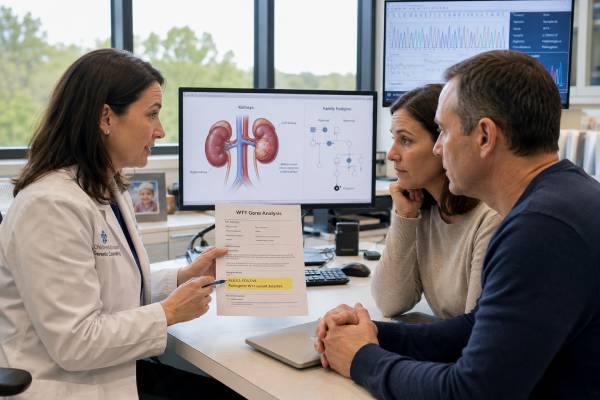
A WT1 genetic test looks for an inherited or de novo pathogenic variant that can cause WT1 disorder, a spectrum involving Wilms tumor, progressive kidney disease, and differences in gonadal or reproductive development. The older labels Denys-Drash syndrome and Frasier syndrome describe recognizable patterns, but modern care increasingly uses the broader diagnosis because features overlap and the exact variant often predicts risk better than a syndrome name.
Testing may be considered for a child with Wilms tumor at a very young age, tumors in both kidneys, steroid-resistant nephrotic syndrome, persistent protein in the urine, kidney failure without a clear cause, or a 46,XY difference of sex development. The result can change tumor surveillance, kidney monitoring, treatment choices, gonadal evaluation, and testing for relatives. Interpretation must also distinguish a sequence variant within WT1 from a larger chromosome 11 deletion such as WAGR syndrome. A negative result does not eliminate every inherited cause of Wilms tumor or kidney disease, and a variant of uncertain significance should not be used alone for major medical decisions.
- WT1 pathogenic variants can increase the risk of Wilms tumor and cause progressive glomerular kidney disease.
- The location and type of variant help estimate whether tumor risk, kidney failure, or gonadoblastoma risk is most prominent.
- Children with an applicable WT1-related Wilms tumor risk commonly receive abdominal ultrasound every three months through age seven.
- A WT1 sequence test may not detect the larger chromosome deletion that causes WAGR syndrome unless deletion analysis is included.
- Most affected people have a new variant, but a constitutional carrier can pass it to each child with a 50% probability.
Table of Contents
- What WT1 Does
- Who May Need WT1 Testing
- Testing Methods and WAGR Syndrome
- Understanding WT1 Results
- Wilms Tumor Risk and Screening
- Kidney Disease and Blood Pressure
- Gonadal Development and Family Testing
- Limitations and Next Steps
What WT1 Does
WT1 is a transcription-factor gene on chromosome 11. During fetal development, it helps coordinate formation of the kidneys, urinary tract, gonads, and related reproductive structures. In mature kidneys, WT1 remains important in podocytes, the specialized cells that help form the filtration barrier in each glomerulus. A damaging constitutional variant can therefore affect both organ development and long-term kidney function.
WT1 also acts as a tumor-suppressor gene. A child born with one altered copy may be predisposed to Wilms tumor, also called nephroblastoma, after additional changes occur in a developing kidney cell. Wilms tumor is primarily a childhood kidney cancer. In WT1 disorder it tends to occur younger than sporadic Wilms tumor, and bilateral or multifocal disease is more common with some variant types.
The clinical spectrum is broad. One person may first present with a renal tumor, another with proteinuria or steroid-resistant nephrotic syndrome, and another with atypical genital development or delayed puberty. Some people develop more than one feature over time. For example, Wilms tumor can precede recognized kidney disease by years, so apparently normal renal function at cancer diagnosis does not end the need for follow-up.
Older terms can still appear in medical records:
- Denys-Drash syndrome traditionally described early, rapidly progressive glomerular disease, Wilms tumor risk, and sometimes a 46,XY difference of sex development, often associated with certain missense variants in the WT1 DNA-binding region.
- Frasier syndrome traditionally described later progressive glomerular disease, 46,XY gonadal dysgenesis, and gonadoblastoma risk, often associated with splice variants affecting the KTS isoform balance in intron 9.
- Isolated WT1-related nephropathy or Wilms tumor predisposition may occur without the full historical triad.
These categories are imperfect. The same variant class can produce different findings, and an individual may not fit a textbook syndrome. Current interpretation emphasizes the exact variant, chromosome complement, anatomy, age, kidney status, and personal tumor history.
A WT1 result found in a tumor is not automatically inherited. Wilms tumors can acquire somatic WT1 alterations that are limited to the cancer. Constitutional testing from blood, saliva, or another non-tumor specimen is needed when hereditary predisposition is suspected. Conversely, some tumor tests do not reliably detect every germline WT1 alteration, so a normal tumor result cannot substitute for a dedicated germline genetic test.
WT1 disorder is usually autosomal dominant when the variant is constitutional. Most diagnosed cases are de novo, meaning the variant arose in the egg, sperm, or early embryo rather than being inherited from an affected parent. Variable expression means a mildly affected parent can occasionally have a child with more severe disease.
Who May Need WT1 Testing
Testing is most useful when the result could explain a tumor or kidney disorder and change surveillance or family care. A pediatric oncologist, nephrologist, urologist, endocrinologist, or clinical geneticist may recommend it.
Clinical situations that can prompt WT1 testing include:
- Wilms tumor diagnosed in infancy or at an unusually young age.
- Bilateral Wilms tumors, multifocal tumors, or nephrogenic rests in both kidneys.
- Wilms tumor plus proteinuria, nephrotic syndrome, kidney dysfunction, hypertension, congenital urinary abnormalities, or genital differences.
- Steroid-resistant nephrotic syndrome, especially with early onset, diffuse mesangial sclerosis, or focal segmental glomerulosclerosis.
- Progressive proteinuria or chronic kidney disease without a satisfactory acquired explanation.
- A 46,XY difference of sex development, complete gonadal dysgenesis, atypical external genital development, or absent/delayed puberty together with kidney findings.
- Gonadoblastoma or another germ-cell tumor arising in dysgenetic gonadal tissue.
- A close relative with a confirmed constitutional WT1 pathogenic variant.
- A chromosome 11p13 deletion involving WT1, particularly when aniridia or developmental features raise concern for WAGR syndrome.
Not every child with unilateral Wilms tumor needs a single-gene WT1 test. The likelihood is higher when diagnosis is early, disease is bilateral, pathology or congenital findings are suggestive, or family history indicates predisposition. Many centers use a multigene Wilms tumor predisposition panel because several genes and imprinting disorders can produce overlapping presentations.
Similarly, nephrotic syndrome has many genetic and acquired causes. WT1 may be included on a kidney-disease panel rather than ordered alone. Genetic testing is particularly important in steroid-resistant disease because a confirmed monogenic podocyte disorder can prevent prolonged exposure to ineffective immunosuppression and can inform transplant planning.
A person assigned female at birth who has unexplained kidney disease and delayed puberty may need chromosome analysis in addition to WT1 testing. A phenotypic female with a 46,XY chromosome complement and dysgenetic gonads can have important gonadoblastoma risk even when external anatomy did not suggest a difference earlier in life.
Before testing, collect pathology reports, operative notes, renal biopsy findings if one was performed, urine protein measurements, kidney-function trends, blood pressure records, imaging, karyotype or microarray results, and cancer histories from both sides of the family. Exact details are more useful than broad labels. For example, “kidney cancer” in an adult relative is usually not Wilms tumor and may point to a different hereditary condition.
Testing an affected child or adult is more informative than beginning with an unaffected relative. Once a familial pathogenic variant is known, relatives can receive targeted testing rather than repeating a broad panel. Predictive testing in children is appropriate because both tumor screening and kidney monitoring can begin during childhood.
Genetic counseling should address possible findings beyond cancer risk. Families may learn about future kidney failure, gonadal development, fertility, and a child’s chromosome complement. These are medically important and emotionally sensitive topics, so age-appropriate, private, multidisciplinary communication is essential.
Testing Methods and WAGR Syndrome
A dedicated WT1 assay usually sequences the coding exons and relevant splice regions, including the intron 9 splice sites associated with altered KTS isoform balance. It should also evaluate exon-level or whole-gene deletions and duplications. Blood is the most common sample. Saliva or buccal material may be accepted, although blood often provides cleaner DNA in young children.
Testing may be performed in several ways:
- Single-gene sequence and deletion/duplication analysis when WT1 disorder is strongly suspected.
- A Wilms tumor predisposition panel when the phenotype overlaps multiple genes or syndromes.
- A nephrotic syndrome or chronic kidney disease panel when glomerular disease is the main presentation.
- Chromosomal microarray when WAGR syndrome or another copy-number disorder is suspected.
- Tumor-normal testing when Wilms tumor tissue is available and the clinical team wants to compare acquired and constitutional findings.
WAGR is an acronym for Wilms tumor predisposition, aniridia, genitourinary anomalies, and a range of developmental or neurologic findings. It usually results from a contiguous deletion at chromosome 11p13 that includes both WT1 and PAX6. A small WT1 sequencing panel can miss a larger deletion if copy-number analysis is not included. Conversely, chromosomal microarray can define the deletion but may not detect a small sequence change within WT1.
For a possible low-level mosaic result, the laboratory may test a second tissue. Mosaicism means the variant arose after conception and is present in only some cell lineages. The clinical risk depends on tissue distribution, which cannot always be measured directly. A negative blood test can occasionally miss mosaicism that is concentrated in kidney or gonadal tissue.
Understanding WT1 Results
The result should be interpreted with the phenotype, variant location, test method, and family data. A laboratory classification is not a complete care plan.
Pathogenic or likely pathogenic variant
A constitutional pathogenic or likely pathogenic WT1 variant establishes WT1 disorder in a person with a compatible presentation. It supports variant-informed Wilms tumor surveillance, lifelong kidney monitoring, evaluation of gonadal development when relevant, and targeted testing for relatives.
The variant type can help estimate the dominant risks:
- Missense variants affecting the zinc-finger DNA-binding region, especially exons 8 and 9, are often associated with early and progressive glomerular disease and substantial Wilms tumor risk.
- Truncating variants can be strongly associated with Wilms tumor, including bilateral disease, while kidney disease may emerge more slowly.
- Intron 9 splice variants affecting the +KTS/−KTS balance are commonly associated with progressive glomerulopathy and 46,XY gonadal dysgenesis. Wilms tumor risk is generally lower than with many exonic variants, while gonadoblastoma risk can be clinically important.
- Whole-gene or contiguous deletions require assessment of neighboring genes and may indicate WAGR syndrome.
These are patterns, not guarantees. A child’s plan should not rely only on a codon or historical syndrome label.
Negative result
A negative targeted test for the exact familial variant usually means the relative did not inherit that WT1-related risk. A negative full test in an affected person is less conclusive. The disease may be caused by another gene, an imprinting abnormality, a copy-number change not covered by the assay, deep intronic or regulatory variation, or mosaicism below the test’s detection threshold.
For Wilms tumor, a negative WT1 result does not rule out all predisposition syndromes. For kidney disease, it does not prove that the condition is immune-mediated or steroid responsive. Further panel testing, chromosome analysis, methylation studies, or research evaluation may be appropriate.
Variant of uncertain significance
A VUS means current evidence cannot determine whether the change causes disease. It should not, by itself, lead to prophylactic nephrectomy, removal of gonadal tissue, predictive testing of healthy children, or a definitive diagnosis. Management should follow the person’s actual tumor, renal, and developmental findings.
Segregation testing in parents, review of population data, RNA studies for splice effects, functional evidence, and periodic laboratory reanalysis may eventually clarify the result. Families should understand the principles of VUS interpretation and avoid treating uncertainty as a positive result.
Benign or likely benign variant
A benign or likely benign finding does not explain WT1 disorder and should not change care. The report may list common polymorphisms, but they are not cancer-risk results.
Mosaic or uncertain constitutional status
A variant detected at a fraction lower than expected for a heterozygous germline result may represent mosaicism, sample artifact, or another biological explanation. Testing another tissue and comparing tumor and normal samples can help. Even when mosaicism is confirmed, risk estimates may be less precise because different organs can carry different proportions of altered cells.
The report should also distinguish a sequence-level WT1 finding from an 11p13 deletion. These diagnoses overlap in Wilms tumor risk but differ in eye, developmental, endocrine, and family implications.
Wilms Tumor Risk and Screening
Wilms tumor risk varies substantially by WT1 variant. Exonic pathogenic variants generally carry enough childhood risk to justify surveillance, whereas the risk associated with classic intron 9 splice variants is much lower. A genetics and oncology team should determine whether screening is indicated for the specific result rather than applying one schedule to every WT1 finding.
For children with a qualifying WT1-related predisposition, a common surveillance approach is renal or complete abdominal ultrasound every three months from diagnosis or birth through the seventh birthday. The short interval reflects the growth rate of Wilms tumor and the concentration of risk in early childhood. Some protocols use renal ultrasound only; others include the full abdomen depending on the syndrome and local guidance.
Ultrasound avoids ionizing radiation and usually does not require sedation. It should be performed by an experienced pediatric imaging service when possible. The order should state the genetic predisposition so both kidneys are evaluated carefully for small masses and nephrogenic rests.
| Clinical situation | Common approach | Important qualification |
|---|---|---|
| Exonic WT1 pathogenic variant with Wilms tumor risk | Renal or abdominal ultrasound about every three months through age seven | Exact start and stop ages follow the specialist protocol |
| Intron 9 splice variant | Individualized discussion because Wilms tumor risk is lower | Kidney-disease and gonadal monitoring remain important |
| Prior unilateral Wilms tumor | Surveillance of the remaining kidney and oncology follow-up | Bilateral or metachronous risk may affect surgical planning |
| WAGR deletion | Syndrome-specific Wilms tumor surveillance | Eye, developmental, genitourinary, and metabolic care may also be needed |
A constitutional WT1 result can influence surgery. Preserving functioning renal tissue is particularly valuable when the person also faces progressive glomerular disease or bilateral tumor risk. Nephron-sparing surgery may be considered in selected patients, but decisions depend on tumor location, stage, protocol, kidney function, and surgical expertise. Genetic status does not make conservative surgery safe in every case.
After age seven, routine predisposition ultrasound usually stops because most WT1-associated Wilms tumors occur earlier. Kidney follow-up continues, and survivors of Wilms tumor need oncology surveillance based on treatment exposures and remaining renal tissue.
Kidney Disease and Blood Pressure
WT1-related glomerulopathy can begin in infancy, childhood, adolescence, or occasionally later. The earliest clue may be persistent protein in the urine. Other signs include edema, low blood albumin, high cholesterol, microscopic blood in the urine, hypertension, declining estimated glomerular filtration rate, or full nephrotic syndrome.
Monitoring commonly includes:
- Urinalysis or a quantitative urine protein-to-creatinine or albumin-to-creatinine ratio.
- Blood pressure measured with an appropriately sized cuff.
- Serum creatinine, cystatin C when useful, electrolytes, and estimated kidney filtration.
- Serum albumin and lipid testing when protein loss is significant.
- Assessment of edema, growth, nutrition, anemia, and bone-mineral health in chronic kidney disease.
- Kidney imaging integrated with tumor surveillance during the at-risk years.
GeneReviews recommends checking for proteinuria every six months through age ten and at least annually thereafter, although people with known kidney disease need more frequent care. Lifelong monitoring is important because normal childhood testing does not guarantee that glomerular disease will never develop.
Renin-angiotensin system blockade with an ACE inhibitor or angiotensin receptor blocker may reduce proteinuria and protect kidney function when clinically appropriate. Blood-pressure control, avoidance of nephrotoxic exposures, vaccination, nutrition, and prompt treatment of dehydration or infection can also matter. Families should tell all clinicians that the person may have reduced renal reserve before receiving contrast agents or medications that affect kidney function.
Progression to kidney failure can be rapid with some missense variants and slower with other variant classes. No genetic result predicts the exact age for an individual. Planning may eventually include dialysis access, transplant evaluation, and discussion of native-kidney management. WT1-related podocyte disease generally does not recur in the transplanted kidney because the donor kidney does not carry the recipient’s pathogenic variant.
Before transplantation, the team assesses residual Wilms tumor risk and whether native nephrectomy is appropriate. Cancer history can affect transplant timing and immunosuppression. Coordination among nephrology, oncology, urology, transplant surgery, and genetics is especially important.
Gonadal Development and Family Testing
WT1 influences testicular and gonadal development. The most clinically significant effects occur in some people with a 46,XY chromosome complement. Findings can range from typical male development to undervirilized external genitalia or complete gonadal dysgenesis with a female phenotype. Internal reproductive anatomy, hormone production, fertility, and tumor risk may all differ.
Dysgenetic gonadal tissue containing Y-chromosome material can develop gonadoblastoma. Risk is particularly important with intron 9 splice variants and complete gonadal dysgenesis. Evaluation may include karyotype or chromosomal testing, pelvic or abdominal imaging, endocrine laboratory studies, and examination by teams experienced in differences of sex development.
Decisions about gonadal surgery are individualized according to tumor risk, anatomy, hormone function, age, and the person’s values. When immediate surgery is not chosen, surveillance limitations should be discussed because small gonadal tumors can be difficult to detect. Puberty induction or sex-hormone replacement may be needed when gonads do not produce adequate hormones.
Most constitutional WT1 pathogenic variants occur de novo. Parental testing is still important. If one parent has the variant, each sibling has a 50% chance of inheriting it. If neither parent tests positive in blood, sibling risk is low but not zero because a parent could have germline mosaicism. Each child of an affected constitutional carrier has a 50% chance of inheriting the variant, although fertility may be reduced in some forms of WT1 disorder.
Relatives should receive targeted familial variant testing for the exact pathogenic change. Testing a healthy child is medically actionable because renal and tumor surveillance may begin immediately. A VUS should generally not be used for predictive testing outside a structured segregation study.
Reproductive options include natural conception, prenatal diagnosis, and in vitro fertilization with preimplantation genetic testing for monogenic disease. Testing can determine whether an embryo or pregnancy carries the familial variant but cannot predict the exact combination or severity of Wilms tumor, kidney disease, or developmental findings.
A family result may also clarify care for adults who were thought to be unaffected. Mild proteinuria, hypertension, fertility concerns, or a remote childhood tumor may become relevant after the variant is identified. Adult carriers need renal evaluation even after the childhood Wilms tumor window has passed.
Limitations and Next Steps
WT1 testing has important limits. Standard sequencing may not identify deep intronic or regulatory variants. Deletion/duplication analysis may miss balanced chromosome rearrangements, low-level mosaicism, or complex structural changes. A panel may not include methylation or imprinting studies needed for other Wilms tumor predisposition conditions. The report should list the regions and variant types assessed.
Risk estimates come from relatively small cohorts and can be affected by referral bias. Historical syndrome labels, prophylactic surgeries, and differences in surveillance make penetrance difficult to measure. The exact variant improves counseling but does not provide certainty about whether or when a tumor or kidney failure will occur.
A negative result should trigger a review of whether the correct test was ordered. Aniridia may call for chromosomal microarray to assess PAX6 and WT1. Bilateral Wilms tumor may justify a broader predisposition evaluation. Steroid-resistant nephrotic syndrome may require a kidney gene panel. Tumor-only testing may need confirmation in normal tissue.
After a positive result, ask the care team:
- Which WT1 variant class was found, and what risks are best supported for that exact result?
- Does the child need renal ultrasound every three months, and until what age?
- How often should urine protein, blood pressure, and kidney function be checked?
- Is chromosome analysis, gonadal imaging, or endocrine evaluation indicated?
- Does the result represent WT1 disorder, WAGR syndrome, mosaicism, or a tumor-only change?
- Which relatives should have targeted testing, and when should testing begin?
- Who will coordinate oncology, nephrology, urology, endocrinology, genetics, and reproductive care?
Keep a copy of the complete laboratory report, not only a portal summary. Variant classification, surveillance guidance, and family circumstances can change. Periodic review with genetics is reasonable, especially after a VUS, a negative result despite strong suspicion, or new features in the family.
Urgent care is appropriate for a newly felt abdominal mass, blood in the urine, severe swelling, breathing difficulty from fluid overload, very high blood pressure, severe headache with hypertension, marked reduction in urine, or signs of acute kidney injury. Routine genetic follow-up should never delay evaluation of acute symptoms.
References
- WT1 Disorder 2025 (Review)
- Wilms Tumor Predisposition 2022 (Review)
- Update on Surveillance Guidelines in Emerging Wilms Tumor Predisposition Syndromes and Other Rare Syndromes 2025 (Guideline)
- Clinical Characterization of a National Cohort of Patients With Germline WT1 Variants Including Late-Onset Phenotypes 2024 (Cohort Study)
- Spectrum of Clinical Manifestations in Children With WT1 Mutation: Case Series and Literature Review 2022 (Review)
- WT1 Gene Pathogenic Variants: Clinical Challenges and Treatment Strategies in Pediatric Nephrology—One Center Practice 2025 (Review)
Disclaimer
This article provides educational information and is not a substitute for medical advice, diagnosis, or treatment. WT1 surveillance and management depend on the exact variant, age, chromosome complement, anatomy, tumor history, kidney function, and local clinical guidelines. A clinical geneticist, pediatric oncologist, nephrologist, and other specialists should interpret results and design the care plan.