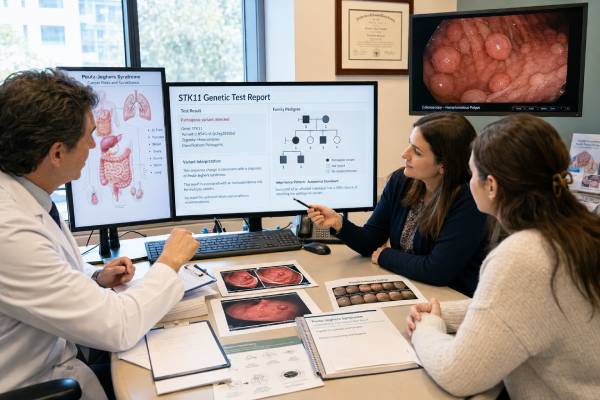
An STK11 genetic test looks for an inherited pathogenic variant that causes Peutz-Jeghers syndrome. This condition is characterized by hamartomatous polyps, dark freckle-like pigmentation around the lips and mouth, and increased risks for several cancers. Polyps most often affect the small intestine and can cause bleeding, anemia, abdominal pain, bowel obstruction, or intussusception, in which one segment of intestine slides into another. Cancer surveillance extends beyond the digestive tract and may include the pancreas, breast, reproductive organs, and lungs.
Testing usually uses blood or saliva and should include sequencing plus deletion-duplication analysis. A positive germline result confirms the syndrome and allows targeted testing for relatives. A negative result does not fully exclude Peutz-Jeghers syndrome when the clinical features are convincing, because mosaicism or an undetected variant may be present. A variant of uncertain significance is not a diagnosis and should not direct preventive surgery. Results are most useful when paired with a coordinated surveillance plan that begins in childhood for polyp complications and expands with age for cancer risk.
- A pathogenic STK11 result confirms Peutz-Jeghers syndrome and supports lifelong gastrointestinal and cancer surveillance.
- Small-bowel polyps can cause intussusception or obstruction even before cancer screening becomes the main concern.
- A negative test does not exclude the syndrome when characteristic polyps and mucocutaneous pigmentation are present.
- A VUS should not be used alone to test healthy relatives or recommend risk-reducing surgery.
- Each child of a person with a germline STK11 pathogenic variant has a 50% chance of inheriting it.
Table of Contents
- What STK11 Does
- Who May Need STK11 Testing
- How the Test Is Performed
- Understanding STK11 Results
- Polyps and Childhood Care
- Cancer Risks and Surveillance
- Family Testing and Reproductive Options
- Limitations and Next Steps
What STK11 Does
STK11, also called LKB1, encodes a serine-threonine kinase that helps cells sense energy conditions, maintain polarity, and restrain growth through pathways that include AMPK and mTOR. It functions as a tumor suppressor. A person with Peutz-Jeghers syndrome is usually born with one nonworking copy. Polyps or tumors can develop after the remaining working copy is lost in a cell.
Peutz-Jeghers polyps are hamartomas, meaning they contain an overgrowth of tissue normally found at that site. Their characteristic branching smooth-muscle core helps a pathologist distinguish them from many other polyp types. They occur most often in the small intestine but can also affect the stomach and colon.
Mucocutaneous pigmentation is another classic feature. Dark blue-brown or black macules may appear on the lips, around the mouth, inside the cheeks, around the nose or eyes, on fingers and toes, and sometimes around the anus. Facial spots often fade after childhood, while spots inside the mouth may persist. Pigmentation alone is not specific, but the pattern can be a strong clue when paired with polyps or family history.
STK11 variants found in a lung or other tumor are not automatically evidence of Peutz-Jeghers syndrome. Somatic STK11 alterations are common in some sporadic cancers, especially lung adenocarcinoma. A tumor-only result must be confirmed in blood or another normal sample before it is considered inherited. This distinction is the same principle used for germline genetic testing versus tumor testing.
Peutz-Jeghers syndrome is variable. One person may have repeated childhood bowel procedures, while a relative with the same variant may have few early symptoms. The exact variant does not reliably predict the number of polyps, the age of intussusception, or which cancer will occur. Management relies on syndrome-level surveillance and the person’s history rather than a rigid genotype forecast.
Who May Need STK11 Testing
STK11 testing is appropriate when a person meets or approaches clinical diagnostic criteria for Peutz-Jeghers syndrome. It may be ordered as a single-gene test when the presentation is classic or as part of a hereditary polyposis or cancer panel when several syndromes are possible.
Features that prompt evaluation include:
- Two or more histologically confirmed Peutz-Jeghers-type polyps.
- Any Peutz-Jeghers polyp plus characteristic mucocutaneous pigmentation.
- Any Peutz-Jeghers polyp plus a family history of the syndrome.
- Characteristic pigmentation plus a close relative with Peutz-Jeghers syndrome.
- Childhood intussusception or small-bowel obstruction caused by hamartomatous polyps.
- Multiple gastrointestinal hamartomatous polyps without another diagnosis.
- A known STK11 pathogenic variant in the family.
- A personal combination of early cancers or sex-cord tumors that raises suspicion for the syndrome.
Clinical diagnosis can sometimes be established without a molecular result. Genetic confirmation is still useful because it clarifies family testing and supports a structured surveillance pathway. Conversely, a pathogenic STK11 result can diagnose the syndrome before classic features are fully developed.
A person with one common gastrointestinal polyp or isolated lip freckles usually does not have enough evidence for STK11-only testing. Dermatologic pigmentation can result from several conditions, medications, ancestry-related variation, or normal freckles. Pathology review of removed polyps is often more informative than relying on a verbal description.
Testing children is appropriate when there is a familial variant or strong clinical suspicion because polyp-related complications can occur before adulthood. The result can change the timing of small-bowel imaging, endoscopy, and symptom education. Pediatric testing should include preparation for how the result will be explained as the child matures.
A multigene hereditary cancer panel may include STK11, APC, MUTYH, SMAD4, BMPR1A, PTEN, and mismatch-repair genes. Panel selection should match the polyp pathology and family pattern. Broad testing without phenotype review can produce uncertain findings that do not explain the disease.
Before testing, gather colonoscopy and endoscopy reports, small-bowel imaging, operative notes, polyp pathology, photographs or dermatology notes, and relatives’ genetic reports. Confirming that a polyp truly has Peutz-Jeghers histology can prevent misclassification.
How the Test Is Performed
Most germline tests use blood or saliva. No fasting is required. The laboratory should evaluate the coding exons and splice boundaries of STK11 and perform deletion-duplication analysis. Disease-causing changes can include single-nucleotide variants, small insertions or deletions, splice variants, or larger missing sections of the gene.
The testing pathway may include:
- Sequence analysis for small variants.
- Copy-number analysis for exon-level or whole-gene deletions and duplications.
- Targeted familial testing when the exact variant is known.
- A multigene panel when the phenotype overlaps other polyposis or cancer syndromes.
- Mosaicism assessment when clinical criteria are met but standard blood testing is negative.
Results often take two to six weeks. Targeted family testing can be faster. The report should state the transcript, variant notation, classification, and methods used.
Mosaicism means the pathogenic variant arose after fertilization and is present in only some cells. A low-level mosaic variant may be missed in blood or saliva, especially if the affected tissues carry a higher proportion. Testing another tissue, using a higher-depth assay, or analyzing a polyp can be considered with genetics and the laboratory.
Tumor or polyp sequencing can support a difficult case but does not automatically establish germline status. A variant present in a polyp may be a second somatic change. Confirmation in non-neoplastic tissue is required for family risk assessment.
Pretest counseling should address the possibility of a VUS, unexpected findings on a panel, insurance considerations, and the fact that surveillance can continue based on a clinical diagnosis even when testing is negative. The absence of a molecular explanation should not erase well-documented Peutz-Jeghers pathology.
Testing a relative requires the original report whenever possible. The exact DNA change is needed for a focused familial variant test. A family statement such as “we have the Peutz-Jeghers gene” is not precise enough.
Understanding STK11 Results
Clinical laboratories classify variants as pathogenic, likely pathogenic, uncertain significance, likely benign, or benign. The classification describes whether the DNA change causes disease, not the person’s current polyp burden or cancer status.
Pathogenic or likely pathogenic
A positive germline result confirms Peutz-Jeghers syndrome. Clinical care should include gastrointestinal polyp surveillance, age-appropriate cancer screening, and testing of relatives. Likely pathogenic variants are generally managed the same as pathogenic variants.
The result does not predict certainty of cancer. Published lifetime cancer estimates are high at a syndrome level, but exact numbers vary by study, organ, age, and surveillance. The result also does not show whether a current symptom is caused by a polyp; symptoms still require evaluation.
The report should be stored permanently. It may be needed decades later to justify surveillance, update relatives, or compare a tumor finding with the inherited variant.
Negative
A negative targeted test in a relative means the known familial variant was not inherited. That person generally does not need Peutz-Jeghers-specific surveillance.
A negative full-gene test in someone with classic polyps and pigmentation does not necessarily exclude the syndrome. Possible explanations include mosaicism, a variant outside the assay’s range, technical limitations, or a clinical diagnosis not caused by detectable STK11 changes. Management can remain based on clinical criteria.
A negative result is less informative when no affected family member has been tested. Whenever possible, testing should begin with the person most likely to have the syndrome.
Variant of uncertain significance
A VUS is not a positive result. It should not be used by itself to diagnose Peutz-Jeghers syndrome, test healthy relatives as though they are at risk, or recommend preventive surgery. The person’s polyp pathology and clinical features guide care.
Some uncertain variants are later reclassified. Evidence may come from functional studies, RNA analysis, population data, other affected families, and whether the variant segregates with disease. Patients should keep the report and ask how the laboratory communicates updates. The framework for pathogenic, benign, and VUS results is especially useful when a broad panel reports several findings.
Benign or likely benign
These variants do not explain the syndrome and usually do not change care. They may not appear in the main report.
Polyps and Childhood Care
Childhood management focuses first on preventing bowel obstruction, intussusception, bleeding, and emergency surgery. Small-intestinal polyps can act as a lead point that pulls one bowel segment into another. Repeated intussusception can damage bowel and lead to multiple resections, which in turn can cause short-bowel problems.
Symptoms that need prompt assessment include:
- Severe or recurrent cramping abdominal pain.
- Vomiting, abdominal swelling, or inability to pass stool or gas.
- Red or black stool.
- Unexplained fatigue, pallor, or iron-deficiency anemia.
- A child drawing knees toward the chest or having episodic pain with quiet intervals.
- Unexplained weight loss or poor growth.
Intussusception is an emergency when it causes obstruction or compromised blood flow. A child with sudden severe pain, persistent vomiting, lethargy, or bloody stool should receive urgent care rather than wait for routine endoscopy.
Surveillance protocols commonly include baseline upper endoscopy, colonoscopy, and small-bowel evaluation in childhood, often around age eight, with timing adjusted for symptoms and family history. If significant polyps are found, examinations may repeat every one to three years. If baseline studies are normal, some guidance delays routine repeat evaluation until later adolescence. The treating center should use current pediatric recommendations.
Small-bowel assessment may use video capsule endoscopy or magnetic resonance enterography. Capsule endoscopy gives detailed mucosal views but can become retained if a severe narrowing exists. MR enterography avoids radiation and can show larger polyps and obstruction. The choice depends on age, anatomy, prior surgery, symptoms, and local expertise.
Large or symptomatic small-bowel polyps can be removed with device-assisted enteroscopy or during surgery. Intraoperative enteroscopy may allow multiple polyps to be cleared while limiting repeated bowel resections. Polypectomy thresholds vary by location and guideline, but size, symptoms, growth, and intussusception risk drive decisions.
Iron studies are useful when there is fatigue or suspected bleeding. Pigmentation does not need treatment unless the person wants cosmetic care. It should, however, be documented because facial spots may fade and later clinicians may not recognize the childhood pattern.
Children with PJS can also develop sex-cord tumors. Boys may develop large-cell calcifying Sertoli cell tumors with signs such as breast development or early puberty. Girls can develop ovarian sex-cord tumors with annular tubules. Pubertal changes, testicular masses, pelvic pain, or abnormal bleeding require specialist evaluation.
Cancer Risks and Surveillance
Peutz-Jeghers syndrome increases risk across several organs, including the colon, stomach, small bowel, pancreas, breast, cervix, ovary, testis, and lung. Risk accumulates with age. Surveillance aims to find precancerous lesions or early cancers while avoiding unnecessary procedures.
| Area | Typical approach | Important notes |
|---|---|---|
| Stomach, colon, and small bowel | Periodic upper endoscopy, colonoscopy, and small-bowel imaging or capsule examination | Intervals depend on findings, symptoms, and prior polyp burden |
| Pancreas | MRI/MRCP and/or endoscopic ultrasound in an experienced high-risk program beginning in adulthood | Screening often begins around age 30–35, but protocols vary |
| Breast | Breast awareness, clinical examination, annual MRI from young adulthood, and mammography added with age | Plans should balance sensitivity, radiation, breast density, and individual history |
| Cervix and gynecologic organs | Regular gynecologic assessment with attention to symptoms and specialist-directed screening | Gastric-type endocervical adenocarcinoma is not driven by high-risk HPV and may not be prevented by routine HPV-based screening alone |
| Testes | Clinical examination and ultrasound when findings or hormonal signs are present | Sertoli cell tumors may cause estrogen effects or early puberty |
| Lung and other organs | Risk-factor reduction and symptom-based evaluation; additional screening follows general or individualized guidance | Smoking avoidance is especially important |
Pancreatic surveillance should occur in a center experienced with high-risk patients. MRI/MRCP avoids radiation and evaluates ducts and cysts. Endoscopic ultrasound can detect small solid lesions but is invasive and operator-dependent. Screening can produce incidental cysts, uncertain findings, and procedures; shared decision-making is essential.
Breast surveillance often begins earlier than population screening. A breast specialist can discuss annual MRI, mammography timing, and risk-reducing mastectomy. Preventive surgery is not automatic and should consider age, prior biopsies, family experience, fertility plans, and personal values.
Gynecologic care requires awareness of tumors that differ from common HPV-related cervical cancer. Persistent watery vaginal discharge, abnormal bleeding, pelvic pain, or a cervical abnormality deserves prompt evaluation even after a recent routine screening result. Ovarian symptoms such as persistent bloating, pelvic pain, or a mass also need assessment.
Surveillance does not eliminate cancer risk. New symptoms should be evaluated between scheduled visits. A written calendar that names the responsible gastroenterologist, pancreas program, breast clinic, and gynecologist reduces missed or duplicated care.
Family Testing and Reproductive Options
Peutz-Jeghers syndrome is autosomal dominant. Each child of a carrier has a 50% chance of inheriting the pathogenic STK11 variant. Men and women can transmit it equally. Expression is variable, so a mildly affected parent can have a child with major childhood polyp complications and vice versa.
After a familial variant is identified, first-degree relatives should be offered targeted testing. Children are often prioritized because early surveillance can prevent emergency bowel complications. A child who tests negative for the known family variant can generally avoid PJS-specific endoscopy and imaging.
If both parents of an affected person test negative in blood, the variant may be de novo. Parental gonadal mosaicism means sibling risk is not always zero. The affected person still has a 50% chance of passing the variant to each child.
Reproductive options include natural conception, prenatal diagnosis through chorionic villus sampling or amniocentesis, and in vitro fertilization with preimplantation genetic testing for monogenic disease. Testing can determine whether the familial variant is present but cannot predict the severity of polyposis or cancer history.
Family communication should include the exact laboratory report, not only a diagnosis label. A genetics clinic can prepare a letter describing the inheritance, need for childhood assessment, and how relatives can arrange testing.
Adults who learned their diagnosis in childhood may benefit from renewed counseling before family planning. They may have understood the syndrome mainly as a polyp condition and not realized the implications for cancer surveillance and children.
Limitations and Next Steps
No STK11 test detects every possible disease mechanism. Deep intronic variants, complex rearrangements, regulatory changes, and low-level mosaicism may be missed. A negative result should be compared with the strength of the clinical diagnosis and the laboratory’s methods.
Cancer-risk estimates come from cohorts with different surveillance, referral patterns, and age distributions. They cannot predict an individual’s exact outcome. Surveillance recommendations also evolve as experience grows, particularly for pancreatic and gynecologic screening.
Useful next steps after a positive result are:
- Confirm the exact variant and obtain genetic counseling.
- Review prior polyp pathology and gastrointestinal procedures.
- Arrange age-appropriate upper, lower, and small-bowel surveillance.
- Create a plan for abdominal pain, bleeding, anemia, and obstruction symptoms.
- Add adult pancreatic, breast, gynecologic, and other surveillance at the recommended ages.
- Offer targeted testing to children and other relatives.
- Keep a lifelong procedure and pathology record to avoid unnecessary repeat studies.
- Revisit the plan when symptoms, family history, or guidelines change.
Care often involves gastroenterology, genetics, surgery, radiology, pancreas specialists, breast care, gynecology, pediatrics, and primary care. One clinician or hereditary cancer program should maintain the overall schedule.
The main testing mistakes are dismissing classic PJS after a negative blood result, treating a VUS as diagnostic, delaying childhood surveillance until cancer-screening age, and focusing only on the colon while overlooking the small bowel. A result is most protective when it leads to coordinated polyp prevention and organ-specific surveillance across the lifespan.
A transition plan is useful when pediatric care moves to adult gastroenterology, genetics, breast, pancreatic, and gynecologic services. It should record prior polyp locations and sizes, intussusception or surgeries, the last small-bowel study, and the date each organ-specific screen is due. People with recurrent abdominal symptoms should also have an emergency plan because scar tissue, prior bowel resection, and new polyps can produce similar symptoms that need different treatment.
References
- Peutz-Jeghers Syndrome 2021 (Review)
- The Management of Peutz–Jeghers Syndrome: European Hereditary Tumour Group (EHTG) Guideline 2021 (Guideline)
- Clinical Guidelines for Diagnosis and Management of Peutz-Jeghers Syndrome in Children and Adults 2023 (Guideline)
- Peutz-Jeghers Syndrome: A Comprehensive Review of Genetics, Clinical Features, and Management Approaches 2024 (Review)
- Clinical and Molecular Analysis in Patients with Peutz-Jeghers Syndrome 2024 (Cohort Study)
- Peutz-Jeghers syndrome in gynecological cancers: bibliometric trends, clinical insights, and future directions 2025 (Review)
Disclaimer
STK11 results and Peutz-Jeghers surveillance should be interpreted by genetics and syndrome-experienced specialists using the person’s polyp history and current guidance. Sudden severe abdominal pain, persistent vomiting, bloody stool, fainting, or signs of bowel obstruction require urgent medical evaluation.