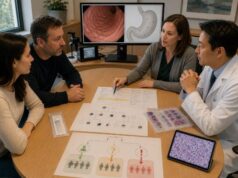
A CHEK2 genetic test looks for inherited changes in a DNA-damage response gene associated most consistently with a moderate increase in female breast cancer risk. Some pathogenic variants may also raise prostate cancer risk, while the relationship with colorectal cancer has become less certain as larger studies and professional guidance have evolved. The result is therefore interpreted by variant type, personal history, family history, sex, age, ancestry, and other risk factors rather than by the gene name alone.
CHEK2 is commonly included on hereditary breast, ovarian, colorectal, prostate, or broad cancer panels. A positive result can support earlier or more intensive breast screening and may prompt testing of adult relatives. It does not mean cancer is inevitable, and it usually does not justify the same management used for high-penetrance genes such as BRCA1, BRCA2, or TP53. Lower-risk missense variants, variants of uncertain significance, and tumor-only findings require especially careful interpretation. Genetic counseling helps translate the laboratory classification into an individualized plan and prevents unnecessary screening or surgery.
- CHEK2 pathogenic variants most clearly increase female breast cancer risk, usually in the moderate-risk range.
- Risk differs by variant: truncating variants generally carry more evidence than low-risk missense variants such as p.Ile157Thr.
- Current guidance does not automatically recommend intensified colon screening solely because of a CHEK2 result.
- A positive result is inherited in an autosomal dominant pattern, so each child has a 50% chance of the familial variant.
- A variant of uncertain significance should not change medical care or be used for predictive family testing.
Table of Contents
- What CHEK2 Does and Why Variants Differ
- Who May Be Offered CHEK2 Testing
- How the Test Is Performed
- How to Read Positive, Negative, and VUS Results
- Breast Cancer Risk and Screening
- Colon, Prostate, and Other Cancer Risks
- Family Testing, Inheritance, and Reproductive Options
- Limitations and Questions for the Care Team
What CHEK2 Does and Why Variants Differ
CHEK2 encodes checkpoint kinase 2, a protein activated when DNA is damaged. It helps coordinate cell-cycle arrest, DNA repair, or programmed cell death so that cells do not continue dividing with serious genomic errors. A loss-of-function variant can weaken this checkpoint and make it easier for additional cancer-promoting changes to accumulate over time.
CHEK2 is considered a moderate-penetrance cancer predisposition gene. Penetrance describes the chance that a person with a pathogenic variant develops a related condition. The average risk is higher than population risk but lower and more variable than the risk associated with many pathogenic variants in BRCA1, BRCA2, TP53, or CDH1. Some carriers never develop cancer.
Not all CHEK2 variants have equal effects. Truncating variants—frameshift, nonsense, canonical splice, and certain large deletion variants—usually disrupt protein production and have the strongest evidence for clinically meaningful breast cancer risk. The European founder variant c.1100delC is the most extensively studied example. Other truncating variants are often managed similarly, although ancestry-specific evidence may be limited.
Several recurrent missense variants have lower or uncertain penetrance. CHEK2 c.470T>C, p.Ile157Thr, often written p.I157T, is associated with a smaller increase in breast cancer risk than truncating variants and may not reach a threshold for enhanced screening by itself. The c.1283C>T, p.Ser428Phe variant, seen more often in people with Ashkenazi Jewish ancestry, also has conflicting or lower-risk evidence. A laboratory may classify such variants as pathogenic or likely pathogenic based on functional impact, yet the clinical actionability can still be lower than for a truncating variant.
Risk is also modified by family history, reproductive and hormonal factors, breast density, age, lifestyle, and many common genetic variants. A person with a truncating CHEK2 variant and several close relatives with early breast cancer may exceed a 30% lifetime risk, while another carrier without affected relatives may have a substantially lower estimate. A validated risk model can combine these factors.
Most clinical testing is germline testing, performed on blood or saliva to identify an inherited variant present in nearly every cell. A CHEK2 change can also appear on a tumor sequencing report. Tumor-only testing cannot determine whether the change is inherited, and some tumor findings may be acquired or arise from clonal blood cells. Confirmation with a dedicated germline genetic test is needed before relatives are counseled.
Who May Be Offered CHEK2 Testing
CHEK2 is usually tested as part of a multigene hereditary cancer panel rather than as a single-gene test. The clinical picture of CHEK2-related risk overlaps with BRCA1, BRCA2, PALB2, ATM, TP53, PTEN, and other genes, so panel testing often gives a more complete answer using the same sample.
Testing may be considered for a person with:
- Breast cancer diagnosed at a young age
- Bilateral breast cancer or more than one primary breast cancer
- Male breast cancer
- Breast cancer plus a close family history of breast, ovarian, pancreatic, or prostate cancer
- Metastatic, high-risk, or early-onset prostate cancer when germline testing criteria are met
- Multiple relatives with breast or prostate cancer across generations
- A known CHEK2 pathogenic variant in a blood relative
- A CHEK2 alteration detected on tumor profiling that may be germline
- A family history suggestive of hereditary cancer when an affected relative is unavailable
The most informative person to test first is usually a relative who has had a relevant cancer. A positive result in that person identifies a specific familial variant and makes testing in unaffected relatives straightforward. Testing an unaffected person first can still be appropriate, but a negative result may be uninformative if no familial variant has been established.
A history of colorectal cancer alone does not specifically point to CHEK2. Lynch syndrome genes, APC, MUTYH, and other colorectal predisposition genes may be more relevant depending on age, tumor mismatch-repair results, and polyp burden. A broad hereditary cancer panel may include CHEK2, but the test should not be framed as a CHEK2-only explanation for colon cancer.
Pretest counseling should address possible outcomes, insurance and privacy considerations, family communication, and the chance of finding a result unrelated to the original cancer. The counselor should document cancers in first-, second-, and third-degree relatives, ages at diagnosis, pathology when available, ancestry on both sides of the family, and prior genetic testing.
Testing children is generally deferred because CHEK2-associated screening begins in adulthood and no established childhood intervention depends on the result. An exception could arise in an unusual family with a different indication or a research protocol, but routine predictive testing of minors is not recommended.
How the Test Is Performed
Germline CHEK2 testing usually uses a blood sample, saliva sample, or buccal swab. No fasting is needed. Blood often provides the most reliable DNA quantity, but saliva is useful when venipuncture is difficult. A standard result may take one to several weeks depending on the laboratory and whether additional analysis is required.
The assay should include sequencing and deletion/duplication analysis. Sequencing detects single-nucleotide changes and small insertions or deletions. Copy-number analysis detects deletion or duplication of one or more exons or the entire gene. Some panels use next-generation sequencing for both; others supplement sequencing with multiplex ligation-dependent probe amplification or a comparable method.
CHEK2 has a nearby pseudogene and repetitive regions that can complicate analysis. Modern validated assays use carefully designed probes and bioinformatics, but certain variants may require Sanger sequencing, long-range PCR, or another orthogonal method. The laboratory report should describe limitations and regions with insufficient coverage.
A targeted familial-variant test is appropriate when a relative’s exact pathogenic variant is known. It is less expensive and easier to interpret than repeating a broad panel, but it only answers whether that one variant is present. A broader panel may be reasonable if the person’s history suggests another syndrome or if the original family testing was limited.
Tumor testing is different. A tumor panel examines DNA from cancer cells and can identify somatic treatment biomarkers as well as possible inherited variants. A CHEK2 variant at an allele fraction near 50% can raise suspicion for germline origin, but purity, copy-number changes, loss of the normal allele, and clonal hematopoiesis can alter the fraction. Blood-based liquid biopsy is particularly vulnerable to detecting variants from age-related blood-cell clones rather than the tumor.
When a tumor or ctDNA report suggests inherited CHEK2, confirmatory testing should use a clinical germline laboratory. Blood or saliva may be acceptable in most solid-tumor patients. In people with hematologic malignancy, recent stem-cell transplantation, or substantial clonal hematopoiesis, cultured skin fibroblasts or another non-hematopoietic source may be needed.
How to Read Positive, Negative, and VUS Results
A pathogenic or likely pathogenic germline CHEK2 variant is considered a positive result. It supports CHEK2-related cancer predisposition, but management depends on the variant’s risk level and the person’s calculated risk. A likely pathogenic result is generally managed like a pathogenic result; “likely” reflects the laboratory’s evidence threshold, not a prediction that the person is likely to develop cancer.
A positive report should be reviewed for variant type. A truncating variant such as c.1100delC usually carries moderate breast cancer risk. A lower-risk missense variant may not, by itself, justify MRI or other enhanced surveillance. The clinical genetics team should not rely only on the laboratory label; it should consult gene-specific evidence and current professional guidance.
A negative result has several possible meanings:
- If the person tests negative for a known familial CHEK2 variant, the result is a true negative for that variant. The person usually returns to screening based on personal and remaining family history rather than the CHEK2-associated risk.
- If no relative has a known variant, a negative panel is often uninformative. The family history may still reflect an undetected variant, a gene not tested, polygenic factors, shared exposures, or chance.
- If the assay did not include deletion/duplication testing or had poor coverage, residual technical risk remains.
- A negative CHEK2 result does not rule out other hereditary cancer syndromes.
A variant of uncertain significance, or VUS, means evidence is insufficient to classify the change as disease-causing or benign. It should not trigger breast MRI, prophylactic mastectomy, early colonoscopy, or family predictive testing. Care should be based on personal and family history while the laboratory gathers more evidence. Most VUS results that are reclassified become benign or likely benign.
A benign or likely benign variant does not explain hereditary cancer risk and is not medically actionable. Reports may omit common benign variants.
Occasionally two CHEK2 pathogenic variants are found. Biallelic carriers may have higher breast cancer risk, earlier onset, or multiple cancers, especially when both variants are truncating, but data remain limited and management should be individualized. The laboratory should determine whether variants are in cis on the same chromosome or in trans on opposite chromosomes, often by testing parents or other relatives.
Variant classification can change. Patients should keep a copy of the report and update contact information with the testing laboratory or genetics clinic. Reinterpretation is especially important for older reports using terms such as “deleterious,” “mutation,” or “suspected pathogenic” without current evidence categories. The concepts behind a VUS result apply across hereditary cancer genes.
Breast Cancer Risk and Screening
Female breast cancer is the best-established CHEK2-associated malignancy. Contemporary estimates place average lifetime risk for many heterozygous pathogenic-variant carriers around 20% to 30%, with a broad approximate range of 15% to 40% after accounting for variant type and modifiers. This range is not a personal forecast. Risk can be higher with a strong family history, dense breasts, or additional genetic factors and lower in other settings.
CHEK2-associated breast cancers are often estrogen receptor positive, although any subtype can occur. Carriers who have had breast cancer also have an increased risk of a new cancer in the opposite breast compared with noncarriers. The absolute contralateral risk depends on age at first diagnosis, menopausal status, treatment, and family history.
For women with a truncating CHEK2 pathogenic variant, many U.S. recommendations support:
- Annual mammography beginning around age 40, or earlier based on family history
- Consideration of annual breast MRI with contrast beginning around age 30 to 35
- Clinical review of breast awareness, symptoms, and individual risk factors
Exact ages vary by country and guideline. MRI eligibility may be determined by a model-estimated lifetime breast cancer risk of at least 20%, not by the gene result alone. MRI is more sensitive than mammography but can lead to additional imaging and benign biopsies. The two tests are often alternated every six months, although evidence for a specific alternating schedule is limited.
Lower-risk variants such as p.I157T or p.S428F may not justify enhanced screening in the absence of other risk factors. A woman whose calculated lifetime risk remains below the MRI threshold may follow population mammography guidance. The genetics note should explicitly state whether the result is a moderate-risk truncating variant or a lower-risk allele to prevent overmanagement.
Risk-reducing bilateral mastectomy is not routinely recommended for all CHEK2 carriers. It can lower breast cancer incidence substantially but has not been shown to improve survival for the average carrier. Discussion may be appropriate when modeled risk is very high, the family history is striking, prior chest radiation or atypical breast lesions add risk, screening is difficult, or the person strongly prefers surgery after counseling.
For a carrier with breast cancer, treatment is generally based on stage, hormone receptor status, HER2 status, tumor genomics, age, and health. A germline CHEK2 variant alone does not establish sensitivity to PARP inhibitors, and it is not currently equivalent to BRCA1 or BRCA2 for drug selection. Standard breast-conserving therapy and radiation are usually options; CHEK2 heterozygosity does not confer the extreme radiation sensitivity seen in biallelic ATM disorders.
Male breast cancer risk may be increased, but the absolute risk remains low and evidence is insufficient for routine mammography in every male carrier. Men should report a breast lump, nipple change, discharge, or skin retraction promptly. Imaging can be individualized for gynecomastia, prior breast disease, or a strong male breast cancer history.
Colon, Prostate, and Other Cancer Risks
The colorectal cancer association has changed as evidence has matured. Earlier studies of selected families suggested increased risk, and older reports often recommended colonoscopy beginning at age 40 every five years. Larger contemporary analyses have not consistently confirmed a clinically meaningful increase independent of family history. Current U.S. guidance generally recommends average-risk colorectal screening for a CHEK2 carrier who has no personal history of colorectal cancer, polyps, or relevant family history.
This does not mean colon screening is unnecessary. It means the interval is determined by standard factors: age, prior polyps, inflammatory bowel disease, symptoms, and family history. A first-degree relative with early colorectal cancer or advanced polyps can justify earlier colonoscopy regardless of CHEK2. Anyone with rectal bleeding, iron-deficiency anemia, persistent change in bowel habits, or unexplained weight loss needs diagnostic evaluation rather than waiting for routine screening.
Prostate cancer risk appears modestly increased for some CHEK2 pathogenic variants, with stronger evidence for truncating variants and for aggressive disease in selected studies. The absolute risk remains uncertain and is modified by ancestry, age, and family history. Male carriers should discuss prostate-specific antigen testing and its potential benefits and harms with a clinician, often beginning around age 40, particularly when a close relative had prostate cancer.
PSA screening can detect clinically important cancer earlier but can also identify indolent disease and lead to biopsy complications or treatment-related urinary and sexual effects. A CHEK2 result supports shared decision-making; it does not mandate biopsy or treatment. Abnormal PSA values are interpreted with trend, prostate size, examination, MRI, biomarkers, and urologic assessment.
Associations with thyroid, kidney, melanoma, gastric, pancreatic, ovarian, and hematologic cancers have been reported, but most remain conflicting or too small to support routine organ-specific surveillance solely because of CHEK2. Standard population screening and symptom-based evaluation are appropriate unless personal or family history creates a separate indication.
A family with ovarian cancer, pancreatic cancer, diffuse gastric cancer, polyposis, or very early sarcoma should not assume CHEK2 explains everything. Another pathogenic variant may be present, and updated panel testing or review of the affected relative’s records may be warranted. Moderate-risk genes can coexist with high-risk syndromes.
Cancer prevention remains valuable: avoid tobacco, maintain a healthy weight, exercise regularly, limit alcohol, protect skin from ultraviolet exposure, and keep routine screenings current. These measures do not eliminate inherited risk, but they improve overall health and reduce several common cancer risks.
Family Testing, Inheritance, and Reproductive Options
CHEK2-related predisposition follows autosomal dominant inheritance. A person with one germline pathogenic variant has a 50% chance of passing it to each child, regardless of sex. Siblings usually have up to a 50% chance if a parent is a carrier. The variant can come from the maternal or paternal side, so cancer history on both sides is relevant.
Adult first-degree relatives are generally offered targeted testing for the known familial variant. Testing can then extend to aunts, uncles, cousins, and other relatives through the branch of the family in which the variant is found. A written family letter from the genetics clinic can explain the result without disclosing unnecessary medical details.
A relative who tests positive does not inherit the proband’s cancer diagnosis or exact risk. Their plan depends on age, sex, variant type, breast density, reproductive history, family history, and prior biopsies. A relative who tests negative for the established familial variant usually does not need CHEK2-specific surveillance, although cancer risk from the other side of the family or non-genetic factors remains.
Testing minors is usually postponed until adulthood because there is no established CHEK2-directed childhood screening. Delaying preserves the child’s future autonomy and avoids anxiety without losing a preventive opportunity. Families can share age-appropriate information and arrange counseling before adult screening would begin.
Reproductive options include natural conception without testing, prenatal diagnosis, preimplantation genetic testing for monogenic disease, donor egg or sperm, adoption, or deciding not to have children. CHEK2 is a moderate-risk adult-onset condition, so values differ about whether embryo or prenatal testing is appropriate. Nondirective counseling should explain variable penetrance, uncertain risk for some variants, and the possibility that recommendations will change.
Rarely, both partners may carry CHEK2 pathogenic variants. Current evidence does not define a severe recessive childhood syndrome analogous to ataxia-telangiectasia, but a child could inherit two variants and potentially have higher cancer risk. A genetics specialist can review the exact variants and limited biallelic data.
Family communication may be emotionally difficult, especially when relatives have different attitudes toward testing. The person who received the result is not responsible for persuading everyone. Providing accurate documentation and access to a counselor is usually more effective than presenting the result as an emergency.
Limitations and Questions for the Care Team
CHEK2 interpretation is unusually dependent on variant-specific evidence. A report that simply says “positive CHEK2” can lead to inappropriate screening if the variant is a low-risk allele. Ask the genetics professional to state the estimated risk category and the evidence supporting each recommendation.
Laboratory methods also matter. Some older tests examined only c.1100delC or a small founder-variant panel. A negative founder test does not exclude other CHEK2 variants or pathogenic variants in other genes. Conversely, broad panels increase the chance of a VUS that should not be treated as a diagnosis.
Risk estimates are derived largely from European-ancestry populations and may be less precise for other ancestries. Family structure can also distort estimates: small families, adoption, early deaths, limited information, and few female relatives can hide hereditary breast cancer.
Useful questions include:
- What exact CHEK2 variant was found, and is it truncating or missense?
- Is this variant considered moderate risk, low penetrance, or uncertain in clinical actionability?
- What is my modeled lifetime breast cancer risk after family history and breast density are included?
- At what age should mammography and breast MRI begin, and should they alternate?
- Would risk-reducing mastectomy offer meaningful benefit in my situation?
- Does my personal or family history justify earlier colonoscopy despite current CHEK2 guidance?
- When should prostate screening be discussed?
- Could the result have come from tumor cells or clonal hematopoiesis rather than the germline?
- Which relatives should be offered targeted testing, and should children wait until adulthood?
- When should the report be re-reviewed for reclassification or guideline changes?
A CHEK2 result is only one part of hereditary cancer assessment. Screening recommendations may change when a relative develops cancer, a pathology report is corrected, a VUS is reclassified, or professional guidance changes. Periodic genetics follow-up—often every few years—keeps the plan current.
New breast or prostate symptoms should be evaluated promptly rather than waiting for the next screening visit. Seek medical assessment for a breast or underarm lump, nipple discharge or retraction, persistent focal breast pain, blood in urine or semen, urinary obstruction, rectal bleeding, or unexplained weight loss. Most such symptoms are not cancer, but inherited risk lowers the threshold for timely evaluation.
References
- CHEK2-Related Cancer Predisposition 2025 (Review)
- ACMG PRACTICE RESOURCE: Management of individuals with germline pathogenic/likely pathogenic variants in CHEK2 2023 (Practice Resource)
- ENIGMA CHEK2gether Project: A Comprehensive Study Identifying Functionally Impaired CHEK2 Germline Missense Variants 2023 (Study)
- CHEK2 variants, breast cancer, and implications for management: a narrative review 2025 (Review)
- Double CHEK2 Pathogenic and Low-Risk Variants and Associated Cancer Phenotypes 2025 (Study)
Disclaimer
This information is educational and does not replace individualized advice from a genetic counselor, oncologist, breast specialist, gastroenterologist, or urologist. Cancer risks and screening recommendations depend on the exact variant, personal and family history, country-specific guidance, and changes in medical evidence. Do not alter screening or pursue preventive surgery solely from a CHEK2 report without professional interpretation.