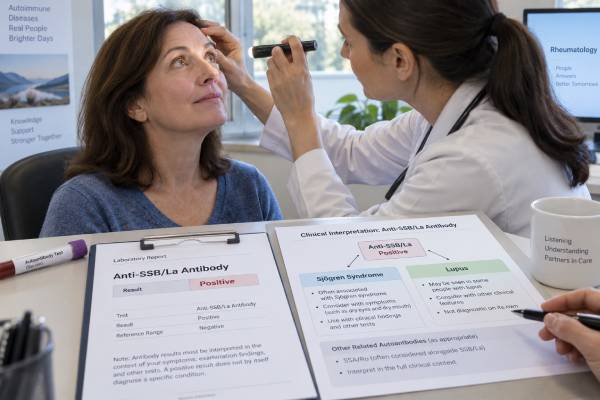
The anti-SSB/La antibody test detects autoantibodies against the La protein, an RNA-binding protein found inside cells. Anti-SSB is most often seen together with anti-SSA/Ro in Sjögren disease and systemic lupus erythematosus. When both antibodies are present and the person has compatible symptoms, the pattern can support an autoimmune connective tissue disease. An isolated anti-SSB result—positive SSB with negative SSA—has much less diagnostic value and may be a false-positive or clinically nonspecific finding, especially when the signal is weak.
This distinction is important because anti-SSB used to receive more weight in older Sjögren classification systems. Current ACR/EULAR criteria give weight to anti-SSA/Ro, not isolated anti-SSB. A positive test therefore needs to be placed beside symptoms, objective tear and saliva testing, the ANA, other autoantibodies, and sometimes a minor salivary gland biopsy. Anti-SSB may also be relevant in pregnancy, usually as part of an SSA-positive profile, because these maternal antibodies can cross the placenta and contribute to neonatal lupus risk.
- Anti-SSB/La is most meaningful when anti-SSA/Ro is also positive and the clinical picture suggests Sjögren disease or lupus.
- Isolated anti-SSB positivity is uncommon and, by itself, does not diagnose Sjögren disease, lupus, or another connective tissue disease.
- There is no universal normal range; laboratories report method-specific units or categories such as negative, equivocal, and positive.
- Anti-SSB levels are not routinely used to monitor flares, organ damage, or treatment response.
- Pregnancy planning should focus on the full anti-SSA/Ro and anti-SSB/La profile, prior pregnancy history, and specialist guidance.
Table of Contents
- What the La Antibody Targets
- When Clinicians Order the Test
- Interpreting Combined and Isolated Results
- Anti-SSB in Sjögren Disease
- Anti-SSB in Lupus and Overlap Disease
- Pregnancy and Neonatal Lupus Considerations
- Confirmation, Follow-Up, and Red Flags
What the La Antibody Targets
Anti-SSB/La antibodies recognize the La protein, also called SSB. La binds newly made RNA molecules and helps protect, process, and fold them. It is normally located inside the cell, but cellular stress and cell death can expose nuclear and cytoplasmic material to the immune system. In susceptible people, that exposure can contribute to a sustained autoantibody response.
The names on laboratory reports may include:
- Anti-SSB antibody
- Anti-La antibody
- SS-B/La IgG
- Sjögren syndrome type B antibody
- La ribonucleoprotein antibody
Anti-SSB belongs to the extractable nuclear antigen group. It is commonly tested in an ENA antibody panel after a positive ANA or when symptoms suggest a systemic autoimmune rheumatic disease.
Anti-SSB and anti-SSA/Ro are closely linked in clinical practice, but they target different proteins. Anti-SSA/Ro may recognize Ro60, Ro52, or both. Anti-SSB recognizes La. The immune response often spreads across this related RNA-protein system, which helps explain why anti-SSB usually appears with anti-SSA rather than alone.
The test is not a measurement of tear production, salivary gland damage, or current inflammation. It shows that a particular autoantibody is detectable above the assay cutoff. A positive result can strengthen an autoimmune pattern, but it cannot identify the affected organs.
When Clinicians Order the Test
Anti-SSB is usually ordered as part of a broader evaluation rather than as a single screening test. The most common reasons include:
- Persistent dry or gritty eyes
- Dry mouth, frequent sipping, or difficulty swallowing dry foods
- Recurrent cavities, oral yeast infections, or salivary gland swelling
- Photosensitive rash or suspected subacute cutaneous lupus
- Inflammatory joint pain or swelling
- Unexplained low blood counts
- Raynaud phenomenon with other connective tissue disease features
- A positive ANA with a speckled pattern
- Known anti-SSA/Ro positivity
- Pregnancy planning in someone with a known or suspected autoimmune disease
Testing may also appear on a broad commercial autoimmune panel ordered for nonspecific fatigue or pain. That setting creates a greater risk of finding weak, isolated results that do not represent a defined disease. Autoantibody panels are most useful when a clinician has already identified a plausible clinical question.
A dedicated Sjögren syndrome antibody panel may include SSA/Ro, SSB/La, ANA, and rheumatoid factor. These markers can support the evaluation, but objective eye and salivary tests remain important. Dryness is common and has many non-autoimmune causes.
Interpreting Combined and Isolated Results
The relationship between anti-SSB and anti-SSA is more informative than the SSB result alone.
| Antibody pattern | Typical meaning | Key caution |
|---|---|---|
| SSA positive, SSB positive | A coherent Ro/La autoimmune profile that can support Sjögren disease, lupus, or related disease | The pattern still does not diagnose a disease without compatible clinical findings |
| SSA positive, SSB negative | A common and clinically meaningful pattern in Sjögren disease, lupus, and subacute cutaneous lupus | SSB negativity does not weaken a strong SSA-associated diagnosis substantially |
| SSA negative, SSB positive | An isolated SSB result with limited diagnostic value | Confirmation is often appropriate, especially for a weak result |
| SSA negative, SSB negative | No detectable Ro/La antibodies on that platform | Seronegative Sjögren disease or another autoimmune condition can still occur |
Why isolated anti-SSB is treated cautiously
Recent studies using confirmation with more than one method show that true isolated anti-SSB is rare. Many initial positives do not reproduce on a second assay. Even when confirmed, isolated anti-SSB has not shown a stable, strong relationship with Sjögren disease or another specific connective tissue disease.
For that reason, isolated anti-SSB was removed from the 2016 ACR/EULAR Sjögren classification criteria. It should not be used alone to label a person with Sjögren disease, lupus, or “early autoimmune disease.”
A clinician may ask:
- Was the signal barely above the cutoff or strongly positive?
- Was it found by a line blot, multiplex assay, ELISA, or another method?
- Is anti-SSA truly negative, including both Ro52 and Ro60 if separately available?
- Is the ANA positive by indirect immunofluorescence?
- Are there objective autoimmune findings?
- Does repeat testing with another technique confirm the result?
What a negative result means
A negative anti-SSB test does not rule out Sjögren disease or lupus. Anti-SSA is the more important Ro/La marker for current Sjögren classification. Some patients are negative for both and require a diagnosis based on objective gland testing, biopsy, and systemic features.
Do higher values mean more severe disease?
No universal severity scale exists. A strong result may be more likely to be analytically real than a borderline result, but the number does not directly measure gland destruction, kidney disease, lymphoma risk, or treatment need. Results from different manufacturers cannot be compared unit for unit.
Anti-SSB in Sjögren Disease
Sjögren disease is an autoimmune illness that can damage tear and salivary glands and affect many other organs. Common symptoms include dry eyes, dry mouth, fatigue, joint pain, and gland swelling. Systemic complications can involve nerves, lungs, kidneys, skin blood vessels, and blood cells.
Anti-SSB often accompanies a more clearly B-cell-active serologic profile that may also include:
- Anti-SSA/Ro
- A positive ANA
- Rheumatoid factor
- Elevated IgG or polyclonal hypergammaglobulinemia
- Low complement in some patients
Studies have associated combined SSA/SSB positivity with younger disease onset, stronger glandular autoimmunity, and some systemic manifestations. These are broad group associations. Anti-SSB does not predict an individual course with enough accuracy to dictate treatment.
Why objective testing still matters
Dry-eye and dry-mouth symptoms do not always match the degree of measured gland dysfunction. A complete evaluation may include:
- Schirmer testing for tear production
- Ocular staining for surface damage
- Unstimulated whole salivary flow
- Dental and oral examination
- Salivary gland ultrasound in experienced centers
- Minor salivary gland biopsy when needed
The 2016 criteria assign major weight to anti-SSA/Ro and to a positive minor salivary gland biopsy. They do not award points for isolated anti-SSB. A patient with confirmed SSB plus SSA can still meet criteria through the SSA component, while someone with SSB alone needs other objective findings.
The current British Society for Rheumatology guideline also emphasizes comprehensive assessment and individualized management rather than diagnosis from one antibody. Treatment targets the actual problem—eye inflammation, oral dryness, arthritis, neuropathy, lung disease, vasculitis, or another manifestation—not the anti-SSB level itself.
Lymphoma concerns
Sjögren disease carries an increased risk of certain B-cell lymphomas, but most patients never develop one. Anti-SSB alone is not a lymphoma test. More concerning features include persistent one-sided or marked salivary gland swelling, enlarged lymph nodes, palpable purpura, low C4, cryoglobulins, monoclonal protein, unexplained weight loss, fevers, or night sweats.
These findings deserve prompt medical review, while a stable positive antibody without red flags does not justify repeated whole-body scans.
Anti-SSB in Lupus and Overlap Disease
Anti-SSB can occur in systemic lupus erythematosus, usually with anti-SSA/Ro. It is particularly associated with an Ro/La immune profile rather than with one specific lupus organ complication.
A person with lupus may have:
- Photosensitive or subacute cutaneous rash
- Mouth or nasal ulcers
- Inflammatory arthritis
- Low white blood cells or platelets
- Pleuritis or pericarditis
- Kidney inflammation
- Neurologic disease
- Other lupus-specific antibodies
Anti-SSB does not establish lupus activity and does not replace anti-dsDNA, complement, urine, blood-count, and organ-specific monitoring. A lupus blood test panel combines markers with different roles rather than treating every autoantibody as interchangeable.
Anti-SSB may also appear in people with an overlap of Sjögren disease and lupus. These patients can have prominent dryness together with lupus manifestations. The diagnostic label should reflect the full clinical picture and may change over time as new objective features emerge.
Subacute cutaneous lupus is strongly associated with anti-SSA/Ro; anti-SSB may accompany it. Some medicines can trigger an Ro/La-positive cutaneous lupus-like eruption. A medication review is important when a new photosensitive rash appears, but prescribed medicines should not be stopped without guidance.
Pregnancy and Neonatal Lupus Considerations
Anti-SSB/La is an IgG antibody that can cross the placenta. Pregnancy risk is usually assessed together with anti-SSA/Ro because SSA is the central marker linked to autoimmune fetal atrioventricular block. Isolated anti-SSB is so uncommon that its independent risk is not well defined.
Neonatal lupus can include:
- A temporary photosensitive rash
- Temporary low blood cells
- Temporary liver abnormalities
- Congenital atrioventricular heart block or other cardiac injury
Most noncardiac manifestations resolve as maternal antibodies leave the baby’s circulation. Complete heart block is usually permanent.
The commonly quoted risk of heart block is about 2% in an anti-SSA/Ro-exposed pregnancy without a previously affected child and substantially higher after a prior affected pregnancy. Anti-SSB may be present in the same mother, but the risk should not be estimated from SSB units alone.
A person who is pregnant or considering pregnancy should have the complete SSA/Ro and SSB/La profile reviewed before or early in pregnancy. A care plan may include:
- Assessment of maternal autoimmune disease activity
- Review of pregnancy-compatible medicines
- Discussion of hydroxychloroquine when indicated
- Serial fetal echocardiography during the highest-risk gestational window
- More intensive monitoring after a previously affected pregnancy
- Pediatric assessment after birth when appropriate
The anti-SSA/Ro pregnancy-risk profile generally drives fetal surveillance decisions. An isolated weak SSB result should be confirmed rather than automatically triggering a high-risk label.
Confirmation, Follow-Up, and Red Flags
Anti-SSB testing usually needs no fasting. A routine blood draw can cause brief soreness, bruising, or lightheadedness. High-dose biotin can interfere with some immunoassays, so patients should report supplements and follow the laboratory’s instructions.
When confirmation makes sense
Confirmation is especially useful when anti-SSB is positive but anti-SSA is negative. A reasonable process is to:
- Review the exact numeric value and reference interval.
- Identify the testing platform.
- Check separate Ro52 and Ro60 results if available.
- Review ANA by indirect immunofluorescence and the clinical context.
- Repeat anti-SSB with a different method when the result would change diagnosis or pregnancy management.
Two independent methods agreeing on a strong result increases confidence that the antibody is real. It still does not create a diagnosis without symptoms or objective findings.
What follow-up may include
For suspected Sjögren disease, follow-up can include eye testing, salivary testing, dental assessment, immunoglobulins, complement, CBC, kidney tests, urinalysis, and sometimes lip biopsy. For suspected lupus, clinicians add anti-dsDNA, anti-Sm, complement, urine protein, and organ-specific evaluation. For pregnancy, maternal-fetal medicine and rheumatology should coordinate surveillance.
Repeated anti-SSB levels usually do not help. A patient with stable disease does not need the antibody checked every few months simply because it remains positive.
Symptoms that need prompt assessment
Contact a clinician promptly for persistent gland swelling, new numbness or weakness, shortness of breath, blood or protein in the urine, unexplained purpura, significant weight loss, fever, or night sweats. Seek urgent care for severe chest pain, major breathing difficulty, stroke-like symptoms, seizures, or another acute medical emergency.
The most useful bottom line is that anti-SSB/La is a supporting antibody, not a stand-alone verdict. Combined SSA/SSB positivity can form a coherent Sjögren or lupus pattern. Isolated SSB positivity should be verified and interpreted conservatively, with decisions based on the person rather than the laboratory label.
References
- Isolated anti-SS-B (La) antibodies: rare occurrence and lack of diagnostic value 2025 (Clinical Study)
- British Society for Rheumatology guideline on management of adult and juvenile onset Sjögren disease 2025 (Guideline)
- Autoantibodies in Sjögren’s syndrome and its classification criteria 2021 (Review)
- Sjögren’s syndrome: a systemic autoimmune disease 2022 (Review)
- Sjögren’s Antibodies and Neonatal Lupus: A Scoping Review 2024 (Review)
- Molecular Mechanisms of Fetal and Neonatal Lupus 2024 (Review)
Disclaimer
This article provides general education and cannot diagnose Sjögren disease, lupus, or pregnancy complications. Anti-SSB/La should be interpreted by a qualified clinician with anti-SSA/Ro results, symptoms, examination findings, and objective tests. Pregnant or pregnancy-planning patients should review the full antibody and medication plan with rheumatology and obstetric specialists.