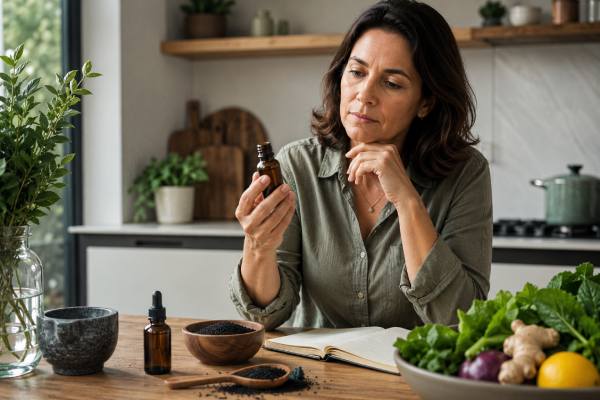
Black seed oil has the kind of reputation that makes careful readers pause. It is praised as a traditional remedy, sold as an immune-support supplement, and often described in language that sounds broader than the evidence allows. The oil, pressed from the seeds of Nigella sativa, contains several biologically active compounds, especially thymoquinone, that appear to influence inflammation, oxidative stress, and some immune pathways. That makes it scientifically interesting. It does not make every product effective, every claim reliable, or every use case sensible.
For people trying to decide whether black seed oil is worth taking, the useful questions are practical ones. Does it actually improve immune health in humans, or mostly change lab markers? What doses have been studied? Do seed powders, oils, and standardized extracts count as the same thing? And which medications or medical conditions make it a poor choice? The answers are more nuanced than the marketing, but they are clear enough to help you use it more safely.
Essential Insights
- Black seed oil may have anti-inflammatory and immunomodulatory effects, but strong proof for preventing everyday infections is still limited.
- Human studies are more promising for selected immune-related or inflammatory conditions than for broad “immune boosting.”
- Product quality and thymoquinone content vary widely, so equal-looking labels may not deliver equal doses.
- It can interact with blood sugar, blood pressure, and blood-thinning medicines, and it is not a low-risk choice for everyone.
- If you use it, choose a standardized product, keep the dose modest, and review your medications first.
Table of Contents
- What the Evidence Really Shows
- How It May Affect Immunity
- Dosage and Product Quality
- Side Effects and Interactions
- Who Should Avoid It
- When It Actually Makes Sense
What the Evidence Really Shows
Black seed oil sits in an awkward but important category: promising, biologically active, and not yet proven for the broad claims often made on supplement labels. The strongest scientific case is not that it “boosts immunity” in a simple, all-purpose way. It is that compounds in Nigella sativa may influence inflammation, oxidative stress, and some immune signaling pathways, with human studies showing scattered benefits in selected settings. That is a more modest and more accurate description.
When researchers have looked across systematic reviews and clinical studies, the pattern is mixed. There are signals of benefit in areas such as allergic conditions, inflammatory markers, blood sugar control, and some cardiometabolic outcomes. There are also individual trials suggesting changes in immune-related markers in healthy volunteers and symptom improvement in some immune-mediated or inflammatory conditions. But that is not the same as saying black seed oil reliably prevents colds, reduces infection frequency, or strengthens immune defenses in otherwise healthy adults.
This distinction matters because the phrase “immune support” is often used as a catch-all. In real clinical terms, support could mean less inflammatory reactivity, better barrier function, more balanced cytokine signaling, fewer symptoms in allergic disease, or improved recovery from illness. Those are not interchangeable. A supplement can show a shift in a lab marker without producing a meaningful improvement in how often someone gets sick or how quickly they recover.
Product-linked evidence is another major limitation. Many studies use seed powder, not oil. Others use oil capsules, topical preparations, or standardized extracts with known thymoquinone content. Those forms are not equivalent. A good trial on one preparation does not automatically validate every black seed oil sold online. Some products appear to contain far less active compound than shoppers assume, which makes “study-backed” marketing much weaker than it looks.
So where does that leave the average reader? With cautious interest, not enthusiasm. Black seed oil may have a role as an adjunct in selected inflammatory or immune-related contexts. It does not have strong evidence as a universal immunity enhancer. That is exactly why it helps to separate serious evidence from supplement language and keep immune boosting claims in perspective. A more realistic frame is often immune resilience: steadier function, less unnecessary inflammation, and fewer habits that make the system harder to regulate.
How It May Affect Immunity
The main reason black seed oil attracts interest is that its active compounds appear to influence several parts of the inflammatory and immune response at once. Thymoquinone gets most of the attention, but it is not the only relevant compound. Depending on the preparation, black seed oil may contain a mixture of volatile and fixed oils, terpenes, fatty acids, and antioxidant components that could shape its biological effects.
In practical terms, the most plausible benefit is not “more immunity.” It is better regulation of certain immune and inflammatory pathways. Laboratory and animal data suggest that Nigella sativa may affect cytokines, oxidative stress, inflammatory enzymes, and immune cell behavior. Human data are much thinner, but some studies suggest modest shifts in immune markers or symptom improvement in conditions where inflammation and immune reactivity play a central role, such as allergic rhinitis or selected autoimmune and inflammatory states.
That is why the herb is better understood as immunomodulatory rather than immune-stimulating. Modulation means influencing the balance or intensity of an immune response. Stimulation suggests a generalized increase in immune strength, which is both less precise and often misleading. In many immune-related problems, excessive or poorly directed inflammation is part of the issue. A compound that calms some pathways while supporting others may be useful even if it does not “supercharge” the immune system.
This also explains why black seed oil looks more convincing in discussions of inflammation, allergy, and symptom severity than in prevention of routine viral infections. The human evidence does not strongly show that people taking it get fewer colds, avoid more infections, or recover dramatically faster from common respiratory illnesses. What it may do, in some settings, is reduce inflammatory intensity or symptom burden.
That makes the context important. Someone hoping black seed oil will replace sleep, vaccines, hand hygiene, or prescribed treatment is likely to be disappointed. Someone using it thoughtfully as an adjunct within a broader plan may be closer to the evidence. This is also where general immune education matters. If the immune system is already under pressure from sleep loss, chronic stress, ultra-processed eating, or poor baseline health, a single oil supplement is unlikely to offset all of that. Bigger factors like chronic inflammation and the basic logic of how the immune system works matter far more than one bottle on a supplement shelf.
Dosage and Product Quality
Dosage is where black seed oil becomes harder to use intelligently, because the studies do not all test the same thing. Some trials use crushed or powdered seeds. Others use oil capsules. Others use thymoquinone-rich standardized extracts. A label that says “black seed oil 500 mg” does not tell you whether the product resembles what was used in research unless it also tells you something about standardization, extraction method, or active compound content.
In human studies, several dosing patterns appear repeatedly. Seed powder has been studied in the range of about 500 mg to 2 g per day. Oil capsules in some older condition-specific studies have been used around 500 mg twice daily. Standardized, thymoquinone-rich black cumin oil preparations have been studied at lower weights, such as around 200 mg per day, because the active compound concentration is higher. These are not equivalent doses. A capsule with more total oil is not necessarily stronger if its thymoquinone content is low.
A practical way to compare products is to look for three things:
- The exact form used, such as cold-pressed oil, seed powder, or standardized extract
- Whether thymoquinone content is listed
- Whether the product has third-party testing for identity and purity
This matters because commercial black seed products vary more than many buyers realize. Independent analysis of market products has shown very large differences in thymoquinone content between oils and capsules that look similar on the label. That variability affects both efficacy and safety. A product with very low active compound content may be unlikely to do much. A highly concentrated product may behave more like an extract than a food oil and deserves more caution.
For general use, a conservative approach is better than assuming more is better. Start with the lowest clearly labeled dose, take it with food if your stomach is sensitive, and avoid combining it with several new supplements at once. Give more attention to the form than the hype. A standardized capsule from a company with credible testing is more useful than a large bottle with vague purity claims. This is also why choosing third-party tested supplements is not just a nice extra here. It is central to using black seed oil at all. And if you are already taking several products marketed for immune health, it is worth stepping back before adding another, because too many supplements can backfire even when each one sounds mild on its own.
Side Effects and Interactions
Black seed oil is often described as well tolerated, and in short-term human studies that is broadly fair. But “well tolerated” should not be confused with side-effect free. The most common problems are gastrointestinal: nausea, bloating, abdominal discomfort, reflux, loose stools, and an unpleasant aftertaste. Headache, dizziness, and skin reactions can also occur. Topical use can irritate the skin in some people, especially if the oil is concentrated or applied to already inflamed areas.
The more important issue for many adults is interaction risk. Black seed oil appears capable of affecting blood pressure, blood sugar, and possibly drug metabolism. That means the people most likely to take it are often the ones who should be most careful. If a supplement can modestly lower glucose or blood pressure in some settings, then pairing it with diabetes or blood pressure medication could increase the chance of low readings, especially if food intake is inconsistent or the dose is escalated quickly.
Practical medication categories that deserve caution include:
- Blood pressure medicines
- Diabetes medicines, including insulin
- Blood thinners and antiplatelet medicines
- Drugs with a narrow therapeutic range
- Multiple supplements that also affect glucose, blood pressure, or inflammation
There is also a laboratory reason for caution. Some data suggest that Nigella sativa or thymoquinone may inhibit drug-metabolizing enzymes such as CYP2C9 and CYP3A4 in experimental settings. That does not prove a major interaction for every medicine in every person, but it is enough to make casual stacking unwise. Warfarin is the classic example of a medicine where even a theoretical interaction deserves respect. The same goes for patients on several prescriptions, where small overlapping effects can become more significant.
Surgery is another overlooked issue. Anything that may influence bleeding, blood pressure, or glucose control can complicate the perioperative period, so many clinicians would rather know about black seed oil ahead of time than discover it on the medication list after a problem appears.
One more point matters for immune support readers specifically: black seed oil is often added to already crowded supplement routines. That is exactly when interactions and attribution problems become harder. If you start black seed oil alongside berberine, magnesium, quercetin, and an herbal blend, and then you develop dizziness, bruising, or stomach upset, you may have no idea which product is responsible. That is why supplement and medication interactions deserve a real review before you start. It is also why using black seed oil as one carefully chosen tool is safer than treating it as part of a trial-and-error stack.
Who Should Avoid It
Some people should avoid black seed oil outright, while others should use it only with medical guidance. Pregnancy is one of the clearest caution areas. Safety data are not strong enough to support routine supplemental use during pregnancy, and thymoquinone-rich preparations are not the kind of product most clinicians would want used casually in that setting. Breastfeeding data are also limited and do not justify confident self-prescribing, especially with concentrated oils or extracts.
Children are another group where adult supplement logic does not transfer cleanly. A food spice and a concentrated oil capsule are not the same thing. Unless a pediatric clinician recommends it for a specific reason, black seed oil is generally not something to improvise in children.
People taking prescription medications deserve extra care, but several groups stand out:
- Anyone on insulin or glucose-lowering medication
- Anyone on blood pressure medication
- Anyone taking anticoagulants or antiplatelet drugs
- Anyone scheduled for surgery
- Anyone taking multiple daily prescriptions with complex metabolism
There is also a group that is not always mentioned in simple supplement guides: people with autoimmune disease or those taking immunosuppressive therapy. Black seed oil is not automatically forbidden in those settings, and some studies have explored it in immune-mediated conditions. But an immune-active supplement is rarely a casual decision when the immune system is already being medically managed. If you have rheumatoid arthritis, lupus, inflammatory bowel disease, multiple sclerosis, psoriasis, or another autoimmune disorder, it makes more sense to treat black seed oil as a clinician-guided adjunct than as a general wellness add-on. Readers in that group may find it helpful to think about it in the larger context of autoimmune flare management rather than as a standalone “immune support” product.
Severe allergy history is another reason for caution. Black seed oil is still a plant-derived product with active constituents, and allergic reactions are possible. The same goes for people with very sensitive digestion, frequent reflux, or previous reactions to herbal oils.
Finally, black seed oil is a poor choice for people who want certainty. The evidence is not clean enough, the product variability is too large, and the dose equivalence between different formulations is too messy. If your health situation is complicated, simpler and better-established strategies usually deserve attention first. In pregnancy, that often means starting with the basics of safe immune support during pregnancy rather than experimenting with concentrated herbal oils.
When It Actually Makes Sense
Black seed oil makes the most sense when expectations are narrow, the product is trustworthy, and the user understands that the evidence is supportive rather than definitive. A reasonable use case is someone who wants a cautiously chosen adjunct for inflammation-leaning or allergy-leaning symptoms, is not pregnant, is not taking high-risk medications, and is willing to use a standardized product without assuming it replaces ordinary care.
It makes less sense as a broad infection-prevention tool. The human data do not strongly support the common sales pitch that black seed oil will keep you from getting sick, build a more powerful immune system, or act as a substitute for sleep, nutrition, movement, vaccination, or indicated medical treatment. If your goal is fewer colds, better recovery, or steadier everyday health, the basics still outperform the supplement aisle.
It may be worth considering when:
- You want a modest, evidence-aware adjunct rather than a cure
- You have reviewed your medications and major medical conditions first
- You are using one well-labeled product rather than several overlapping ones
- You are willing to stop if it clearly does not help or causes side effects
It is usually not worth considering when:
- You want a fast immune “boost”
- You are stacking several immune supplements already
- You cannot tell what form or strength the product actually contains
- You have a condition or medication profile that raises interaction risk
This is the part many people find surprising: even if black seed oil is biologically active, it may still be low on the priority list. If you sleep five hours a night, eat erratically, are under heavy chronic stress, and are hoping a supplement will compensate, black seed oil is not the bottleneck. The higher-value work is almost always elsewhere. That is why the broader conversation around immune support supplements matters, and why many people get more real-world benefit from the habits in evidence-based immune support habits than from adding one more oil capsule.
A good rule of thumb is this: use black seed oil only when it fits into a stable plan, not when it is being asked to rescue an unstable one. It can be a thoughtful experiment. It should not be a desperate shortcut.
References
- Nigella sativa and health outcomes: An overview of systematic reviews and meta-analyses 2023 (Overview of Systematic Reviews)
- The Immunomodulatory Effect of Nigella sativa 2023 (Review)
- Effect of Nigella sativa on general health and immune system in young healthy volunteers; a randomized, placebo-controlled, double-blinded clinical trial 2023 (RCT)
- A phase I clinical trial to evaluate the safety of thymoquinone-rich black cumin oil (BlaQmax®) on healthy subjects: Randomized, double-blinded, placebo-controlled prospective study 2022 (Phase I Trial)
- Screening of Thymoquinone Content in Commercial Nigella sativa Products to Identify a Promising and Safe Study Medication 2022
Disclaimer
This article is for educational purposes only and is not medical advice. Black seed oil may affect inflammation, blood sugar, blood pressure, and drug metabolism, so it is not appropriate for everyone and should not be used as a substitute for prescribed treatment, vaccination, or medical evaluation. Speak with a qualified clinician before using it if you are pregnant, breastfeeding, taking prescription medication, living with autoimmune disease, preparing for surgery, or managing diabetes, high blood pressure, or bleeding risk.
If this article helped you, please share it on Facebook, X, or another platform where it might help someone make a more careful supplement decision.