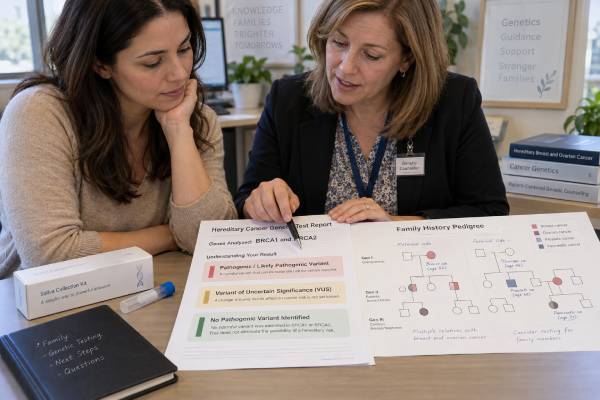
A BRCA1 and BRCA2 test looks for inherited gene variants that can substantially raise the risk of breast, ovarian, pancreatic, prostate, and certain other cancers. In someone who already has breast cancer, the result can affect treatment choices, future screening, surgery discussions, and testing for relatives. In someone without cancer, it can clarify whether a strong personal or family history is caused by a known hereditary cancer syndrome. The most important distinction is between a pathogenic or likely pathogenic variant, a true negative result, an uninformative negative result, and a variant of uncertain significance (VUS). Those categories do not carry the same meaning. A VUS is not treated like a harmful BRCA mutation, and a negative result does not always erase inherited risk. Because the result can influence several people in a family, BRCA testing works best when the test is selected and interpreted with qualified genetics expertise.
- BRCA1/2 testing usually uses blood or saliva to look for inherited pathogenic variants present throughout the body.
- A pathogenic or likely pathogenic BRCA1/2 variant confirms a hereditary cancer predisposition; a VUS does not.
- Current ASCO–SSO guidance recommends BRCA1/2 testing for all newly diagnosed breast cancer patients age 65 or younger and selected older patients.
- A negative result can be reassuring when a known family variant was specifically excluded, but it may be uninformative when no family cause is known.
- When a hereditary BRCA variant is found, close blood relatives can usually have targeted testing for that exact family variant.
Table of Contents
- What BRCA1 and BRCA2 Testing Measures
- Who Should Consider BRCA1/2 Testing
- How the Test Is Done and What the Report Contains
- What Positive, Negative, and VUS Results Mean
- How BRCA Results Can Affect Treatment and Prevention
- Family Risk and Cascade Testing After a Positive Result
- Questions to Ask After BRCA Testing
What BRCA1 and BRCA2 Testing Measures
BRCA1 and BRCA2 are tumor-suppressor genes involved in repairing damaged DNA. Everyone normally carries two copies of each gene. An inherited pathogenic variant in one copy reduces the cell’s backup capacity for accurate DNA repair. If the remaining working copy is later lost or damaged in a breast cell, genomic errors can accumulate more easily and contribute to cancer development.
A germline BRCA test asks whether a clinically important variant was inherited and is therefore present in essentially every cell. That is different from tumor sequencing, which studies changes inside the cancer. A BRCA1 or BRCA2 variant detected in a tumor can be inherited, acquired only by the tumor, or occasionally difficult to classify without a separate germline test. If tumor profiling finds a potentially important BRCA alteration, clinicians often consider confirmatory germline testing because the implications for relatives and future cancer risk are different.
BRCA1- and BRCA2-associated cancers are not identical. BRCA1-related breast cancers are more often triple-negative, while BRCA2-related breast cancers are more often estrogen-receptor positive, although neither pattern is absolute. Both genes can markedly increase female breast cancer risk, and both can increase the chance of a second primary breast cancer. BRCA2 is also strongly relevant to male breast and prostate cancer risk. For a broader view of inherited susceptibility beyond these two genes, a multigene hereditary breast cancer panel may be appropriate when the personal or family history could fit more than one syndrome.
The test does not measure whether cancer is currently present, how large a tumor is, or whether treatment is working. It identifies inherited susceptibility. That distinction helps prevent a common mistake: treating a genetic-risk result like a tumor marker. A hereditary result changes risk assessment and may change therapy, but it does not replace pathology, imaging, staging, or routine tumor biomarker testing.
Who Should Consider BRCA1/2 Testing
Testing is now offered more broadly than it was a decade ago. The 2024 ASCO–Society of Surgical Oncology guideline recommends BRCA1/2 testing for all people newly diagnosed with breast cancer at age 65 or younger. For patients older than 65, testing is recommended selectively when personal history, family history, ancestry, a second primary breast cancer, or eligibility for a PARP inhibitor makes the result clinically relevant. Testing is also important in recurrent or metastatic breast cancer when BRCA status could guide targeted therapy.
Age is only one clue. A person may merit testing because of triple-negative breast cancer, bilateral or multiple primary breast cancers, male breast cancer, ovarian cancer in the family, pancreatic cancer, metastatic or high-risk prostate cancer, or a known BRCA variant in a blood relative. Certain founder populations have a higher frequency of specific BRCA variants, but ancestry should not be used to exclude testing in people from other backgrounds.
People without cancer may also be tested. When possible, the most informative strategy is to test a relative who has had a BRCA-associated cancer first. If that person has a pathogenic variant, unaffected relatives can then have targeted testing for the exact family change. Testing an unaffected relative first can still be reasonable when affected relatives are unavailable, but a negative result may be harder to interpret because there is no known family variant to compare against.
Children are generally not tested for adult-onset BRCA1/2-associated cancer risk because routine childhood cancer screening or risk-reducing interventions are not based on BRCA status. Testing is usually deferred until adulthood, when the person can participate in informed decision-making and the result can change medical care.
A genetics consultation before or around testing can clarify whether BRCA1/2 alone is sufficient or whether genes such as PALB2, CHEK2, ATM, TP53, PTEN, or others should be included.
How the Test Is Done and What the Report Contains
Germline BRCA testing usually requires a blood sample or saliva sample. No fasting is normally needed. The laboratory analyzes BRCA1 and BRCA2 for sequence changes and, when the assay is designed appropriately, larger deletions or duplications that may remove or duplicate one or more exons. Modern comprehensive testing is much broader than the limited founder-variant panels used by some direct-to-consumer services.
That difference in test scope matters. A negative result from a test that checks only a handful of common variants does not rule out other pathogenic variants in BRCA1 or BRCA2. When clinical suspicion is meaningful, a comprehensive clinical-grade test is generally more informative than a narrow consumer screen. The report should state which genes and variant types were analyzed and should describe important technical limitations.
Results are commonly categorized as pathogenic, likely pathogenic, variant of uncertain significance, likely benign, or benign. Laboratories use evidence such as population frequency, functional studies, segregation with disease in families, computational data, and previously published clinical observations. Classification can change as evidence accumulates. A laboratory may later reclassify a VUS or, less commonly, another category, which is one reason patients should keep their genetics contact information current.
Turnaround time varies by laboratory and clinical urgency. In a newly diagnosed patient, clinicians may request testing early enough to inform surgery or systemic treatment. A rushed decision should still be based on a clearly classified result. If the report is difficult to understand, the most useful questions are: Was this germline testing? Was it comprehensive? Is the variant pathogenic/likely pathogenic or a VUS? Does the result explain the family history? And does it change treatment now?
What Positive, Negative, and VUS Results Mean
A pathogenic or likely pathogenic result means the laboratory has enough evidence to consider the variant disease-causing. For BRCA1 or BRCA2, that finding establishes hereditary breast and ovarian cancer predisposition. It does not mean cancer is inevitable, nor does it predict the exact age at which cancer will occur. NCI summarizes female lifetime breast cancer risk as more than 60% for people with inherited harmful BRCA1 or BRCA2 changes, compared with roughly 13% in the general female population. Individual risk is modified by age, family history, prior cancer, reproductive factors, and other variables.
A true negative is particularly informative. This occurs when a family has a known pathogenic BRCA variant and the person tested does not carry it. Their BRCA-related inherited risk from that family variant returns toward population expectations, although other independent risk factors can still matter.
An uninformative negative is different. If no pathogenic variant has ever been identified in an affected relative, a negative BRCA1/2 test means the laboratory did not find a reportable harmful variant in the genes tested. The family history could still reflect another gene, a variant current testing cannot detect or interpret, multiple small genetic effects, shared environmental factors, or chance. Risk management may therefore still be based partly on the family pedigree.
A variant of uncertain significance is not a positive result. It means there is not enough evidence to label the change pathogenic or benign. Clinical guidelines advise against using a VUS to justify preventive mastectomy, oophorectomy, targeted therapy, or predictive testing of relatives as though the variant were known to cause disease. Management should instead follow the person’s cancer diagnosis, family history, and other established risk factors while the laboratory continues to evaluate the variant.
A negative or VUS result may prompt discussion of broader testing when the history remains suspicious. The key is to avoid both false reassurance and unnecessary alarm.
How BRCA Results Can Affect Treatment and Prevention
For a person with breast cancer, a germline BRCA result can affect several decisions. In selected HER2-negative early or metastatic breast cancers, a pathogenic germline BRCA1/2 variant can establish eligibility for PARP-inhibitor therapy under the appropriate drug indication and clinical setting. The result can also influence surgical discussions because carriers have a higher risk of a new primary cancer in the opposite breast than noncarriers. That does not mean bilateral mastectomy is mandatory. Age, cancer prognosis, breast imaging options, prior radiation, personal preferences, and competing health risks all matter.
Risk management extends beyond the current breast cancer. Female BRCA carriers may discuss intensified breast screening, including MRI at appropriate ages, and risk-reducing salpingo-oophorectomy based on the gene, age, childbearing plans, and guideline recommendations. BRCA1 and BRCA2 differ in the timing and magnitude of ovarian cancer risk, so recommendations are personalized. Screening or prevention for pancreatic and prostate cancer may also be relevant in selected carriers and families.
For someone without cancer, the goal is prevention and early detection rather than cancer treatment. A positive test can support a structured surveillance plan rather than vague “extra screening.” The details should come from current hereditary-cancer guidance because recommendations evolve as evidence changes.
A hereditary BRCA result should also be integrated with the tumor’s separate biology. ER, PR, HER2, grade, stage, and genomic assays answer different questions. For example, an inherited BRCA2 variant does not by itself tell whether a tumor is hormone-receptor positive. The breast cancer biomarker panel remains essential for treatment planning.
Family Risk and Cascade Testing After a Positive Result
BRCA1 and BRCA2 pathogenic variants are inherited in an autosomal dominant pattern. Each first-degree relative—parent, sibling, or child—has a 50% chance of carrying the same variant if one parent is a carrier. The variant can be inherited from either the mother or father. A paternal family history is just as relevant as a maternal one, even though small families or few female relatives can make the pattern less obvious.
Once a familial pathogenic variant is known, relatives usually do not need a broad diagnostic search to answer whether they inherited that specific risk. They can often have targeted testing for the exact variant. This is called cascade testing. A negative targeted result in that setting is much more definitive than a negative test in a family where no causative variant has been found.
Sharing results can be emotionally and practically difficult. A genetics professional can provide a family letter that states the gene, exact variant, laboratory classification, and how relatives can obtain counseling. Relatives should receive the actual report when possible rather than relying on a verbal description such as “the breast cancer gene was positive.” Exact documentation prevents testing the wrong gene or wrong variant.
Not every relative who carries the variant will develop cancer, and relatives can make different choices about screening and risk-reducing surgery. Genetic information is shared biological information, but medical decisions remain individual. Insurance, privacy, reproductive planning, and communication with adult children may also be part of counseling. In the United States, federal protections such as GINA address certain health-insurance and employment discrimination issues but do not cover every type of insurance, so counseling may include practical legal considerations.
If a VUS is found, cascade testing of healthy relatives is generally not used for routine clinical decision-making. The family should instead follow evidence-based screening based on established risk while awaiting any future reclassification.
Questions to Ask After BRCA Testing
A BRCA report is most useful when it leads to a clear plan. Ask whether the result is germline or tumor-only, whether the laboratory calls the variant pathogenic/likely pathogenic or uncertain, and whether the assay included deletion/duplication analysis. If the result is negative, ask whether it is a true negative for a known family variant or an uninformative negative.
For a positive result, ask which decisions are time-sensitive. Newly diagnosed patients may need to know whether the result changes systemic therapy or surgery now. Others may be able to separate treatment of the current cancer from longer-term discussions about the opposite breast, ovarian risk, pancreatic risk, or family testing.
It is also reasonable to ask how often the genetics team expects to revisit the result. Variant databases, risk estimates, and management recommendations change. A test performed years ago may have used a narrower panel or older methods, especially if the family history remains strongly suggestive despite a negative result. In those cases, updated testing may be appropriate.
Bring a three-generation family history when possible, including cancer type and age at diagnosis on both sides of the family. Pathology details such as triple-negative breast cancer, ovarian/fallopian-tube cancer, pancreatic cancer, and metastatic or high-risk prostate cancer can materially change interpretation.
The most useful final question is simple: “What does this result change for me, and what does it change for my relatives?” A good interpretation should distinguish immediate treatment decisions, future cancer-risk management, and family implications rather than blending them together.
How timing changes the value of testing
The same BRCA result can have different practical importance depending on when it becomes available. Before breast surgery, a confirmed inherited pathogenic variant may affect discussion of breast-conserving surgery versus unilateral or bilateral mastectomy because the patient is also thinking about future primary-cancer risk. That does not mean bilateral mastectomy is mandatory. Age, current tumor prognosis, expected risk reduction, breast surveillance options, reconstructive goals, medical conditions, and personal preferences all belong in the decision.
During systemic-treatment planning, germline BRCA status may determine eligibility for a PARP inhibitor in defined early-stage or metastatic settings. The oncology team must still confirm the disease stage, HER2 status, previous treatments, and the exact drug indication. A pathogenic variant is therefore actionable only when the surrounding clinical criteria are also met.
After treatment, the focus shifts toward future cancer prevention and relatives. Risk management may include intensified breast surveillance and discussion of ovarian/fallopian-tube risk reduction at an age tailored to the gene and family history. Male carriers also need gene-specific counseling because BRCA2 in particular is relevant to male breast and prostate cancer. Pancreatic screening may be considered for some carriers under specialty guidelines and family-history criteria.
Timing matters for family testing too. Once a pathogenic family variant is known, adult relatives can have a focused test for that exact change. A relative who tests negative for the known familial variant usually avoids the BRCA-associated risk attributable to that variant, although ordinary population risks and unrelated family-history factors still remain.
References
- Germline Testing in Patients With Breast Cancer: ASCO-Society of Surgical Oncology Guideline 2024 (Guideline)
- BRCA Gene Changes: Cancer Risk and Genetic Testing Fact Sheet – NCI 2024
- BRCA1- and BRCA2-Associated Hereditary Breast and Ovarian Cancer – GeneReviews® – NCBI Bookshelf 2026 (Review)
- Updated Guidelines on When to Consider Germline Testing for Patients with Breast Cancer 2024 (Review)
- Germline Testing in Patients With Breast Cancer: ASCO-Society of Surgical Oncology Guideline Q and A 2024 (Guideline)
Disclaimer
This article provides general education about BRCA1/2 testing and hereditary breast cancer risk. Genetic results can affect cancer treatment, preventive care, and relatives, so they should be interpreted with a qualified clinician or genetics professional who can apply current guidance to the individual and family history.