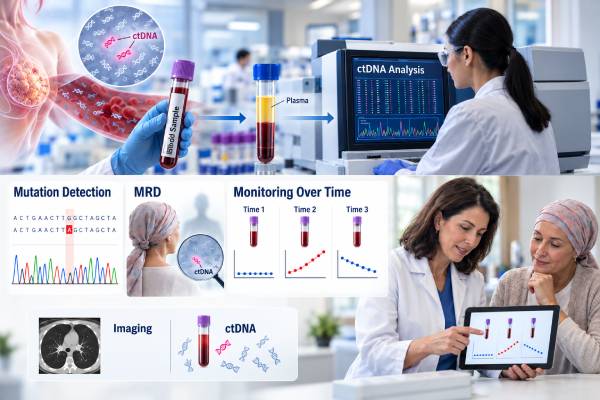
A circulating tumor DNA (ctDNA) test looks for fragments of DNA released by cancer cells into the bloodstream. In breast cancer, ctDNA has two very different clinical roles. In advanced disease, validated plasma tests can identify actionable mutations when tissue testing is difficult, too slow, or specifically permitted by a drug indication. In early-stage disease, highly sensitive assays can sometimes detect molecular residual disease (MRD) months before imaging shows recurrence, but an early positive result is not automatically a reason to start treatment outside a proven clinical pathway. Current 2026 ASCO guidance says ctDNA testing should be offered only when the result can be linked to an evidence-based clinical action, and a negative plasma result may need tissue confirmation when suspicion remains. ctDNA is therefore powerful but context-dependent: mutation profiling, treatment selection, response monitoring, and MRD surveillance are not interchangeable uses of the same technology.
- ctDNA is tumor-derived DNA found within the much larger pool of cell-free DNA circulating in plasma.
- In advanced breast cancer, ctDNA can identify actionable mutations such as ESR1 or PIK3CA when a validated assay and treatment indication support testing.
- A negative ctDNA result can be false negative when tumor shedding is low; tissue testing may still be needed.
- After curative treatment, ctDNA-positive MRD strongly predicts higher recurrence risk, but routine recurrence monitoring is not yet recommended for all patients.
- ctDNA concentration or “tumor fraction” should not be used by itself as a surrogate for disease burden or as the sole basis for treatment decisions.
Table of Contents
- What ctDNA Is and How It Differs From Cell-Free DNA
- ctDNA in Advanced Breast Cancer
- ctDNA and Molecular Residual Disease After Curative Treatment
- What Positive, Negative, and Indeterminate ctDNA Results Mean
- Mutation Detection and Treatment Selection
- ctDNA for Treatment-Response Monitoring
- Limits and Sources of Error in ctDNA Testing
- Questions to Ask Before ctDNA Testing
What ctDNA Is and How It Differs From Cell-Free DNA
Cell-free DNA (cfDNA) is released into blood by many normal processes, including turnover of blood cells and other tissues. Circulating tumor DNA is the fraction of cfDNA that originates from cancer cells. In a patient with breast cancer, ctDNA may carry somatic mutations, copy-number changes, methylation patterns, or other molecular features that match the tumor.
A ctDNA assay usually starts with a plasma sample. Blood is collected into tubes designed to stabilize nucleated cells, processed quickly or according to validated handling rules, and the plasma is separated before DNA extraction. The amount of tumor-derived DNA can be tiny, particularly after surgery or during effective treatment, so assay sensitivity and specimen handling are central to accuracy.
There are two broad testing strategies. Tumor-naive assays look for alterations using a predefined panel without first sequencing an individual patient’s tumor. Tumor-informed assays first identify mutations in the person’s tumor and then build a personalized blood test to track those mutations. Tumor-informed testing can increase sensitivity for very low-level MRD, but it requires adequate tumor tissue and extra setup time.
ctDNA is not the same as a circulating tumor cell test. CTC assays look for intact cancer cells in blood; ctDNA assays analyze DNA fragments. It is also not the same as a serum marker such as CA 15-3, which measures a protein-related antigen rather than tumor DNA.
The core advantage of ctDNA is molecular detail. A blood sample can sometimes reveal resistance mutations or actionable targets without an invasive biopsy. The core limitation is that not every tumor sheds enough DNA into plasma to be detected.
ctDNA in Advanced Breast Cancer
In metastatic breast cancer, ctDNA has an established role in tumor genotyping when the result can change treatment. The 2026 ASCO ctDNA guideline states that plasma testing for tumor genetic alterations may be used when tissue testing is challenging or unsafe, when tissue results would not be available in time for a treatment decision, or when a regulatory indication allows or requires ctDNA testing.
This is particularly relevant because metastatic breast cancer evolves under treatment pressure. A tumor that was profiled years earlier can acquire new alterations. Blood-based testing can sample DNA shed from multiple disease sites at once and may capture heterogeneity that a single biopsy misses.
Examples include ESR1 mutations in hormone receptor-positive/HER2-negative disease and PIK3CA mutations that can affect targeted-therapy options. In September 2026, the FDA granted accelerated approval to camizestrant plus a CDK4/6 inhibitor after detection of an ESR1 mutation during aromatase-inhibitor plus CDK4/6 therapy, before radiographic progression, using an FDA-authorized test. That approval is an example of ctDNA moving from descriptive monitoring into a defined treatment-triggering role.
Still, tissue remains important. Plasma testing can miss alterations because of low tumor shedding, low disease burden, central nervous system-dominant disease, recent therapy, or technical limits. If a negative or inconclusive plasma result conflicts with the clinical situation, ASCO recommends seeking tissue-based confirmation when feasible.
ctDNA can also reveal variants arising from clonal hematopoiesis—age-related blood-cell clones rather than the cancer. Good assays and interpretation workflows try to distinguish these findings, but this remains an important source of false attribution.
ctDNA and Molecular Residual Disease After Curative Treatment
After surgery and systemic therapy for early-stage breast cancer, the MRD question is different from advanced-disease genotyping. Here, the goal is to detect tiny amounts of residual tumor DNA when conventional imaging shows no evidence of disease. A positive result can indicate that microscopic cancer persists somewhere in the body even though the location is unknown.
Across breast cancer studies, ctDNA-detected MRD has shown strong clinical validity as a prognostic marker. Reviews report that molecular relapse can precede radiologic or clinical recurrence by roughly 8–12 months in many cohorts, though lead time varies widely by subtype, assay, sampling schedule, and disease site. A positive result is therefore associated with a much higher risk of future recurrence.
Clinical validity is not the same as clinical utility. To justify routine surveillance, clinicians need evidence that acting on the earlier molecular signal improves outcomes compared with waiting for standard clinical or imaging evidence. That requires interventional trials in which treatment is changed based on ctDNA and the change produces better patient outcomes.
The 2022 ESMO ctDNA recommendations concluded that MRD detection after treatment for early-stage cancer had strong evidence of prognostic validity but should not be routinely used to direct treatment because clinical utility had not been established. The 2026 ASCO ctDNA guideline remains cautious and says testing outside a clinical trial should be linked to an evidence-based action. The 2026 ASCO breast cancer surveillance guideline also does not recommend ctDNA generally for recurrence monitoring at this time.
For patients offered MRD testing in research or a specialized program, the key question is not simply “Can the assay detect relapse early?” but “What will we do differently if it is positive, and is that action proven to help?”
What Positive, Negative, and Indeterminate ctDNA Results Mean
A positive ctDNA result means the assay detected a tumor-associated molecular signal above its validated threshold. In advanced disease, that may identify an actionable mutation. In an MRD setting, it indicates a high-risk molecular signal, but it does not locate the cancer or prove that a scan will already be abnormal.
A negative result is more complicated. It means the assay did not detect ctDNA at that time; it does not prove that no cancer is present. Sensitivity depends on the amount of tumor DNA in plasma, the number of mutations tracked, blood volume, assay error suppression, disease site, and timing. Very small residual disease can fall below detection.
A negative plasma genotyping result can also be non-informative if the sample has very low tumor fraction. This is why ASCO recommends tissue confirmation when a negative, inconclusive, or clinically discordant result could miss an actionable alteration.
An indeterminate or technically limited result may occur when there is inadequate DNA, low signal, sequencing failure, or ambiguity about whether a variant comes from the tumor. Some reports also provide a tumor fraction estimate. That estimate can be useful for understanding assay sensitivity, but current ASCO guidance says fractional, percentage, or concentration-based ctDNA measures should not be used as a stand-alone surrogate for disease burden.
Serial testing can provide more information than a single time point, but frequency should have a reason. Repeating a test every few weeks simply to watch a number can increase anxiety without improving care. In validated treatment-monitoring protocols, timing is linked to therapy cycles or defined decision points.
Mutation Detection and Treatment Selection
The most mature clinical use of ctDNA is identifying genomic alterations that have an established treatment consequence. A plasma next-generation sequencing panel can look at many cancer genes simultaneously, while focused PCR or digital PCR assays may target a smaller number of mutations with high sensitivity.
In hormone receptor-positive metastatic breast cancer, ESR1 mutations are an important example. These mutations often emerge during aromatase-inhibitor therapy and can drive estrogen-independent receptor activity. ctDNA is particularly useful because ESR1 mutations may be heterogeneous and may arise in multiple metastatic sites. A blood sample can detect several clones without choosing one lesion to biopsy.
PIK3CA testing is another common example. A pathogenic PIK3CA mutation in an appropriate HR-positive/HER2-negative advanced breast cancer can affect eligibility for PI3K-pathway targeted therapy. Other alterations—such as AKT1, PTEN, BRCA1/2, ERBB2 mutations, or rare tumor-agnostic fusions—may also be relevant depending on the specific drug, assay, and indication.
A mutation result must be interpreted at the variant level, not just the gene level. Not every change in a cancer gene is activating, pathogenic, or targetable. Reports may classify variants by clinical significance, and oncology teams often use curated databases or molecular tumor boards when evidence is complex.
ctDNA can complement a solid tumor NGS panel, but it does not always replace tissue. Tissue remains valuable for histology, receptor testing, morphology, and alterations that may be harder to detect in plasma, including some copy-number changes and fusions.
ctDNA for Treatment-Response Monitoring
Researchers have repeatedly shown that ctDNA levels often fall when therapy is effective and rise when cancer progresses. That biologic relationship makes ctDNA attractive as a real-time response marker. However, routine use requires more than correlation.
The 2026 ASCO guideline specifically cautions against using fractional or concentration-based ctDNA measures as surrogate measures of disease burden to make treatment decisions outside research. A percentage change in ctDNA is not yet a universal replacement for RECIST imaging, symptom assessment, or other established measures.
There are several reasons. Different assays quantify ctDNA differently; mutations can disappear because a particular clone is suppressed while another resistant clone grows; treatment can transiently alter DNA release; and some metastatic sites shed far less DNA than others. Brain-dominant disease, for example, may be poorly represented in plasma.
That does not make serial ctDNA useless. In a trial or validated disease-specific protocol, molecular response can provide earlier evidence of benefit or resistance and can identify emerging mutations. The 2025 SERENA-6 trial showed that scheduled ctDNA monitoring for newly detectable ESR1 mutations could identify a group in whom switching endocrine therapy before imaging progression improved progression-free survival. The FDA’s 2026 accelerated approval built on that concept in a specific indication.
The lesson is precision: ctDNA monitoring should be tied to a known clinical action. “The number changed” is not enough. The result needs a validated interpretation and a treatment pathway that has evidence behind it.
Limits and Sources of Error in ctDNA Testing
The biggest technical limitation is low tumor shedding. Early cancers, small residual disease, bone-only disease, and central nervous system disease can produce little detectable plasma ctDNA. Effective therapy can also lower ctDNA to levels below assay sensitivity. These situations increase false-negative risk.
Preanalytic handling matters because most cfDNA in a blood tube comes from normal cells. If white blood cells rupture before plasma separation, they release genomic DNA that dilutes the tumor signal. Specialized collection tubes, processing times, centrifugation, and storage requirements are therefore part of assay quality.
False-positive interpretation can occur through clonal hematopoiesis. Blood-forming cells acquire mutations with age and treatment exposure, and some of those mutations occur in genes also seen in cancer. Without appropriate filtering or matched white-cell analysis, a plasma variant can be mistakenly attributed to the breast tumor.
Biological heterogeneity is another challenge. A ctDNA profile is a composite of DNA shed by different metastases. That is often an advantage, but it can also produce low-frequency subclones whose clinical importance is uncertain. A mutation at 0.2% variant allele frequency is not automatically less important than one at 20%; abundance depends on tumor fraction, copy number, and clone size.
Finally, commercial assays differ in genes, depth, error correction, reporting thresholds, tumor-informed versus tumor-naive design, and regulatory status. Two “ctDNA tests” can have very different performance characteristics. Patients should know which assay was used and what exact clinical purpose it was validated for.
Questions to Ask Before ctDNA Testing
The most useful first question is: What decision will this test change? In advanced cancer, the answer may be selection of a targeted therapy when tissue is unavailable. In a clinical trial, it may determine eligibility or trigger a protocol-defined treatment switch. In MRD surveillance, the answer may be less certain, and that uncertainty should be explicit.
Ask whether the assay is tumor-informed or tumor-naive, which genes or mutations it tracks, what its limit of detection is, and whether low tumor fraction could make a negative result non-informative. If an actionable mutation is not found, ask whether tissue testing is still needed.
For recurrence monitoring, ask what happens after a positive result. Will imaging be performed? Will treatment start immediately? Is that approach supported by a randomized trial for this exact breast cancer subtype? If there is no evidence-based action, the value of knowing earlier may be limited and can carry psychological costs.
Ask about timing. A test drawn too soon after surgery, during a treatment transition, or at an interval not validated by the assay may be harder to interpret. Also ask whether serial testing should use the same platform to avoid technical differences.
Finally, separate ctDNA from hereditary testing. A BRCA1 or BRCA2 variant found in plasma could be germline or somatic. If a result could represent inherited cancer risk, confirmatory germline testing may be needed before making family recommendations.
ctDNA is one of the most rapidly evolving tools in breast oncology. Its best use is not “more testing,” but testing at a moment when the result can be interpreted correctly and acted on in a way that improves care.
The key difference between prognostic detection and proven clinical utility
A ctDNA result can be highly prognostic without yet being proven useful as a routine intervention trigger. In early breast cancer, multiple studies show that postoperative or follow-up ctDNA positivity strongly predicts later clinical relapse and can precede imaging by months. That is an important biological signal. The unresolved question is whether acting on that signal before conventional recurrence is found improves survival, quality of life, or other patient-centered outcomes.
This distinction explains why ctDNA MRD research is advancing rapidly while routine surveillance remains limited. A test can detect molecular relapse earlier, yet earlier knowledge is only clinically beneficial if there is an effective treatment strategy for that earlier state and evidence that starting it sooner helps more than waiting for standard evidence of recurrence. Ongoing trials are designed to answer exactly that question. Until then, MRD testing outside a trial should be discussed with clear expectations about what a positive or negative result can and cannot change.
References
- Circulating Tumor DNA Testing in Solid Tumors and Lymphoma: ASCO Guideline 2026 (Guideline)
- ESMO recommendations on the use of circulating tumour DNA assays for patients with cancer: a report from the ESMO Precision Medicine Working Group 2022 (Position Statement)
- Current Clinical Utility of Circulating Tumor DNA Testing in Breast Cancer: A Practical Approach. 2024 (Review)
- Minimal residue disease detection in early-stage breast cancer: a review 2025 (Review)
- Recommendations for the use of next-generation sequencing (NGS) for patients with advanced cancer in 2024: a report from the ESMO Precision Medicine Working Group 2024 (Position Statement)
- Breast Cancer Follow-Up and Surveillance After Primary Treatment: ASCO Guideline Update 2026 (Guideline)
Disclaimer
This article is educational and does not recommend ctDNA testing for any individual. The clinical meaning of ctDNA depends on cancer stage, assay design, tumor shedding, treatment history, and whether an evidence-based action exists for the result; testing should be interpreted by the oncology team.