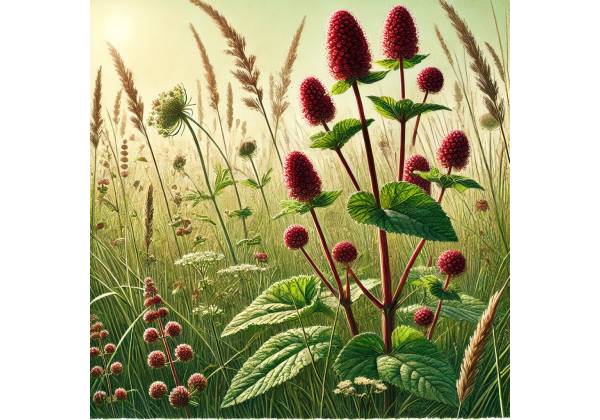
Burnet (Sanguisorba officinalis), often called great burnet, is a traditional astringent herb valued for its “tightening” and cooling character. In European folk practice and East Asian herbal systems, the root is most commonly used to help manage overly loose stools, calm irritated tissues, and support the body’s natural stopping of minor bleeding. Those same astringent qualities also explain why burnet has long been applied topically for weepy or inflamed skin and for minor cuts or grazes.
Modern analysis shows that burnet contains high levels of tannins alongside other plant compounds that may help shape inflammation, oxidative stress, and microbial balance on the skin and in the gut. At the same time, “astringent” is not always synonymous with “safe for everyone.” Burnet can worsen constipation in some people, and it may not be appropriate during pregnancy or alongside certain medications. Used thoughtfully, it can be a practical, traditional tool for short-term support rather than a cure-all.
Essential Insights
- May help firm loose stools and reduce minor weeping or irritation of tissues.
- Avoid long-term daily use if you tend toward constipation or low iron.
- Typical adult decoction range: 9–15 g/day of dried root (short-term).
- Avoid during pregnancy and breastfeeding unless a qualified clinician advises it.
Table of Contents
- What is burnet used for?
- Key compounds and medicinal actions
- Burnet for diarrhea and gut
- Topical uses for skin
- Burnet dosage and timing
- Is burnet safe to take?
- What the evidence says
What is burnet used for?
Burnet is a perennial plant in the rose family (Rosaceae). When people say “burnet” in an herbal context, they may mean different species—most commonly great burnet (Sanguisorba officinalis) or salad burnet (Sanguisorba minor). Salad burnet is better known as a culinary herb with a mild cucumber-like flavor. Great burnet is the one most associated with medicinal use, especially the root.
Names and parts used
Great burnet may appear under names such as “great burnet root,” “burnet-bloodwort,” or, in East Asian traditions, Di Yu (often referring to the dried root). The root and rhizome tend to be the most astringent and tannin-rich parts. Some modern products also use aerial parts, but those are not as consistently represented in traditional dosing guidance.
Traditional uses in plain language
Across different traditions, the core “theme” of burnet is astringency plus cooling:
- Stops excess flow: Traditionally used when something is “leaking” or running too freely—such as overly loose stools or minor bleeding.
- Soothes irritated surfaces: Used for irritated mucous membranes (like the gut lining during acute diarrhea) and for irritated skin.
- Supports tissue tone: Astringent plants can temporarily tighten tissues by interacting with proteins at the surface, which may reduce weeping and oozing.
People most often look for burnet when they want support for:
- Acute loose stools (especially when stools are watery and frequent).
- Minor bleeding tendencies (for example, hemorrhoidal bleeding or spotting that has already been medically assessed).
- Topical care for minor skin irritation, weepy patches, and small abrasions.
What burnet is not
Burnet is not a substitute for emergency care. Seek prompt medical help for black or tarry stool, vomiting blood, heavy rectal bleeding, severe dehydration, rapidly worsening burns, or any bleeding you cannot explain. Burnet is best understood as short-term, supportive care—useful when your situation is mild, understood, and stable.
Key compounds and medicinal actions
Burnet’s effects are strongly shaped by its chemistry, especially the plant’s concentration of tannins. Tannins are not a single compound but a broad family of polyphenols that can bind to proteins. That binding is one reason astringent herbs often feel “drying” in the mouth and can reduce weeping on the skin or overly loose stool in the gut.
Tannins and phenolic acids
Great burnet contains multiple tannin classes, including ellagitannins and related polyphenols. These can break down into smaller phenolic compounds (such as gallic acid and ellagic acid derivatives) depending on preparation, processing, and gut microbiota metabolism. From a practical standpoint, high-tannin herbs tend to:
- Create a protective, tightening layer on mucosal surfaces (helpful when stool is too watery).
- Reduce “wetness” in superficial tissue irritation (useful for some weepy skin patterns).
- Offer antioxidant support because polyphenols can neutralize reactive molecules.
Triterpenoids and saponins
Burnet also contains triterpenoids and saponins (a class of compounds that can influence cell signaling and barrier function). Some burnet constituents in this category have been studied for their relationship to inflammatory pathways. In real-world terms, this may help explain why burnet is sometimes used when irritation is part of the picture, not only “excess flow.”
Flavonoids and other supportive compounds
Flavonoids and related plant compounds may add gentle anti-inflammatory and antioxidant effects. While these actions can sound broad, they matter most when you connect them to specific use cases:
- In acute diarrhea, you want a combination of surface-level astringency and calm to the irritated lining.
- In topical applications, you want reduced weeping and a more stable skin surface.
Processing matters
In some traditions, the root is used either unprocessed or processed (for example, carbonized/charred forms) to shift how strongly it supports stopping bleeding versus other actions. This is one reason two “burnet” products can feel different even if they share the same plant name.
Burnet for diarrhea and gut
Burnet is best known as a short-term astringent for the gut—most relevant when stool is loose, frequent, and watery. The aim is not to “shut down” digestion but to help the irritated surface of the intestines feel less raw and less prone to fluid loss. In traditional language, burnet is often chosen when there is a sense of heat or inflammation alongside diarrhea, but you do not need that framework to use it safely.
When burnet is a reasonable fit
Burnet may be worth considering when:
- Loose stools began recently (often within 1–3 days).
- You do not have severe fever, persistent vomiting, or signs of significant dehydration.
- You suspect irritation from food, stress, mild infection, or travel changes.
- Your stool is loose and urgent rather than bulky and slow-moving.
People sometimes compare burnet to other strongly astringent herbs used for diarrhea; for example, tormentil for astringent diarrhea support is another classic option with a similar “tightening” profile.
How it may help
Astringent herbs can:
- Reduce excess secretion on the gut surface.
- Temporarily improve stool consistency.
- Ease that “raw” feeling that sometimes accompanies frequent bowel movements.
Burnet is not a replacement for oral rehydration. If diarrhea is ongoing, the most important “treatment” is still fluids and electrolytes.
Practical use approach
A simple, conservative strategy for adults is:
- Start with a weaker preparation (tea or light decoction) and monitor response over 12–24 hours.
- Use for short bursts (often 1–3 days), then stop once stool normalizes.
- If stool becomes hard, crampy, or you feel bloated, back off—those can be signs the astringency is too strong.
When to avoid burnet for gut issues
Do not self-treat with burnet if you have:
- Blood in stool that has not been medically evaluated.
- Severe abdominal pain, high fever, or dehydration signs (dizziness, confusion, minimal urination).
- Suspected food poisoning with severe symptoms, or diarrhea lasting more than 3 days without improvement.
Topical uses for skin
Burnet has a long history of external use for irritated, weepy, or inflamed skin. The goal is similar to its gut use: provide astringency at the surface, reduce excess fluid, and support a calmer local environment. Topical use is often more forgiving than internal use because you can apply small amounts to a limited area.
Common topical scenarios
People traditionally use burnet preparations for:
- Minor cuts and abrasions (after cleaning) when the skin feels fragile or weepy.
- Mild “wet” irritation patterns (for example, areas that ooze clear fluid).
- Supportive care around hemorrhoids (for example, as a cooled wash or compress), when a clinician has already confirmed the cause.
- Minor scalds or superficial burns, after immediate first aid (cool running water, gentle protection).
If you are looking at burnet mainly for topical tightening and soothing, you might also recognize similar “astringent skin logic” in witch hazel topical uses, which is commonly used for weepy or irritated skin and for hemorrhoid-area comfort.
Preparation options
Topical burnet is often used as:
- Cooled decoction wash: Make a strong tea/decoction, cool fully, then use as a rinse or compress.
- Compress: Soak clean gauze in cooled liquid and apply for 10–20 minutes.
- Powder or paste: Some traditions use powdered root (or a paste made with water) on small areas.
Keep it simple: clean skin, clean tools, short contact time, and stop if irritation increases.
Safety tips for skin use
- Do not apply to deep wounds, serious burns, or large blistered areas.
- Avoid use on infected skin unless a clinician has guided you (signs include spreading redness, warmth, pus, or worsening pain).
- Patch test first if you have sensitive skin: apply a small amount to a limited area and wait 24 hours.
Topical burnet is a support tool, not a substitute for burn care, wound evaluation, or infection treatment.
Burnet dosage and timing
Burnet dosing is not as standardized as many modern supplements, so it helps to think in ranges, forms, and goals. The root is usually prepared as a decoction (simmered), which extracts tannins effectively. Some people use tinctures or capsules, but quality and strength vary widely.
Typical adult dosage ranges by form
The following ranges are commonly used in traditional-style practice for short-term support:
- Decoction (dried root): 9–15 g per day, simmered and divided into 2–3 servings.
- Tea (milder): 2–4 g dried root per cup, up to 2–3 cups daily.
- Tincture: follow the label because extraction ratios differ; many traditional tinctures are taken in divided doses 2–3 times daily.
- Topical wash/compress: prepare a strong tea/decoction, cool fully, apply 1–3 times daily as needed.
- Powder (topical): a small amount to a limited area, once or twice daily.
If you are using burnet for acute diarrhea, the most conservative plan is 1–3 days, stopping as soon as stool normalizes. For topical use, short cycles are also wise: use for a few days, reassess, and avoid “forever use” on the same skin area.
Timing and absorption considerations
Because tannins can bind to minerals and some compounds in the gut, consider spacing burnet away from:
- Iron supplements and iron-rich meals, especially if you have low iron or heavy menstrual bleeding history. For broader context on timing and absorption, see iron dosing and risks.
- Prescription medications that you need reliably absorbed. A practical spacing rule is 2 hours before or after other supplements or meds unless your clinician advises otherwise.
Adjusting the dose safely
Increase strength slowly and only if needed. Signs you may be taking too much include:
- Constipation, dryness, or reduced appetite
- Abdominal tightness or bloating
- Nausea or an overly “dry” mouthfeel
If those happen, reduce dose, switch to a weaker tea, or stop.
Is burnet safe to take?
Burnet is often well tolerated in food-like amounts, but medicinal dosing deserves a safety-first approach. Its astringent character is helpful when you need it, and uncomfortable when you do not.
Common side effects
Most side effects relate to tannins and strong preparations:
- Constipation or reduced bowel frequency
- Stomach heaviness, mild nausea, or decreased appetite
- Dry mouth or “tight” feeling in the gut
If you already lean constipated, burnet is usually a poor match unless guided by a clinician.
Who should avoid burnet
Avoid or use only with professional guidance if you are:
- Pregnant or breastfeeding (insufficient safety data for medicinal dosing; traditional contraindications often exist for certain patterns).
- Giving it to children (dosing is more sensitive, and diarrhea in children can become serious quickly).
- Managing unexplained bleeding, black stools, or recurrent rectal bleeding.
- Prone to chronic constipation, bowel obstruction risk, or severe IBS with constipation.
Medication and supplement interactions
Interactions are not always clinically proven, but caution is reasonable:
- Iron supplements: tannins may reduce iron absorption; space dosing.
- Blood thinners and antiplatelet drugs: burnet is traditionally used to support stopping bleeding, so discuss it with your prescriber if you use anticoagulants or have clotting disorders.
- Medications needing consistent absorption: separate by about 2 hours as a practical safeguard.
When to stop and get help
Stop burnet and seek medical care if you develop:
- Worsening abdominal pain, fever, dehydration symptoms, or diarrhea lasting more than 3 days
- New rash, facial swelling, wheezing, or other allergy signs
- Any significant or unexplained bleeding
Used as a short-term, goal-directed herb, burnet can be reasonable for many adults—but it is not a “daily wellness” herb for everyone.
What the evidence says
Modern research on Sanguisorba officinalis is active, but the evidence base still has a familiar pattern for many traditional herbs: strong laboratory exploration, promising mechanisms, and comparatively limited high-quality human trials.
Where the research is strongest
- Chemistry and mechanisms: Studies consistently show burnet is rich in tannins and other polyphenols, which plausibly explains astringent and antioxidant actions.
- Hemostatic and surface effects: Research into how burnet constituents interact with proteins supports a rational basis for “stopping bleeding” effects at surfaces, though translating this into clinical outcomes depends on context and dosing.
- Topical potential: Extract studies suggest antioxidant and antibacterial activity on skin-relevant models, supporting why burnet appears in topical traditions.
Where evidence is limited
- Human outcomes: Many claims (for hemorrhoids, heavy bleeding, or specific inflammatory bowel conditions) are not backed by large, well-controlled trials that clearly match the products people buy.
- Standardized dosing: Product-to-product variability is a real challenge—root vs aerial parts, extraction methods, and processing can change the profile.
How to interpret “promising” results
A helpful rule: treat mechanistic research as a map, not a guarantee. If a study uses a concentrated extract in a controlled setting, it does not automatically mean a tea will create the same effect. This is one reason traditional herbal practice emphasizes matching the herb to the pattern (for example, “too wet and too loose” versus “already dry and constipated”).
If your primary concern is bleeding support, you may also see people compare burnet with other traditional hemostatic herbs such as yarrow menstrual and bleeding applications. Comparisons can be useful, but they do not replace individualized safety screening—especially when medications or underlying conditions are involved.
Bottom line
Burnet’s traditional uses align reasonably well with what its chemistry suggests: astringent surface support for the gut and skin, and potential bleeding support in appropriate contexts. The strongest, most responsible way to use it is short-term, specific-purpose, and paired with medical evaluation when symptoms are severe, persistent, or unclear.
References
- A Comprehensive Review of Genus Sanguisorba: Traditional Uses, Chemical Constituents and Medical Applications – PMC 2021 (Review)
- The hemostatic molecular mechanism of Sanguisorbae Radix’s pharmacological active components based on HSA: Spectroscopic investigations, molecular docking and dynamics simulation – PMC 2024
- Sanguisorba officinalis L. ethanolic extracts and essential oil – chemical composition, antioxidant potential, antibacterial activity, and ex vivo skin permeation study – PMC 2024
- The Tannins from Sanguisorba officinalis L. (Rosaceae): A Systematic Study on the Metabolites of Rats Based on HPLC–LTQ–Orbitrap MS2 Analysis – PMC 2021
- TÀI LIỆU BÀO CHẾ ĐÔNG DƯỢC ỨNG DỤNG 2023
Disclaimer
This article is for educational purposes only and does not provide medical advice, diagnosis, or treatment. Herbs can cause side effects and interact with medications, supplements, and medical conditions. Seek urgent care for severe or unexplained bleeding, serious burns, dehydration, high fever, or persistent diarrhea. If you are pregnant, breastfeeding, have a chronic condition, or take prescription medicines (especially blood thinners), consult a qualified clinician before using burnet or any herbal product.
If you found this guide useful, consider sharing it on Facebook, X (formerly Twitter), or your favorite platform to help others make informed, safety-first choices.