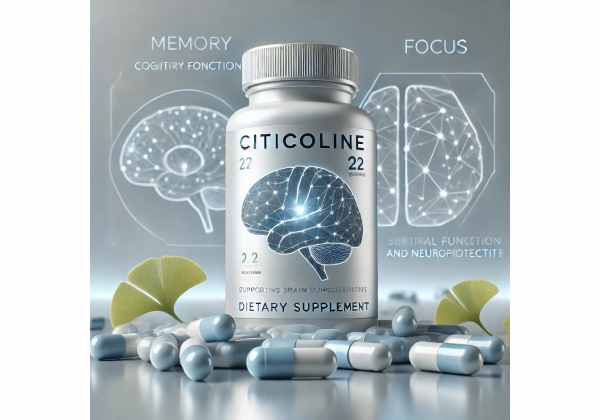
Citicoline has earned a strong reputation in the brain health world because it sits at the intersection of memory, focus, and long-term cognitive support. Unlike many trendy nootropics, it is not a new or mysterious compound. It is a well-studied form of CDP-choline, a substance tied to acetylcholine production, cell membrane repair, and the phospholipids that help brain cells function well. That makes citicoline especially appealing to people who want clearer thinking without the jittery feel of stimulants.
At the same time, it is easy to oversimplify what citicoline can and cannot do. It may support attention, memory, and mental energy in certain groups, but the evidence is stronger in some settings than others. This guide explains how citicoline works, where the benefits look most convincing, who may want to consider it, what dosage ranges are commonly used, and which safety details matter before adding it to your routine.
Table of Contents
- What Citicoline Is
- How Citicoline Supports the Brain
- Where Benefits Look Strongest
- Citicoline for Aging and Mental Wellness
- Dosage, Forms, and Timing
- Safety, Side Effects, and Interactions
What Citicoline Is
Citicoline is the supplemental form of cytidine diphosphate choline, often shortened to CDP-choline. It is a naturally occurring compound involved in making phosphatidylcholine, one of the main phospholipids in cell membranes, including the membranes that surround neurons. In simpler terms, citicoline helps supply raw material the brain uses for communication, structure, and repair.
That matters because citicoline is not just “more choline.” It behaves differently from basic choline salts and is usually discussed separately from other choline donors such as alpha-GPC. After ingestion, citicoline breaks down into choline and cytidine. In humans, much of that cytidine is converted into uridine, which also matters for membrane formation and synaptic function. The result is a compound with a broader brain-support profile than people often assume from the word choline alone.
This is one reason citicoline has stayed relevant in both clinical and supplement settings. It has been used in medical contexts for decades in some countries, especially in relation to neurological recovery and cognitive impairment. In the supplement world, it is usually marketed for:
- memory support
- attention and focus
- mental energy
- age-related cognitive changes
- general brain resilience
Citicoline is also one of the few nootropic ingredients that has evidence in both healthy adults and people with cognitive impairment, although the quality of that evidence is uneven. Some studies suggest meaningful benefits, especially in older adults or people with lower baseline cognitive performance. Other reviews argue that the overall evidence is still too limited or too biased for strong claims, particularly in healthy populations. That mixed picture is important. It makes citicoline more credible than many hype-driven ingredients, but it does not make it a guaranteed cognitive enhancer.
Another reason people like citicoline is that it is not typically experienced as heavily sedating or strongly stimulating. Many users describe it as mentally “clean,” with effects that may feel more like smoother focus or less mental drag than a sharp burst of energy. That makes it attractive to people who want support for concentration or memory without the trade-offs they may notice from caffeine-heavy products.
If you are comparing ingredients in this area, citicoline fits naturally into the broader discussion of choline support for brain health. The key difference is that citicoline is usually chosen not just to raise choline intake, but to support neurotransmission, membrane integrity, and cognitive performance in a more targeted way.
How Citicoline Supports the Brain
Citicoline is appealing because it works through several brain-relevant pathways at once. That does not mean every pathway leads to a noticeable benefit in daily life, but it helps explain why the ingredient has been studied so widely.
The first pathway involves acetylcholine. Choline is a precursor to acetylcholine, a neurotransmitter involved in attention, learning, and memory formation. If the brain has an adequate supply of choline, it is better positioned to support cholinergic signaling. This is one reason citicoline is often discussed in relation to focus and recall rather than mood alone.
The second pathway is membrane support. Neurons rely on healthy cell membranes to send signals efficiently. Citicoline helps provide building blocks for phosphatidylcholine and related membrane phospholipids. That matters for synaptic function, repair, and the general integrity of brain tissue. When researchers describe citicoline as neuroprotective, membrane maintenance is one of the main reasons.
A third pathway involves uridine. After citicoline is broken down and absorbed, the cytidine portion contributes to uridine availability in humans. Uridine is involved in phospholipid synthesis and may help support synapse formation and neuronal signaling. This gives citicoline a broader role than a simple acetylcholine booster.
Citicoline may also influence brain energy metabolism and catecholamine signaling. Some research suggests it can support the availability of dopamine and norepinephrine in ways that may matter for attention, drive, and mental endurance. That does not make it a stimulant, but it may help explain why some people notice better task engagement or less cognitive fatigue.
Put together, citicoline may help through four main mechanisms:
- increasing choline availability for acetylcholine
- supporting phospholipid synthesis in neuronal membranes
- contributing to uridine-related synaptic processes
- supporting signaling tied to attention and mental effort
This combination is why citicoline is sometimes discussed in terms of both short-term cognitive performance and longer-term brain maintenance. It can be relevant to memory and focus in the present, while also fitting into a bigger conversation about preserving cognitive function over time.
Still, mechanism is not the same as outcome. A supplement can look excellent on paper and still produce modest real-world effects. Citicoline has a better bridge between theory and human data than many nootropics, but the size of the benefit often depends on the person using it. Someone with age-related memory complaints or cognitive inefficiency may notice more than a healthy young adult already functioning near baseline.
That distinction is useful when thinking about everyday complaints such as forgetfulness, mental slowdown, or weak working memory. Citicoline may help support the systems involved, but it is not a substitute for sleep, stress control, physical activity, or adequate nutrition.
Where Benefits Look Strongest
Citicoline is often marketed as if it improves every aspect of cognition equally. The research does not support that kind of sweeping claim. Its most plausible benefits cluster around attention, memory, and mental efficiency, with the clearest signals often seen in older adults or people with mild cognitive difficulties.
Memory is the best-known target. In some human studies, citicoline improved measures of episodic memory, especially in older adults with age-associated memory complaints. That does not mean everyone will feel sharper after a week or two, but it does suggest citicoline may be more useful for preserving or modestly improving memory performance than for producing a dramatic “brain boost.”
Attention and focus are another common reason people try it. Some studies in healthy adults have found improvements in attention-related measures, vigilance, or psychomotor speed. These findings are encouraging, especially for people who do not tolerate stimulants well, but they are not uniform across all populations or tasks. Citicoline seems more likely to smooth concentration than to create a strong, immediate performance surge.
The ingredient may also help with mental fatigue. This can be one of the more practical use cases. People sometimes describe citicoline as making it easier to stay mentally organized or keep going through demanding cognitive work. That effect may reflect better attention control, cleaner signaling, or more efficient task engagement rather than raw stimulation.
Where expectations should stay cautious:
- It is not a proven treatment for ADHD.
- It is not established as a treatment for depression or anxiety.
- It is not a replacement for medical care in cognitive decline.
- It is not guaranteed to help healthy high performers.
This last point is especially important. Some cognition supplements work best when there is a need to correct or support something that is suboptimal. Citicoline may fit that pattern. A person with mild memory inefficiency, age-related cognitive changes, or reduced mental sharpness may notice more than someone who is already sleeping well, eating well, and performing strongly.
A realistic summary looks like this:
- strongest practical use: memory and attention support
- likely secondary use: mental stamina and cognitive efficiency
- weakest claims: major mood improvement, instant productivity, or universal benefit
Citicoline also tends to make more sense as part of a focused plan rather than a rescue tool. If someone’s main complaint is poor concentration, it helps to ask why. Sleep loss, stress overload, depression, blood sugar swings, and screen fatigue can all impair focus. A supplement can support the system, but it rarely fixes the root problem alone. That is why citicoline fits better in a framework of understanding concentration problems than in a quick-fix mindset.
For many readers, that balance is actually good news. Citicoline is not magic, but it may be genuinely useful in the areas where the evidence is most coherent.
Citicoline for Aging and Mental Wellness
Citicoline becomes more interesting when the goal shifts from everyday productivity to aging, recovery, or broader mental wellness. That is where the evidence base widens, although it also becomes more uneven.
In aging adults, citicoline has been studied for memory complaints, mild cognitive impairment, and cognitive decline linked to vascular or neurodegenerative processes. Some reviews and clinical studies suggest benefit, especially when treatment is continued for months rather than days. The strongest pattern is not a dramatic reversal of decline, but rather a possible slowing of worsening or a modest improvement in cognitive scores over time.
That is a meaningful distinction. A supplement that helps stabilize function in someone already dealing with decline is very different from a supplement that turns a healthy adult into a high performer. Citicoline appears more credible in the first role than the second.
There is also interest in citicoline after neurological stress, such as stroke or brain injury. In these medical contexts, citicoline has a long history of study, but results have been mixed. Some smaller or observational studies look promising, while larger trials in acute settings have not always shown clear benefit. For that reason, citicoline should be viewed as a possible adjunct in clinical care, not a stand-alone answer.
The mental wellness side is even more nuanced. Citicoline is sometimes used by people hoping for better mood, motivation, or emotional steadiness. There are a few reasons this idea persists:
- acetylcholine and dopamine both influence cognition and motivation
- clearer thinking can indirectly improve mood and confidence
- some small studies and clinical uses suggest adjunctive value in certain psychiatric settings
But citicoline is not primarily a mood supplement. It is better described as cognitively supportive than emotionally regulating. A person with brain fog, slow recall, or low mental energy may feel better overall when those problems improve, yet that is not the same as treating depression or anxiety directly.
This matters because the supplement may be most suitable for people who fit one of these patterns:
- older adults with mild memory complaints
- people who want non-stimulant support for focus
- individuals interested in long-term brain maintenance
- those with cognitive fatigue who want a more structured nootropic trial
By contrast, someone mainly seeking calm, sleep, or mood stabilization may be better served by other options. Citicoline is usually not the first supplement chosen for those goals. When readers are thinking more broadly about aging and prevention, it belongs next to fundamentals like exercise, blood pressure control, social engagement, and cognitive decline prevention habits rather than in place of them.
The best way to think about citicoline in mental wellness is as a support for the brain systems that make clear thinking possible. That can be valuable, but it is different from promising emotional transformation.
Dosage, Forms, and Timing
Citicoline dosage depends on the goal, the product form, and the context in which it is being used. In supplements, the most common daily range is 250 mg to 500 mg once or twice daily, with total intake often falling between 250 mg and 1,000 mg per day. Clinical research has also used higher amounts, especially in medical settings, but routine supplement use tends to stay below those levels.
A practical way to think about dosage is by intent:
- 250 to 500 mg daily: common starting range for general focus or brain support
- 500 to 1,000 mg daily: often used in studies on memory or cognitive complaints
- above 1,000 mg daily: more likely to belong to clinician-guided or condition-specific use
Citicoline is sold mainly in capsules, tablets, powders, and nootropic blends. Some products use the generic term citicoline, while others use branded forms. What matters most is the actual citicoline amount per serving and whether the label is transparent.
Timing is more individual than many labels suggest. Because citicoline is not strongly sedating, most people take it earlier in the day. Morning dosing is common, and a second dose, if used, is often taken around midday rather than late evening. Some users find that taking it too late makes them feel mentally “on” when they would rather be winding down.
A sensible approach is:
- start with the lower end of the range
- take it in the morning with or without food, depending on tolerance
- keep the same dose for at least one to two weeks
- increase only if the first dose is clearly well tolerated and the goal is still unmet
- avoid changing several brain supplements at once
This matters because citicoline is not always dramatic. The benefit can be subtle at first, especially if the goal is memory support rather than immediate alertness. People who expect a stimulant-like effect may mistakenly conclude it is doing nothing.
It is also worth separating single-ingredient products from blends. A blend may be useful, but it makes evaluation harder. If you want to know whether citicoline helps you, testing it on its own is usually clearer. After that, it can be combined more thoughtfully with complementary ingredients. Some people compare it with nutrients involved in membrane health and attention, such as omega-3 support for mood and focus, but stacking should be deliberate rather than random.
Two final points improve real-world use. First, choose products from companies that provide clear dosing and basic quality testing. Second, tie the trial to a defined goal: memory lapses, concentration, mental fatigue, or age-related cognitive support. A supplement is much easier to judge when the target is specific.
Safety, Side Effects, and Interactions
Citicoline is generally considered well tolerated, which is one reason it remains popular in both clinical and supplement settings. Compared with many compounds sold for brain health, its safety profile is relatively reassuring. Even so, “well tolerated” does not mean side-effect free, and it does not mean appropriate for everyone.
The most commonly reported side effects are usually mild and may include:
- headache
- nausea
- stomach discomfort
- diarrhea
- restlessness
- trouble sleeping if taken too late
- a feeling of overstimulation in sensitive users
This last point catches some people off guard. Citicoline is not a classic stimulant, but because it may support acetylcholine and dopamine-related pathways, some users feel more mentally activated than expected. That is usually a timing issue rather than a major safety problem, which is why morning use is often the easiest place to start.
Interaction data are not as extensive as many readers would like, so caution matters. Citicoline may be worth discussing with a clinician if you take medications that affect dopamine, acetylcholine, cognition, or neurological function. It may also deserve more caution in people with complex psychiatric or neurological treatment plans, simply because adding a cognitively active supplement can change how a person feels even when no dangerous interaction is documented.
Use extra caution if you are:
- pregnant or breastfeeding
- taking prescription medication for a neurological condition
- managing bipolar symptoms or significant mood instability
- using multiple nootropics at once
- unusually sensitive to supplements that increase alertness
For most healthy adults, citicoline is more likely to be underwhelming than harmful. The bigger practical risk is using it carelessly in a large supplement stack and then having no idea what is causing benefits or side effects. Citicoline also should not distract from more important issues. If concentration is worsening, memory problems are progressing, or mental function has changed quickly, that deserves evaluation rather than endless supplement experiments.
A safer framework is straightforward:
- use one new cognitive supplement at a time
- start low
- take it earlier in the day
- stop if it worsens sleep, anxiety, headaches, or agitation
- talk with a clinician if symptoms are significant or medications are involved
That is especially true in a crowded market of focus supplements with mixed evidence and risk. Citicoline stands out because it has a more serious research history than many rivals, but it still works best when used carefully and with realistic expectations.
References
- Is Citicoline Effective in Preventing and Slowing Down Dementia?—A Systematic Review and a Meta-Analysis 2023 (Systematic Review and Meta-Analysis)
- Citicoline: pharmacological and clinical review, 2022 update 2022 (Review)
- Citicoline and Memory Function in Healthy Older Adults: A Randomized, Double-Blind, Placebo-Controlled Clinical Trial 2021 (RCT)
- Citicoline for Supporting Memory in Aging Humans 2023 (Review)
- ‘Citicoline’ and support of the memory function: Evaluation of a health claim pursuant to Article 13(5) of Regulation (EC) No 1924/2006 2024 (Scientific Opinion)
Disclaimer
This article is for educational purposes only and is not medical advice. Citicoline supplements are not approved to diagnose, treat, cure, or prevent depression, anxiety, ADHD, dementia, or other medical conditions. Research on citicoline is promising in some areas, but benefits vary by population, dose, and health status. Speak with a qualified healthcare professional before using citicoline if you are pregnant, breastfeeding, have a neurological or psychiatric condition, or take prescription medications. Seek medical care for rapidly worsening memory problems, confusion, severe mood changes, or major difficulty functioning day to day.
If this article was helpful, consider sharing it on Facebook, X, or another platform you use so more readers can find accurate information about citicoline.