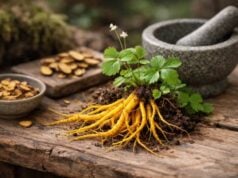
Cytinus (Cytinus hypocistis) is a rare-looking medicinal plant not because it is colorful or fragrant, but because it lives almost entirely hidden. It is a holoparasite: instead of making its own food through photosynthesis, it grows inside the roots of other plants (often rockroses), then briefly appears above ground as fleshy, scale-covered flower spikes. Traditional Mediterranean herbal practice has treated Cytinus as an astringent—used to “tighten” tissues, dry excess secretions, and support situations where the body is losing fluids or blood. That reputation fits its chemistry: Cytinus is notably rich in hydrolysable tannins and related polyphenols.
Modern research has expanded the conversation beyond folk use. Lab studies suggest antioxidant activity, antimicrobial potential, and enzyme-inhibitory effects that are relevant to skin care (such as tyrosinase and elastase). Still, human clinical evidence is limited, and dosing norms are not standardized. This guide explains what Cytinus is, what it contains, what it may help with, how it is traditionally prepared, and how to approach safety with a clear, conservative mindset.
Key Facts
- Tannin-rich extracts may support short-term astringent needs such as watery diarrhea or minor mucosal irritation.
- High tannin content can irritate sensitive stomachs and may reduce iron absorption if taken frequently.
- Traditional tea-style preparations often use 1–2 g dried inflorescence in 200–250 mL water, up to 1–2 times daily for short periods.
- Pregnant or breastfeeding people, children, and anyone with anemia or on diabetes medicines should avoid or use only with clinician guidance.
Table of Contents
- What is cytinus?
- Key ingredients and active compounds
- Traditional uses and potential benefits
- How cytinus is used
- How much cytinus per day?
- Side effects, interactions, and who should avoid
- What the evidence says
What is cytinus?
Cytinus (Cytinus hypocistis) is a holoparasitic flowering plant found mainly in Mediterranean ecosystems. “Holoparasitic” means it depends fully on a host plant for water and nutrients; it has no meaningful green leaves and does not photosynthesize in the way most plants do. For most of the year, Cytinus is invisible because its vegetative body lives inside the host’s root tissues. When it is ready to reproduce, it sends up short, fleshy inflorescences—often yellow to orange—emerging at the base of the host plant.
From a user’s perspective, Cytinus is not a common household herb. It is gathered seasonally, and the parts used traditionally are typically the flowering structures (and sometimes the nectar-like exudates). This short window of availability is one reason the plant has stayed niche, even in regions where it is known. Another reason is that Cytinus can be confused in folk naming with other parasitic plants. In some Mediterranean contexts, parasitic flowering spikes were historically grouped together in local language, even when the plants were botanically distinct. That matters if you ever consider buying a product: accurate species labeling is essential.
Cytinus has a long-standing place in regional traditions where strong astringents were valued. In older herbal frameworks, it was used when the body seemed to be “leaking” or “too loose”—for example, watery diarrhea, weeping skin, minor bleeding, or excessive secretions. In modern physiology, “astringent” actions often correlate with tannin-rich preparations that can precipitate proteins on the surface of tissues, creating a temporary tightening effect and reducing irritation.
Because Cytinus is parasitic, its chemistry and potency may vary with the host species and local growing conditions. That does not mean it is unreliable, but it does mean that a “one-size-fits-all” dosing rule is hard to justify. If you are looking for predictable, standardized effects, Cytinus is better thought of as a traditional botanical with emerging research interest rather than a fully standardized supplement.
The most helpful orientation is simple: Cytinus is a tannin-rich, strongly astringent Mediterranean parasite used traditionally for short-term, symptom-focused support. Everything else—skin applications, enzyme inhibition, antioxidant claims—should be viewed as promising but still developing.
Key ingredients and active compounds
Cytinus owes most of its traditional “tightening” reputation to an unusually high content of polyphenols, especially hydrolysable tannins. These are not the same as the condensed tannins found in some teas and barks; hydrolysable tannins include gallotannins and ellagitannins, which can break down into smaller phenolic units. This distinction matters because ellagitannins and their derivatives are frequently linked to antioxidant behavior and enzyme interactions in laboratory studies.
Hydrolysable tannins and ellagitannins
Analytical studies on Cytinus hypocistis have repeatedly highlighted a complex profile of hydrolysable tannins. You may see individual compounds discussed in research contexts (for example, pedunculagin and other ellagic-acid-related structures). For readers, the practical takeaway is not memorizing names—it is understanding what tannins do:
- They can create a temporary “tightening” sensation on mucous membranes and skin.
- They may reduce fluid loss by decreasing surface irritation and secretions.
- They can interact with proteins and digestive enzymes, which can be beneficial in some short-term cases but irritating if overused.
If you have ever noticed how strongly astringent certain fruits or teas feel, you already understand the sensory signature of tannins. A familiar polyphenol-rich comparison is pomegranate polyphenols and their antioxidant profile, which also includes ellagitannin-related compounds—one reason Cytinus is sometimes discussed as an emerging cosmeceutical ingredient.
Flavonoids and related phenolics
Alongside tannins, Cytinus extracts contain additional phenolic compounds, including flavonoid-type molecules. These may contribute to antioxidant capacity and antimicrobial effects observed in vitro. In general, when tannins dominate a profile, flavonoids often act as supporting players: they can broaden antioxidant behavior, influence inflammatory pathways in cell models, and contribute to color and stability in extracts.
Carbohydrates and nectar-associated constituents
Cytinus is also known for its nectar-like components and carbohydrate-rich fractions. Traditional uses sometimes include sucking or tasting the sweet parts of the inflorescence. From a biochemical standpoint, sugars and polysaccharides may influence texture and soothing qualities in topical or oral preparations, though they are not usually considered the main “actives” in modern herbal pharmacology.
Why extraction matters
Because Cytinus chemistry is heavily polyphenol-driven, extraction method changes the final product dramatically. Water extracts emphasize tannins and water-soluble fractions; alcohol-water blends often extract a broader phenolic spectrum; and advanced solvent systems can shift selectivity even further. This is why two products labeled “Cytinus extract” can behave differently in practice.
In summary, Cytinus is best understood as a tannin-forward botanical with supporting polyphenols. That profile fits traditional astringent uses and also explains why researchers are interested in skin-relevant enzyme inhibition and antioxidant activity.
Traditional uses and potential benefits
Cytinus sits in a category of herbs that are not “general tonics,” but situational tools. In traditional Mediterranean practice, it was used when the priority was to reduce excessive output—too much stool water, too much bleeding, or too much weeping from irritated tissues. That is the classic astringent niche, and it remains the most coherent way to interpret Cytinus today.
1) Digestive astringent support
Traditional use most commonly points to short-term help for watery diarrhea or dysentery-like states. In modern terms, a tannin-rich tea may reduce intestinal irritation and decrease the “urgency” that comes from inflamed mucosa. This does not replace rehydration, and it is not a substitute for medical evaluation when diarrhea is severe, persistent, bloody, or accompanied by fever. But as a short, conservative intervention, astringent herbs can sometimes help calm acute looseness while you address hydration and diet.
A useful comparison for the astringent category is oak bark as an astringent herb. The goal is not to suggest Cytinus is identical, but to highlight the shared logic: tannins can be helpful when tissues are irritated and “leaky,” and unhelpful when tissues are already dry or inflamed from another cause.
2) Hemostatic and “tightening” traditions
In folk settings, Cytinus preparations were used for minor bleeding concerns—often framed as a local hemostatic or astringent rinse rather than a systemic “blood-stopper.” This could include mouth and throat rinses for irritated gums or minor oral bleeding, or local applications for hemorrhoidal discomfort. Here the mechanism is plausibly local: tannins can reduce surface oozing and create a protective layer that decreases irritation.
3) Skin and mucosal soothing
While Cytinus is astringent, it is not necessarily harsh when properly diluted. Traditional practice includes washes and compresses for irritated skin or inflamed eyes in some regions (though eye use is not advisable without professional guidance). In modern herbal self-care, the safer translation is a diluted external wash for intact skin, used briefly and followed by observation for irritation.
4) Modern “cosmeceutical” interest
Recent research attention has focused on antioxidant behavior and enzyme inhibition relevant to skin appearance—particularly enzymes linked to hyperpigmentation and skin aging pathways. It is important to interpret this correctly: these are laboratory findings, not proof of visible changes in humans. Still, they provide a plausible rationale for why Cytinus extracts might appear in topical formulations rather than oral supplements.
5) Antimicrobial potential
Extracts have shown antimicrobial activity in vitro against certain bacteria and fungi. For practical use, this supports the idea of Cytinus as a topical adjunct—something that might help reduce microbial burden on the skin surface when used appropriately—rather than a replacement for clinically indicated antimicrobial treatment.
Overall, Cytinus may be most useful as a short-term astringent and as a topical botanical ingredient. The strongest benefit claims remain limited by the lack of robust human trials, so conservative, symptom-focused use is the most responsible framing.
How cytinus is used
Because Cytinus is uncommon and strongly astringent, “how to use it” should emphasize preparation, dilution, and duration. In most traditional contexts, it was used as a tea or decoction, sometimes as a rinse or wash rather than as a daily tonic.
Common forms
Cytinus is most often encountered as:
- Dried inflorescences (the fleshy flowering structures)
- Coarsely powdered dried material
- Hydroalcoholic extract (tincture-style) in niche products
- Topical extract as a cosmetic ingredient in formulated products
If you see Cytinus in a modern product, it is more likely to be in a topical blend than a stand-alone capsule, largely because its tannins make it strong and because topical use allows for controlled concentration.
Tea vs decoction
For tannin-heavy plants, both tea and decoction can work, but they produce slightly different results:
- Infusion (tea): Pour hot water over the dried plant, steep, strain. This often yields a slightly gentler astringency and is easier for beginners.
- Decoction: Simmer the plant in water for 10–15 minutes, then cool and strain. This can extract tannins more aggressively and may taste more bitter/astringent.
If your main goal is mucosal soothing (throat rinse, mouth rinse), an infusion is usually sufficient. If you are using it for short-term bowel looseness, a mild decoction may feel more “binding,” but it also increases the chance of constipation in sensitive people.
Topical preparations
Traditional external use can be translated into safer modern practice as:
- Rinse for intact skin: Use a cooled infusion, applied with clean cotton or a cloth.
- Brief compress: Apply for 5–10 minutes, then remove and observe the skin response.
- Gargle or mouth rinse: Use diluted, cooled infusion; do not swallow large amounts.
If your goal is astringent skin support, compare the approach to other classic topical astringents like witch hazel topical uses: short contact time, patch testing, and avoiding compromised skin until you know how you react.
Best practices for first-time use
- Start diluted. Astringents can feel uncomfortable if you begin too strong.
- Use short timeframes. Think days, not months, unless guided by a clinician.
- Track the specific symptom. Cytinus is not for “general wellness”; it is for a targeted issue.
- Avoid stacking with other strong astringents initially. Too much tannin load increases constipation risk and stomach irritation.
What not to do
- Do not use Cytinus as a daily “detox tea.”
- Do not treat persistent diarrhea or bleeding without medical evaluation.
- Do not use undiluted strong preparations on sensitive skin or near eyes.
Used thoughtfully, Cytinus is best approached as a short-term, astringent botanical with potential topical value—not as a routine supplement.
How much cytinus per day?
Cytinus does not have a widely accepted standardized oral dose in modern clinical practice. Most research focuses on chemical profiling and in vitro or animal models rather than human dosing studies. That means any dose guidance must be conservative, rooted in traditional preparation logic, and framed as short-term support—not long-term supplementation.
General dosing principle
With tannin-rich plants, the main risk is not usually “toxicity” in the dramatic sense, but over-astringency: constipation, stomach irritation, nausea, and reduced absorption of minerals (especially iron) if used frequently. So the best dosing rule is: use the minimum effective strength for the shortest necessary duration.
Traditional tea-style range (conservative)
For short-term use as an astringent tea:
- 1–2 g dried inflorescence steeped in 200–250 mL hot water for 10–15 minutes, strained.
- Typical use: once daily, and if needed up to twice daily for 2–5 days.
This range is intentionally modest. If you are using it for acute bowel looseness, the goal is to reduce urgency while you prioritize fluids, electrolytes, and bland foods. If symptoms persist beyond 48–72 hours, or include fever or blood, it is safer to stop self-treatment and seek medical guidance.
Decoction range (stronger, more binding)
For a stronger traditional preparation:
- 2–3 g dried material simmered in 250 mL water for 10 minutes, cooled and strained.
- Typical use: once daily for 1–3 days.
If you are prone to constipation, this approach can overshoot quickly. If stools become hard, painful, or infrequent, stop Cytinus and increase fluids and dietary fiber.
Topical infusion range
For external use on intact skin:
- 5–10 g dried material steeped in 250 mL hot water, cooled thoroughly, then used as a rinse or compress.
Use once daily for a few days, and discontinue if dryness, burning, or redness develops.
Tinctures and extracts
If a tincture or standardized extract is used, follow product labeling and consider clinician guidance. Because tannin content varies by extraction method, “mg” alone does not guarantee equivalent strength across brands. If the product does not specify plant part, extraction solvent, or quality testing, it is difficult to dose responsibly.
Timing
- For digestive uses: take after a small meal to reduce stomach irritation.
- For mouth rinse: use after oral hygiene, then avoid eating for 15–20 minutes.
- For topical use: apply after cleansing and drying the area.
The key is restraint: Cytinus is a strong astringent. If you need ongoing daily support, it is better to identify and address the underlying cause than to stay on a binding herb long-term.
Side effects, interactions, and who should avoid
Cytinus is often described as “safe” in traditional use, but safety depends on dose, duration, and your health context. The same tannins that make Cytinus useful can also create predictable problems when overused.
Common side effects
The most likely side effects are related to astringency:
- Constipation (especially if used more than a few days)
- Stomach upset or nausea (more likely with strong decoctions on an empty stomach)
- Dry mouth or throat irritation if used too concentrated as a rinse
- Skin dryness or stinging with topical overuse
If any of these occur, reduce concentration, reduce frequency, or stop use.
Interactions and practical cautions
- Iron and mineral absorption: Tannins can bind dietary iron and other minerals. If you are prone to anemia or already have low iron, frequent Cytinus use may be counterproductive.
- Diabetes medicines: Some Cytinus research discusses enzyme inhibition relevant to carbohydrate digestion. While this is not proof of a clinically meaningful glucose-lowering effect, it is enough to justify caution if you take insulin or glucose-lowering medication. Monitor carefully and avoid self-experimentation without medical guidance.
- Multiple astringents: Combining Cytinus with other high-tannin herbs can increase constipation and GI irritation.
- Sensitive digestion: If you have chronic gastritis, reflux, or irritable bowel symptoms, a strong astringent may aggravate discomfort.
Who should avoid cytinus
Avoid Cytinus (or use only under qualified guidance) if you are:
- Pregnant or breastfeeding
- A child or adolescent
- Living with anemia or iron deficiency
- Managing diabetes with medication
- Prone to chronic constipation
- Recovering from an eating disorder or restrictive patterns (binding herbs can reinforce unhealthy control behaviors)
When to seek medical care
Do not use Cytinus as a substitute for medical evaluation in these situations:
- Diarrhea lasting more than 72 hours
- Diarrhea with fever, blood, severe abdominal pain, or dehydration signs
- Any unexplained bleeding (heavy menstrual bleeding, rectal bleeding, persistent gum bleeding)
- Skin lesions that are spreading, infected, or not improving
Quality and identification concerns
Because Cytinus is not widely standardized, product integrity matters. Look for clear species labeling (Cytinus hypocistis), plant part (usually inflorescence), and basic quality controls. Avoid products that use vague names, omit plant part, or make aggressive disease-treatment claims.
In short, Cytinus is best used briefly, conservatively, and for specific goals. Most safety issues come from doing too much for too long rather than from a single modest, short-term preparation.
What the evidence says
Cytinus has a strong “traditional use signal” and a growing “laboratory evidence signal,” but it still lacks the kind of human clinical evidence that would justify confident therapeutic claims. Understanding what research can and cannot tell you will help you use Cytinus rationally.
Where the evidence is strongest
Modern studies consistently support three ideas:
- Cytinus is polyphenol- and tannin-rich. Multiple chemical profiling approaches show a robust hydrolysable tannin footprint. This aligns with traditional astringent use and helps explain why Cytinus extracts behave strongly in antioxidant assays.
- Extracts show antioxidant activity in vitro. Cytinus extracts have performed well in several lab models of oxidative stress. While this does not automatically translate into human benefits, it supports topical and nutraceutical interest, especially for formulations designed to protect against oxidative damage.
- Enzyme inhibition is plausible. Research has explored inhibition of enzymes relevant to skin and metabolism. The skin-focused angle is particularly coherent: tyrosinase inhibition relates to pigmentation pathways, and elastase inhibition relates to collagen breakdown and visible aging processes. These are not guarantees of visible results, but they are more directly “translatable” to topical formulation logic than many vague supplement claims.
Where evidence is limited
- Human trials: There is no robust body of randomized controlled trials showing Cytinus treats diarrhea, bleeding, infections, or skin aging in humans.
- Standardized dosing: Because extracts vary by solvent and method, “equivalent dosing” is not established.
- Long-term safety: Traditional use implies short-term application; long-term daily oral use is not well studied.
How to interpret traditional claims
Traditional medicine often uses “pattern language” rather than disease labels. Cytinus being described as astringent, hemostatic, or tonic reflects a functional intent: reduce excess output and support tissue tone. That is compatible with tannin chemistry. The mistake is translating that into modern disease promises (“treats colitis,” “stops bleeding disorders,” “reverses aging”). The evidence does not support that.
A practical, evidence-aligned way to use cytinus
If you choose to use Cytinus, the most evidence-aligned approach is:
- Short-term astringent support for mild, self-limited issues (with clear stop rules)
- Topical use in controlled concentrations (especially in formulated products)
- Avoidance of long-term daily oral supplementation
What would strengthen the case
To move from “promising” to “proven,” Cytinus needs:
- Human safety and tolerability studies at defined doses
- Product standardization around key tannin markers
- Clinical trials for specific outcomes (for example, topical hyperpigmentation measures or validated skin elasticity markers)
Until then, Cytinus is best viewed as a traditional astringent with strong phytochemical interest and early bioactivity data—useful in the right context, but not a substitute for medical care or a guaranteed solution.
References
- Cytinus under the Microscope: Disclosing the Secrets of a Parasitic Plant – PMC 2021 (Review)
- Selectivity Tuning by Natural Deep Eutectic Solvents (NADESs) for Extraction of Bioactive Compounds from Cytinus hypocistis—Studies of Antioxidative, Enzyme-Inhibitive Properties and LC-MS Profiles 2022 (Experimental Study)
- Unveiling the metabolites underlying the skin anti-ageing properties of Cytinus hypocistis (L.) L. through a biochemometric approach – PubMed 2024 (Experimental Study)
- Antimicrobial, antioxidant and anti-tyrosinase properties of extracts of the Mediterranean parasitic plant Cytinus hypocistis – PMC 2015 (Experimental Study)
Disclaimer
This article is for educational purposes only and does not provide medical advice, diagnosis, or treatment. Cytinus is a tannin-rich astringent herb with limited human clinical evidence, and inappropriate use may worsen constipation, irritate the stomach, or interfere with iron status. Do not use Cytinus to self-treat persistent diarrhea, bleeding, infection, or any serious condition. If you are pregnant or breastfeeding, have anemia, have diabetes, take prescription medicines, or have chronic digestive issues, consult a qualified healthcare professional before using Cytinus or any herbal preparation. Seek urgent medical care for severe or persistent symptoms, dehydration, or unexplained bleeding.
If you found this guide helpful, please share it on Facebook, X (formerly Twitter), or your preferred platform so more readers can make informed, safety-first decisions.