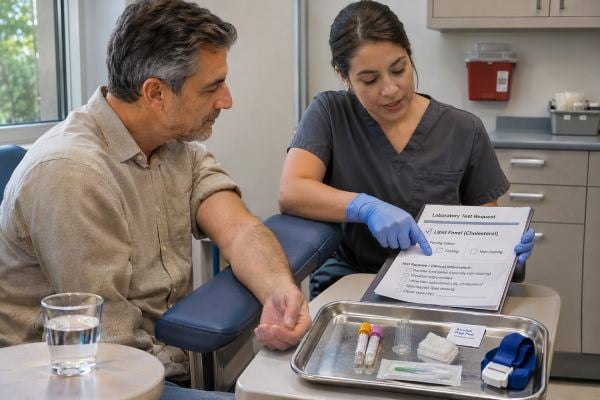
For most routine cholesterol checks, you do not need to fast. A non-fasting lipid panel is accurate enough for cardiovascular risk assessment in many adults and is now widely accepted because total cholesterol, HDL cholesterol, and several other lipid measures change little after a normal meal. Triglycerides can rise after eating, however, and that change can affect calculated LDL cholesterol. For that reason, a fasting test is still useful in selected situations, especially when triglycerides are high, a previous result is difficult to interpret, or a clinician needs a standardized measurement before making a treatment decision. The best test is therefore the one that answers the clinical question, not automatically the fasting one. If fasting is requested, follow the laboratory’s instructions closely, usually avoiding calories for about 8 to 12 hours while drinking plain water. If fasting is not requested, eat normally rather than changing your diet just to produce a better-looking result.
Table of Contents
- Fasting vs Non-Fasting: Which Cholesterol Test Is Better?
- What Changes in a Lipid Panel After You Eat
- When a Non-Fasting Cholesterol Test Works Well
- When a Fasting Cholesterol Test Is Still Useful
- How to Prepare for Fasting and Non-Fasting Testing
- How to Interpret LDL, Triglycerides, and Other Results
- Retesting, Follow-Up, and Common Questions
Fasting vs Non-Fasting: Which Cholesterol Test Is Better?
For routine cardiovascular risk screening, a non-fasting lipid panel is often the better first choice because it is convenient, reflects everyday physiology, and usually provides the information needed to estimate risk. Major laboratory and cardiovascular guidance has moved away from requiring fasting for every lipid test.
A standard lipid panel usually reports total cholesterol, HDL cholesterol, triglycerides, and LDL cholesterol. LDL may be measured directly, but it is often calculated from the other values. Eating has relatively small effects on total cholesterol and HDL, while triglycerides can rise more noticeably after a meal. That post-meal rise is the main reason fasting sometimes improves interpretation.
Neither test is inherently more “accurate” in every circumstance. They answer slightly different practical needs:
- Non-fasting testing is usually suitable for routine screening, cardiovascular risk assessment, and many follow-up checks.
- Fasting testing can be useful when triglycerides are elevated, when calculated LDL may be unreliable, or when a clinician wants a repeat value under standardized conditions.
The shift toward non-fasting testing also improves access. People can have blood drawn without arranging an early-morning appointment, skipping breakfast, or risking low blood sugar from a prolonged fast. This is particularly helpful for older adults, people with diabetes, children, and anyone taking medicines that are easier or safer to use with food.
What matters most is consistent interpretation. If you are tracking a change over time, your clinician may prefer similar testing conditions from one measurement to the next. Understanding normal cholesterol levels and treatment targets also helps put the numbers in context rather than focusing only on whether the blood draw was fasting.
What Changes in a Lipid Panel After You Eat
After a meal, the digestive system packages dietary fat into particles called chylomicrons. These particles circulate temporarily and contribute to a rise in triglycerides. The size of the rise depends on the meal, the time since eating, alcohol intake, insulin sensitivity, baseline triglycerides, and individual metabolism.
For most people eating an ordinary meal, the average post-meal changes in total cholesterol and HDL are small. Triglycerides can rise more, which is expected rather than automatically abnormal. Non-fasting triglyceride cutoffs are therefore interpreted with the timing and clinical context in mind.
LDL deserves special attention because many laboratories calculate it rather than measuring it directly. Traditional LDL formulas use total cholesterol, HDL cholesterol, and triglycerides. When triglycerides are high, the calculation becomes less reliable. Newer equations improve accuracy across a wider range of triglyceride and LDL values, but no equation completely removes the need for clinical judgment.
Other lipid-related measures are less sensitive to meals. Non-HDL cholesterol, calculated as total cholesterol minus HDL cholesterol, captures cholesterol carried in LDL and other atherogenic particles. Apolipoprotein B, or apoB, estimates the number of atherogenic particles. Lipoprotein(a), or Lp(a), is largely genetically determined and does not require fasting for routine measurement.
This is one reason a mildly different LDL value between a fasting and non-fasting test does not always mean your cardiovascular risk suddenly changed. The full pattern matters. A guide to LDL, HDL, and triglycerides can help explain how each component contributes to the overall interpretation.
When a Non-Fasting Cholesterol Test Works Well
A non-fasting panel is appropriate for many common situations. If a clinician orders a routine cholesterol check and gives no fasting instruction, you can usually eat normally beforehand.
Non-fasting testing works especially well for:
- Initial cardiovascular risk screening in most adults.
- Routine annual or periodic cholesterol checks.
- Many follow-up measurements after lifestyle or medication changes.
- Checking total cholesterol, HDL cholesterol, non-HDL cholesterol, apoB, or Lp(a).
- Situations where fasting would be inconvenient or medically risky.
There is also a physiologic argument for non-fasting testing: people spend much of the day in a fed state. A non-fasting triglyceride value can reflect how the body handles lipids during ordinary life. Research has shown that non-fasting lipid values can predict cardiovascular risk effectively.
Convenience is not a trivial benefit. Requiring fasting can delay testing, reduce completion rates, and create unnecessary barriers. Someone who has an afternoon appointment should not have to go without food all day merely because “cholesterol tests are fasting” if the clinician does not actually need a fasting sample.
For people with diabetes, avoiding an unnecessary fast can reduce the chance of hypoglycemia, especially when insulin or certain glucose-lowering medicines are involved. Medication timing should still follow the prescribing clinician’s instructions rather than being improvised on the day of testing.
A non-fasting result is also useful when the goal is broad risk assessment rather than a single LDL number. Clinicians increasingly consider non-HDL cholesterol and, in selected cases, apoB testing alongside LDL, particularly when triglycerides, diabetes, obesity, or metabolic syndrome complicate the picture.
When a Fasting Cholesterol Test Is Still Useful
Fasting has not become obsolete. It remains useful when post-meal triglycerides or LDL calculation could obscure an important decision. A clinician may request a fasting sample after reviewing a non-fasting result rather than requiring fasting from everyone at the start.
Common reasons to fast include:
- High triglycerides. If a non-fasting triglyceride value is markedly elevated, a fasting repeat can help determine the baseline level and assess the risk of severe hypertriglyceridemia.
- Concern about pancreatitis risk. Very high triglycerides require prompt evaluation, and fasting measurements are often used to guide management.
- An unexpectedly low or inconsistent calculated LDL. High triglycerides can make some LDL calculations less dependable.
- A need for standardized follow-up. Specialists may want fasting values when comparing response to therapy in a complex lipid disorder.
- Suspected genetic dyslipidemia. A fasting profile can provide a cleaner baseline when evaluating severe or mixed lipid abnormalities.
- Other blood tests ordered at the same time. Glucose, metabolic, or specialized testing may have separate fasting requirements even if the lipid panel itself does not.
If triglycerides are high, the next step depends on how high they are and why. Alcohol, poorly controlled diabetes, hypothyroidism, kidney disease, medications, obesity, and genetic conditions can all contribute. The approach to high triglycerides and how to lower them is different from simply repeating a routine cholesterol test.
Do not assume that a fasting repeat means the first test was “wrong.” Often the first result did its job by identifying a pattern that deserves a more controlled second measurement.
How to Prepare for Fasting and Non-Fasting Testing
Preparation should preserve your usual physiology rather than create an artificially favorable result. The laboratory order or clinician’s instructions take priority because fasting requirements can differ when several tests are bundled together.
If you were told to fast
Most fasting lipid tests use an 8- to 12-hour fast. During that period, plain water is usually allowed and encouraged. Water helps with hydration and can make the blood draw easier.
Unless your clinician or laboratory says otherwise:
- Do not eat food or drink caloric beverages during the fasting window.
- Avoid coffee with milk, cream, sugar, or flavored additives. Even black coffee may not be allowed for some combined tests, so ask if instructions are unclear.
- Avoid alcohol before testing, especially a large amount, because it can raise triglycerides.
- Do not have an unusually heavy, high-fat meal the night before in an attempt to “get it out of your system.” Eat your normal dinner.
- Keep your usual diet and activity pattern in the days leading up to the test.
- Take prescription medicines as directed unless the clinician specifically tells you to change the timing.
People with diabetes should get individualized fasting instructions. Skipping breakfast while taking the usual dose of insulin or a medicine that can lower glucose may be unsafe. The ordering clinician should explain how to handle medications and when to eat afterward.
If you do not need to fast
Eat normally. Do not deliberately skip meals or eat an unusually “healthy” breakfast to influence the result. A typical day gives the most useful real-world measurement. It is still sensible to avoid an unusually large alcohol intake or a massive fatty meal immediately before testing, because either can make triglycerides harder to interpret.
Tell the clinician or laboratory when you last ate if they ask. That detail can help explain an unexpected triglyceride result.
How to Interpret LDL, Triglycerides, and Other Results
A lipid panel should be interpreted as part of cardiovascular risk, not as a pass-or-fail test. Age, blood pressure, smoking, diabetes, kidney disease, family history, and existing cardiovascular disease can change how aggressively cholesterol should be treated.
LDL cholesterol remains a central treatment target. In many adults, lower LDL is associated with lower atherosclerotic cardiovascular risk, especially when baseline risk is high. An LDL of 190 mg/dL or higher is a major finding whether the sample was fasting or non-fasting and can suggest severe primary hypercholesterolemia or familial hypercholesterolemia.
Triglycerides vary more with food. A modest non-fasting increase may simply reflect recent eating, while a very high value deserves follow-up. Persistent elevation can signal metabolic disease, excess alcohol use, medication effects, or a genetic disorder. Severe triglyceride elevation can also increase pancreatitis risk.
Non-HDL cholesterol is useful because it includes cholesterol in all apoB-containing, potentially atherogenic particles. It can be calculated from a standard lipid panel without fasting and remains informative when triglycerides are elevated.
HDL cholesterol is part of risk assessment, but trying to raise HDL with a specific supplement or medication is not the main goal. Treatment focuses more on lowering atherogenic particles and addressing overall risk.
If the laboratory flags a value, look at the reference interval and the clinical target separately. A laboratory’s “normal range” is not always the same as the LDL goal for someone with prior heart attack, stroke, diabetes, FH, or other high-risk conditions.
Retesting, Follow-Up, and Common Questions
One cholesterol result rarely tells the whole story. Biological variation, illness, medication changes, weight changes, alcohol intake, and recent meals can all influence the numbers. When a result is unexpected, repeating the test under appropriate conditions is often more useful than reacting to a single measurement.
After starting or changing cholesterol-lowering therapy, clinicians commonly recheck lipids within several weeks to confirm response and adherence. Once treatment is stable, testing can be less frequent. The schedule depends on the medicine, baseline risk, and how close the person is to the treatment goal.
Can I drink water while fasting? Usually yes. Plain water does not add calories and helps prevent dehydration. If a laboratory gives different instructions because of another test, follow those instructions.
Does black coffee break a fast? Policies vary. Coffee can affect some measurements and may not be permitted for combined fasting tests. Plain water is the safest choice when strict fasting has been requested.
What if I accidentally ate? Tell the laboratory or clinician. The test may still be useful, particularly if routine non-fasting lipids are acceptable. Do not hide the meal and assume the sample is invalid.
Should I stop cholesterol medicine before the test? No, not unless your clinician specifically instructs you to. Follow-up testing is often intended to measure how well the medicine is working while you are taking it.
Should every future test use the same fasting status? Not necessarily, but consistency can help when a clinician is following a borderline triglyceride level or a complex lipid disorder. Ask whether the next test needs to be fasting and why.
The simplest rule is this: do not fast automatically. Follow the order you were given, keep your routine as normal as possible, and treat fasting as a tool for specific situations rather than a universal requirement.
Timing around illness also matters. Cholesterol values can shift during and after acute infections, surgery, hospitalization, major weight change, or other physiologic stress. If a lipid result is being used to establish a long-term baseline, the clinician may prefer to repeat it after recovery rather than interpreting a temporary change as the person’s usual level. This is separate from fasting status: a perfectly fasted sample taken during acute illness may still be less representative than a non-fasting sample obtained when health is stable.
Another reason to repeat testing is laboratory calculation. LDL cholesterol is often estimated with an equation, and the equation used can differ by laboratory. Newer formulas tend to perform better than the older Friedewald calculation at lower LDL levels and higher triglyceride levels, but calculated LDL can still become less dependable when triglycerides are very high. In that situation, the clinician may focus more on non-HDL cholesterol or apoB, request a fasting repeat, or order a direct LDL measurement. A direct LDL test is not automatically superior for every person; it is simply another tool when the usual calculation is not giving a clear answer.
If you are comparing two lipid panels, look for more than a single number. Note whether the tests were fasting or non-fasting, whether your weight or medicines changed, whether one test followed an unusual meal or alcohol intake, and whether you were acutely ill. Small differences can reflect normal biological variation. Large or persistent changes deserve explanation, especially when LDL remains very high or triglycerides are repeatedly elevated.
Finally, fasting should never become a barrier to necessary care. If a person arrives for a routine appointment without fasting, a useful non-fasting lipid panel can often be drawn rather than postponing the test for weeks. The clinician can then request a targeted fasting repeat only if the result raises a question that genuinely requires it. This stepwise approach reduces inconvenience while preserving accuracy where it matters most.
If the order is unclear, ask one simple question before the blood draw: “Do I need to fast for this test?” That is better than guessing. If the answer is yes, also ask whether water, coffee, and morning medicines are allowed, because those details may depend on tests ordered alongside the lipid panel. Clear instructions prevent unnecessary repeat testing.
References
– ADLM Guidance Document on the Measurement and Reporting of Lipids and Lipoproteins 2024 (Guideline) – Worldwide Increasing Use of Nonfasting Rather Than Fasting Lipid Profiles 2024 (Review) – Unraveling the controversy between fasting and nonfasting lipid testing in a normal population: a systematic review and meta-analysis of 244,665 participants 2024 (Systematic Review) – Nonfasting lipid testing: all the good reasons to do it, and potential physician and patient behaviors preventing its implementation 2026 (Review) – Fasting is not routinely required for determination of a lipid profile: clinical and laboratory implications including flagging at desirable concentration cut-points-a joint consensus statement from the European Atherosclerosis Society and European Federation of Clinical Chemistry and Laboratory Medicine 2016 (Position Statement)
Disclaimer
This article is for general educational purposes and is not a substitute for medical advice. Follow the fasting and medication instructions provided by your clinician or laboratory, especially if you have diabetes, very high triglycerides, or other conditions that make fasting potentially unsafe.