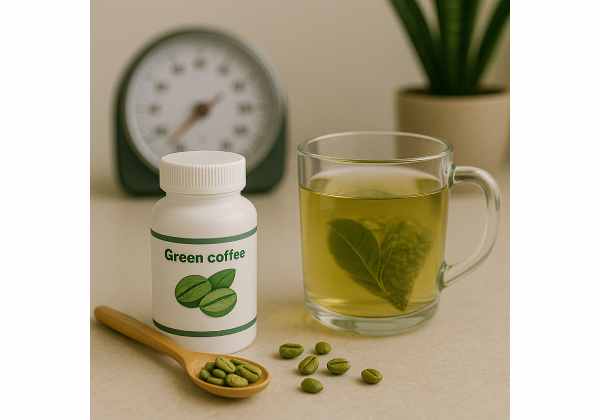
Green coffee bean extract has been promoted as a natural shortcut for fat loss for more than a decade. The sales pitch is simple: because the beans are unroasted, they retain more chlorogenic acids, and those compounds are supposed to help reduce body weight, appetite, blood sugar, or fat storage. The real evidence is less dramatic. Human studies suggest that green coffee bean extract may produce small changes in weight-related measures in some settings, but the effect is usually modest, inconsistent, and easy to exaggerate.
This review looks at what green coffee bean extract actually is, what the best trials and meta-analyses show, why the supplement became so popular, where dose and product quality complicate the picture, and when the risks or downsides outweigh the likely benefit.
Table of Contents
- What green coffee bean extract actually is
- Why the hype got ahead of the data
- What human research shows on weight loss
- How it might work and why that matters less than you think
- Dose, product quality, and label confusion
- Side effects, safety, and who should avoid it
- What is more likely to help than green coffee bean extract
What green coffee bean extract actually is
Green coffee bean extract is made from unroasted coffee beans. Before coffee is roasted, the beans contain relatively higher amounts of chlorogenic acids, a group of polyphenols often treated as the main “active” compounds in weight-loss supplements built around green coffee. Roasting changes the chemical profile of coffee, so supplement companies often present green coffee as something fundamentally different from the beverage most people drink every day.
That distinction is partly true, but it is also one reason the product is easy to oversell. Green coffee bean extract is not a single ingredient with a uniform composition. Different products vary in chlorogenic acid content, caffeine content, extraction method, dose per capsule, and overall standardization. Some products are decaffeinated or low in caffeine, while others still contain enough caffeine to matter for sleep, jitters, or heart rate in sensitive users.
The theoretical appeal is easy to understand. Chlorogenic acids have been studied for possible effects on glucose handling, fat metabolism, inflammation, and blood pressure. Those mechanisms make green coffee bean extract sound like a supplement that could quietly improve several metabolic variables at once. But “biologically plausible” and “clinically meaningful” are not the same thing.
A more grounded way to think about it is this:
- Green coffee bean extract is a supplement derived from unroasted coffee beans.
- It is usually marketed for fat loss, appetite control, blood sugar support, or metabolic health.
- Its proposed benefits are tied mostly to chlorogenic acids, not to the simple fact that it comes from coffee.
- Product quality is highly variable, which makes one brand hard to compare with another.
- Any real-world weight-loss effect, when present, tends to be small rather than dramatic.
That last point matters most. Green coffee bean extract is not in the same category as a structured diet, a well-designed exercise program, or an evidence-based medication for obesity. It sits in the much more uncertain middle ground of supplements that may have measurable effects in some trials, but not necessarily effects large enough to change a person’s trajectory in everyday life.
Why the hype got ahead of the data
Green coffee bean extract became a perfect supplement-marketing story: it sounded natural, it came from a familiar food, it had a memorable “active compound” in chlorogenic acid, and early human research looked promising enough to generate headlines. But those early signals were never strong enough to support the claims that followed.
The pattern is familiar in weight-loss supplements. A few small trials show encouraging results, marketers repeat the most flattering interpretation, and the caveats get left behind. With green coffee bean extract, the caveats were important from the start: short study durations, small sample sizes, heterogeneous products, varying doses, and risk of bias. Once those issues are taken seriously, the story becomes much less exciting.
A useful way to frame the gap between marketing and evidence is to compare common claims with what the literature actually supports:
| Claim | What the evidence suggests | Practical takeaway |
|---|---|---|
| It melts fat quickly | Human studies do not show rapid or dramatic fat loss | Expectations should be modest |
| It works even without diet changes | Most trials are short and controlled, and benefits are small | It does not replace a calorie deficit |
| It is just like drinking coffee | Supplements vary in chlorogenic acids and caffeine content | Products are not interchangeable with brewed coffee |
| It is proven for obesity treatment | The evidence is mixed and far weaker than for approved medications | It is not a primary obesity treatment |
| Natural means risk-free | Caffeine-related effects, product variability, and interactions still matter | “Natural” is not the same as harmless |
Another reason the hype lasted is that the likely effect size is just big enough to sound marketable. A difference of around 1 kilogram or a small drop in BMI can look impressive in advertising copy, especially if it is detached from the limits of the study. But for someone trying to lose 20, 40, or 60 pounds, that is not a meaningful stand-alone result.
This is why green coffee bean extract fits best into a “myth versus evidence” conversation rather than a “miracle versus scam” conversation. The myth is not that it does absolutely nothing. The myth is that it does enough to deserve center stage. It usually does not.
If you are comparing claims across supplements, it helps to know how to spot weight-loss claim red flags. Green coffee bean extract is a classic example of an ingredient with a real scientific backstory but a much weaker practical payoff than the headlines suggest.
What human research shows on weight loss
The best way to judge green coffee bean extract is not by mechanism or testimonials, but by human trials and meta-analyses.
The broad picture is this: some studies show small improvements in body weight, BMI, or related metabolic markers, but the results are inconsistent and the average effect is modest. That means the question is not simply “does it work?” The more useful question is “does it work enough to matter?”
Several review-level findings help answer that.
A 2019 systematic review and dose-response meta-analysis found a significant reduction in BMI, but not a statistically significant reduction in body weight overall. Waist circumference also did not clearly improve. That is an important result because it suggests green coffee bean extract may nudge some measurements without reliably producing a clearly visible change on the scale.
A later 2021 systematic review and meta-analysis reported a larger pattern of benefits across cardiometabolic outcomes, including reductions in body weight of about 1.24 kg and BMI of about 0.55 kg per square meter, along with improvements in some blood pressure and fasting glucose measures. That sounds more encouraging, but it still needs perspective. A loss of roughly 1.24 kg is not trivial in a paper, yet it is also not a strong clinical result for a person trying to substantially reduce body fat.
The 2023 systematic review focused more narrowly on green bean coffee extract with at least 500 mg per day of chlorogenic acid. It found a reduction in body weight of about 1.30 kg, but the meta-analysis included only three randomized trials and just over one hundred participants total. That is too small a base to justify sweeping conclusions.
A 2023 randomized controlled trial in adults with type 2 diabetes and overweight or obesity found improvements in body weight and BMI over 10 weeks, plus favorable changes in some cardiometabolic markers. But even this more positive trial does not change the broader conclusion. It suggests possible benefit in a specific population under trial conditions; it does not prove that green coffee bean extract is a dependable weight-loss tool for the general public.
The fairest summary is:
- The evidence leans toward small rather than large effects.
- Benefits may be more noticeable in people who already have overweight, obesity, or metabolic disease than in healthy lean adults.
- Weight-related improvements are often accompanied by substantial uncertainty because trials differ in product type, dose, caffeine content, duration, and participant characteristics.
- The literature is much better at showing statistical changes than it is at showing meaningful long-term body-composition transformation.
This is one reason people who use green coffee bean extract often feel confused. The supplement can be “supported by studies” and still disappoint in real life. That is not a contradiction. It is exactly what happens when average effects are small and individual products are inconsistent.
How it might work and why that matters less than you think
Green coffee bean extract is usually explained through chlorogenic acid. Proposed mechanisms include slowing glucose absorption, affecting enzymes involved in carbohydrate metabolism, improving insulin sensitivity, altering fat oxidation, and modestly influencing appetite or inflammation. Some studies also suggest effects on blood pressure or lipid handling.
These ideas are plausible, and they help explain why green coffee has attracted research interest beyond weight loss alone. But mechanism-heavy arguments often create the illusion of certainty. A supplement can influence one metabolic pathway and still fail to produce meaningful fat loss over time.
That distinction matters because body weight is not controlled by one pathway. Real fat loss depends on energy balance, appetite regulation, adherence, food environment, sleep, physical activity, muscle retention, and time. A supplement that slightly improves one variable may still be drowned out by the rest of the system.
Green coffee bean extract is also often discussed as if chlorogenic acid is the whole story. In reality, several factors can change the response:
- the amount of chlorogenic acid in the product
- whether the product contains caffeine
- the participant’s baseline weight and metabolic health
- the duration of use
- what the person is eating and doing during the study
This is why it is risky to reason from mechanism alone. Even when the biological theory sounds strong, the observed human effect may stay small.
There is also a practical issue. Supplements that work mainly through subtle metabolic shifts tend to be much less noticeable to the user than supplements that change appetite, energy, or digestion in an obvious way. That can make green coffee bean extract feel “silent,” which some people interpret as clean and effective. Often it simply means the effect is too small to notice directly.
That does not mean mechanism research is unimportant. It helps explain why green coffee bean extract remains scientifically interesting. But for someone deciding whether to buy a bottle, the mechanism should never outweigh the outcome data. And outcome data say that green coffee bean extract may have a minor supporting role at best, not a leading role.
Dose, product quality, and label confusion
One of the biggest problems with green coffee bean extract is that “dose” is not as straightforward as it sounds. Studies and products may describe the intervention in different ways:
- total extract dose per day
- chlorogenic acid dose per day
- number of capsules rather than standardized active compounds
- caffeinated versus decaffeinated extract
That is how two labels can both say “green coffee bean extract” while delivering very different products.
In clinical trials, doses often fall in the range of 400 to 1,000 mg per day of extract, sometimes with chlorogenic acid standardized at a particular percentage. Some meta-analyses focus on chlorogenic acid exposure more directly, such as at least 500 mg per day. Those are not interchangeable descriptions, which is one reason consumers can struggle to compare products with research.
A practical label-reading table helps:
| Label feature | Why it matters | What to look for |
|---|---|---|
| Total extract amount | May not reflect active chlorogenic acid content | Check whether the extract is standardized |
| Chlorogenic acid percentage | This is usually the main marketed active component | Look for a clearly stated percentage or milligram amount |
| Caffeine content | Can affect tolerance, sleep, and side effects | Do not assume it is caffeine-free |
| Serving size | The front label may describe one capsule, not the daily amount | Read the full suggested daily serving |
| Quality assurance | Supplements vary in purity and consistency | Favor clearer standardization and stronger testing practices |
This is also where marketing language tends to outrun science. Phrases like “supports fat-burning,” “targets stubborn fat,” or “metabolic activator” are much more confident than the research justifies.
For anyone considering a supplement trial, it helps to know how to read weight-loss supplement labels and why third-party testing matters. With green coffee bean extract, product variability is not a side issue. It is central to understanding why published results do not translate cleanly into predictable real-world outcomes.
Side effects, safety, and who should avoid it
Green coffee bean extract is often marketed as gentle, and compared with aggressive stimulant blends that is partly fair. But “gentle” should not be confused with “risk-free.”
The most likely problems are related to caffeine content, gastrointestinal tolerance, or supplement variability. Depending on the formulation and the person taking it, possible issues include:
- jitteriness or feeling overstimulated
- faster heart rate or palpitations
- sleep disruption
- nervousness or worsened anxiety
- stomach upset, nausea, or loose stools
- headaches in sensitive users
Some products are low in caffeine or decaffeinated, so not everyone will experience these effects. But labels are not always clear enough, and many users assume green coffee bean extract is metabolically active without being stimulant-like. That is not always true.
Safety is also about context. Someone who drinks little caffeine, has trouble sleeping, or already has anxiety may tolerate green coffee bean extract poorly even if the average study describes it as safe. On the other hand, a habitual coffee drinker might notice very little from a low-caffeine product.
The people who should be more cautious include those who are pregnant, breastfeeding, highly sensitive to caffeine, or living with uncontrolled hypertension, significant arrhythmias, or a medication regimen where stimulant-like ingredients could complicate things. Anyone with diabetes or other metabolic disease should also be more careful about assuming a supplement is benign just because it is sold over the counter.
This is one reason it is useful to compare green coffee bean extract with a more familiar caffeine-based approach. If the main perceived advantage is “a little more metabolic support,” but the cost is extra caffeine-related side effects, many people would be better off understanding how caffeine works for weight loss and where its safety limits are rather than layering another supplement into the mix.
The larger safety lesson is the same one that applies across the supplement market: products marketed for weight loss deserve more skepticism than products marketed for general nutrition. Anyone thinking about green coffee bean extract should keep it inside the broader framework of safe weight-loss planning, not treat it as a shortcut that bypasses the usual need for judgment.
What is more likely to help than green coffee bean extract
The most honest way to evaluate green coffee bean extract is by opportunity cost. If you spend time, money, and attention on it, what are you not doing instead?
For most people, the answer is clear. The biggest return still comes from fundamentals:
- creating a sustainable calorie deficit
- eating enough protein to protect lean mass
- building a food pattern that controls hunger
- increasing daily movement and structured exercise
- getting enough sleep to support appetite control and recovery
Those are not exciting, but they outperform marginal supplements over and over again.
If your plan is not yet consistent, green coffee bean extract is very unlikely to be the missing piece. A better investment would be tightening the basics with a more durable calorie deficit strategy and setting an appropriate protein intake target. Those changes are more likely to improve hunger, adherence, body composition, and long-term maintenance than a supplement that produces small average shifts in the literature.
There is also a psychological benefit to seeing green coffee bean extract clearly. Once you stop expecting “metabolic” supplements to carry the plan, it becomes easier to focus on what actually drives progress. That usually means fewer moving parts, not more.
So where does green coffee bean extract fit?
- It may be reasonable for a healthy adult who understands that the likely benefit is small.
- It is not a strong first-choice supplement for someone whose main goal is meaningful fat loss.
- It is a poor substitute for evidence-based habits and a poor substitute for proper medical care when obesity or metabolic disease is severe.
- It makes the most sense, if it makes sense at all, as a low-priority experiment rather than a core tool.
The bottom line is simple: green coffee bean extract is not pure myth, but the stronger weight-loss claims made about it usually outrun the evidence. The evidence supports a maybe. The marketing usually sells a certainty.
References
- Chlorogenic acid in green bean coffee on body weight: a systematic review and meta-analysis of randomized controlled trials 2023 (Systematic Review and Meta-Analysis)
- Effects of green coffee aqueous extract supplementation on glycemic indices, lipid profile, CRP, and malondialdehyde in patients with type 2 diabetes: a randomized, double-blind, placebo-controlled trial 2023 (RCT)
- The Effect of Green Coffee Bean Extract on Cardiovascular Risk Factors: A Systematic Review and Meta-analysis 2021 (Systematic Review and Meta-Analysis)
- The effects of green coffee extract supplementation on glycemic indices and lipid profile in adults: a systematic review and dose-response meta-analysis of clinical trials 2020 (Systematic Review and Dose-Response Meta-Analysis)
- Dietary Supplements for Weight Loss – Health Professional Fact Sheet 2022 (Fact Sheet)
Disclaimer
This article is for general educational purposes only. Green coffee bean extract can affect people differently depending on caffeine sensitivity, medical conditions, and other supplements or medications. It is not a substitute for professional medical advice, diagnosis, or treatment.
If you found this article useful, please share it on Facebook, X, or any other platform your audience uses.