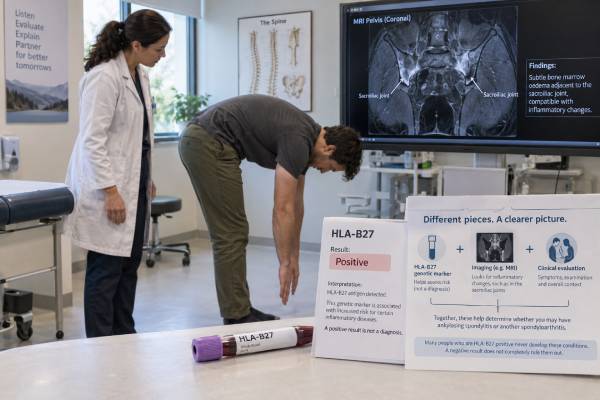
The HLA-B27 test looks for an inherited immune-system marker that is strongly associated with ankylosing spondylitis and several related forms of spondyloarthritis. A positive result can make these conditions more likely when a person has compatible symptoms, but it does not prove that inflammatory arthritis is present. Many healthy people carry HLA-B27 and never develop joint, spine, eye, skin, or bowel disease. A negative result also cannot fully rule out spondyloarthritis.
Doctors interpret HLA-B27 alongside the symptom pattern, physical examination, family history, inflammation tests, and imaging—especially magnetic resonance imaging (MRI) or X-rays of the sacroiliac joints. The test is most useful when there is a real clinical reason to suspect spondyloarthritis, such as back pain that began before age 45, prolonged morning stiffness, alternating buttock pain, heel inflammation, recurrent uveitis, psoriasis, or inflammatory bowel disease. Understanding that context prevents a genetic risk marker from being mistaken for a stand-alone diagnosis.
- A positive HLA-B27 result means the marker is present; it does not mean ankylosing spondylitis is confirmed.
- A negative result lowers the likelihood of HLA-B27-associated disease but does not exclude axial or peripheral spondyloarthritis.
- No fasting or special preparation is usually needed; the test requires a routine blood sample.
- HLA-B27 status is inherited and generally does not change, so repeat testing is rarely useful.
- Urgent eye pain, redness, light sensitivity, or sudden blurred vision needs same-day medical assessment because acute anterior uveitis can threaten vision.
Table of Contents
- What the HLA-B27 Test Measures
- Why the Test Is Ordered
- What a Positive HLA-B27 Result Means
- What a Negative Result Means
- How HLA-B27 Fits Into Diagnosis
- Testing Process, Accuracy, and Limitations
- Practical Next Steps After Testing
What the HLA-B27 Test Measures
HLA-B27 is a version of the human leukocyte antigen B protein. Human leukocyte antigens sit on the surface of many cells and help the immune system distinguish the body’s own tissues from potentially harmful material. The instructions for making these proteins come from genes inherited from biological parents.
The laboratory usually reports HLA-B27 as positive/present or negative/absent. This is not a test with a concentration that rises and falls, and there is no therapeutic or “optimal” range. A positive result simply means that the laboratory detected an HLA-B27 allele or antigen.
Laboratories may use flow cytometry, polymerase chain reaction, or another molecular typing method. Molecular testing can identify the genetic variant directly and may distinguish specific HLA-B27 subtypes when detailed typing is requested. Routine clinical evaluation usually needs only a positive or negative result because subtype testing rarely changes everyday diagnostic decisions.
HLA-B27 is especially important because it has one of the strongest known genetic associations with axial spondyloarthritis. However, the marker is not itself an inflammatory measurement. It does not show whether a joint is currently swollen, whether the sacroiliac joints are inflamed, or whether treatment is working. Tests such as C-reactive protein and erythrocyte sedimentation rate answer different questions by looking for systemic inflammation.
The marker’s frequency varies substantially by ancestry and geographic region. It is more common in some northern European and Indigenous populations and less common in many African, Asian, and Middle Eastern populations. This matters because the usefulness of a positive result depends partly on how common HLA-B27 is in the person’s background and how likely spondyloarthritis seemed before testing.
The biological link is still being studied. Leading explanations include unusual folding of the HLA-B27 protein, changes in how immune cells display small protein fragments, and interactions with gut microbes and inflammatory pathways such as interleukin-23 and interleukin-17. These mechanisms help explain why HLA-B27 is a risk factor rather than a deterministic gene: the marker may create susceptibility, while other genes, infections, mechanical stress at tendon attachments, and environmental factors influence whether disease actually appears. No clinical HLA-B27 test can determine which proposed mechanism is active in an individual person.
Why the Test Is Ordered
Doctors usually order HLA-B27 when symptoms suggest a condition in the spondyloarthritis family. These inflammatory diseases can affect the spine, sacroiliac joints, peripheral joints, tendon and ligament attachment sites, eyes, skin, or bowel.
The test may be considered when a person has chronic back pain lasting at least three months that began before age 45, particularly when the pain has inflammatory features. These include:
- Morning stiffness that improves with movement
- Pain that wakes the person during the second half of the night
- Improvement with exercise but little improvement with rest
- Alternating pain deep in the buttocks
- A clear response to nonsteroidal anti-inflammatory drugs
- Reduced spinal movement or chest expansion
HLA-B27 can also support evaluation when the main symptoms occur outside the spine. Examples include recurrent acute anterior uveitis, heel or Achilles tendon inflammation, swollen fingers or toes, unexplained arthritis in a lower limb, psoriasis, Crohn disease, ulcerative colitis, or reactive arthritis after an infection.
A clinician may combine HLA-B27 with CRP, ESR, a blood count, liver and kidney tests, and imaging in an ankylosing spondylitis blood test panel. A broader spondyloarthritis blood test panel may be more appropriate when the symptoms involve peripheral joints, entheses, skin, bowel, or eyes rather than mainly the spine.
The test is less helpful as a screening test in people without suggestive symptoms. Testing a healthy person because a distant relative has ankylosing spondylitis can create anxiety without providing a reliable prediction. Even among first-degree relatives, HLA-B27 is only one part of risk; most carriers do not develop ankylosing spondylitis.
What a Positive HLA-B27 Result Means
A positive result means that HLA-B27 was detected. Its clinical meaning depends on the reason for testing.
In a person with classic inflammatory back pain, sacroiliac tenderness, a strong family history, or typical MRI changes, HLA-B27 can add meaningful support to a diagnosis of axial spondyloarthritis. In a person with nonspecific back pain and no other suggestive features, the same result may be an incidental inherited finding.
Ankylosing spondylitis—now commonly described as radiographic axial spondyloarthritis—has a particularly strong association with HLA-B27. In many populations of European ancestry, roughly 80% to 95% of people with ankylosing spondylitis are HLA-B27 positive. The proportion can be much lower in other populations, so a fixed percentage should never be applied to everyone.
The reverse relationship is far weaker: only a minority of HLA-B27-positive people develop ankylosing spondylitis or another spondyloarthritis. In many estimates, the lifetime risk of ankylosing spondylitis among HLA-B27-positive people in the general population is only several percent, though risk rises with a first-degree family history and compatible symptoms.
A positive result may be associated with several conditions:
| Condition | How HLA-B27 may help | What else is needed |
|---|---|---|
| Axial spondyloarthritis | Raises diagnostic likelihood when symptoms fit | History, examination, CRP/ESR, and sacroiliac imaging |
| Reactive arthritis | Can support the pattern and may relate to more persistent axial disease | Recent infection history, examination, and infection testing when indicated |
| Acute anterior uveitis | Helps explain recurrent, sudden one-eye inflammation | Urgent slit-lamp examination by an eye professional |
| Psoriatic or inflammatory bowel disease–associated arthritis | May be more common when axial features are present | Skin, nail, bowel, joint, and imaging assessment |
HLA-B27 positivity does not establish how severe disease will be. It cannot predict with certainty whether spinal fusion, eye inflammation, disability, or another complication will occur. It also does not select a specific medication by itself. Treatment decisions are based on symptoms, objective inflammation, imaging, function, prior therapies, other health conditions, and patient preferences.
What a Negative Result Means
A negative HLA-B27 result means the laboratory did not detect the marker. It may reduce the probability of axial spondyloarthritis, especially in populations where most affected people are HLA-B27 positive, but it does not rule the disease out.
HLA-B27-negative axial spondyloarthritis is well recognized. Depending on ancestry and the population studied, a substantial minority of people with radiographic or non-radiographic axial spondyloarthritis do not carry HLA-B27. Women, people from populations with a lower background frequency of the allele, and people with psoriasis- or bowel-associated disease may be diagnosed despite a negative result.
A negative test deserves particular caution when symptoms are persuasive. Examples include inflammatory back pain that started in early adulthood, MRI evidence of active sacroiliitis, psoriasis with spinal symptoms, Crohn disease with heel or sacroiliac pain, recurrent uveitis, or a first-degree relative with spondyloarthritis.
Sometimes the result is negative because a screening method did not identify a rare subtype. Modern molecular methods make this uncommon, but the laboratory method and report should be checked when the clinical picture is unusually strong or the result conflicts with earlier testing.
A negative result also does not distinguish mechanical back pain from inflammatory back pain by itself. Mechanical pain is more likely to follow strain, worsen with particular movements, and improve with rest, but overlap is common. Diagnosis requires the full pattern rather than one laboratory marker.
How HLA-B27 Fits Into Diagnosis
There is no single blood test for ankylosing spondylitis or axial spondyloarthritis. Diagnosis is a clinical judgment that combines symptoms, examination findings, laboratory results, and imaging.
HLA-B27 appears in classification criteria used in research, including the Assessment of SpondyloArthritis international Society framework. These criteria can help organize evidence, but they are not a substitute for a physician’s diagnosis. Classification rules are designed to create consistent study groups and can misclassify individuals when used mechanically.
A diagnostic evaluation often includes the following elements:
- Symptom pattern. The clinician asks when pain began, whether activity improves it, whether it interrupts sleep, and whether there are eye, skin, bowel, tendon, or peripheral joint symptoms.
- Physical examination. Spinal mobility, chest expansion, sacroiliac provocation, swollen joints, entheses, skin, nails, and eyes may be assessed.
- Inflammation markers. CRP and ESR may be elevated, but normal values are common and do not exclude active disease.
- Imaging. Pelvic X-rays can show structural sacroiliitis in established disease. MRI can detect active inflammation before definite X-ray changes appear, although MRI findings must be interpreted carefully because strain, childbirth, aging, and other conditions can mimic sacroiliitis.
- Alternative diagnoses. Clinicians consider disc disease, osteoarthritis, fibromyalgia, infection, fracture, gout, rheumatoid arthritis, inflammatory bowel disease, and other causes based on the presentation.
The distinction between radiographic and non-radiographic axial spondyloarthritis depends on whether definite structural sacroiliitis appears on plain X-ray—not on HLA-B27 status. A person may have active inflammatory disease and a positive HLA-B27 result while X-rays remain normal.
HLA-B27 is not useful for monitoring disease activity. Once a person’s status is known, repeating it does not show whether inflammation has improved. Monitoring relies on symptoms, function, physical findings, validated disease-activity scores, CRP, and imaging in selected situations.
Testing Process, Accuracy, and Limitations
The HLA-B27 test usually requires a small blood sample from a vein in the arm. Fasting is not generally required, and medications do not usually need to be stopped. The collection itself takes only a few minutes. Bruising, brief soreness, lightheadedness, or rarely infection at the needle site are the main procedural risks.
Results may return within a few days, although timing depends on whether the sample is tested locally or sent to a reference laboratory. Reports may use wording such as “positive,” “detected,” “present,” “negative,” or “not detected.”
The analytical test is usually reliable, but its diagnostic accuracy is a different issue. A technically correct positive result can still be clinically unimportant because healthy people carry HLA-B27. Likewise, a technically correct negative result can occur in someone who truly has spondyloarthritis.
The largest interpretation mistakes are predictable:
- Treating a positive result as proof of ankylosing spondylitis
- Treating a negative result as proof that inflammatory disease is absent
- Ordering the test for ordinary back pain without examining the symptom pattern
- Repeating the test to monitor a flare or treatment response
- Ignoring ancestry-related differences in HLA-B27 frequency
- Using classification criteria as an automatic diagnostic calculator
- Delaying eye care while waiting for a rheumatology appointment
Direct-to-consumer genetic results deserve extra care. Some consumer platforms infer HLA-related markers from selected variants rather than performing clinical HLA typing. A medical laboratory may need to confirm the finding before it influences care.
Because HLA-B27 is inherited, relatives may ask whether they should be tested. Routine testing of children or symptom-free family members is usually not recommended. The result cannot predict exactly who will develop disease, when symptoms would begin, or how severe they would be. Symptom awareness and timely medical assessment are often more useful than predictive testing alone.
Practical Next Steps After Testing
The most useful next step is to interpret the result with the symptoms that led to testing.
For a positive result with suggestive symptoms, discuss whether rheumatology referral, sacroiliac imaging, CRP/ESR testing, or assessment for psoriasis, bowel inflammation, enthesitis, and uveitis is appropriate. Bring a timeline of symptoms, note whether exercise or rest changes the pain, and record any family history of ankylosing spondylitis, psoriasis, uveitis, or inflammatory bowel disease.
For a positive result without symptoms, treatment is not needed solely because HLA-B27 is present. There is no proven preventive medicine for healthy carriers. Seek evaluation if persistent inflammatory-type back pain, unexplained joint swelling, heel pain, recurrent eye inflammation, psoriasis, or prolonged bowel symptoms develop.
For a negative result with ongoing suspicion, ask what evidence still supports or argues against spondyloarthritis. MRI, examination findings, extra-articular symptoms, and the pattern over time may matter more than the genetic result. A negative HLA-B27 result should not end the evaluation when objective inflammation or a classic history is present.
Certain symptoms need faster action. A hot, severely painful, swollen joint with fever may indicate infection and requires urgent assessment. Sudden eye pain, redness, light sensitivity, or blurred vision may represent acute anterior uveitis and needs same-day eye care. New weakness, numbness around the groin, loss of bladder or bowel control, or severe back pain after trauma also requires emergency evaluation.
Questions worth asking at the follow-up visit include:
- What was my pretest likelihood of spondyloarthritis, and how did this result change it?
- Do my symptoms sound inflammatory, mechanical, or mixed?
- Do I need an X-ray, MRI, or neither at this stage?
- Are CRP and ESR useful in my case even if they were normal before?
- Could psoriasis, bowel disease, infection, or eye inflammation be part of the same condition?
- What symptoms should trigger urgent care or a rheumatology referral?
The key is to treat HLA-B27 as one piece of evidence. Used in the right clinical setting, it can shorten the route to an accurate diagnosis. Used alone, it can either create unnecessary fear or provide false reassurance.
References
- HLA-B27 antigen 2025 (Official Page)
- Diagnosis and Treatment of Ankylosing Spondylitis 2024 (Review)
- [The role of HLA-B27 in the pathogenesis and diagnosis of axial spondyloarthritis : 50 years after discovery of the strong genetic association] 2024 (Review)
- ASAS-EULAR recommendations for the management of axial spondyloarthritis: 2022 update 2023 (Guideline)
- Ankylosing spondylitis risk factors: a systematic literature review 2022 (Systematic Review)
- Ankylosing spondylitis 2022 (Official Page)
Disclaimer
This article is for general education and does not diagnose ankylosing spondylitis or another spondyloarthritis. HLA-B27 results must be interpreted with symptoms, examination findings, laboratory tests, and imaging by a qualified clinician. Seek urgent care for a hot swollen joint with fever, new neurologic symptoms, or sudden painful red-eye symptoms with light sensitivity or vision change.