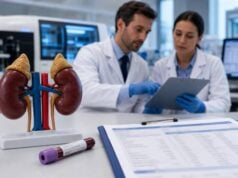
Kidney injury molecule-1, usually shortened to KIM-1, is a marker of injury in the kidney’s tubules, especially the proximal tubules that help reclaim water, minerals, glucose, amino acids, and other filtered substances. When these tubular cells are stressed or damaged, they can produce more KIM-1, and part of the molecule may appear in urine or blood. That makes KIM-1 different from traditional kidney markers such as creatinine, which mainly reflect filtration rather than direct cell injury.
A KIM-1 test is not yet a routine kidney blood test for most people. It is used more often in research, clinical trials, drug safety monitoring, and some specialized kidney evaluations. A high result can suggest tubular kidney injury, but it does not diagnose the cause by itself. Results need to be interpreted alongside symptoms, urine output, medication history, creatinine, eGFR, urinalysis, and other kidney markers.
- KIM-1 measures kidney tubular injury, most often injury affecting proximal tubule cells.
- High KIM-1 usually suggests recent or ongoing kidney cell stress, but it does not identify the exact cause on its own.
- There is no single universal normal range for KIM-1, because assays, sample types, and reporting units vary by laboratory.
- Urine KIM-1 is commonly used in studies of acute kidney injury, often reported as concentration or normalized to urine creatinine.
- Low or undetectable KIM-1 is usually expected in healthy kidneys, but a low result does not rule out all kidney problems.
- Urgent care is needed for low urine output, swelling, confusion, shortness of breath, chest pain, severe dehydration, or very abnormal potassium or creatinine.
Table of Contents
- What KIM-1 Measures in the Kidney
- When a KIM-1 Test May Be Used
- Sample Types, Preparation, and Reporting Units
- Normal Range, High Results, and Low Results
- Common Causes of High KIM-1
- KIM-1 Compared With Other Kidney Markers
- Follow-Up After Abnormal KIM-1 Results
- Limitations and Future Use of KIM-1 Testing
What KIM-1 Measures in the Kidney
KIM-1 is a protein found at very low levels in healthy kidney tissue. Its full scientific name is kidney injury molecule-1, and it is also known as HAVCR1 or TIM-1. The name matters because it describes where the marker becomes important: kidney cells start producing much more KIM-1 after injury, especially in the proximal tubules.
The proximal tubules sit just after the kidney’s filtering units. Their job is demanding. They handle a large amount of filtered fluid, reabsorb useful substances, manage acid-base balance, and process many medications and toxins. Because they work so hard, they are vulnerable to low blood flow, oxygen shortage, inflammation, sepsis, contrast dye, and drug-related toxicity.
When proximal tubular cells are injured, KIM-1 rises on the cell surface. Part of the molecule can be shed into urine, where it may be detected by laboratory assays. Blood or plasma KIM-1 can also be measured, but urine KIM-1 has been especially studied because tubular cells release the marker into the urinary space.
KIM-1 is often described as a damage biomarker rather than a function biomarker. That distinction is important.
A function marker shows how well the kidneys are doing a job. Serum creatinine, for example, is used to estimate kidney filtration. A damage marker points more directly to tissue stress or injury. KIM-1 may rise before creatinine clearly changes in some forms of acute kidney injury, because damaged tubule cells can release markers before overall filtration drops enough to affect blood creatinine.
This does not make KIM-1 a replacement for standard kidney tests. It gives a different type of information. A person can have tubular injury with only mild early changes in creatinine, or they can have reduced filtration from chronic kidney disease without KIM-1 being the main marker used for day-to-day monitoring. The most useful interpretation comes from combining KIM-1 with clinical context and standard kidney markers such as creatinine, eGFR, urine findings, and medication history.
When a KIM-1 Test May Be Used
A KIM-1 test is most useful when the concern is kidney tubular injury rather than routine screening. In everyday medical care, many clinicians still rely on creatinine, eGFR, blood urea nitrogen, electrolytes, urinalysis, urine albumin, and imaging when needed. KIM-1 is more likely to appear in specialized settings, research studies, hospital protocols, kidney injury panels, or drug safety monitoring.
KIM-1 has been studied in acute kidney injury, often called AKI. AKI means kidney function worsens over hours to days. It can happen after major surgery, severe infection, shock, dehydration, heart failure, urinary blockage, toxin exposure, or medication-related injury. Standard AKI definitions rely mainly on a rise in serum creatinine and a drop in urine output. KIM-1 adds a possible signal of tubular damage.
A clinician or researcher may measure KIM-1 in situations such as:
- suspected acute kidney injury before creatinine has clearly peaked
- monitoring kidney stress after cardiac surgery or major vascular surgery
- sepsis or critical illness with risk of kidney damage
- possible nephrotoxic medication exposure
- transplant research, including delayed graft function
- clinical trials of drugs that may affect the kidneys
- chronic kidney disease studies focused on tubular injury
- autoimmune or inflammatory kidney disease research
- evaluation of kidney injury markers in occupational or environmental exposures
KIM-1 can also be part of multi-marker panels. A single kidney biomarker rarely tells the whole story. The kidney has several compartments, including glomeruli, tubules, blood vessels, and interstitial tissue. Different markers may reflect different injury patterns. For example, NGAL testing is another kidney injury marker studied in AKI, while cystatin C is often used as an alternative filtration marker for estimating kidney function.
KIM-1 may be especially helpful when the clinical question is, “Are the kidney tubules injured?” It is less useful as a stand-alone answer to, “What disease does this person have?” A high KIM-1 result can raise suspicion for tubular injury, but it cannot separate dehydration from sepsis, drug toxicity, obstruction, or ischemic injury without more information.
Sample Types, Preparation, and Reporting Units
KIM-1 can be measured in urine or blood, depending on the assay and reason for testing. Urine testing is common in AKI research because KIM-1 is released from injured tubular cells into the urine. Blood or plasma testing has also been studied, especially in chronic kidney disease and risk prediction research.
Most KIM-1 tests are laboratory-developed or research-based immunoassays. An immunoassay uses antibodies designed to detect the KIM-1 protein. Because different test platforms may use different antibodies, calibration methods, sample handling steps, and reporting units, results from one lab may not match another lab exactly.
Urine KIM-1
Urine KIM-1 may be reported as a simple concentration, such as pg/mL, ng/mL, or another assay-specific unit. It may also be adjusted for urine creatinine, such as ng/mg creatinine or pg/mg creatinine. Creatinine adjustment helps account for urine dilution. A very concentrated urine sample can make many urine substances look higher, while a very dilute sample can make them look lower.
Urine timing also matters. In AKI studies, KIM-1 may be measured at baseline, after surgery, during intensive care admission, or at selected time points after an exposure. The result depends partly on when the sample is collected relative to the kidney insult.
Blood or plasma KIM-1
Blood KIM-1 is less familiar to most patients but has been studied in acute and chronic kidney injury. It may reflect kidney injury signals that enter the circulation, and research has linked higher plasma KIM-1 with worse kidney outcomes in some CKD populations. It is still not used like a routine kidney function blood test panel in standard primary care.
Preparation
Most KIM-1 testing does not require fasting unless it is ordered with other tests that do. The most important preparation is giving the lab and clinician accurate context. Medication use, recent contrast imaging, infection, surgery, exercise extremes, dehydration, and known kidney disease can all change interpretation.
Before testing, a clinician may ask about:
- recent hospital admission or surgery
- fever, infection, vomiting, diarrhea, or low blood pressure
- nonsteroidal anti-inflammatory drugs such as ibuprofen or naproxen
- antibiotics or antivirals with kidney toxicity risk
- chemotherapy, immunosuppressants, or contrast dye exposure
- urine output changes
- swelling, shortness of breath, or blood in urine
- known CKD, diabetes, hypertension, or heart failure
KIM-1 should not be interpreted as a home wellness score. It is a context-dependent kidney injury marker.
Normal Range, High Results, and Low Results
There is no single normal KIM-1 range that applies to every person, every sample type, and every laboratory. This is one of the most important points for interpreting results. KIM-1 assays are not as standardized as routine tests such as sodium, potassium, creatinine, or blood urea nitrogen.
Some research studies find very low or nearly undetectable KIM-1 levels in healthy controls. Other studies report measurable values, especially when sensitive assays are used. Results may also differ by age, sex, urine concentration, kidney function, albuminuria, diabetes, inflammatory disease, and the specific lab method.
A KIM-1 result should be compared with the reference interval, decision limit, or study threshold supplied by the laboratory that performed the test. If the report does not provide a reference range, the ordering clinician may need to interpret the number based on the assay, population, and clinical question.
| Result pattern | What it may suggest | What to check next |
|---|---|---|
| Low or undetectable KIM-1 | No clear signal of KIM-1-related tubular injury at that time | Creatinine, eGFR, urine output, urinalysis, and symptoms if kidney disease is still suspected |
| Mildly elevated KIM-1 | Possible early, mild, or resolving tubular stress | Trend over time, hydration status, medications, urine albumin, and repeat kidney panel |
| Clearly elevated KIM-1 | More concerning tubular injury signal, especially if kidney function or urine output is changing | AKI evaluation, medication review, electrolytes, urinalysis, imaging if obstruction is possible |
| Rising KIM-1 over serial tests | Possible worsening or ongoing tubular injury | Urgent review if paired with rising creatinine, low urine output, high potassium, acidosis, or severe illness |
| Falling KIM-1 after a known injury | Possible improvement in tubular injury signal | Confirm recovery with kidney function, urine output, and clinical status |
A high KIM-1 result is not the same as kidney failure. It is a signal that tubular cells may be injured or stressed. Some people with high KIM-1 may have normal or only mildly abnormal creatinine at the time of testing. Others may already meet AKI criteria because creatinine has risen or urine output has dropped.
A low KIM-1 result is usually reassuring for that specific marker, but it does not rule out every kidney problem. Glomerular diseases, vascular kidney problems, urinary blockage, early hemodynamic changes, or chronic kidney disease may still require evaluation. A person can have a low KIM-1 and still have an abnormal eGFR, urine albumin, urine sediment, or imaging study.
For routine kidney assessment, clinicians usually still start with creatinine, eGFR, blood urea nitrogen, electrolytes, urinalysis, and urine albumin-to-creatinine ratio. KIM-1 may add information when tubular injury is the concern.
Common Causes of High KIM-1
High KIM-1 points toward tubular kidney injury, but the cause depends on the clinical setting. The same elevated result can mean different things in a patient after cardiac surgery, a person with sepsis, a transplant recipient, or someone taking a kidney-toxic medication.
Acute kidney injury
AKI is one of the main settings where KIM-1 has been studied. Tubular cells can be injured when kidney blood flow drops, oxygen delivery falls, inflammation rises, or toxic substances directly affect the nephron. KIM-1 may rise after ischemic injury, where the kidney receives too little blood or oxygen for a period of time.
Examples include severe dehydration, shock, major surgery, blood loss, heart failure flare, or sepsis. In these situations, the kidneys may initially receive less effective blood flow. If the stress continues, tubular cells can become injured, and KIM-1 may increase.
Sepsis and critical illness
Sepsis can harm the kidneys through inflammation, changes in small blood vessels, altered oxygen use, low blood pressure, and exposure to multiple medications. A high KIM-1 in this setting may reflect tubular injury, but it must be interpreted with urine output, creatinine trends, fluid balance, blood pressure, infection severity, and electrolyte results.
In intensive care, one abnormal biomarker rarely drives treatment alone. Clinicians focus on stabilizing circulation, treating infection, avoiding additional kidney insults, adjusting drug doses, and deciding whether kidney replacement therapy is needed.
Medication-related kidney toxicity
Some medicines can stress or injure kidney tubules, especially in people with CKD, dehydration, older age, heart failure, or exposure to multiple nephrotoxic drugs. Examples include certain antibiotics, antivirals, chemotherapy agents, calcineurin inhibitors, and high or prolonged use of nonsteroidal anti-inflammatory drugs. Drug levels may be monitored for medicines such as gentamicin or vancomycin because excessive exposure can raise kidney risk.
KIM-1 has been used in drug development and safety research because it can signal tubular injury. In routine care, medication decisions still rely on the whole clinical picture, including creatinine, urine output, drug levels when available, and whether safer alternatives exist.
Chronic kidney disease and albuminuria
KIM-1 is not only an acute injury marker. Research has also connected higher blood or urine KIM-1 with chronic kidney disease, albuminuria, tubular stress, and risk of progression in some populations. Chronic kidney disease is often monitored with eGFR and urine albumin, but those markers do not fully describe tubular injury.
In CKD, a high KIM-1 may suggest ongoing tubulointerstitial damage. That can occur alongside diabetes, high blood pressure, autoimmune kidney disease, inherited kidney disease, or long-standing protein leakage into urine. It does not replace CKD staging, but it may help researchers understand risk and mechanisms.
Autoimmune and inflammatory kidney disease
KIM-1 may rise in some inflammatory kidney diseases where tubules and the surrounding interstitial tissue are involved. For example, tubulointerstitial injury can occur in vasculitis, interstitial nephritis, lupus-related kidney disease, and other inflammatory conditions. In these cases, urine findings such as blood, protein, casts, or white cells may be just as important as biomarker results.
Obstruction and other kidney stress
A urinary blockage from a stone, enlarged prostate, tumor, or scar tissue can raise pressure inside the urinary tract and damage kidney tissue if not relieved. KIM-1 may be abnormal in some obstructive injury patterns, but imaging is usually more important when obstruction is suspected. Symptoms such as flank pain, inability to urinate, fever, or severe nausea need prompt evaluation.
KIM-1 Compared With Other Kidney Markers
KIM-1 is easiest to understand when compared with familiar kidney tests. Traditional markers still guide most clinical decisions because they are standardized, widely available, inexpensive, and linked to clear diagnostic criteria. KIM-1 may add value by showing tubular injury, but it does not replace the basics.
| Marker | Main information it gives | Strength | Limitation |
|---|---|---|---|
| KIM-1 | Tubular injury signal, especially proximal tubule stress | May detect kidney cell injury before major filtration change in some settings | No universal normal range; not routine in many clinics |
| Creatinine | Waste product used to estimate filtration | Widely available and central to AKI and CKD assessment | Can lag behind early injury and is affected by muscle mass |
| eGFR | Estimated kidney filtration rate | Useful for CKD staging and medication dosing | Less reliable during rapidly changing AKI |
| BUN | Urea nitrogen level influenced by kidney function, hydration, protein intake, and bleeding | Helpful when interpreted with creatinine and clinical context | Less specific for kidney injury |
| Urine albumin | Protein leakage, often reflecting glomerular or vascular kidney risk | Strong long-term CKD and cardiovascular risk marker | Does not directly measure tubular injury |
| NGAL | Kidney injury and inflammatory signal | Studied in AKI, critical illness, surgery, and pediatrics | Can be influenced by inflammation and infection |
| Electrolytes | Sodium, potassium, chloride, bicarbonate, and related fluid/acid-base status | Essential for safety and urgent treatment decisions | May be abnormal for many reasons beyond kidney injury |
Creatinine and eGFR answer a filtration question. KIM-1 answers more of a tissue-injury question. Electrolytes answer a safety and balance question. Urinalysis answers a pattern-recognition question by looking for blood, protein, casts, infection signs, and concentration.
This is why clinicians often order several tests together. A high KIM-1 with rising creatinine, falling urine output, abnormal urinalysis, and disturbed electrolyte panel results is more concerning than an isolated mild KIM-1 elevation in a stable person with normal kidney function and no symptoms.
Potassium deserves special attention. Kidney injury can cause potassium to rise, and high potassium can affect heart rhythm. A KIM-1 result itself does not show potassium danger, so clinicians still need direct potassium measurement when AKI is suspected.
Follow-Up After Abnormal KIM-1 Results
The right follow-up depends on how high the result is, why the test was ordered, and whether the person is sick. A KIM-1 result in a research study may not require the same response as a high result in a hospitalized patient with low urine output.
A clinician may repeat KIM-1 if the goal is to track injury over time. Trends can be more useful than a single value. A rising pattern may suggest ongoing injury, while a falling pattern may fit recovery. Still, trends must be matched with creatinine, urine output, vital signs, and other laboratory results.
Common follow-up tests may include:
- serum creatinine and eGFR
- blood urea nitrogen
- sodium, potassium, chloride, bicarbonate, calcium, magnesium, and phosphorus
- urinalysis with microscopy
- urine albumin-to-creatinine ratio or protein-to-creatinine ratio
- urine culture if infection is possible
- medication levels when relevant
- kidney ultrasound if obstruction, stones, or structural disease is possible
- autoimmune, infection, or toxin testing when history suggests it
Medication review is often one of the most useful steps. A clinician may adjust doses for kidney function, pause avoidable nephrotoxins, review nonprescription pain relievers, or check whether contrast dye, antibiotics, antivirals, chemotherapy, or transplant medicines contributed.
Hydration status also matters, but “drink more water” is not always the right answer. Some people with dehydration need fluids. Others with heart failure, advanced kidney disease, or fluid overload may worsen with excess fluids. The best plan depends on blood pressure, weight changes, swelling, urine output, sodium level, and heart or liver disease.
Urgent evaluation is important when kidney injury may be severe or fast-moving. Seek prompt medical care for:
- very low urine output or inability to urinate
- new confusion, severe weakness, fainting, or severe drowsiness
- shortness of breath or rapid swelling
- chest pain, palpitations, or severe muscle weakness
- persistent vomiting or diarrhea with dehydration
- fever, chills, low blood pressure, or suspected sepsis
- severe flank pain, especially with fever or reduced urination
- known high potassium, severe acidosis, or rapidly rising creatinine
A high KIM-1 result should not be managed in isolation. The safest question is not only “Why is KIM-1 high?” but also “Is kidney function stable, are electrolytes safe, and is the cause reversible?”
Limitations and Future Use of KIM-1 Testing
KIM-1 is promising, but it has clear limitations. The biggest issue is standardization. Routine tests such as creatinine and potassium have established methods, widely recognized reference ranges, and clear clinical thresholds. KIM-1 testing varies more across platforms and studies. Differences in sample type, timing, storage, units, and cutoff values can change interpretation.
Another limitation is specificity. KIM-1 is more kidney-tubule focused than many general markers, but it still does not identify the cause of injury. Ischemia, sepsis, drugs, toxins, inflammation, proteinuric disease, and chronic tubular stress may all raise it. That makes KIM-1 useful as a signal, not a final diagnosis.
Timing can also confuse interpretation. A sample collected too early may miss a rise. A sample collected late may show a marker that is already falling or may reflect ongoing repair rather than new injury. In AKI, creatinine, urine output, KIM-1, NGAL, cystatin C, and other markers may change on different timelines.
Patient differences matter too. Age, CKD stage, albuminuria, diabetes, body size, urine concentration, and critical illness can affect biomarker levels. A cutoff that performs well after cardiac surgery may not perform the same way in sepsis, transplant medicine, outpatient CKD, or children.
Despite these limits, KIM-1 has strong scientific appeal because it reflects biology that routine filtration markers miss. Future use may be strongest in panels rather than as a single test. A kidney injury panel could combine functional markers, damage markers, inflammation markers, and clinical risk scores to detect injury earlier and estimate the chance of recovery or progression.
KIM-1 may also remain important in drug development. Detecting kidney injury earlier in clinical trials can help researchers identify nephrotoxicity, adjust dosing, protect participants, and decide whether a drug needs more safety evaluation. This is different from using KIM-1 as a routine screening test in healthy people.
For patients, the most practical interpretation is simple: KIM-1 can show kidney tubular stress, but it needs context. A high result deserves careful review, especially if creatinine is rising, urine output is falling, electrolytes are abnormal, or the person is acutely ill. A normal result may be reassuring, but it does not replace standard kidney evaluation when symptoms or other tests are concerning.
References
- Kidney injury molecule 1 in the early detection of acute kidney injury-a systematic review and meta-analysis 2025 (Systematic Review)
- Biomarkers in acute kidney injury 2024 (Review)
- Systematic Review of Kidney Injury Biomarkers for the Evaluation of CKD of Uncertain Etiology 2024 (Systematic Review)
- Plasma and Urinary KIM-1 in Chronic Kidney Disease: Prognostic Value, Associations with Albuminuria, and Implications for Kidney Failure and Mortality 2025 (Cohort Study)
- Sepsis-associated acute kidney injury: consensus report of the 28th Acute Disease Quality Initiative workgroup 2023 (Consensus Report)
- Reviews: Qualification of Biomarker: clusterin (CLU), Cystatin-C (CysC), Kidney Injury Molecule-1 (KIM-1), N-acetyl-beta-D-glucosaminidase (NAG), Neutrophil Gelatinase-Associated Lipocalin (NGAL), and osteopontin (OPN) 2020 (Official Page)
Disclaimer
KIM-1 testing is a specialized kidney injury marker and should not be used to diagnose or treat kidney disease without medical guidance. A high KIM-1 result needs interpretation with kidney function tests, urine findings, symptoms, medications, and the reason the test was ordered. Seek urgent medical care for sharply reduced urination, severe illness, shortness of breath, confusion, chest pain, or known dangerous electrolyte abnormalities.