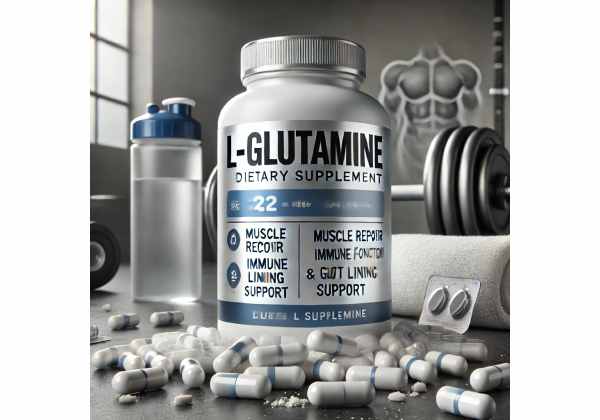
L-glutamine is often marketed for gut support, exercise recovery, and immune function, but its connection to brain health is what makes it especially interesting. Glutamine is the most abundant amino acid in the body, and in the brain it serves as a key precursor for both glutamate and GABA, the main excitatory and inhibitory neurotransmitters. That role gives it real biological relevance to mood, cognition, stress response, and mental resilience. At the same time, biological relevance is not the same as proven clinical benefit. The strongest human evidence for L-glutamine supplementation still centers on gut and medical nutrition settings, while direct evidence for better mood, sharper memory, or improved focus remains limited. That makes it a supplement worth understanding carefully rather than one to approach with broad expectations. This article explains how L-glutamine works in the brain, where it may support mental wellness, who may benefit most, how it is used, and what safety issues deserve attention.
Table of Contents
- How L-glutamine Connects to the Brain
- What Benefits Are Realistically Possible
- The Gut-Brain Angle
- Who May Consider L-glutamine
- Dosage, Forms, and Timing
- Safety, Side Effects, and Cautions
How L-glutamine Connects to the Brain
L-glutamine is not a classic nootropic, but it does sit close to some of the brain’s most important pathways. In the central nervous system, glutamine is a major part of the glutamate-glutamine cycle, the metabolic shuttle that helps neurons and astrocytes recycle neurotransmitter material. In simple terms, glutamine helps replenish glutamate and GABA, two signaling molecules that shape attention, learning, emotional regulation, stress response, and the balance between excitation and inhibition.
That sounds like a strong reason to assume supplementation should improve mood or cognition. The reality is more restrained. A nutrient can be essential to a system without producing major benefits when taken in extra amounts. The brain tightly regulates glutamine transport and neurotransmitter balance, so swallowing more L-glutamine does not automatically mean a large or predictable change in brain signaling.
Still, the biology matters because it explains why researchers remain interested. L-glutamine may influence mental wellness through several overlapping pathways:
- as a precursor in glutamate and GABA metabolism
- as a fuel source for rapidly dividing cells, especially in the gut and immune system
- as a contributor to nitrogen transport and metabolic balance
- as a substrate linked to antioxidant defenses through glutathione-related pathways
- as a possible support for stress recovery when illness, inflammation, or metabolic strain are present
The brain relevance becomes more plausible under conditions of stress rather than in a perfectly healthy, well-rested adult. That is one reason glutamine shows up in discussions of illness, inflammation, intense physical stress, and gut barrier function more often than in mainstream cognitive-enhancement research. If a person’s nervous system is being affected indirectly by poor recovery, chronic physiological stress, or intestinal dysfunction, L-glutamine may matter more as a supportive nutrient than as a direct brain booster.
This also helps explain why the evidence can feel mixed. Mechanistically, L-glutamine is important. Clinically, direct human trials on depression, anxiety, memory, or focus are sparse. The gap between “important in theory” and “proven in practice” is where a lot of supplement confusion begins.
A practical way to think about L-glutamine is that it supports terrain more than performance. It may help maintain the conditions that allow the brain and body to function well, especially when those conditions are under pressure. That is a legitimate role, but it is different from the promise of an immediate increase in alertness or mental speed. Readers looking for a fast effect often expect too much from glutamine, while readers interested in resilience, recovery, and systems support tend to frame it more accurately.
What Benefits Are Realistically Possible
When people search for L-glutamine and brain health, they are usually looking for one of four outcomes: better focus, better mood, less stress, or clearer thinking. The most honest answer is that L-glutamine has plausible links to all four, but the direct human evidence is still too limited to make strong promises.
The strongest case for glutamine is not that it reliably improves cognition in healthy adults. It is that glutamine homeostasis matters to emotional and cognitive function, and disturbances in glutamatergic systems are relevant to several brain disorders. That is meaningful, but it does not prove that routine supplementation improves day-to-day mental performance for most people.
Where might benefits show up in real life?
- Stress-related mental fatigue: Some people under heavy physical or metabolic stress may feel better overall when recovery improves, and that can include mental steadiness.
- Cognitive resilience under strain: There is some early and indirect support for glutamine in settings where the brain is challenged by systemic stress, but this is not yet robust evidence for general use.
- Mood support through indirect pathways: Any mood benefit is more likely to be secondary to improved recovery, gut function, or reduced physiological strain than to a direct antidepressant effect.
- Clinical or medical nutrition contexts: In certain illness-related settings, glutamine has been studied more seriously, but that is not the same as over-the-counter mental wellness use.
What L-glutamine probably does not do well is provide a noticeable, stimulant-like improvement in attention or working memory. It is unlikely to feel like caffeine, and it is not established as a front-line supplement for low mood or anxiety. Someone seeking the kind of sharper focus discussed in broader conversations about evidence-based nootropics for focus may find glutamine underwhelming if they expect a direct cognitive lift.
This is where expectation-setting matters. The best-supported way to think about L-glutamine is not as a primary cognitive enhancer but as a conditional support nutrient. If your mental wellness is being affected by poor recovery, intestinal stress, or broader physiological strain, glutamine may help at the margins. If you are healthy, well nourished, and simply hoping to think faster, the benefit may be minimal or absent.
That nuance is not a weakness. It is part of using the supplement intelligently. A supplement does not have to act dramatically to be useful. But it does need to be matched to the right problem. With L-glutamine, the most credible benefits are indirect, context-dependent, and more likely to appear over time than in a single dose. That places it in a very different category from acute performance supplements and helps explain why the science seems promising in some discussions and inconclusive in others.
The Gut-Brain Angle
If there is one path that makes L-glutamine more relevant to mental wellness, it is the gut-brain axis. Glutamine is a preferred fuel for enterocytes, the cells that line the intestine, and it plays a role in maintaining intestinal barrier integrity. That matters because the gut is not separate from mental health. Sleep, mood, focus, inflammation, and stress sensitivity can all be shaped by gut function to some extent.
This is also where the supplement’s reputation has grown. L-glutamine is often used to support gastrointestinal recovery, and the argument for brain-health relevance usually runs through that route rather than through direct neurotransmitter effects alone. The logic is straightforward:
- Gut stress and higher intestinal permeability can contribute to systemic inflammation.
- Systemic inflammation can affect energy, mood, and cognition.
- L-glutamine may support intestinal barrier function in some adults.
- Therefore, some mental benefits may occur indirectly through better gut stability.
That logic is plausible, but it still needs careful wording. It does not mean L-glutamine is a treatment for depression or anxiety. It means it may be more relevant when gut issues, recovery stress, or inflammation are part of the bigger picture.
This is where some people may notice value. For example, someone with digestive stress, poor recovery, and brain fog may be dealing with an interconnected problem rather than a purely “brain” problem. In that case, L-glutamine can make more sense than it would for someone whose only goal is to improve concentration during office work.
This indirect route also helps explain why L-glutamine is often mentioned alongside broader topics such as the gut-brain axis and mental focus. It belongs more naturally in that conversation than in a simple list of memory supplements.
At the same time, the gut-brain argument can be overused in marketing. Many things that improve gut health do not automatically create visible changes in mood or cognition. The connection is real, but it is not guaranteed or uniform from person to person. Factors such as diet quality, stress load, sleep, microbiome status, medication use, and the nature of the gut problem all matter.
The most practical interpretation is this: L-glutamine may support mental wellness best when mental symptoms overlap with digestive strain, inflammation, or recovery issues. It is less compelling as a direct brain supplement in someone with no meaningful gut or systemic stress concerns. This is a narrower use case than many labels suggest, but it is also more useful because it is rooted in a mechanism that fits real-world physiology rather than hype.
Who May Consider L-glutamine
L-glutamine is not a supplement for everyone, and it is not the first place to look for every mental wellness goal. It tends to make the most sense for people whose symptoms fit a broader recovery or gut-support picture rather than a pure neurotransmitter problem.
The clearest candidates include people with higher physiological stress or gut-related strain. That may include people recovering from heavy training, individuals with digestive stress, those under prolonged physical demand, or people whose mental fatigue seems to travel with recovery issues rather than appearing in isolation.
L-glutamine may be more worth considering when several of these are true:
- mental fatigue overlaps with digestive discomfort or poor gut tolerance
- physical stress, illness recovery, or high training load is part of the picture
- diet is inconsistent and recovery capacity feels low
- the goal is support and resilience rather than a fast mental effect
Some people also become interested in L-glutamine because of low mood or stress sensitivity during periods of heavy life strain. That is understandable, but it is important to keep the supplement in proportion. If the core problem is depression, panic, insomnia, or trauma-related stress, L-glutamine is usually not the most direct or evidence-based option. Other strategies and, when appropriate, clinical treatment matter much more. Someone whose symptoms fit broader patterns of mental fatigue and its causes often needs a wider assessment than one amino acid can provide.
It may be a poor fit for people who expect rapid cognitive enhancement, acute calm, or immediate mood elevation. Glutamine is more likely to disappoint in those scenarios because that is not where its best rationale lies.
It is also worth being careful with self-diagnosis. Many people who feel mentally slow, tired, or emotionally flat assume they need a brain supplement, but those symptoms can come from sleep debt, thyroid issues, iron deficiency, medication effects, burnout, or insufficient overall nutrition. In those cases, L-glutamine may be harmless yet irrelevant.
A good rule is to ask a simple question before using it: am I trying to improve a stressed system, or am I hoping for a direct brain effect? If the answer is the first one, L-glutamine may be worth a try. If the answer is the second, there may be better-matched options. This is one of those supplements that becomes more sensible the more specific the use case is. It becomes less convincing the more general the promise is.
Dosage, Forms, and Timing
L-glutamine is most often sold as a powder, though capsules and tablets also exist. Powder is common because the dose used in practice is often several grams, and taking that amount in capsules can be inconvenient. The plain free-form amino acid is the usual version people buy, and for most purposes there is little reason to seek a complex proprietary formula.
Unlike vitamins with a defined recommended daily allowance for routine use, L-glutamine does not have one standard mental-wellness dose. Doses in studies and consumer products vary widely depending on the goal. In general, over-the-counter use often falls in the 5 to 10 gram per day range, sometimes split into two servings. In medical settings and some research, much higher doses have been used, but that does not mean higher is automatically better for brain or mood support.
A cautious practical approach often looks like this:
- Start with a modest daily amount, such as 3 to 5 grams.
- Take it consistently for a period rather than expecting an immediate effect.
- Reassess whether the target problem has actually improved.
- Avoid escalating the dose simply because the effect is subtle.
Timing is flexible. Some people take L-glutamine between meals, especially when using it for gut support. Others take it after exercise or with food. There is no strong evidence that one exact time of day creates a special brain benefit. Consistency matters more than clock timing.
For mental wellness use, the most important dosing principle is not precision timing but realistic matching. Someone taking L-glutamine for indirect support may need days or weeks to judge whether digestion, recovery, or mental steadiness feels different. Someone taking it for a same-day productivity boost is probably using the wrong tool.
It also helps to compare L-glutamine with other supplements honestly. If your main issue is stress-related sleep disruption, something geared more directly toward rest, such as glycine for sleep and next-day clarity, may fit better. If your issue is daytime focus, glutamine is not usually the first option. If your issue is a combined picture of gut strain, recovery, and mental fatigue, glutamine becomes more interesting.
Because dosing is not standardized for mental health use, the safest habit is to keep the regimen simple: plain powder, moderate dose, one clear reason for using it, and a defined trial period. That makes it easier to tell whether it belongs in your routine or whether it is just adding complexity without providing much value.
Safety, Side Effects, and Cautions
L-glutamine is generally considered well tolerated in many adults, especially at moderate doses, but “generally well tolerated” is not the same as risk-free. Side effects are usually mild when they occur, yet the right safety question is not only “Is it safe?” but also “For whom, at what dose, and in what context?”
The most commonly reported side effects are gastrointestinal and nonspecific, including:
- bloating
- nausea
- stomach discomfort
- constipation or changes in bowel habits
- headache in some users
At moderate short-term doses, these effects are usually manageable. Still, long-term high-dose use is less settled, and that is one reason broad, indefinite supplementation is not ideal without a clear reason.
There are also some specific cautions. L-glutamine metabolism can increase ammonia handling demands, which matters in people with advanced liver disease. In that setting, glutamine may worsen hepatic encephalopathy risk and should not be treated casually. This is one of the most important medical cautions because it shows how a supplement that seems benign in healthy adults can become a poor choice in a more complex clinical context.
Extra caution also makes sense for:
- people with advanced liver disease or a history of hepatic encephalopathy
- those with severe kidney disease
- pregnant or breastfeeding individuals unless advised by a clinician
- people using L-glutamine as a substitute for evaluation of persistent cognitive or mood symptoms
- anyone taking multiple high-dose amino acid supplements at the same time
One more subtle caution is conceptual rather than toxicological. L-glutamine can sound more proven for brain health than it actually is because its mechanism is so interesting. That can tempt people to keep taking it even when it is not clearly helping. A supplement should earn its place in a routine. If the reason for using it was brain fog, low mood, or poor focus, and none of those change after a fair trial, it may not be the right fit.
That is especially true when persistent symptoms may have more obvious explanations such as sleep loss, chronic stress, or nutrient deficits. In many cases, basic foundations such as sleep, protein intake, and broader nutrition for mood and focus will matter more than glutamine alone.
The bottom line on safety is fairly balanced. L-glutamine is low-risk for many healthy adults when used sensibly, but it is not a free pass for high-dose, long-term self-experimentation. The safer path is a moderate dose, a clear goal, attention to medical context, and a willingness to stop if it does not appear useful.
References
- The Role of Glutamine Homeostasis in Emotional and Cognitive Functions 2024 (Review)
- The Glutamate/GABA‐Glutamine Cycle: Insights, Updates, and Advances 2025 (Review)
- A systematic review and meta-analysis of clinical trials on the effects of glutamine supplementation on gut permeability in adults 2024 (Systematic Review and Meta-Analysis)
- Tolerability of glutamine supplementation in older adults: a double-blind placebo-controlled randomized clinical trial 2024 (RCT)
- L-Glutamine 2021 (LiverTox Resource)
Disclaimer
This article is for educational purposes only and is not medical advice. L-glutamine may be useful in certain situations, especially when gut health, recovery, or medical nutrition issues are part of the picture, but it is not a substitute for diagnosis or treatment of depression, anxiety, cognitive decline, or other mental health concerns. People with liver disease, kidney disease, pregnancy, breastfeeding, or ongoing medical treatment should speak with a qualified clinician before using L-glutamine supplements. If your symptoms are persistent, severe, or worsening, seek professional evaluation rather than relying on supplements alone.
If you found this article helpful, please share it on Facebook, X (formerly Twitter), or any other platform you prefer.