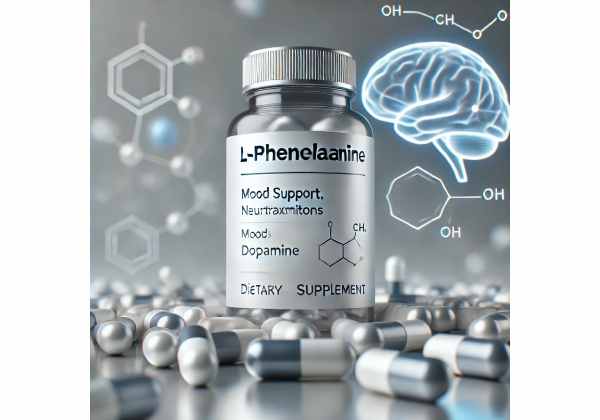
L-phenylalanine has an appealing story on paper. It is an essential amino acid, it feeds into tyrosine, and tyrosine helps the body make dopamine, norepinephrine, and other important compounds tied to alertness, motivation, and mental performance. That biochemical path is real. The harder question is whether taking extra L-phenylalanine as a supplement meaningfully improves mood, focus, or cognitive function in everyday life. This is where the topic becomes less straightforward. The mechanism is relevant, but the clinical evidence for broad brain or mental-wellness benefits is limited, older, and much weaker than many supplement claims suggest. At the same time, safety deserves real attention because phenylalanine is not suitable for everyone, especially people with phenylketonuria. This article explains what L-phenylalanine does, how it relates to brain chemistry, what the research actually supports, how dosing is usually approached, and where the main risks and cautions lie.
Table of Contents
- What L-phenylalanine does
- Why the brain cares
- What the evidence shows
- Who may consider it
- Dosage and supplement forms
- Safety and key cautions
What L-phenylalanine does
L-phenylalanine is an essential amino acid, which means your body cannot make it on its own and you must obtain it from food. In ordinary nutrition, that is not usually difficult. Protein-rich foods such as meat, dairy, eggs, fish, soy, legumes, and nuts all contribute phenylalanine. Under normal conditions, the body uses it as a building block for protein and also converts part of it into tyrosine through the enzyme phenylalanine hydroxylase. That conversion matters because tyrosine then serves as a precursor for several biologically important compounds, including dopamine, norepinephrine, epinephrine, thyroid hormones, and melanin.
This pathway is the main reason L-phenylalanine ends up in brain-health conversations. It sounds intuitive: if phenylalanine sits upstream of catecholamines, perhaps more phenylalanine means more mental energy, better focus, or a brighter mood. But biology is rarely that linear. In healthy people who already consume enough protein, the rate-limiting steps in neurotransmitter production are not simply a matter of adding more precursor. The brain regulates these pathways closely, and extra intake does not automatically translate into higher dopamine or better cognition.
That is an important point because L-phenylalanine is often marketed as though it works like a motivational lever for the brain. In reality, it functions more like raw material within a regulated system. It matters deeply for normal physiology, but that does not mean supplementation creates a noticeable brain boost. In fact, one of the most useful nuances in the research is that tyrosine, not phenylalanine, is generally the preferred immediate substrate in catecholamine synthesis when tyrosine is available in normal amounts. That helps explain why the supplement story for L-phenylalanine is much less dramatic than the pathway diagram suggests.
It is also important to separate L-phenylalanine from other forms people may encounter. D-phenylalanine is a different isomer, and DL-phenylalanine is a mixture of both forms. Older research on mood often involved DL-phenylalanine or combination treatment rather than pure L-phenylalanine, which makes many online claims sound more precise than the actual evidence. If a label says phenylalanine, the exact form matters.
For practical purposes, L-phenylalanine is best understood as a metabolically important amino acid with a plausible brain connection, not as a proven nootropic. That makes it more comparable to foundational nutrient support than to a fast-acting cognitive enhancer. Readers trying to place it in context often benefit from comparing it with more directly studied precursor compounds such as L-tyrosine for mood and focus, which sits one metabolic step closer to catecholamine synthesis.
Why the brain cares
The brain cares about L-phenylalanine because the amino acid sits upstream of several systems that affect attention, motivation, stress response, and mental performance. Once phenylalanine is converted to tyrosine, tyrosine can be used to make dopamine and norepinephrine. Those neurotransmitters help regulate effort, reward processing, vigilance, and aspects of working memory. On paper, that gives L-phenylalanine a credible neurological role. It is not a random wellness ingredient with a vague claim. It participates in chemistry the brain genuinely depends on.
Still, the pathway has to be interpreted carefully. A precursor is not the same thing as an on-switch. In everyday physiology, neurotransmitter production is shaped by multiple bottlenecks: enzyme activity, transport across the blood-brain barrier, neuronal firing patterns, stress state, and competition among large neutral amino acids. The brain does not simply turn extra dietary phenylalanine into proportionally more dopamine because a supplement label suggests it might. In fact, the research literature has long noted that tyrosine is usually the preferred substrate for catecholamine synthesis under normal conditions. Unless tyrosine is unusually low, changes in phenylalanine intake do not necessarily drive meaningful increases in catecholamine output.
This is one reason L-phenylalanine can be scientifically relevant without being a standout supplement. Its importance lies in the system, but the system is not easily pushed from above by modest extra intake. That tension between plausible mechanism and limited practical effect is the central story of the supplement.
The pathway also has a second side, and this is where safety becomes important. Phenylalanine is helpful within its normal metabolic range, but when phenylalanine accumulates excessively, it can become neurotoxic. That is what happens in phenylketonuria, a genetic disorder in which the conversion of phenylalanine to tyrosine is impaired. High blood and brain phenylalanine levels in PKU are associated with cognitive problems, mood difficulties, attention issues, and long-term neurological harm if untreated. So the same amino acid that matters for normal neurotransmitter biology can become harmful in the wrong metabolic context.
This dual nature explains why supplement discussions around phenylalanine need more caution than discussions around many mainstream vitamins. The amino acid is not inherently “stimulating” or “depressing.” Its effects depend on context, dose, metabolism, and the person using it. That is especially true if someone is already dealing with mental fatigue, low motivation, or concentration problems. In many cases, the relevant issue may not be lack of phenylalanine at all. It may be poor sleep, chronic stress, burnout, or an overload problem better explained by the broader story of dopamine, motivation, focus, and habits.
So when people ask whether L-phenylalanine supports brain health, the most accurate answer is conditional. It is essential for normal physiology and neurochemistry. That does not make extra supplementation a reliable way to improve how the brain feels or performs.
What the evidence shows
The evidence for L-phenylalanine as a brain-health or mental-wellness supplement is much thinner than the biochemical story might lead you to expect. There are older studies and theoretical reasons for interest, especially around mood. But when you look for modern, high-quality clinical evidence showing that pure L-phenylalanine reliably improves depression, focus, memory, or everyday cognitive performance, the support is limited.
Historically, some small and often poorly controlled studies suggested possible antidepressant effects from phenylalanine-related interventions. The problem is that much of this older literature involved DL-phenylalanine rather than pure L-phenylalanine, sometimes in open-label designs and sometimes in combination with other agents. That makes it hard to draw clean conclusions about L-phenylalanine itself. It also means many modern claims borrow credibility from a body of evidence that does not meet current standards for supplement recommendations.
What modern research does support more clearly is the importance of phenylalanine balance, not the idea that more is better. In phenylketonuria, high phenylalanine levels are linked with neuropsychiatric and cognitive problems. More recent work in adults with PKU suggests that phenylalanine exposure still matters for mental and cognitive outcomes, although short-term studies have shown a more nuanced picture than earlier assumptions. This is helpful context because it reminds readers that phenylalanine is a tightly regulated amino acid with a relatively narrow safe use case for supplementation.
On the safety side, one 4-week clinical trial in healthy adult men found that graded phenylalanine supplementation from 3 to 12 g per day did not produce treatment-related adverse events, and the study identified 12 g per day as a short-term no-observed-adverse-effect level under those specific trial conditions. That is useful information, but it should not be confused with a recommendation to use high doses. The study was short, it involved healthy adult males, and it tells us much more about short-term tolerability than about long-term benefit.
A separate risk assessment judged supplemental L-phenylalanine doses from 100 to 1000 mg per day unlikely to cause adverse health effects in healthy adults, while also emphasizing that the conclusions do not apply to people with phenylketonuria. Taken together, the evidence suggests that modest supplemental doses may be tolerated in healthy people, but it does not strongly support taking the supplement for measurable mood or cognitive gains.
That is the practical bottom line. L-phenylalanine has legitimate biochemical relevance, but the step from relevance to recommendation has not been strongly proven for general mental wellness. If someone is searching for a supplement to improve mood, focus, or stress resilience, they are often really entering the broader territory of nootropics and evidence, where mechanisms can sound persuasive long before outcomes are well established.
Who may consider it
L-phenylalanine is not a supplement that makes equal sense for every person interested in brain health. In fact, the best candidates are usually not people looking for a quick mental edge. Because the evidence for direct mood or cognition improvement is limited, the most reasonable use cases are narrow and cautious.
A person might consider L-phenylalanine if they have a specific nutritional reason to think amino acid intake is inadequate, if they are under professional guidance, or if they want to trial a conservative dose within a structured supplement plan rather than as a cure-all. This is especially true for people whose diet has been very low in protein or highly restrictive for a long time. Even then, the first fix is usually better overall protein intake, not a targeted phenylalanine pill.
It makes less sense for the person who wants same-day focus, higher motivation, or a direct mood lift. L-phenylalanine is not a stimulant, and it is not reliably experienced like caffeine or even tyrosine in stress-related settings. If your main problem is fogginess, low drive, or mental slowness, the more useful question is often what is causing it. Sleep debt, iron deficiency, thyroid problems, under-eating, depressive symptoms, medication effects, and chronic stress are all more common explanations than a need for isolated phenylalanine supplementation. That is why many readers get more value from working through why they feel mentally slow before adding another amino acid.
The group that clearly should not self-supplement includes anyone with phenylketonuria. For them, extra phenylalanine is not supportive. It is dangerous. Pregnancy in the context of PKU is an especially serious situation because elevated maternal phenylalanine levels can harm fetal development. That is one of the strongest reasons this supplement deserves more caution than many standard wellness products.
Other people who should be careful include:
- Anyone with a diagnosed metabolic disorder involving phenylalanine handling.
- People using complex psychiatric or neurological medications.
- Individuals with persistent anxiety, agitation, insomnia, or uncontrolled high stress.
- Pregnant or breastfeeding individuals without clinician guidance.
- Children and adolescents unless a qualified clinician advises otherwise.
Another point worth keeping in view is substitution. People sometimes reach for L-phenylalanine when they are really trying to solve attention instability, mood flattening, or stress overload. In those situations, a precursor amino acid may not be the right tool. Nutrition, sleep timing, exercise, therapy, medication review, or a different supplement category may be more aligned with the actual problem.
The best way to think about L-phenylalanine is not as a default brain supplement, but as a selective option that belongs in a narrower conversation. If there is no clear reason to use it, there is usually no strong reason to prioritize it over more established basics.
Dosage and supplement forms
L-phenylalanine is usually sold as capsules, tablets, powders, or combination formulas. Product labels often range from a few hundred milligrams per serving to about 1500 mg, though higher-dose products exist. One reason dosing can become confusing is that the research does not support a single standard brain-health dose. Instead, the available evidence gives us two different kinds of information: conservative risk-assessment ranges for healthy consumers and short-term tolerance data from much higher experimental intakes.
For general supplement use, the most relevant practical range is usually the lower one. A 2020 risk assessment concluded that 100, 250, 500, 750, and 1000 mg per day of L-phenylalanine were unlikely to cause adverse health effects in healthy adults. That is a safety-oriented conclusion, not proof of benefit. It tells you where a modest consumer dose may fit, not where the best brain effects have been demonstrated.
By contrast, a 2021 clinical tolerance study in healthy men tested 3, 6, 9, and 12 g per day for four weeks and found no treatment-related adverse events, defining 12 g per day as a short-term no-observed-adverse-effect level under study conditions. That is interesting, but it is not a practical self-supplementation target. A high short-term tolerance ceiling should never be mistaken for an optimal daily dose, especially when the clinical benefit side of the equation remains uncertain.
For most people who still want to try L-phenylalanine, a cautious approach makes more sense:
- Choose a single-ingredient product rather than a proprietary blend.
- Start with a low dose rather than assuming more is better.
- Use one clear goal, such as tracking energy steadiness or subjective motivation, instead of expecting everything to improve at once.
- Reassess after a short, defined period.
- Stop if you notice no meaningful benefit or any unwanted effects.
Timing is less clearly established than it is for some other supplements. Some people prefer taking amino acid precursors earlier in the day so they are less likely to interfere with sleep, but there is no strong universal rule for L-phenylalanine. If a person is prone to feeling wired or restless, morning use is the safer experiment. Taking it alongside a very high-protein meal may also reduce the clarity of the trial because large neutral amino acids compete with one another for transport.
One more practical point: combinations can blur the picture. Many “mood” or “focus” formulas combine phenylalanine with caffeine, tyrosine, B vitamins, or herbal stimulants. If the goal is to learn whether L-phenylalanine itself helps, mixed formulas make that much harder. People often do better when they start with simpler changes in diet and routine, especially if their larger goal is better nutrition for mood and focus rather than aggressive supplement stacking.
Safety and key cautions
Safety is where L-phenylalanine deserves more respect than its “natural amino acid” label might imply. In healthy adults without metabolic disorders, modest supplemental doses appear relatively well tolerated. A short-term tolerance trial found no treatment-related adverse events at graded doses up to 12 g per day in healthy men over four weeks, and a separate risk assessment judged 100 to 1000 mg per day unlikely to cause adverse effects in healthy adults. That is reassuring, but it does not erase the larger caution: long-term benefit is uncertain, long-term safety data are limited, and the supplement is clearly inappropriate for some people.
The most important contraindication is phenylketonuria. People with PKU cannot metabolize phenylalanine normally, so supplementation can raise blood and brain phenylalanine levels and contribute to neurological harm. This is not a minor caution. It is the central safety issue. Pregnancy affected by PKU requires especially strict medical management because elevated maternal phenylalanine can harm fetal development. Anyone with known PKU or suspected problems in phenylalanine metabolism should never self-prescribe this supplement.
Outside PKU, the safety discussion becomes more individualized. Because L-phenylalanine feeds into catecholamine-related pathways, people with anxiety-prone symptoms, insomnia, or sensitivity to activating supplements may want to be conservative. The evidence does not prove that phenylalanine commonly worsens these symptoms, but it is a reasonable practical caution when using a precursor compound tied to alertness chemistry. The same goes for people using psychiatric or neurological medications. Even when a specific interaction is not fully characterized, adding amino acid precursors without clinician guidance can complicate treatment or make symptoms harder to interpret.
A few grounded rules help keep this supplement in perspective:
- Safe short-term exposure is not the same as proven benefit.
- High-dose research ceilings are not a reason to self-dose aggressively.
- “Essential amino acid” does not mean “the more the better.”
- Protein from food is usually the first place to look before isolated amino acid supplementation.
- Any persistent mood, attention, or memory problem deserves a broader explanation than one missing supplement.
This last point matters because L-phenylalanine is easy to over-romanticize. When people feel flat, distracted, or mentally tired, they often look for a biochemical shortcut. Sometimes the real drivers are simpler and more common: sleep debt, stress overload, heavy caffeine use, or poor daily recovery. In those situations, improving the basics can matter more than adding another precursor. Readers who see a pattern of tension, restlessness, and variable focus may get more traction by stepping back and looking at caffeine, anxiety, focus, and sleep instead of expecting L-phenylalanine to fix the whole picture.
The safest conclusion is balanced. L-phenylalanine is not reckless by default, but it is also not a casual brain booster. It belongs in a careful, selective, and context-aware approach.
References
- Subchronic Tolerance Trials of Graded Oral Supplementation with Phenylalanine or Serine in Healthy Adults 2021 (Clinical Safety Study)
- European guidelines on diagnosis and treatment of phenylketonuria: First revision 2025 (Guideline)
- Cognition after a 4-week high phenylalanine intake in adults with phenylketonuria – a randomized controlled trial 2024 (RCT)
- Risk Assessment of “Other Substances” – L-phenylalanine and DL-phenylalanine 2020 (Risk Assessment)
- Tyrosine, phenylalanine, and catecholamine synthesis and function in the brain 2007 (Review)
Disclaimer
This article is for educational purposes only and is not medical advice. L-phenylalanine may not be appropriate for everyone, especially people with phenylketonuria, pregnancy affected by PKU, metabolic disorders, ongoing psychiatric symptoms, or complex medication use. Supplements should not replace diagnosis, prescribed treatment, psychotherapy, or urgent medical care. Speak with a qualified clinician before using L-phenylalanine if you have persistent mood changes, anxiety, attention problems, memory concerns, or any chronic health condition.
If you found this article useful, please share it on Facebook, X, or your preferred platform.