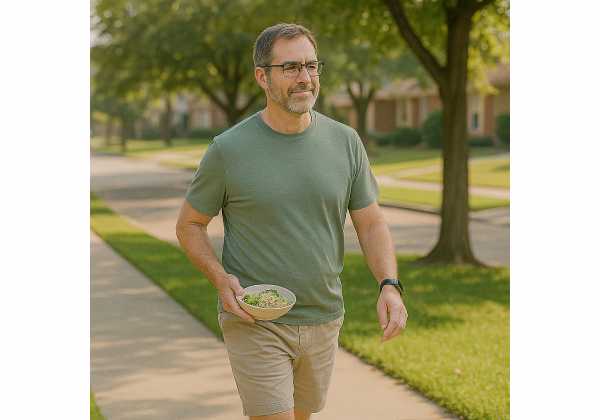
Metabolic health is shaped by far more than workouts. The body responds all day to small choices: standing up, taking stairs, carrying groceries, walking after lunch, cleaning the kitchen, or breaking up a long desk block. These movements count as NEAT, or non-exercise activity thermogenesis, the energy used for daily activity outside formal exercise. Post-meal walking is one of the most useful forms because it places movement exactly when blood glucose is rising.
A short walk after meals helps working muscle pull glucose from the blood, lowers the insulin demand of that meal, and reduces the metabolic cost of long sitting. The habit is simple enough to repeat, which is why it works well for adults focused on glucose control, insulin sensitivity, body composition, and healthy aging. Ten minutes after dinner, three minutes every half hour, and a more active home routine all move the needle when done consistently.
Table of Contents
- What NEAT and Post-Meal Walking Do
- Why Small Movements Improve Glucose
- How to Use Post-Meal Walks
- Build NEAT Into Your Day
- Adjust for Age, Fitness, and Metabolic Risk
- Track Results Without Obsessing
- Common Mistakes That Blunt Benefits
- A Simple Weekly Plan
What NEAT and Post-Meal Walking Do
NEAT includes the movement built into ordinary life. It is not gym time, sport, or a planned training session. It is the energy used for standing, pacing, housework, gardening, errands, stairs, walking between places, carrying bags, cooking, and even small body movements during the day.
That sounds minor until the pattern repeats for years. Two adults with similar body size, age, and formal exercise habits often differ greatly in total daily movement because one sits most of the day while the other keeps moving in small bursts. NEAT is one reason a person who “doesn’t work out much” still maintains better metabolic health than someone who trains three times weekly but sits for the remaining waking hours.
Post-meal walking is a targeted version of NEAT. It uses light movement after breakfast, lunch, dinner, or a carbohydrate-heavy snack to improve the body’s handling of the meal. It is not a punishment for eating and not a calorie-burning trick. It is a timing strategy: move muscle when glucose and insulin are most active.
NEAT and post-meal walking support metabolic longevity in several ways:
- They reduce long unbroken sitting bouts.
- They increase daily energy use without requiring intense exercise.
- They improve glucose disposal after meals.
- They lower the insulin burden of repeated glucose spikes.
- They support weight maintenance by raising daily movement volume.
- They fit into busy, older, injured, or low-equipment lifestyles.
This makes NEAT especially useful alongside formal exercise. A person still benefits from strength training, aerobic conditioning, and mobility work, but NEAT fills the long spaces between sessions. A 45-minute workout does not erase ten hours of sitting. The body still needs frequent low-level muscle activity.
Post-meal walking also pairs well with insulin sensitivity habits because it improves how muscle responds to incoming fuel. Instead of asking the pancreas to manage the whole meal through insulin alone, walking gives skeletal muscle a direct job: use circulating glucose for movement.
The most useful mindset is simple: keep formal training, but stop treating movement as something that only happens during exercise. Metabolic health responds to the full day.
Why Small Movements Improve Glucose
After a meal, digestion breaks carbohydrates into glucose, which enters the bloodstream. Insulin helps move that glucose into cells, especially muscle and liver cells. When insulin sensitivity is high, the body clears glucose efficiently. When insulin sensitivity is lower, glucose stays elevated for longer, and the pancreas releases more insulin to manage the same meal.
Walking changes that situation quickly. Contracting muscle uses glucose for energy. Muscle contraction also stimulates glucose uptake through pathways that do not rely only on insulin. This is why even light walking after a meal often lowers the glucose rise compared with sitting still.
The effect is strongest when movement happens during the post-meal window. Glucose commonly rises most in the first 30 to 90 minutes after eating, although meal size, carbohydrate type, sleep, stress, fitness, and insulin sensitivity shift the curve. A short walk during this window helps muscle act like a glucose sink.
Standing is better than uninterrupted sitting, but walking usually works better than standing. Standing activates postural muscles and reduces sitting time, yet walking creates repeated contractions in the calves, thighs, hips, and trunk. More contracting muscle means greater glucose uptake.
| After-meal behavior | Metabolic effect | Best use |
|---|---|---|
| Sitting for 2–3 hours | Allows a larger and longer glucose rise, especially after high-carbohydrate meals | Limit when glucose control is a priority |
| Standing | Reduces sedentary time and modestly increases muscle activity | Useful when walking is not available |
| Easy walking | Improves muscle glucose uptake with low strain | Best default after meals |
| Short movement breaks | Breaks long sitting and lowers post-meal glucose and insulin exposure | Best for desk days and long evenings |
| Hard exercise right after a large meal | Raises discomfort risk and feels hard to repeat | Save intense sessions for a better time |
There is another reason post-meal walking helps: it prevents the “dinner cliff.” Many adults eat their largest meal at night, then sit on the sofa until bed. Evening glucose tolerance is often less favorable than earlier in the day because circadian biology affects insulin action, digestion, and energy use. A walk after dinner often gives a larger return than a random walk at a time when glucose is already stable.
Post-meal movement also supports metabolic flexibility, the ability to shift between using glucose and fat as fuel. Repeated spikes followed by long sitting push the body toward poor fuel handling. Repeated meals followed by movement train muscle to accept and use incoming energy. For a deeper look at fuel switching, metabolic flexibility is closely related to these daily movement patterns.
The body does not require a heroic effort. It requires a timely signal, repeated often.
How to Use Post-Meal Walks
A useful post-meal walk is easy enough to repeat after most meals. The best starting dose is 10 minutes at a comfortable pace after the meal that usually causes the largest glucose rise. For many adults, that meal is dinner. For others, it is breakfast, lunch, or a sweet snack.
Start the walk within about 15 to 30 minutes after eating. Waiting one or two hours still adds activity, but it misses much of the early glucose rise. A slow start is fine, especially after a larger meal. The pace should allow nasal breathing or easy conversation. The walk should feel like “I could keep going,” not like training.
Use these ranges:
- Minimum effective dose: 3 to 5 minutes after meals or during long sitting.
- Solid daily habit: 10 minutes after one or two meals.
- Stronger glucose strategy: 10 to 20 minutes after the largest meal.
- Desk-day pattern: 2 to 5 minutes of walking or stairs every 20 to 30 minutes during prolonged sitting.
- High-carbohydrate meal strategy: 15 to 20 minutes of easy walking within the first 30 minutes.
The food context matters. A small omelet with vegetables rarely needs the same movement support as a large bowl of rice, pasta, dessert, or takeout meal. Post-meal walking gives the greatest visible benefit after meals that contain more starch, sugar, or total calories. It also helps after restaurant meals, holiday meals, and late dinners.
A simple rule works well: match the walk to the meal.
- Small balanced meal: 5 to 10 minutes.
- Normal mixed meal: 10 minutes.
- Large or high-carbohydrate meal: 15 to 20 minutes.
- Heavy dinner close to bedtime: 10 minutes easy walking plus avoiding another long sitting block.
Post-meal walking is not a license to ignore food quality. Protein, fiber, healthy fats, and lower-glycemic carbohydrates still matter. People working on meal structure often see better results when movement is paired with food habits that flatten blood sugar spikes, such as eating protein and vegetables before refined starches, choosing beans or intact grains, and keeping sweet foods after a real meal instead of alone.
Weather, neighborhood safety, and schedule barriers need simple alternatives. Walk indoors. Do slow laps in a hallway. Use stairs gently. March in place while washing dishes. Do ten sit-to-stands, then walk around the room. Put on a short playlist and move until it ends. The habit matters more than the scenery.
People who track glucose with a continuous glucose monitor often notice that a five-minute walk after lunch lowers the peak more than expected. Others notice less afternoon sleepiness, less bloating, and fewer evening cravings. These are useful signals even without a device.
Build NEAT Into Your Day
NEAT rises when movement becomes the default option. The most durable plan changes the environment so movement happens without constant motivation. A person who keeps walking shoes by the door, places the printer across the room, takes calls standing, and keeps a water bottle away from the desk has built movement into the day.
The biggest NEAT gains usually come from replacing long sitting blocks, not from adding one dramatic activity. A desk worker who stands or walks for three minutes every half hour adds 48 minutes of light movement across an eight-hour workday. That is a major metabolic shift without a workout.
Start with the sitting blocks that repeat daily:
- The first hour after breakfast.
- The work stretch from late morning to lunch.
- The first hour after lunch.
- The commute or screen time after work.
- The sofa block after dinner.
- Weekend computer, reading, or television time.
Then attach movement to things already happening. This is easier than relying on alarms alone.
Try these NEAT anchors:
- Walk during phone calls.
- Stand while reading short messages.
- Do calf raises while brushing teeth.
- Put dishes away one item group at a time.
- Park farther from entrances when safe.
- Carry groceries in more than one trip.
- Use stairs for one or two floors.
- Walk for five minutes before opening a streaming app.
- Do light chores after dinner instead of sitting immediately.
- Use a smaller water cup so refills create movement.
Housework deserves more respect. Vacuuming, mopping, laundry, gardening, cooking, and tidying all count. They also make the home environment support health. A clean kitchen after dinner is not just a chore; it is a post-meal movement routine that reduces grazing and improves tomorrow’s setup.
Workplace NEAT needs tact. Not every job allows standing, walking meetings, or frequent breaks. Still, most people have some openings: bathroom trips, water breaks, stairs, walking to a colleague instead of sending a message, standing during a short call, or pacing while thinking. People who design their surroundings well often find that environment cues for healthier habits reduce the need for willpower.
Step counts help some people, but the number is not magic. A person moving from 3,000 to 6,000 steps daily often feels a major difference. A person already doing 9,000 steps gains more from adding strength training or improving sleep than chasing 14,000 steps. NEAT should support recovery, not become another stressor.
Adjust for Age, Fitness, and Metabolic Risk
The best movement plan respects the body in front of you. A healthy 35-year-old and a 72-year-old with neuropathy, knee pain, and type 2 diabetes do not need the same walking dose. Both benefit from post-meal movement, but the safest path differs.
Older adults often do well with shorter, more frequent walks. Five minutes after meals, repeated consistently, beats a 25-minute walk that causes pain or fatigue. Stable shoes, good lighting, handrails, and even indoor walking routes matter. Balance training and strength work also protect the ability to keep walking over time.
People with joint pain should reduce impact, not abandon movement. Slow flat walking, indoor laps, a stationary bike, gentle stair stepping, water walking, or sit-to-stand sets all work. The movement should raise muscle activity without increasing next-day pain. If knee or hip discomfort appears, shorter bouts and softer surfaces usually help.
People using insulin or medications that increase hypoglycemia risk need clinician-specific guidance. Light walking is usually safe, but glucose-lowering medication changes the risk profile. Symptoms such as shakiness, sweating, confusion, dizziness, or sudden weakness need prompt attention. Carry fast-acting carbohydrate if advised by a clinician.
People with diabetic neuropathy should protect the feet. Check shoes, avoid barefoot outdoor walking, inspect feet daily, and choose routes without trip hazards. Foot blisters and skin breakdown deserve fast care.
Post-meal walking also needs adjustment for reflux, dizziness, or very large meals. A slow stroll after eating usually feels better than brisk walking. Bending, crunches, hard intervals, and heavy lifting right after a big meal often worsen reflux or nausea. Save intense training for a separate window.
People in midlife often need a special note: NEAT is not enough to preserve muscle. Muscle is a metabolic organ. It stores glucose, supports resting metabolic rate, protects joints, and improves long-term insulin sensitivity. Post-meal walks work best when paired with strength training for insulin sensitivity two to four times weekly.
Cardiorespiratory fitness matters too. A person who uses post-meal walks for glucose control still benefits from steady aerobic training. Zone 2 work, hills, cycling, swimming, or brisk walking improve mitochondrial function and the ability to handle fuel. For people building the aerobic side, Zone 2 training for insulin sensitivity fits well beside NEAT.
The right standard is repeatable progress. Movement that leaves you sore, exhausted, ravenous, or discouraged will not last. Movement that feels almost too easy often becomes the habit that changes the year.
Track Results Without Obsessing
Tracking should answer one question: is the habit improving the pattern? It should not turn every meal into a test or every glucose rise into a problem.
The simplest tracking method is a two-week experiment. Choose one meal, usually dinner. Walk for 10 minutes within 30 minutes after that meal for 14 days. Keep the rest of the routine mostly stable. Track three things: how often the walk happened, how energy felt afterward, and whether evening snacking changed.
Useful non-device signals include:
- Less sleepiness after meals.
- Less craving for sweets at night.
- Easier weight maintenance.
- Better digestion after dinner.
- More stable energy between meals.
- Improved walking comfort and pace.
- Better mood after work.
For lab markers, A1c, fasting glucose, fasting insulin, triglycerides, HDL cholesterol, waist circumference, and blood pressure give a broader picture than one post-meal reading. People building a metabolic baseline often start with A1c, fasting glucose, and fasting insulin because those markers help reveal glucose control and insulin demand together.
A continuous glucose monitor offers more detail. It shows the size, timing, and duration of post-meal glucose rises. It also shows how sleep, stress, meal order, alcohol, late eating, and walking change the curve. CGM data is most useful when viewed as patterns, not as moral judgments about foods. A normal glucose rise after a meal is expected. The concern is repeated large, prolonged spikes, especially when paired with high fasting levels, high insulin, rising waist size, and low activity. For people new to sensors, continuous glucose monitoring basics helps separate useful trends from noise.
Step counts and wearable prompts are helpful if they improve behavior. They become unhelpful when they create guilt or push unnecessary volume. A better target is “no long sitting after meals” rather than “hit a perfect number every day.”
Waist measurements also matter. Visceral fat, the deeper abdominal fat around organs, is strongly tied to insulin resistance. A tape measure does not show everything, but it is cheap and practical. Pair waist tracking with weight, strength, energy, and lab trends instead of using any single number as the verdict.
Review the pattern every four weeks. Ask:
- Which meal most needs a walk?
- Which sitting block is still too long?
- Did the habit survive busy days?
- Is the dose too easy, too hard, or just right?
- Do labs, glucose data, waist, or energy suggest improvement?
Small feedback loops beat perfection.
Common Mistakes That Blunt Benefits
The first mistake is making post-meal walking too intense. A hard session after a large meal is uncomfortable and difficult to repeat. Post-meal walking should feel almost casual. The main job is muscle contraction during the glucose rise, not athletic performance.
The second mistake is walking once, then sitting for the rest of the day. A single walk helps, but metabolic longevity responds to distribution. Breaking up sitting throughout the day gives muscle repeated signals. This is especially important for people who work at a desk.
The third mistake is treating standing as equal to walking. Standing is useful, especially when walking is not possible, but it usually produces less glucose uptake than walking. If the choice is sitting or standing, stand. If the choice is standing or walking, walk.
The fourth mistake is ignoring dinner. Many people take a morning walk, then sit after the largest meal of the day. If glucose control is the priority, dinner deserves attention. Even 10 minutes around the block or light kitchen cleanup helps.
The fifth mistake is using post-meal walking to excuse meals that repeatedly overwhelm glucose control. Movement helps, but it does not erase a steady pattern of low-fiber, high-sugar, ultra-processed meals. Food quality, protein distribution, fiber, sleep, and stress still matter. People who struggle with large evening spikes often need both movement and lower-glycemic meal choices.
The sixth mistake is chasing calories. NEAT does increase daily energy use, but the metabolic benefit is broader than calories burned. Muscle contraction, insulin sensitivity, glucose disposal, circulation, and appetite regulation matter. A 10-minute walk is valuable even if the calorie number looks small.
The seventh mistake is skipping resistance work. Walking is excellent, but muscle mass determines much of the body’s glucose storage capacity. Adults over 40 should treat strength as part of metabolic care, not only fitness. Squats to a chair, hip hinges, rows, presses, carries, and step-ups build the tissue that makes post-meal glucose easier to handle.
The eighth mistake is changing too many things at once. Adding fasting, low-carb dieting, intense exercise, sauna, and daily long walks in the same week makes it hard to identify what helps. Start with a post-meal walk, improve meal structure, then add more movement layers.
The ninth mistake is ignoring recovery. More NEAT should not reduce sleep or increase pain. If extra walking worsens sleep, hunger, or soreness, lower the dose and spread movement into smaller bouts.
The final mistake is waiting for ideal conditions. The walk does not need a trail, tracker, perfect shoes, or 30 free minutes. It needs a doorway, a hallway, a sidewalk, or a room.
A Simple Weekly Plan
A good NEAT and post-meal walking plan should fit real life. Start with one anchor habit and one sitting-break habit. Add volume only after the first habits feel automatic.
Here is a simple progression:
| Week | Main habit | Sitting-break habit | Success standard |
|---|---|---|---|
| Week 1 | Walk 10 minutes after dinner on 4 days | Stand or walk 2 minutes once each workday afternoon | Prove the habit fits |
| Week 2 | Walk 10 minutes after dinner on 5 days | Move 2 to 3 minutes every 60 minutes during desk time | Reduce long sitting blocks |
| Week 3 | Add 5 to 10 minutes after lunch on 3 days | Move 2 to 5 minutes every 30 to 45 minutes when possible | Spread movement across the day |
| Week 4 | Use 10 to 20 minutes after the largest meal | Keep no sitting block longer than 60 minutes during waking hours when practical | Make the pattern sustainable |
After four weeks, keep the parts that worked and remove friction from the parts that failed. If dinner walks were easy but lunch walks were not, keep dinner and add a two-minute lunch break. If work breaks were impossible, use commute walking, stairs, or evening housework. The plan should adapt without disappearing.
A strong daily template looks like this:
- Morning: light movement after breakfast or during chores.
- Workday: 2 to 5 minutes of movement during long sitting blocks.
- Lunch: 5 to 10 minutes of walking when possible.
- Late afternoon: stairs, errands, or a short outdoor walk.
- Dinner: 10 to 20 minutes easy walking or active cleanup.
- Evening: avoid a long sofa block immediately after eating.
This routine works even better with structured weekly exercise. Aim for two to four strength sessions, two to four aerobic sessions, and daily NEAT. The exact split changes with age, health status, and schedule, but the principle remains: train sometimes, move often.
NEAT also supports weight maintenance without the mental load of constant calorie math. It raises the activity side of energy balance while improving how meals feel in the body. That is especially valuable during midlife, when muscle mass, sleep quality, hormones, work stress, and caregiving responsibilities often shift at the same time.
The easiest long-term rule is: after meals, do something before sitting. Walk outside, tidy the kitchen, water plants, fold laundry, take stairs, or stroll indoors. Keep it light. Keep it repeatable. Let the body receive the same message several times each day: fuel is coming in, muscle is ready to use it.
References
- Non-Exercise Activity Thermogenesis in Human Energy Homeostasis 2022 (Review)
- Exercise/Physical Activity in Individuals with Type 2 Diabetes: A Consensus Statement from the American College of Sports Medicine 2022 (Consensus Statement)
- The Acute Effects of Interrupting Prolonged Sitting Time in Adults with Standing and Light-Intensity Walking on Biomarkers of Cardiometabolic Health in Adults: A Systematic Review and Meta-analysis 2022 (Systematic Review)
- Interventions to reduce sedentary behaviour in adults with type 2 diabetes: A systematic review and meta-analysis 2024 (Systematic Review)
- Impact of Prolonged Sitting Interruption on Blood Glucose, Insulin and Triacylglycerol in Adults: A Systematic Review and Meta-Analysis 2024 (Systematic Review)
- Acute effects of exercise snacks on postprandial glucose and insulin metabolism in adults with obesity: a systematic review and meta-analysis 2025 (Systematic Review)
Disclaimer
This article is educational and does not replace care from a qualified health professional. People with diabetes, cardiovascular disease, neuropathy, balance problems, pregnancy, recent surgery, or glucose-lowering medication should get individualized guidance before changing activity routines. Stop walking and seek medical advice for chest pain, faintness, unusual shortness of breath, severe foot pain, or symptoms of low blood glucose.