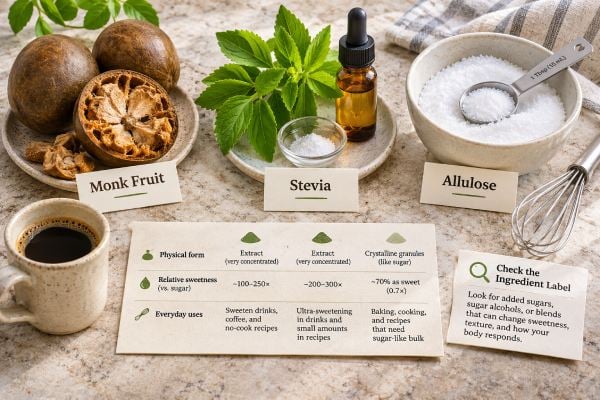
Monk fruit, stevia, and allulose can all replace added sugar with much less immediate impact on blood glucose, but they are not interchangeable. Stevia and monk fruit are intensely sweet, so only tiny amounts of the purified compounds are needed to achieve a desired level of sweetness. Allulose is a “rare sugar” that tastes and cooks more like ordinary sugar but provides far less usable energy and has a small effect on blood glucose.
For baking and texture, allulose is often the most sugar-like option. For drinks or situations where only a small amount of sweetness is required, stevia or monk fruit may be more convenient.
The biggest catch is the product, not the sweetener name on the front label. Monk fruit and stevia are frequently blended with erythritol, allulose, dextrose, maltodextrin, or other ingredients that can change carbohydrate content, taste, and digestive effects. The evidence base also differs: stevia has more human research than monk fruit, while recent trials and meta-analyses suggest allulose may reduce post-meal glucose when taken with carbohydrate. None of these sweeteners makes an otherwise high-sugar diet metabolically healthy.
Table of Contents
- Monk Fruit vs Stevia vs Allulose: Quick Comparison
- Stevia and Blood Sugar
- Monk Fruit and Blood Sugar
- Allulose and Blood Sugar
- Blends, Labels, and Digestive Side Effects
- Which Sweetener Is Best for Your Goal?
- How to Use Sweeteners Without Missing the Bigger Picture
Monk Fruit vs Stevia vs Allulose: Quick Comparison
For blood sugar, all three are usually better than an equal-sweetness amount of added sugar because they provide little or no rapidly absorbable glucose. The practical differences come down to sweetness intensity, the depth of clinical evidence, cooking properties, and individual tolerance.
| Sweetener | Direct glucose effect | Best uses | Main drawbacks |
|---|---|---|---|
| Stevia | Usually minimal when used alone | Coffee, tea, yogurt, drinks, tabletop use | Bitter or licorice-like aftertaste for some people; often sold in blends |
| Monk fruit | Usually minimal when purified extract is used alone | Drinks, yogurt, sauces, tabletop blends | Less human evidence; pure extract is hard to dose and products are commonly blended |
| Allulose | Low; may also reduce the post-meal glucose rise in some settings | Baking, sauces, frozen desserts, recipes needing bulk | Can cause gas, bloating, or diarrhea at larger amounts; more expensive |
If your only question is “Which one spikes glucose the least?” there is no meaningful reason to crown a universal winner among pure products. Stevia and monk fruit are used in such small amounts that they generally contribute negligible digestible carbohydrate. Allulose is consumed in gram quantities, but most of it is not metabolized like ordinary sugar, and clinical research shows little direct glycemic effect.
The more useful question is which product helps you replace sugar consistently without causing digestive problems or encouraging you to eat more sweet foods overall.
A useful way to compare them is by the sugar you are replacing. Two teaspoons of table sugar contain about 8 g of carbohydrate. Replacing that sugar in coffee with a few drops of stevia or monk fruit removes nearly all of that carbohydrate. Replacing sugar gram-for-gram in a recipe with allulose also cuts the glycemic load substantially, but recipe chemistry may change because allulose is less sweet and browns more readily. The benefit comes from displacement: the substitute is useful because less ordinary sugar reaches the meal.
This is also why a broad comparison of erythritol, stevia, and allulose can look different from a comparison of purified stevia and monk fruit extracts: commercial formulations matter.
Stevia and Blood Sugar
Stevia sweeteners are made from purified steviol glycosides found in the leaves of Stevia rebaudiana. They are hundreds of times sweeter than sugar, so the active sweetener is used in very small amounts.
When stevia is consumed by itself, it generally does not raise glucose like sugar. A 2026 randomized crossover study included people with normal weight, overweight, and type 2 diabetes. A stevia-sweetened beverage produced glycemic and hormonal responses similar to water, while adding stevia to a 30 g glucose drink did not materially change the response compared with glucose alone. That is a useful reality check: stevia can replace sugar, but sprinkling it into a sugary drink does not neutralize the sugar already there.
A 2024 meta-analysis of 26 studies found a small reduction in blood glucose associated with stevia, but the certainty of evidence was low. It did not find a significant improvement in A1C or insulin overall. So it is more reasonable to think of stevia as a low-glycemic sugar substitute than as a treatment that lowers diabetes markers.
What stevia tastes like
Taste is the main barrier for many people. Some steviol glycosides create a bitter, herbal, or licorice-like finish. Newer formulations may use specific glycosides or blends to reduce that aftertaste.
Because pure stevia is so concentrated, tabletop products need a carrier to make a spoonful measurable. That carrier might be erythritol, dextrose, maltodextrin, or another ingredient. A packet containing a small amount of a glucose-based carrier may still have very little carbohydrate, but several tablespoons of a baking blend can be a different story.
If a product says “stevia” on the front, check the ingredient list and total carbohydrate per serving rather than assuming the bag contains only stevia extract. The same principle applies to many non-sugar sweetener products, even when the active sweetener itself contains no meaningful carbohydrate.
Monk Fruit and Blood Sugar
Monk fruit, also called luo han guo, comes from Siraitia grosvenorii. Its intense sweetness comes mainly from compounds called mogrosides. Purified monk fruit extract contributes little usable carbohydrate at the amounts needed to sweeten food, so it should not raise glucose the way sucrose does.
The important limitation is evidence. Monk fruit has fewer controlled human trials than stevia and allulose. A 2025 systematic review of randomized trials found only a small human evidence base, with five eligible randomized controlled trials covering different outcomes and formulations. That is not enough to make strong claims that monk fruit improves A1C, insulin sensitivity, body weight, or long-term metabolic health.
So why might someone choose it? Mostly for taste and practicality. Some people prefer monk fruit’s flavor to stevia and find that it has less bitterness. It works well in drinks and tabletop products when the blend fits their needs.
The “monk fruit” on the shelf is often mostly something else
Pure monk fruit extract is extremely sweet. A cup-for-cup granulated product therefore cannot be a cup of pure monk fruit. Manufacturers add a bulking ingredient such as erythritol or allulose so the product measures more like sugar.
That means two packages labeled “monk fruit sweetener” may behave very differently:
- monk fruit + erythritol may have negligible glucose impact but can cause bloating in some people;
- monk fruit + allulose may brown and bake more like sugar and may be easier to use by volume;
- monk fruit + dextrose or maltodextrin may contribute some digestible carbohydrate;
- concentrated liquid drops may contain very little of anything besides water, flavoring, and the high-intensity sweetener.
For blood sugar, the ingredient list is more informative than the marketing name. For digestion, the bulking sweetener may matter more than the monk fruit itself.
Allulose and Blood Sugar
Allulose is structurally similar to fructose and occurs naturally in very small amounts in some foods. Unlike stevia and monk fruit, it is a true sugar molecule and is used in gram quantities. However, the body absorbs much of it and then excretes most of it without metabolizing it for energy in the same way as glucose or fructose.
That gives allulose several practical advantages. It provides bulk, dissolves well, browns during cooking, and can help create soft textures in baked goods and frozen desserts. It is only about 70% as sweet as table sugar, so recipes may need more allulose by weight to reach the same sweetness.
Recent evidence is particularly interesting for post-meal glucose. A 2026 systematic review and meta-analysis of controlled human trials found that allulose significantly reduced postprandial glucose and insulin responses, while it did not significantly improve A1C, fasting glucose, blood lipids, or body composition overall. A 2024 meta-analysis focused on type 2 diabetes also found lower postprandial glucose exposure, but the evidence base was small.
That does not mean allulose is a glucose-lowering medication. Studies often test specific doses taken with carbohydrate under controlled conditions, and the long-term clinical significance is uncertain. It is still most useful as a sugar substitute.
For a deeper look at dosing, safety, and evidence, see how allulose affects blood sugar.
Allulose and digestion
Allulose reaches the intestine in larger amounts than high-intensity sweeteners, so gastrointestinal tolerance can set the practical limit. Larger single doses may cause gas, bloating, abdominal discomfort, or diarrhea. Tolerance varies by body size, dose, and whether it is spread across the day.
Start with a modest amount rather than replacing a large amount of sugar all at once. A recipe containing several tablespoons per serving may behave very differently from one teaspoon in coffee.
Blends, Labels, and Digestive Side Effects
Most confusion about blood sugar and “natural sweeteners” comes from blends. The active sweetener may be almost irrelevant to the total carbohydrate in the finished product.
Use this label-reading sequence:
- Read the ingredient list first. Identify what comes before or after stevia or monk fruit. Ingredients are generally listed by weight.
- Check serving size. A label can show 0 g carbohydrate when a tiny serving rounds down, while a recipe uses many servings.
- Check total carbohydrate and added sugar. Do not rely only on a “zero sugar” badge.
- Look for sugar alcohols or rare sugars. Erythritol, xylitol, sorbitol, maltitol, and allulose have different metabolic and digestive effects.
- Consider how much you actually use. Two packets in coffee is different from half a cup in baking.
Sugar alcohols deserve special attention. Maltitol can raise glucose more than erythritol and often causes digestive symptoms at higher doses. Sorbitol and xylitol may also cause gas or diarrhea. If a “stevia” chocolate or “monk fruit” candy bothers your stomach, the culprit may be a sugar alcohol or added fiber rather than stevia or monk fruit.
A guide to sugar alcohols and glucose can help distinguish ingredients that are often grouped together on low-sugar labels. If gastrointestinal symptoms are the main problem, sugar alcohols and digestive side effects explains why dose matters.
“Zero added sugar” also does not mean zero carbohydrate. A muffin sweetened with stevia can still contain white flour and starch. A protein bar can use monk fruit while containing dates, tapioca starch, or other carbohydrate sources. Judge the entire food, not the sweetening agent alone.
Which Sweetener Is Best for Your Goal?
There is no single best choice, but the decision gets easier when you define the job.
Best for coffee, tea, and drinks: stevia or monk fruit
High-intensity sweeteners work well when you only need sweetness and no bulk. Choose the one whose taste you prefer, then make sure the drops or packets do not add meaningful carbohydrate at the amount you use.
Best for baking and replacing sugar volume: allulose
Allulose behaves more like sugar in recipes because it contributes bulk and browning. It can make baked goods softer and frozen desserts less icy. The tradeoff is digestive tolerance, cost, and the fact that allulose is less sweet than sucrose.
Best evidence for minimal acute glucose effect: all three can work
Pure stevia and monk fruit contribute tiny amounts of carbohydrate, while allulose has repeatedly shown a low direct glycemic effect. The best real-world option is therefore the product that replaces actual sugar without bringing in another digestible carbohydrate.
Best if you have a sensitive stomach: start with tiny-dose sweeteners
Because stevia and monk fruit require very little active compound, a liquid or highly concentrated product may be easier on the gut than a large serving of allulose or sugar alcohols. But the carrier still matters.
Best for long-term weight control: none is a magic solution
Replacing sugar can reduce calories and carbohydrate when the substitution is genuine. But sweeteners do not guarantee weight loss. People may compensate by eating more later, or the sweetener may appear in highly processed foods that remain easy to overeat.
The World Health Organization’s 2023 guideline recommended against using non-sugar sweeteners as a long-term weight-control strategy for the general population, based on uncertainty about sustained benefits and observational associations with chronic disease. That recommendation is not the same as saying stevia or monk fruit acutely raises blood glucose or is inherently toxic. It addresses a different question: whether relying on non-sugar sweeteners produces long-term weight and disease-prevention benefits.
Allulose is also biologically different from high-intensity non-sugar sweeteners, so broad “artificial sweetener” headlines should not automatically be applied to it.
How to Use Sweeteners Without Missing the Bigger Picture
The best use of monk fruit, stevia, or allulose is usually straightforward: replace added sugar where sweetness is useful, then keep the rest of the food pattern focused on minimally processed foods, fiber, protein, and reasonable portions. Taste preference matters because a substitute only helps when you are comfortable using it consistently.
For someone with prediabetes or diabetes, swapping a sugar-sweetened soda for an unsweetened or non-sugar-sweetened drink can remove a large glucose load. Replacing 2 teaspoons of sugar in coffee can also help if it happens several times per day. These are high-value substitutions because actual sugar disappears from the diet. The same logic applies to yogurt, oatmeal, and homemade sauces: start with an unsweetened base, then add a small amount of the sweetener you tolerate. This gives you control over both sweetness and carbohydrate instead of relying on a packaged product whose “sugar-free” label may hide starches or large serving sizes.
By contrast, turning a cookie recipe into a “keto” cookie by replacing sugar but leaving a calorie-dense mix of refined flour, butter, chocolate, and large portions may not improve the overall diet very much. The glucose peak could be lower while the food remains easy to overconsume.
If you use a continuous glucose monitor or home glucose meter, test the finished food, not an isolated ingredient theory. Compare similar portions on more than one day. If a supposedly zero-sugar product repeatedly raises glucose, inspect the flour, starch, milk, fruit, or bulking ingredients before blaming the high-intensity sweetener.
It can also help to gradually reduce how sweet foods taste. Using half as much sweetener over time can make naturally less-sweet foods more satisfying and reduces dependence on finding a perfect sugar substitute.
For baking, remember that sugar does more than sweeten. It holds moisture, contributes bulk, supports browning, and affects spread and freezing point. Stevia or monk fruit cannot replace those functions by themselves, which is why baking blends often contain erythritol, allulose, fiber, or starch. If blood sugar is the priority, check what fills the missing volume. If digestive comfort is the priority, test a small serving before eating several pieces of a new low-sugar dessert.
A practical ranking looks like this: choose unsweetened foods and drinks when they taste good to you; use stevia or monk fruit when a tiny amount of added sweetness is useful; use allulose when you need sugar-like bulk or texture; and keep checking the full ingredient list. For blood sugar control, the sweetener is only one variable. The total carbohydrate, portion, food quality, activity, sleep, medications, and overall eating pattern matter much more.
References
- Glycemic and cardiometabolic effects of rare sugars allulose and tagatose: a systematic review and meta-analysis of controlled human intervention trials 2026 (Systematic Review)
- Impact of allulose on blood glucose in type 2 diabetes: A meta-analysis of clinical trials. 2024 (Meta-Analysis)
- Effect of stevia on blood glucose and HbA1C: A meta-analysis 2024 (Meta-Analysis)
- Acute Stevia Consumption Does Not Alter Endocrine Responses in Individuals with Normal Weight, Overweight, and Type 2 Diabetes Mellitus. 2026 (RCT)
- Monk Fruit Extract and Sustainable Health: A PRISMA-Guided Systematic Review of Randomized Controlled Trials 2025 (Systematic Review)
- Use of non-sugar sweeteners: WHO guideline 2023 (Guideline)
Disclaimer
This article is for general nutrition education and does not replace individualized diabetes care. If you use insulin or other glucose-lowering medication, make major carbohydrate changes with an appropriate treatment plan to reduce hypoglycemia risk. Digestive tolerance and glucose responses to commercial sweetener blends can vary.