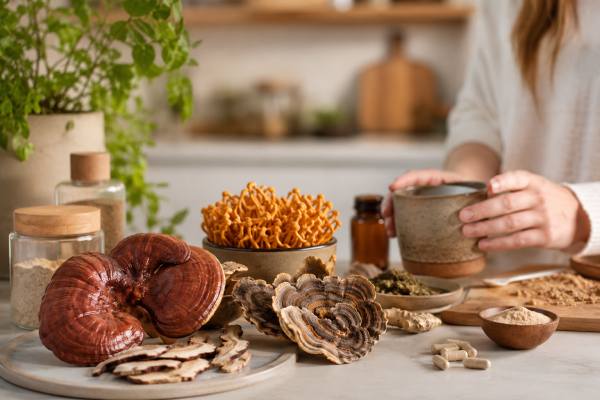
Mushroom supplements have become one of the most crowded corners of the immune-support market. Reishi is sold as a calming immune balancer, cordyceps as an energy and resilience booster, and turkey tail as a gut-friendly immune mushroom with serious clinical interest behind it. The labels sound confident, but the science is not equally strong across all three. Some compounds in these mushrooms, especially beta-glucans and other polysaccharides, do appear to interact with immune pathways. What is much less clear is how often that translates into meaningful benefits for healthy people buying capsules, powders, or tinctures for everyday use.
That gap between mechanism and real-world outcome is where most confusion starts. This article breaks down what reishi, cordyceps, and turkey tail actually are, how they differ, where the evidence is strongest, what the safety and quality issues are, and when these supplements may be worth considering.
Quick Overview
- Reishi, cordyceps, and turkey tail all contain compounds that may influence immune signaling, but they are not interchangeable.
- Turkey tail has the strongest human clinical history, mainly in oncology-adjunct settings rather than routine cold prevention.
- Reishi and cordyceps have promising preclinical data, but everyday immune claims often go further than current human evidence.
- Product quality matters because species, extraction methods, and active-compound levels vary widely between brands.
- The most sensible use is targeted and cautious, especially if you take medications, have autoimmune disease, or expect a supplement to replace sleep, nutrition, or medical care.
Table of Contents
- What Makes These Mushrooms Different
- What the Evidence Really Shows
- Reishi and Immune Balance
- Cordyceps and Immune Support
- Turkey Tail and Clinical Evidence
- Safety Quality and Smart Use
What Makes These Mushrooms Different
“Mushroom supplements” sounds like one category, but reishi, cordyceps, and turkey tail are different organisms with different histories, different major compounds, and different evidence profiles. Lumping them together is one reason people get confused. A claim that seems plausible for one species can be weak or unproven for another.
The shared theme is immune modulation rather than blunt immune stimulation. These mushrooms contain beta-glucans and other complex polysaccharides that appear capable of interacting with immune receptors and influencing signaling pathways tied to innate and adaptive immunity. That is why supplement marketing often uses words like support, balance, resilience, and defense. The biology behind those words is not completely invented. What gets overstated is the assumption that all immune modulation is automatically useful, predictable, and clinically meaningful in everyday healthy adults.
Reishi, usually sold as Ganoderma lucidum or lingzhi, is best known for polysaccharides and triterpenes. It is often positioned as the “calming” mushroom, marketed for stress, sleep, inflammation, and immune balance. Cordyceps is a more complicated category because the name may refer to different species, especially Cordyceps militaris and Ophiocordyceps sinensis. It is often sold for stamina, energy, and recovery, with immune claims added as a secondary benefit. Turkey tail, usually labeled as Trametes versicolor or Coriolus versicolor, is the most clinically recognizable of the three because its polysaccharide-rich compounds PSK and PSP have a history of use alongside cancer treatment in parts of Asia.
That last detail matters. When people hear that turkey tail has “clinical evidence,” they often assume the same evidence applies to every capsule on a supplement shelf. It does not. Clinical research has often involved defined extracts or purified preparations used in a medical context. Over-the-counter mushroom blends may vary widely in species, extraction method, dosage, and standardization. A bottle labeled “immune mushroom complex” may include a little reishi, a little cordyceps, and a little turkey tail without matching the products studied in formal trials.
Another important difference is what people are actually trying to get from these products. Some want fewer colds. Some want better recovery from stress or hard training. Some want support during cancer treatment. Some are really looking for more stable sleep, less fatigue, or better gut resilience and are using mushroom language to frame those goals. That is one reason it helps to keep the bigger idea of immune resilience instead of immune boosting in view. Mushrooms are not magic. At best, they may influence part of a larger system that already depends on sleep, food, stress load, movement, and overall health.
So before comparing species, it helps to ask a basic question: what problem are you actually trying to solve? Once that is clear, the differences between reishi, cordyceps, and turkey tail become much easier to interpret.
What the Evidence Really Shows
The mushroom supplement conversation often blurs together three very different levels of evidence: laboratory mechanisms, animal studies, and human clinical outcomes. That blur makes products sound more proven than they usually are. In cell and animal models, medicinal mushrooms can look impressive. Researchers see beta-glucans and related compounds interacting with macrophages, dendritic cells, natural killer cells, cytokines, and inflammatory signaling pathways. That supports the idea that these mushrooms are biologically active. It does not automatically prove that a healthy adult taking a retail supplement will get noticeably fewer infections or a stronger everyday immune response.
Human evidence is where the picture narrows. The most substantial clinical experience is not about preventing ordinary winter illness in the general public. It is mostly about medicinal mushrooms used as adjuncts in oncology, where some preparations have been studied for immune response, symptom burden, treatment tolerance, and quality of life. Even there, the evidence is mixed. Reviews describe promising immunologic signals and acceptable tolerability in many settings, but they also repeatedly point out small sample sizes, varied study design, and inconsistent standardization.
That means readers should separate two questions:
- Do mushroom compounds interact with immune biology?
- Do mushroom supplements meaningfully improve real-world immune outcomes for the average consumer?
The answer to the first is yes, probably. The answer to the second is much less certain.
This is especially important because immune support marketing tends to exploit the gap between mechanism and outcome. A supplement can change a lab marker, activate a receptor in a cell model, or influence cytokine signaling and still fail to produce a clear benefit that someone would actually notice in daily life. That is why many mushroom claims belong in the same reality check as what immune boosting really means. The marketing language often sounds stronger than the human evidence.
Another complication is that mushroom research is not standardized. Trials may use hot-water extracts, alcohol extracts, mycelium preparations, fruiting body extracts, or isolated compounds like PSK and PSP. Doses differ. Extraction methods differ. Active compound content differs. Even when two studies use the same species name, they may not be studying comparable products. That makes it hard to generalize from one trial to every supplement on the market.
A balanced summary looks like this:
- Mushroom polysaccharides and related compounds appear immunologically active.
- Human evidence is strongest in specific medical contexts, especially some cancer-adjunct settings.
- Evidence for broad routine immune support in otherwise healthy adults is still limited.
- Species-specific differences matter more than most marketing suggests.
- Product quality and formulation matter enough that “mushroom supplement” is not a meaningful scientific category by itself.
For everyday users, that means expectations should stay modest. These products may be interesting tools, but they should not replace the better-supported foundations of immune health, such as sleep, nutrition, and managing chronic stress. For a practical baseline, immune support supplements make the most sense when they fill a real gap rather than promise a broad transformation.
Reishi and Immune Balance
Reishi is probably the mushroom most often described in soft-focus wellness language. It is framed as grounding, balancing, adaptogenic, and supportive for both stress and immunity. That image is not random. Reishi contains two compound groups that attract the most interest: polysaccharides, which are often tied to immune signaling, and triterpenes, which are often discussed in relation to anti-inflammatory and other bioactive effects. Together, they help explain why reishi is marketed as more than just an “immune mushroom.”
The scientific case for reishi is strongest at the mechanistic level. Reviews describe immunomodulatory effects involving macrophages, natural killer cells, cytokine activity, and inflammatory pathways. In plain language, reishi appears capable of affecting how immune responses are regulated rather than simply turning them up. That distinction matters because people often assume an immune-support product should always stimulate. In reality, a more useful effect may sometimes be helping the immune system respond in a more proportionate way.
Where reishi becomes less certain is in everyday human outcomes. Much of the clinical attention has focused on oncology-adjunct settings, where reishi products have been studied for immune parameters, tolerability, and symptom-related outcomes. That is not the same as proving a routine retail supplement will help a healthy person avoid getting sick. It also does not mean all reishi products are interchangeable with the products used in clinical research.
Reishi is also one of the mushrooms most likely to be bought for mixed reasons. Some people want immune support. Others really want better sleep, calmer evenings, or less stress reactivity. That overlap is understandable because immune resilience and stress physiology are closely linked. But it can make the evidence harder to interpret. If someone feels better on reishi, is the main effect immune, sleep-related, expectancy-driven, or a mix of several factors? In real life, those lines are blurry.
A reasonable view is that reishi may be most interesting for people looking at immune balance in the context of stress, inflammation, or broader whole-body resilience rather than just cold prevention. That does not make it proven. It makes it conceptually plausible. It also means reishi works better as part of a bigger plan that includes sleep, food quality, and recovery than as a stand-alone solution. The connection is especially clear if chronic stress is part of the problem, which is why stress and immunity matters here.
Safety is another reason reishi needs moderation rather than hype. Reishi products are generally described as well tolerated in many studies, but “generally tolerated” is not the same as risk-free. Digestive upset, rash, product inconsistency, and possible interactions are all worth considering, especially for people on anticoagulants, immune-active medications, or multiple supplements. Reishi’s reputation as a gentle tonic can make people less cautious than they should be.
The bottom line on reishi is neither dismissal nor endorsement. It is a biologically interesting mushroom with meaningful mechanistic data and some clinical relevance, but far less certainty than retail marketing implies for routine immune enhancement in healthy adults.
Cordyceps and Immune Support
Cordyceps has a different reputation from reishi. It is usually marketed less as a calming immune mushroom and more as a vitality or performance mushroom. Many people first encounter it through claims about stamina, oxygen use, endurance, or recovery. Immune support often appears as a secondary benefit, which can make the evidence look stronger than it is simply because the product seems to do many things at once.
Part of the complexity comes from the species issue. Cordyceps supplements may contain Cordyceps militaris, Ophiocordyceps sinensis, or blends that are not always explained clearly. That matters because research does not treat these as identical. Reviews often focus on polysaccharides as key immune-active components, while cordycepin and other compounds are discussed in relation to metabolism, inflammation, and broader biologic activity. The science is interesting, but it is not as plug-and-play as labels suggest.
Mechanistically, cordyceps has a decent case. Experimental work suggests its polysaccharides can influence macrophages, lymphocytes, dendritic cells, cytokines, and immune organ indices in animal models. Some studies also point to possible effects on intestinal immunity and immune suppression caused by stressors such as drugs or radiation. These are real reasons researchers remain interested in cordyceps as an immune-modulating fungus.
The clinical gap is the main issue. Compared with turkey tail, cordyceps has much less human evidence that directly answers the question most supplement buyers care about: does it improve meaningful immune outcomes in ordinary use? The answer at this point is not very clearly. Much of the cordyceps literature is still preclinical or tied to broader functional uses rather than hard immune endpoints in healthy adults.
That does not make the supplement irrational. It means its most plausible uses may lie at the overlap of energy, recovery, and immune resilience rather than direct immune enhancement. Someone under heavy training load, poor recovery, or physiologic stress may find that kind of positioning appealing. But even then, the supplement should not be confused with proven immune protection. If the real issue is sleep debt, overtraining, under-fueling, or poor recovery habits, those still deserve attention first. In that sense, cordyceps often belongs in the same conversation as exercise and immunity rather than being treated as a shortcut around it.
Cordyceps also illustrates a broader supplement problem: a compelling story can outpace clinical certainty. It has a traditional-use narrative, promising mechanistic data, and modern appeal because it seems to support both performance and immunity. That combination is powerful in marketing. But it should not be mistaken for a settled clinical case.
For readers trying to decide whether cordyceps is “worth it,” the most honest answer is conditional. It may be a reasonable choice for someone interested in a mushroom with plausible immune and recovery-related effects, especially if expectations are moderate. It is a weaker choice for someone seeking strong evidence that a supplement will clearly prevent infections or measurably improve everyday immune health on its own.
Turkey Tail and Clinical Evidence
If one mushroom in this trio has the strongest clinical reputation, it is turkey tail. That reputation comes mainly from its protein-bound polysaccharides, especially PSK and PSP, which have been studied and used in cancer-adjunct settings in parts of Asia. This matters because turkey tail is often promoted as the “evidence-based” immune mushroom, and compared with many supplement claims, there is some truth behind that. But the details still matter.
Turkey tail contains beta-glucan-rich polysaccharides that appear capable of influencing innate immune cells and cytokine pathways. Experimental work has linked it to activity involving macrophages, dendritic cells, natural killer cells, and T-cell responses. Human interest has centered less on routine cold prevention and more on supportive oncology use, where PSK and PSP have been studied for immune response, treatment tolerance, and quality-of-life outcomes alongside conventional care.
That is the part many supplement labels leave out. The best-known evidence is not based on generic “turkey tail mushroom powder” used by otherwise healthy people trying to avoid seasonal illness. It comes from defined preparations used in specific medical contexts. Those results cannot simply be transferred to every retail extract. The species may match, but the preparation, dose, and quality may not.
Even so, turkey tail has a more grounded evidence profile than most immune-support mushrooms sold online. Reviews of mushroom supplements in cancer care describe favorable cytokine responses in some studies and note that mushroom products, including preparations related to turkey tail, may improve quality of life or symptom burden in some settings. At the same time, the same reviews stress that evidence is still inconclusive for routine recommendation because many studies are small, observational, or heterogeneous.
Turkey tail also attracts interest for gut-related reasons. Because immune function and gut ecology are closely linked, a mushroom associated with fiber-like polysaccharides and microbiome-relevant effects naturally gets pulled into broader immunity conversations. That angle is plausible, especially if you think about how much immune regulation depends on the gut environment. But it still does not mean a turkey tail supplement reliably “fixes” gut immunity. The bigger drivers remain diet pattern, microbiome diversity, and barrier integrity, which is why the gut-immune connection and microbiome diversity matter more than any one capsule.
If someone wants the most evidence-backed mushroom of the three, turkey tail is the closest fit. But “most evidence-backed” is not the same as “well proven for everyone.” The strongest claim you can make honestly is that turkey tail has meaningful mechanistic support and the most developed clinical track record, especially in cancer-adjunct contexts. That is a real advantage. It is just narrower than broad wellness marketing makes it sound.
So turkey tail deserves more respect than hype. It is not just another trendy mushroom, but it is also not a free pass to assume every product on the market has clinically meaningful immune benefits.
Safety Quality and Smart Use
Most mushroom supplement mistakes happen in the gap between “natural” and “standardized.” People assume that because mushrooms are traditional and food-like, the supplements must be gentle, consistent, and broadly safe. But medicinal mushroom products vary dramatically in species identity, extraction method, potency, contamination control, and active-compound content. That means the smartest question is not only whether a species is promising. It is whether the product in your hand is remotely comparable to what the evidence describes.
Standardization is a major issue. Some products emphasize beta-glucans, some total polysaccharides, some fruiting body material, some mycelium-based ingredients, and some broad “mushroom complex” branding without much useful detail. This makes both efficacy and safety harder to judge. A study using a defined preparation does not automatically validate a mixed powder bought online. When ingredients vary from lot to lot or from brand to brand, expectations should stay modest.
Medication interactions and personal context matter too. People on immunosuppressive treatment, anticoagulants, diabetes medications, or multiple supplements should be cautious. The same applies to people with autoimmune conditions, pregnancy, chronic liver or kidney concerns, or a history of supplement sensitivity. Even when the risk is only theoretical or based on limited reports, it is enough to justify more care than the average marketing page encourages. That is where checking interactions first becomes more important than chasing the next promising ingredient.
A practical way to approach mushroom supplements is this:
- Decide why you want one specific mushroom.
- Match the species to the goal instead of buying a random blend.
- Look for transparent labeling and independent testing.
- Start with moderate expectations and one product at a time.
- Reassess whether you are noticing anything meaningful beyond the placebo effect and routine fluctuation.
For product selection, quality markers matter more than ornate storytelling. Clear species identification, extract details, beta-glucan transparency when relevant, contamination testing, and reputable manufacturing practices are all more valuable than vague promises about ancient wisdom or “supercharged immunity.” That is why third-party testing is such a practical filter.
The final issue is expectations. Reishi, cordyceps, and turkey tail are interesting supplements with biologically active compounds and varying degrees of clinical relevance. None should be treated as a substitute for medical care, vaccines, sleep, protein intake, good food, or a thoughtful workup if you are repeatedly ill or chronically run down. For that bigger perspective, why you keep getting sick is often a more important question than which mushroom to buy.
The best use of these supplements is selective and grounded. Choose them because the species fits a real need and the product quality is credible, not because the word mushroom makes the claim feel automatically wise or safe.
References
- Medicinal Mushrooms (PDQ®)–Health Professional Version 2024 (Government Review)
- Medicinal Mushroom Supplements in Cancer: A Systematic Review of Clinical Studies 2023 (Systematic Review)
- Cordyceps Polysaccharides: A Review of Their Immunomodulatory Effects 2024 (Review)
- A Review of Bioactive Components and Pharmacological Effects of Ganoderma lucidum 2025 (Review)
Disclaimer
This article is for educational purposes only and is not medical advice. Mushroom supplements may interact with medications, may not match the products used in published research, and may not be appropriate for people with autoimmune disease, cancer, liver or kidney disease, pregnancy, or other medical conditions. Anyone considering reishi, cordyceps, or turkey tail for immune support, especially alongside prescription treatment or during serious illness, should discuss it with a qualified clinician.
If this article helped you compare mushroom supplements more clearly, please share it on Facebook, X, or another platform where it could help someone make a more informed decision.