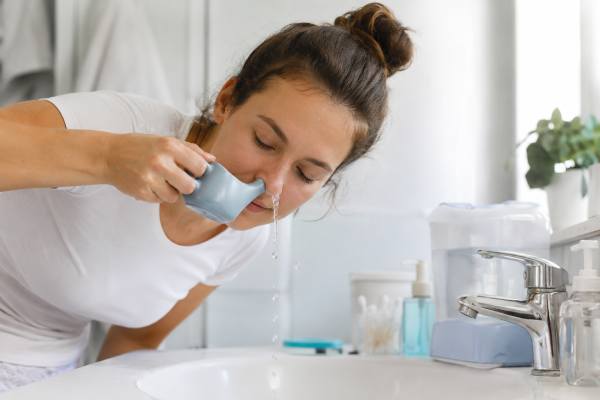
A neti pot can be a simple, effective tool for congestion, thick mucus, allergy flare-ups, and dry indoor air, but only when it is used correctly. The biggest problems do not usually come from the device itself. They come from unsafe water, poor cleaning, the wrong saline mix, or using nasal rinses when the nose and ears are already irritated. That is why neti pot safety matters more than most people realize.
Used well, nasal irrigation can help clear mucus, wash out irritants, and support a more comfortable airway. Used carelessly, it can sting, worsen pressure, spread germs inside the device, or in rare cases expose the nose to dangerous organisms from tap water. This guide explains the water rules that matter most, how to clean a neti pot properly, how to use saline without making your nose burn, which mistakes are most common, and when sinus rinsing is not the right move.
Quick Summary
- The safest water for a neti pot is distilled, sterile, or previously boiled and cooled water, not straight tap water.
- Proper saline irrigation can help loosen mucus, reduce irritants, and make the nasal lining more comfortable during colds, allergies, or dry-air exposure.
- Cleaning and fully drying the device between uses matters because a damp, reused pot can become contaminated.
- Stop and reassess if rinsing causes strong ear pain, significant burning, or worsening blockage rather than relief.
- The easiest low-risk routine is to use premixed saline packets, safe water, gentle technique, and a clean, dry device every time.
Table of Contents
- Why Neti Pots Can Help and Where Risk Starts
- Safe Water Rules That Matter Most
- Saline Mix and Correct Technique
- Cleaning and Storage After Each Use
- Common Mistakes and Side Effects
- When to Avoid It and When to Get Help
Why Neti Pots Can Help and Where Risk Starts
A neti pot works by gently flushing saline through the nasal passages. That simple action can thin mucus, rinse out allergens and dust, loosen crusting, and make it easier for the nose to clear itself. For many people, it is most useful during colds, seasonal allergies, dry indoor heating, or chronic sinus irritation. It is not a cure for sinus disease, but it can be a practical support tool when the goal is to clean and moisten the nasal lining.
That benefit makes sense because the nose is part of the body’s front-line defense. The nasal lining traps particles, humidifies incoming air, and supports the broader system of mucosal immunity. When mucus becomes thick or the lining becomes irritated, that system can feel clogged, inflamed, and less comfortable. Saline irrigation can help restore a cleaner, better-hydrated surface.
But the same route that allows irrigation to help also creates the safety issue. The nose is not the same as the stomach. Water that is safe to swallow is not always safe to push through the nasal passages. Certain organisms that are harmless when swallowed can be dangerous when introduced into the nose. That is why the water rule for neti pots is so strict. Straight tap water is the mistake people most need to remember.
Risk also starts when people assume “natural” means harmless. A neti pot is simple, but it still requires proper water, the right saline concentration, a clean device, and good timing. If the device is dirty, the solution is wrong, or the nose is completely blocked, the rinse can cause pain or pressure instead of relief. If the water is unsafe, the problem can be far more serious.
There is another practical point many people miss: nasal irrigation is a tool, not a signal to ignore the cause of repeated congestion. If you are constantly rinsing but still dealing with heavy blockage, facial pressure, or recurring flare-ups, it may be time to review why sinus symptoms keep coming back rather than simply increasing the number of rinses.
Used correctly, a neti pot can be part of a healthy airway routine. Used casually, it can create avoidable trouble. The safety mindset is straightforward: help the nasal lining without introducing irritation, pressure, or contaminated water. Once that principle is clear, the rest of neti pot safety becomes much easier to remember.
Safe Water Rules That Matter Most
If you remember only one rule from this article, let it be this: do not use plain tap water in a neti pot. The safest options are distilled water, sterile water, or tap water that has been boiled and cooled. This is the most important neti pot safety step because it protects against rare but potentially devastating infections caused by organisms that can survive in household water systems and become dangerous when forced into the nose.
Distilled or sterile water is the simplest choice because it removes guesswork. The label should clearly say “distilled” or “sterile.” If you do not have that available, previously boiled tap water is the standard backup. The water should be boiled, then cooled until it is lukewarm before use. Water that is too hot can burn the nose, while water that is too cold can feel uncomfortable and may make rinsing harder to tolerate.
Safe water matters because nasal tissue is delicate. When you rinse, you are not just washing the surface. You are moving fluid through narrow passages close to sensitive tissue. That is why casual shortcuts, such as “my tap water tastes fine” or “filtered water should be good enough,” are not the right standard unless the filter is specifically appropriate for this purpose. For most people, the simplest rule is still the safest one: buy distilled water or boil and cool tap water.
This also explains why “just once” is not a good exception. Rare infections are still rare, but the reason public health agencies are strict about sinus-rinse water is that the consequence can be severe. A safe rinse is easy to achieve, so there is no reason to gamble with untreated faucet water.
A good routine is:
- Keep a bottle of distilled or sterile water just for nasal rinsing.
- If using boiled tap water, prepare it ahead of time and store it in a clean, closed container.
- Warm the solution to a comfortable lukewarm temperature before use.
- Discard leftover solution that no longer seems clean or fresh.
People sometimes confuse saline packets with safe water. They are not the same thing. A saline packet improves the salt balance of the rinse, but it does not sterilize contaminated water. You still need the correct water source first.
If your nose already feels dry and irritated, it may help to think of water safety and moisture as separate issues. Safe water prevents dangerous contamination. Good moisture supports comfort and barrier function, which is why the larger topic of dry airway surfaces and mucosal defense often overlaps with nasal irrigation in winter or during allergy season.
The short version is simple: safe water first, saline second, device cleanliness third. If the water is wrong, everything else about the rinse matters less.
Saline Mix and Correct Technique
The second major neti pot safety issue is not water source but solution quality and technique. Even safe water can feel awful if the salt concentration is wrong or the rinse is forced through the nose too aggressively. Many people describe the experience as burning, ear pressure, or fluid in the throat when the real problem is the way the rinse is being prepared or performed.
For most users, premixed saline packets are the easiest and safest option. They reduce the chance of making a solution that is too weak, too strong, or not well dissolved. Plain water alone is not a good substitute because it can irritate the nasal lining. The salt balance matters. That is why a proper saline solution usually feels gentler than water by itself.
Technique also makes a big difference. A neti pot should be used with the head tipped slightly forward and to the side over a sink, not thrown backward. The mouth should stay open so breathing feels relaxed and the liquid has a clear path. The goal is gentle flow, not force. If you squeeze too hard with a squeeze bottle or rush the pour, pressure may travel toward the ears and create discomfort.
A simple method looks like this:
- Wash your hands.
- Make sure the device is clean and dry before filling it.
- Use safe water and the correct saline packet or manufacturer-approved mix.
- Lean over the sink with forehead and chin roughly level.
- Pour gently through one nostril and let the solution drain from the other side.
- Repeat on the opposite side.
- Gently clear the nose afterward without forceful blowing.
One common mistake is trying to rinse when the nose is completely blocked. If nothing can pass through, pushing harder usually does not help. It may only raise pressure and make the ears feel clogged. Another common mistake is relying too much on sprays before or after rinsing. A short course of a decongestant spray may sometimes be used for severe temporary blockage, but repeated use can cause rebound symptoms, which is why decongestant spray overuse needs to stay on the radar.
Frequency matters too. More is not always better. During a cold or heavy allergy flare, once or twice daily may be reasonable for some people. Outside those times, overdoing rinses can leave the nose feeling stripped or irritated. The nose needs moisture and healthy mucus, not endless flushing.
When used with good technique, irrigation can be a useful complement to broader self-care during upper airway symptoms. It fits most naturally alongside the more general approach described in safe saline nasal irrigation for colds, where comfort, hydration, and proper water safety matter more than doing it as often as possible.
Cleaning and Storage After Each Use
A neti pot that is used correctly but cleaned poorly can still become a problem. The device repeatedly comes into contact with mucus, saline, moisture, and your hands. If it is put away wet or only rinsed casually every few days, it can become a place where contamination builds up. That is why cleaning and drying are part of neti pot safety, not just a bonus step.
The safest habit is to clean the device after every use. Begin by emptying out all remaining solution. Do not store leftover saline in the pot for later. Then wash the device according to the manufacturer’s instructions. In many cases, that means washing with soap and safe water, rinsing thoroughly, and letting it dry completely. Some people assume a quick swish is enough, but dried residue and damp corners can linger longer than expected.
Drying matters just as much as washing. Moist, closed devices are not ideal storage environments. After cleaning, either dry the inside with a clean paper towel if the manufacturer allows it, or leave the device open to air dry fully before putting it away. A pot that feels even slightly damp inside is better left out longer.
A practical cleaning routine looks like this:
- wash hands before handling the device
- discard leftover rinse solution after each session
- wash the neti pot after each use
- rinse away all soap residue
- let the device dry completely
- store it in a clean place, not beside a damp sink basin
It is also smart to inspect the device regularly. Replace it if it becomes cloudy, cracked, hard to clean, or develops rough areas where residue collects. A worn-out device is harder to keep sanitary.
Sharing is another mistake to avoid completely. Neti pots are personal devices. Even in the same household, each person should have their own. Labeling devices can help if more than one person uses nasal irrigation at home.
Cleaning standards become even more important in people with vulnerable airways or weakened immune defenses. If you are already dealing with chronic sinus problems, post-viral irritation, or frequent infections, the last thing you want is a poorly maintained device adding to the load. In that setting, it can also be helpful to review when persistent sinus trouble needs a closer look rather than assuming better cleaning alone will solve everything.
One final cleaning point is often missed: the counter around the device matters too. If the pot dries next to a visibly dirty sink area, the routine is not as clean as it looks. A clean device, safe water, and complete drying work together. Skip one, and the safety margin narrows.
Common Mistakes and Side Effects
Most neti pot problems come from a small set of repeat mistakes. The first is using unsafe water. The second is getting the saline mix wrong. The third is using too much force or trying to rinse through a nose that is so blocked the fluid has nowhere comfortable to go. The fourth is poor cleaning and storage. Nearly every routine neti pot complaint fits somewhere inside that group.
Typical minor side effects include:
- mild stinging or burning
- temporary ear pressure
- water draining later when you bend forward
- slight nasal irritation
- occasional small nosebleeds if the lining is already dry
These are usually signs to adjust the process, not always signs that nasal rinsing is a bad idea. Burning often means the mix is wrong or the nose is already irritated. Ear pressure often means the flow is too forceful or the rinse is being attempted during heavy blockage. Small nosebleeds may point to dryness, frequent rinsing, or underlying irritation.
The most common mistakes are:
- Using straight tap water.
This is the big one and the one most worth remembering. - Using plain water without proper saline.
This often leads to burning and poor tolerance. - Rinsing too forcefully.
More pressure does not mean a better result. - Using the device when one nostril is completely blocked.
This can worsen pressure rather than relieve it. - Reusing old solution or storing solution in the device.
Fresh preparation is safer. - Not cleaning and drying the device after each use.
Damp, repeatedly used equipment is a bad habit. - Using it too often.
Overuse can leave the nasal lining irritated rather than soothed.
Dry indoor air can make some of these problems worse. If the nose already feels crusted, tight, or raw, even a correct rinse may feel harsh unless the broader environment improves too. That is one reason attention to indoor humidity can make a difference during winter heating or air-conditioned seasons. Moderately humid indoor air supports comfort and may make saline rinsing more tolerable.
A person who also sleeps with an open mouth may experience the same cycle from a different angle: dry nose, dry mouth, irritated throat, and repeated need for moisture support. In that case, the overlap with mouth breathing and dry airway effects is worth noticing.
The key idea is that side effects are usually information. They are telling you something about water safety, concentration, technique, frequency, or the condition of the nose itself. The right response is not to force through it. It is to identify which part of the routine is going wrong.
When to Avoid It and When to Get Help
A neti pot is not the right tool for every situation. If the nose is only mildly congested and the rinse feels comfortable, it can be helpful. But if you have severe blockage, significant ear pain, recent nasal surgery, an active ear infection, frequent nosebleeds, or a known structural problem, it is better to pause and get advice instead of pushing through discomfort.
Some people should be more cautious from the start. Anyone with a significantly weakened immune system, major sinus disease, or recent head and neck procedures should check with a clinician before adding routine nasal irrigation. That does not mean saline rinses are off-limits for everyone in those groups. It means the margin for error is smaller, and technique plus device care become more important.
Stop using the device and seek medical advice if you notice:
- strong or worsening ear pain
- repeated nosebleeds
- marked burning even with proper saline
- worsening sinus pressure after rinsing
- persistent one-sided blockage
- ongoing symptoms despite correct use
Seek urgent care right away if headache, fever, confusion, vomiting, or severe illness develops after unsafe sinus rinsing. Those symptoms are rare, but they are exactly why water safety is taken so seriously.
It is also time to step back if you find yourself using a neti pot constantly just to get through the week. Chronic daily dependence can be a clue that the real issue is allergies, structural blockage, reflux, medication effects, or a recurrent sinus problem that deserves proper assessment. In those cases, a rinse may still help, but it should not be the only strategy.
A good rule of thumb is to think of a neti pot as supportive care rather than primary diagnosis. It can make breathing more comfortable, improve mucus clearance, and reduce irritants. It cannot tell you why the nose is always blocked. If congestion is frequent, sleep is affected, or symptoms recur over and over, the safer move is to look deeper rather than rinse harder.
Used thoughtfully, nasal irrigation can be a useful part of a broader plan to protect the airway and stay more comfortable during colds, allergy flares, and dry-air seasons. But the safest version is always the same: safe water, proper saline, careful cleaning, gentle technique, and a willingness to stop when the body is clearly saying this is not the right moment.
References
- Is Rinsing Your Sinuses With Neti Pots Safe? | FDA 2025 (Official Guidance)
- How to Safely Rinse Sinuses | Naegleria fowleri Infection | CDC 2025 (Official Guidance)
- Acanthamoeba Infection and Nasal Rinsing, United States, 1994–2022 2024 (Case Series)
- Nasal Irrigations: A 360-Degree View in Clinical Practice 2025 (Review)
- Clinical Practice Guideline: Nasal Irrigation for Chronic Rhinosinusitis in Adults 2022 (Guideline)
Disclaimer
This article is for educational purposes only and is not medical advice, diagnosis, or treatment. Neti pots and other nasal irrigation devices can be useful, but improper water choice, device hygiene, or technique can cause harm. Seek medical care if rinsing causes significant ear pain, persistent bleeding, worsening symptoms, or if you develop severe headache, fever, vomiting, or confusion after unsafe nasal rinsing. Check with a qualified clinician before regular use if you are immunocompromised, have recent nasal or ear surgery, or have severe chronic sinus disease.
If this article helped, consider sharing it on Facebook, X (formerly Twitter), or another platform where it may help someone use a neti pot more safely and confidently.