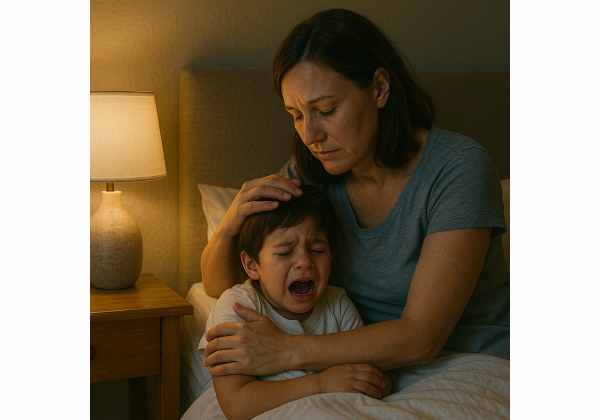
Night terror disorder involves repeated episodes of intense fear during sleep in which a person may scream, sit up, thrash, appear panicked, or seem awake while actually remaining only partly aroused. These episodes can be alarming for family members or bed partners because the person often looks terrified, is hard to comfort, and usually has little or no memory of what happened afterward.
Sleep terrors are most often seen in children and are commonly outgrown, but they can also occur in teenagers and adults. In adults, new, frequent, violent, or unusual nighttime events deserve closer attention because other sleep, neurological, medical, or psychiatric conditions can look similar. Understanding what a night terror is—and what it is not—helps separate a frightening but often benign parasomnia from situations that need professional evaluation.
What to recognize early
- Night terrors usually arise from deep non-REM sleep, often in the first part of the night.
- Common signs include screaming, wide-eyed fear, sweating, fast breathing, racing heartbeat, confusion, and poor response to comfort.
- Unlike nightmares, sleep terrors usually leave little or no clear dream memory the next morning.
- They can be confused with nightmares, nocturnal panic attacks, seizures, sleepwalking, REM sleep behavior disorder, or sleep apnea-related awakenings.
- Professional evaluation matters when episodes begin in adulthood, cause injury, are highly frequent, include unusual movements, or occur with daytime sleepiness, breathing pauses, neurological symptoms, or major distress.
Table of Contents
- What Night Terror Disorder Means
- Symptoms and Observable Signs
- How Night Terrors Differ From Similar Events
- Causes and Sleep Mechanisms
- Risk Factors and Common Triggers
- Effects and Possible Complications
- Diagnostic Context and Red Flags
What Night Terror Disorder Means
Night terror disorder refers to repeated sleep terror episodes that are distressing, disruptive, risky, or clinically significant. In modern sleep and psychiatric classification, sleep terrors are usually understood as a type of non-rapid eye movement sleep arousal disorder, meaning they occur when the brain partially wakes from deep non-REM sleep but does not fully shift into normal awareness.
The word “terror” can be misleading because the person is not usually having a vivid nightmare in the usual sense. During a sleep terror, parts of the brain involved in movement and bodily alarm may become activated while awareness, memory, and judgment remain mostly asleep. This is why someone may scream, bolt upright, sweat, or push away a caregiver, yet later have no clear recollection of the event.
Night terrors belong to a broader group called parasomnias. Parasomnias are unwanted behaviors, movements, emotions, perceptions, or experiences that happen during sleep or during transitions between sleep and wakefulness. Sleepwalking and confusional arousals are close relatives of sleep terrors because they also arise from incomplete arousal out of non-REM sleep.
A typical sleep terror has several core features:
- It begins suddenly, often with a scream, cry, shout, or look of intense fear.
- The person appears awake but is confused, unreachable, or only partly responsive.
- Physical alarm signs are common, such as sweating, rapid breathing, a racing pulse, dilated pupils, or flushing.
- The episode usually happens in the first third or first half of the night, when deep non-REM sleep is more prominent.
- Afterward, the person often settles back into sleep and remembers little or nothing in the morning.
Night terrors are especially common in childhood because children have more deep sleep and maturing sleep-wake regulation. A child may have dramatic episodes while still being developmentally healthy. That said, “common” does not mean every episode should be dismissed. The context matters: age of onset, frequency, injury risk, daytime functioning, medical history, medications, and whether the events have features that do not fit sleep terrors.
In adults, sleep terrors are less common and more likely to raise questions about sleep fragmentation, alcohol or medication effects, trauma-related symptoms, mood or anxiety conditions, sleep apnea, restless legs syndrome, neurological disorders, or nocturnal seizures. Adult sleep terrors can still be true non-REM parasomnias, but the diagnostic threshold for looking for mimics is usually lower.
Night terror disorder is not the same as being “afraid of the dark,” having ordinary bad dreams, or waking up anxious. It is a sleep-state problem in which the person’s behavior looks intensely fearful while the brain remains partly asleep. This difference explains why reassurance during the episode often seems not to register and why memory afterward is usually absent or patchy.
Symptoms and Observable Signs
The most important symptoms of night terror disorder are sudden fear behaviors during sleep, poor responsiveness during the episode, and little or no memory afterward. Because the person experiencing the episode may not remember it, the most useful details often come from a parent, partner, sibling, roommate, or other witness.
A night terror can look dramatic. The person may sit up quickly, scream, cry, shout, gasp, stare, kick, thrash, clutch bedding, or appear to fight off something unseen. Their eyes may be open, but their gaze may seem glassy or unfocused. They may speak in short, confused phrases or make sounds that do not form clear sentences.
Physical signs of autonomic arousal are common. These are the body’s “alarm system” signs and may include:
- Rapid heartbeat
- Fast or heavy breathing
- Sweating
- Flushed face
- Enlarged pupils
- Trembling or tense muscles
- Sudden agitation or defensive movements
During the episode, the person may not recognize familiar people or may react as if others are part of the threat. This can be upsetting for parents or partners, but it fits the incomplete-arousal pattern: the person is not fully awake and may not be accurately processing the room, voices, or attempts at comfort.
The length of an episode varies. Some sleep terrors last seconds to a few minutes. Others appear to last longer, especially when there is movement around the room, repeated settling and re-arousal, or a witness understandably perceives the event as prolonged. Afterward, the person may lie down again and return to sleep with little sign that anything unusual happened.
Morning memory is usually limited. Children often remember nothing. Adults may remember a vague feeling, a fragment of threat, or a brief image, but they usually do not recall a detailed dream narrative in the way people often do after nightmares. This memory gap is one of the most useful clues.
Night terrors can occur alongside other non-REM arousal behaviors. A person may sit up and scream during one episode, walk during another, or appear confused without obvious fear during another. Sleepwalking, sleep talking, and confusional arousals can overlap with sleep terrors because they share similar sleep-stage mechanisms.
The pattern across the night also matters. Sleep terrors usually appear during the early part of the sleep period, especially when deep non-REM sleep is most likely. Events that happen repeatedly near morning, are strongly dream-driven, or involve detailed recall may suggest a different sleep condition.
Some episodes include behaviors that create safety concerns. A person may run, strike out, fall, collide with furniture, leave the bedroom, or resist someone who tries to block them. These behaviors do not mean the person is intentionally aggressive. They do mean the episode has practical significance and may warrant closer evaluation, especially if injuries or near-injuries occur.
Daytime symptoms are not always present. Many children with occasional sleep terrors are otherwise alert, well-rested, and functioning normally. More frequent or disruptive episodes, however, may be associated with poor sleep quality, daytime sleepiness, irritability, concentration problems, or family sleep disruption. If poor sleep is also causing daytime cognitive symptoms, it may overlap with broader concerns such as sleep deprivation effects on mood and attention.
How Night Terrors Differ From Similar Events
Night terrors are best understood by comparing them with other nighttime events that can look frightening from the outside. The key clues are timing, awareness, memory, movement pattern, and whether the person is fully awake afterward.
People often confuse night terrors with nightmares, but they are not the same. Nightmares are usually vivid dreams that occur during REM sleep, often later in the night. The person wakes up, can usually be comforted, and may remember the dream. Night terrors arise from non-REM sleep, often earlier in the night, and the person typically remains confused or unreachable with little recall. This distinction is especially important when stress or anxiety is present, because stress-related nightmares can cause intense fear but follow a different pattern.
Nocturnal panic attacks can also resemble sleep terrors. A person may wake abruptly with a racing heart, shortness of breath, chest tightness, shaking, or fear of dying. The difference is that in a panic attack, the person is usually awake and aware soon after the episode begins. They may remember the event clearly and describe panic symptoms afterward. A true sleep terror has more confusion, less responsiveness, and less recall. When nighttime panic is part of the concern, it may help to understand the separate pattern of nocturnal panic attacks.
Seizures are another important mimic. Some nocturnal seizures can cause sudden vocalizations, unusual postures, repetitive movements, stiffening, jerking, confusion, or injuries. They may be brief, stereotyped, and repeated in similar ways. Because some seizure types can be difficult to distinguish from parasomnias based only on a witness description, unusual or suspicious episodes deserve medical evaluation.
REM sleep behavior disorder is different from night terror disorder but can also involve dramatic movement. In REM sleep behavior disorder, the normal muscle paralysis of REM sleep is reduced or absent, allowing a person to act out dreams. It is more often seen in older adults and tends to occur later in the night when REM sleep is more common. Dream recall is usually more detailed than in sleep terrors.
| Nighttime event | Typical timing | Awareness during event | Memory afterward | Key distinction |
|---|---|---|---|---|
| Night terror | Early night, during deep non-REM sleep | Partly asleep, confused, hard to comfort | Little or none | Looks terrified but is not fully awake |
| Nightmare | Often later night, during REM sleep | Awake after the dream | Often clear dream recall | Fear comes from a remembered dream |
| Nocturnal panic attack | Can occur during sleep or on awakening | Usually awake and aware soon after | Usually remembers panic symptoms | Fear is experienced while awake |
| Nocturnal seizure | Any part of night | May be impaired | Variable | Often brief, repeated, stereotyped, or neurologically unusual |
| REM sleep behavior disorder | More often later night | Asleep during dream enactment | Often recalls dream content | Dream enactment during REM sleep, more common in older adults |
Sleep-disordered breathing can complicate the picture. A person with obstructive sleep apnea may gasp, choke, move abruptly, or wake in fear because breathing has been interrupted. Sleep apnea can also fragment sleep and potentially make parasomnias more likely in someone predisposed to them. For that reason, snoring, witnessed pauses in breathing, morning headaches, and unrefreshing sleep are important context when nighttime episodes are being described.
Restless legs syndrome and periodic limb movements can also disturb sleep and increase arousals. These conditions do not look like classic sleep terrors, but they can create the fragmented sleep environment in which non-REM arousal events become more likely. The distinction matters because the visible night terror may not be the only sleep problem present.
Causes and Sleep Mechanisms
The exact cause of night terror disorder is not fully known, but the leading explanation is incomplete arousal from deep non-REM sleep. The brain appears to be caught between sleep and wakefulness, with some systems activated and others still offline.
Normal sleep is not a single uniform state. Across the night, the brain cycles through non-REM and REM sleep. Deep non-REM sleep, often called slow-wave sleep, is especially prominent earlier in the night. Sleep terrors usually arise when the brain begins to arouse from this deep sleep but does not fully wake.
During this partial arousal, the body’s motor and autonomic systems may become active. That can produce sitting, shouting, sweating, fast breathing, and defensive movements. At the same time, the parts of the brain needed for full awareness, reasoning, memory formation, and accurate interpretation of the environment may remain partly asleep. This mismatch explains the central puzzle of night terrors: the person looks awake and terrified but does not respond like someone who is fully conscious.
Several mechanisms may contribute:
- High sleep pressure: When someone is very sleep-deprived, deep non-REM sleep may become more intense, increasing the chance of unstable arousals.
- Sleep fragmentation: Anything that repeatedly interrupts sleep can create more transitions between sleep stages.
- Developmental sleep patterns: Children have abundant deep sleep and still-developing sleep-wake regulation.
- Inherited vulnerability: Sleep terrors and sleepwalking often cluster in families.
- State dissociation: Different brain networks may briefly operate in different states, with wake-like movement but sleep-like awareness.
Night terrors are not usually caused by a single frightening thought or dream. Stress can be relevant, but it is better understood as one possible contributor to sleep disruption and arousal instability rather than the whole explanation. A child may have sleep terrors without obvious emotional trauma, and an adult with anxiety may have nighttime events that are not sleep terrors. Careful distinction matters.
The sleep-stage mechanism also explains why timing is so helpful. Events that happen soon after falling asleep or in the first part of the night fit the deep non-REM pattern. Events that happen closer to morning, when REM sleep is more frequent, may point toward nightmares, REM sleep behavior disorder, or another condition.
Brain arousal during sleep is not always abnormal. Everyone shifts between sleep depths during the night. In night terror disorder, the transition becomes behaviorally dramatic. The person may show fear, movement, and bodily alarm without the full conscious experience and memory that would usually accompany waking fear.
This does not mean the event is “fake,” intentional, or simply behavioral. The person is not choosing to scream or act frightened. It also does not automatically mean there is a serious psychiatric disorder. Sleep terrors sit at the boundary of sleep medicine, neurology, pediatrics, and mental health because they involve sleep-state regulation, behavior, emotion, and sometimes coexisting medical or psychological factors.
Risk Factors and Common Triggers
Night terror disorder is more likely when a person has an underlying tendency toward non-REM arousal events plus conditions that deepen, fragment, or destabilize sleep. Risk factors do not prove causation, but they help explain why episodes may appear during some life periods and not others.
Age is one of the clearest factors. Sleep terrors are much more common in children than in adults. They often appear during early or middle childhood and may fade with maturation. A child’s nervous system, sleep architecture, and high amount of deep sleep can make incomplete arousals more likely.
Family history is also important. Sleep terrors, sleepwalking, and confusional arousals often run in families. A child with a parent or sibling who had sleepwalking or sleep terrors may have a higher likelihood of similar events. This pattern suggests inherited vulnerability in sleep-wake regulation, although genes are not the whole story.
Sleep loss is a major practical contributor. When someone is overtired, the brain may spend more time in deep sleep or rebound into deeper sleep, which can set the stage for partial arousals. Irregular schedules, travel, shift work, late nights, and disrupted routines can all change sleep timing and depth. In adults, circadian strain may overlap with conditions such as shift-work sleep disruption, which can affect both sleep stability and daytime functioning.
Illness and fever can trigger episodes in children. Fever, pain, congestion, or acute infection can make sleep more fragmented and increase arousals. Night terrors that appear during a short illness may not follow the same pattern once the illness has resolved.
Stress and emotional strain can contribute, especially when they interfere with sleep. This does not mean the episode is a direct expression of a hidden fear. It means stress may raise arousal levels, disrupt sleep continuity, and make partial awakenings more likely. In some adults, trauma symptoms, anxiety, depression, or other mental health conditions may coexist with parasomnias, but the relationship can be complex and bidirectional.
Other sleep disorders can be relevant because they repeatedly interrupt sleep. Obstructive sleep apnea can cause snoring, breathing pauses, gasping, and repeated arousals; it can also lead to daytime fatigue and cognitive symptoms. When those features appear alongside night terrors, the broader pattern may resemble sleep apnea-related sleep disruption. Restless legs syndrome can also fragment sleep, especially when uncomfortable leg sensations or periodic limb movements are present; it may overlap with nighttime restlessness and distress described in restless legs and nighttime anxiety.
Substances and medications may matter in some cases. Alcohol, sedatives, certain antidepressants, and other medicines can alter sleep architecture or arousal thresholds. Caffeine and stimulant use may also affect sleep timing and continuity. The relationship depends on the person, dose, timing, and medical context.
Neurological conditions are less common causes but become more important in adults with new or atypical episodes. Parkinson’s disease, neurodegenerative disorders, traumatic brain injury, and seizure disorders can all enter the differential diagnosis when nighttime behaviors are unusual, injurious, or new later in life.
The practical point is that night terror disorder often reflects a combination: a susceptible sleeper, a vulnerable sleep stage, and a trigger that increases arousal instability. Identifying the pattern helps clinicians decide whether the episodes fit a typical childhood parasomnia or need broader diagnostic review.
Effects and Possible Complications
The main complications of night terror disorder are sleep disruption, injury risk, daytime effects, and emotional strain on families or bed partners. Occasional childhood sleep terrors may have little lasting impact, but frequent, intense, or unsafe episodes can affect quality of life.
The most immediate risk is physical injury. A person may thrash, fall out of bed, hit furniture, run, open doors, or collide with objects. A parent or partner may also be struck accidentally if they try to block movement during a confused episode. Injuries are usually minor, but the risk becomes more serious when episodes involve leaving the bedroom, stairs, sharp objects, windows, or aggressive defensive movements.
Sleep disruption can affect the whole household. Parents may stay awake listening for another episode. Siblings may be frightened by screaming. Partners may lose sleep or feel anxious about sharing a bed. Even when the person with night terrors remembers nothing, others may experience the event as highly stressful.
Daytime effects depend on frequency and sleep quality. A person with rare episodes may feel completely fine during the day. More frequent events, especially when combined with another sleep disorder, may contribute to:
- Daytime sleepiness
- Irritability
- Trouble concentrating
- Morning fatigue
- Reduced school or work performance
- Mood changes related to poor sleep
- Tension within the household
Embarrassment can be a complication for older children, teenagers, and adults. A person may feel ashamed after hearing what happened, even if they were not aware during the episode. Adults may worry about how partners, roommates, or family members perceive them. This can create anticipatory anxiety around sleep, travel, sleepovers, shared housing, or intimate relationships.
Misinterpretation is another concern. Night terrors may be mistaken for “acting out,” deliberate aggression, demonic or supernatural experiences, severe psychiatric instability, or attention-seeking behavior. These interpretations can increase stigma and delay accurate evaluation. Clear explanation helps reduce blame: during a night terror, the person is not fully awake and is not intentionally choosing the behavior.
There may also be a risk of missing another condition. If all nighttime events are assumed to be harmless night terrors, seizures, sleep apnea, REM sleep behavior disorder, medication effects, substance-related sleep disruption, or trauma-related sleep symptoms could be overlooked. This is especially relevant when the pattern is atypical or begins in adulthood.
Mental health overlap requires careful wording. Sleep terrors are not, by themselves, proof of anxiety, trauma, depression, psychosis, or a personality problem. However, mental health conditions can coexist with parasomnias, and poor sleep can worsen emotional regulation. A person who is already stressed, sleep-deprived, or emotionally vulnerable may find that repeated nighttime events add to the burden.
For families, the distress often comes from helplessness. Watching a child scream while appearing unreachable can feel frightening even when the child has no memory afterward. For adults, the distress may center on loss of control, fear of injury, or concern about what the episodes mean. In both cases, the significance of night terror disorder depends not only on the episode itself but also on frequency, safety, daytime functioning, and whether there are signs of another underlying condition.
Diagnostic Context and Red Flags
Night terror disorder is usually evaluated through a careful clinical history, especially witness descriptions of what happens before, during, and after the event. Testing is not always needed, but atypical features, adult onset, injury risk, or possible mimics can make further evaluation important.
A clinician typically wants to understand the pattern. Useful details include the person’s age, when episodes began, how often they occur, what time of night they happen, how long they last, what the person does, whether they respond to voices, whether they remember anything, and whether there are daytime symptoms. A witness account is often more reliable than the sleeper’s own memory because amnesia is common.
Home video may sometimes help clinicians understand the behavior, although it does not replace professional assessment. A short recording can show whether the episode looks like a non-REM arousal, a seizure-like event, REM dream enactment, panic awakening, or another pattern. The clinical value depends on the clarity of the recording and the full medical context.
A sleep study may be considered when the diagnosis is uncertain, when events are dangerous, when another sleep disorder is suspected, or when symptoms do not fit a typical pattern. Polysomnography records sleep stages, breathing, oxygen levels, heart rhythm, limb movements, and sometimes video. For readers trying to understand what that type of evaluation measures, polysomnography sleep study testing provides helpful diagnostic context.
An EEG may be considered if nocturnal seizures are part of the differential diagnosis. This is especially relevant when episodes are brief, highly stereotyped, occur many times in one night, involve unusual posturing or rhythmic movements, or are followed by prolonged confusion. The role of an EEG test for brain activity is to look for patterns that may support or rule out seizure-related causes, depending on the situation.
Professional evaluation is especially important when any of the following are present:
- Episodes begin for the first time in adulthood.
- Events are frequent, worsening, or severely disruptive.
- The person is injured or nearly injured.
- Someone else is injured or at risk.
- The behavior includes running, leaving the home, driving, cooking, or other dangerous activity.
- Episodes look identical each time, are very brief, or include unusual stiffening, jerking, or repetitive movements.
- There are witnessed breathing pauses, choking, loud snoring, or marked daytime sleepiness.
- The person has new neurological symptoms, head injury, fainting, or unexplained confusion.
- Episodes occur with heavy alcohol use, substance use, or recent medication changes.
- There are severe mood symptoms, psychosis-like experiences, self-harm concerns, or risk of harm to others.
Urgent evaluation may be needed if an episode involves serious injury, prolonged unresponsiveness, seizure-like activity, breathing difficulty, sudden neurological symptoms, or immediate safety risk. In children, occasional classic sleep terrors are often not an emergency, but patterns outside the usual age range or behavior pattern should not be ignored.
Diagnosis also includes ruling out ordinary variations. A single frightened awakening after a stressful day, a remembered nightmare, or a brief episode during fever may not indicate night terror disorder. The term “disorder” becomes more appropriate when events are recurrent and clinically meaningful because of distress, impairment, safety risk, or diagnostic uncertainty.
The most balanced view is neither dismissive nor alarmist. Night terrors can be frightening to witness and still be benign, especially in children. They can also be a clue to sleep fragmentation, neurological events, medication effects, or mental health overlap, especially in adults. The details of the episode, the person’s age, the daytime picture, and the safety context determine how much concern is warranted.
References
- Diagnosis and Management of NREM Sleep Parasomnias in Children and Adults 2023 (Review)
- Sleepwalking, sleep terrors, sexsomnia and other disorders of arousal: the old and the new 2022 (Review)
- Psychopathology and NREM sleep parasomnias: A systematic review 2025 (Systematic Review)
- A Comprehensive Review of Non-Rapid Eye Movement (NREM) Parasomnias 2025 (Review)
- Night terrors and nightmares 2025 (Clinical Information)
- Sleep terrors (night terrors) – Symptoms and causes 2025 (Clinical Information)
Disclaimer
This article is for general educational purposes only and is not a substitute for professional medical advice, diagnosis, or treatment. Nighttime episodes that involve injury, breathing difficulty, seizure-like activity, adult-onset symptoms, severe distress, or risk of harm should be evaluated by a qualified health professional.
Thank you for taking the time to learn about this sensitive sleep condition; sharing this article may help someone recognize when frightening nighttime behavior deserves a clearer medical explanation.