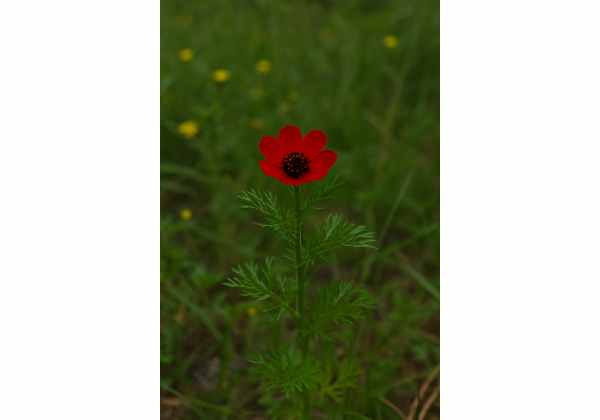
Pheasant’s Eye, Adonis annua, is a striking annual flower with finely cut leaves and deep scarlet blooms, but its medicinal story is far more serious than its ornamental beauty suggests. Belonging to the buttercup family, this plant has a history of regional folk use for heart-related complaints, fluid retention, and gout. Those traditional uses are not random. Like other species in the Adonis genus, A. annua contains cardioactive compounds that can influence heart rhythm and contractility.
That same chemistry is the reason this herb must be handled with unusual caution. Any discussion of “benefits” has to be balanced against a narrow safety margin, inconsistent product quality, and a lack of modern human evidence supporting home use. In fact, many claims found online reflect research on the broader Adonis genus or on related species, not on Adonis annua itself. The most honest way to understand Pheasant’s Eye is as a historically important but potentially poisonous medicinal plant. Its key question is not simply what it can do, but whether it should be used outside specialist supervision at all.
Essential Insights
- Pheasant’s Eye has a traditional reputation as a cardiotonic and diuretic herb, but those effects come from potentially dangerous cardiac glycosides.
- Its most notable medicinal property is strong cardioactive chemistry, which explains both its historical use and its toxicity risk.
- 0 mg for unsupervised self-treatment is the safest practical dose because no validated home-use dosage range has been established.
- People with heart disease, anyone taking digoxin or rhythm medicines, pregnant people, children, and pet owners should avoid self-use.
Table of Contents
- What Pheasant’s Eye is and why plant identity matters
- Key ingredients and why this herb is potent
- Pheasant’s Eye health benefits and medicinal properties
- Traditional uses and what modern herbalism can and cannot claim
- Dosage, timing, and why home use is not recommended
- Safety, side effects, interactions, and who should avoid it
- What the research and clinical reality actually show
What Pheasant’s Eye is and why plant identity matters
Pheasant’s Eye, Adonis annua, is an annual species in the Ranunculaceae family, the same broad family that includes several plants known for potent and sometimes toxic chemistry. It is native across parts of southern and central Europe, the Mediterranean region, and western Asia, and it has also been grown as an ornamental because of its vivid red flowers. In the field or garden, it is easy to admire. In herbal medicine, it is a plant that demands more caution than most readers expect.
The first important point is that medicinal discussions around “Adonis” are often botanically messy. Some older and regional sources mix Adonis annua with closely related or similarly named annual species, especially Adonis aestivalis. In addition, many modern medicinal claims about the genus come mostly from work on Adonis vernalis or other better-studied relatives rather than on Adonis annua itself. That means a reader searching for the health effects of Pheasant’s Eye can easily end up absorbing information that belongs partly to another species.
This matters because plant identity shapes everything that follows:
- the concentration of cardiac glycosides
- the intended medicinal use
- the expected toxicity
- the credibility of any dosage suggestion
- the relevance of modern research
Unlike gentle culinary herbs, Pheasant’s Eye has never been a casual kitchen plant. Its historical role was closer to that of a strong folk cardiotonic or diuretic, and even then it was not a universally trusted household herb. Traditional records describe the whole plant or aerial parts being used in decoctions or infusions in some regions, especially for cardiovascular complaints, edema, and gout. But these uses emerged in settings where people often learned directly from local healers and did not assume that “natural” meant “safe.”
Another important feature is that the medicinal part is not a mild root or aromatic leaf. The plant’s pharmacologic relevance comes from compounds distributed in the aerial parts and seeds, and these compounds can affect the heart. That alone places it in a different category from most herbs people buy for general wellness.
Pheasant’s Eye is therefore best understood as a cardioactive medicinal plant with ornamental value, not as an everyday supplement. That description may sound severe, but it is the most useful starting point. A reader who begins with the assumption that this is a red-flowered but risky herb will make better decisions than one who begins with the assumption that it is simply an obscure natural remedy waiting to be rediscovered.
One more layer of identity matters here. Many people looking up Pheasant’s Eye are actually looking for one of three things: a botanical profile, a history of traditional use, or a safe supplement guide. The first two are realistic. The third is where caution becomes essential. This is not the kind of plant that translates neatly from historical use into safe modern self-treatment.
Key ingredients and why this herb is potent
The defining chemistry of Pheasant’s Eye is its cardiac glycoside content. These compounds are the main reason the plant was historically valued as a cardiotonic, and they are also the main reason it can be dangerous. Cardiac glycosides are not vague “plant actives.” They are a pharmacologically forceful class of compounds that can alter heart contractility, heart rhythm, and conduction.
In practical terms, these compounds act in a way broadly similar to the cardioactive glycosides better known from foxglove-related chemistry. That does not mean Adonis annua is identical to foxglove or to prescription digoxin, but it does mean the same basic warning applies: once a plant can meaningfully influence the heart, small differences in dose, preparation, or body response start to matter a great deal.
The broader Adonis genus has been studied for more than 120 identified compounds, with cardiac glycosides standing out as the most medically important group. In annual red-flowered species such as Adonis annua, other constituents also appear, including flavonoids, carotenoids, coumarin-like substances, and pigments. One unusual botanical point is that Adonis annua petals are notable for astaxanthin and related carotenoid pigments. That is chemically interesting, but it is not the feature that explains the herb’s traditional medicinal use. The medicinal risk-benefit story belongs mainly to the cardiac glycosides.
The key chemical consequences of this profile are easy to summarize:
- the plant may increase force of contraction in the heart
- it may slow or destabilize heart rhythm
- it may produce beneficial cardiotonic effects at very narrow margins
- it may shift quickly from “active” to “toxic”
That narrow margin is the core problem. Many herbs have active compounds, but few have a safety profile so tightly bound to the same chemistry that creates their historical medicinal reputation. With Pheasant’s Eye, there is very little separation between the mechanism behind the claim and the mechanism behind the harm.
This is why phrases such as “natural heart support” are deeply misleading here. The plant does not support the cardiovascular system in a gentle, nutrient-like way. It acts more like a crude, poorly standardized source of cardioactive substances. That is historically fascinating, but clinically risky.
The ingredient story also explains why product labels can be deceptive. A dried herb capsule may look mild, but appearance tells you almost nothing about cardiac glycoside concentration. Species confusion, plant part differences, harvest timing, and poor standardization can all shift the final potency. With an herb like Pheasant’s Eye, those variations matter more than they would with a culinary mint or chamomile flower.
So when people ask about the “key ingredients” in this herb, the honest answer is not just a list of phytochemicals. It is a safety message: the ingredients that make Pheasant’s Eye medicinal are the same ones that make unsupervised use a poor idea.
Pheasant’s Eye health benefits and medicinal properties
Pheasant’s Eye has been associated with cardiotonic, diuretic, antispasmodic, and sometimes anti-inflammatory uses. Those claims did not appear from nowhere. They reflect how cardioactive plants were historically used before modern cardiology offered safer and more precise medications. Still, “historically used for” and “established health benefit” are not the same thing, and this herb shows why that distinction matters.
The most commonly cited medicinal property is cardiotonic activity. In plain language, that means the plant was believed to strengthen the heartbeat or help in states of weak cardiac function. Some experimental work with related annual Adonis species supports real cardiovascular activity, including bradycardia, blood pressure changes, and rhythm effects. But this is exactly the point where benefit and danger merge. A cardioactive effect is not automatically a wellness benefit. It can just as easily become an overdose effect or an arrhythmia risk.
The second common traditional property is diuretic action. In older herbal systems, herbs that affected the heart were often linked with edema or fluid retention because improving circulation and urine flow were seen as connected goals. Ethnobotanical reports on Adonis annua and closely related annual species include use for hydropsy, edema, gout, and cardiovascular complaints. That makes historical sense. It does not create a modern recommendation.
A third claimed property is antispasmodic or calming action. Some older sources describe Adonis species as useful when heart complaints were accompanied by nervousness or excitability. That reputation may partly reflect the way cardioactive plants were interpreted in older medicine rather than a clear modern sedative mechanism.
What can reasonably be said in favor of Pheasant’s Eye?
- it has real pharmacologic activity
- it belongs to a genus with documented traditional cardiotonic use
- it has plausible historical relevance for edema and weak-circulation complaints
- it may show antimicrobial, anti-inflammatory, or cytotoxic effects in preclinical settings
What cannot reasonably be said?
- that it is a validated home remedy for heart disease
- that it is a safe modern herb for “circulation support”
- that it has a proven supplement role for gout, swelling, or infections
- that its laboratory anticancer signals justify self-treatment
This is an unusual case where the most important “health benefit” is actually a lesson in restraint. The plant proves that strong botanical effects are possible. It also proves that not every historically active herb belongs in modern self-care. If a person is seeking gentle cardiovascular support, Pheasant’s Eye is not the right starting point. Even in traditions that respected cardioactive herbs, these plants were not treated lightly.
It can be helpful to compare this with gentler heart-related botanicals such as hawthorn preparations, where the modern conversation is usually about supportive use rather than narrow-margin toxicity. Pheasant’s Eye sits in a very different category. Its medicinal properties are real, but they are not user-friendly.
So the clearest answer to the search intent is this: Pheasant’s Eye has historically recognized medicinal properties, especially around the heart and fluid balance, but those properties are not a green light for casual use. In modern practice, the potential benefits are overshadowed by the difficulty of using the plant safely.
Traditional uses and what modern herbalism can and cannot claim
Traditional use is one of the main reasons people still ask about Pheasant’s Eye. Ethnobotanical records from parts of the Mediterranean and Middle East describe annual Adonis species, including Adonis annua, being used for cardiovascular disease, gout, edema, and related complaints. In some reports, the whole plant was decocted or infused. In others, the herb was regarded as a cardiotonic or diuretic. These records are part of the plant’s cultural and medicinal history, and they deserve respect.
But traditional use needs interpretation. Historical medicine often relied on direct observation of strong plants, not on the assumption that every herb could be standardized and sold safely. A plant might be remembered as effective precisely because it had powerful physiologic effects, even if it also had substantial toxicity.
That is why modern herbalism has to be selective about what it inherits. With Pheasant’s Eye, the most defensible modern claims are not broad consumer claims. They are narrower observations such as:
- the plant has a documented folk-medicine history
- some regional traditions used it for heart weakness, edema, and gout
- it belongs to a genus with strong cardiotonic identity
- the same traditional reputation is paired with important toxicity concerns
What modern herbalism can say:
- This plant is historically meaningful.
- Its traditional uses are coherent with its chemistry.
- It helps explain how earlier medical systems discovered cardioactive herbs.
- It deserves careful academic and pharmacologic attention.
What modern herbalism cannot honestly say:
- That traditional use alone proves safety.
- That an infusion sold online is appropriate for home cardiovascular care.
- That a plant with cardiac glycosides should be treated like a mild tonic.
- That folk use erases the need for medical supervision.
The difference between historical use and current recommendation is especially important because the internet tends to flatten them into one story. A reader may see “used traditionally for heart complaints” and hear “good for my heart.” Those are not the same statement. In fact, with a plant like Pheasant’s Eye, they may point in opposite directions. The very feature that once made the herb therapeutically interesting is the feature that makes modern self-use unsafe.
Another useful limit of modern herbalism is that it recognizes better options now exist. Earlier communities often relied on the strong plants available to them. Today, heart rhythm problems, edema, and chest symptoms require evaluation, diagnosis, and targeted treatment. That changes the role of a plant like Adonis annua. It becomes more of a historical medicinal plant than a practical home herb.
This is not a dismissal of tradition. It is a mature reading of it. The traditional uses of Pheasant’s Eye tell us what the plant was for, what people feared it might do, and why the genus became important in cardiac folk medicine. They do not tell us that the herb deserves a place in modern unsupervised wellness routines.
Dosage, timing, and why home use is not recommended
This is the section many readers search for first, and it is the one where the most caution is needed. For Pheasant’s Eye, there is no validated safe home dosage range that can be responsibly recommended for self-treatment. That is not a missing detail. It is the most important dosing fact about the herb.
Traditional records describe whole-plant decoctions or infusions, but these reports do not translate into modern safe-use instructions. They usually do not provide standardized concentrations, and even when they do describe preparation style, they do not solve the biggest problem: variable cardiac glycoside content. An herb whose potency can shift with species identity, harvest conditions, plant part, and storage is already hard to dose. An herb that can also affect heart rhythm is harder still.
Why a normal dosage guide is not appropriate here:
- there are no modern clinical dosing standards for over-the-counter Adonis annua use
- potency is unlikely to be consistent across products
- the line between active and toxic may be narrow
- many medicinal claims derive from genus history, not modern human trials
- the condition categories people seek it for are often high-risk on their own
This means several common supplement behaviors are particularly unwise with Pheasant’s Eye:
- Starting with tea because “tea is gentle.”
- Increasing the amount if no effect is felt quickly.
- Combining it with other “heart herbs.”
- Using it for swelling or palpitations without diagnosis.
- Assuming a smaller body size or “natural” preparation makes it safe.
Even timing cannot be discussed in the usual way. For most herbs, timing relates to meals, sleep, or daily rhythm. For Pheasant’s Eye, timing is overshadowed by the more basic question of whether a person should be taking it at all. If a plant carries meaningful arrhythmia risk, “morning or evening” is not the key clinical issue.
The safest dosing guidance is therefore negative but useful:
- do not self-dose the whole herb
- do not prepare the plant as a home tea for cardiovascular symptoms
- do not use capsules or powders of uncertain standardization
- do not take it in repeated trial-and-error amounts
- do not use it at all if you are already taking heart medication
Readers sometimes find this frustrating because they expect every herb article to end with a tidy amount in grams or drops. But a responsible dosage section has to reflect the plant itself. With Pheasant’s Eye, the most accurate dosage advice is that the herb does not belong in unsupervised home dosing.
If someone ever encounters this plant in a specialist historical or pharmacognostic context, the only reasonable principle is medical supervision with exact product identity and careful monitoring. Outside of that, the most defensible practical dose is none.
Safety, side effects, interactions, and who should avoid it
Safety is the center of the Pheasant’s Eye story. Almost every useful fact about the herb leads back to this section. The plant contains cardiac glycosides, and that means the wrong amount, the wrong person, or the wrong combination can create serious consequences.
Possible side effects and toxicity features include:
- nausea
- vomiting
- abdominal pain
- dizziness
- weakness
- slowed heart rate
- irregular heart rhythm
- dangerous conduction abnormalities
- in severe poisoning, collapse or life-threatening arrhythmia
These are not speculative. They are the sort of symptoms expected from cardioactive glycoside exposure and they are consistent with animal toxicology and genus-level poison reports. This is also why contaminated hay and plant ingestion have been concerns in livestock, especially horses and other sensitive animals.
People who should clearly avoid self-use include:
- anyone with heart disease
- people taking digoxin, digitoxin, or other cardiac glycosides
- people taking antiarrhythmic drugs
- people on diuretics that affect potassium balance
- pregnant or breastfeeding people
- children and older adults
- anyone with unexplained palpitations, fainting, chest symptoms, or swelling
- pet owners if the plant is being grown where animals may chew it
The interaction concern is especially important. Cardiac-active herbs do not exist in isolation. A plant that may influence heart rhythm or electrolyte-sensitive pathways can become much riskier when combined with:
- prescription heart medication
- laxative overuse
- potassium-lowering regimens
- stimulant-heavy supplements
- other cardioactive botanicals
Another risk is delayed diagnosis. A person with fluid retention, fatigue, shortness of breath, or irregular heartbeat might be tempted to look for an old herbal “cardiotonic.” But these symptoms are not a space for self-experimentation with a poisonous flower. They are reasons for proper medical assessment.
Pheasant’s Eye is also not appropriate as a “natural digitalis” substitute. That phrase sometimes appears online, but it is exactly the kind of comparison that encourages unsafe thinking. Pharmaceutical cardiac glycosides, when used at all, are carefully dosed and monitored. A garden or wild-crafted herb is not an equivalent substitute.
A few safety rules are non-negotiable:
- Do not ingest the plant casually.
- Do not assume ornamental use means medicinal safety.
- Keep it away from grazing animals and curious pets.
- Seek urgent care if ingestion is followed by vomiting, dizziness, or heart-related symptoms.
- Do not use historical reputation as proof of tolerability.
If there is one sentence that captures the safety profile, it is this: Pheasant’s Eye is a medicinally interesting plant but a poor candidate for self-medication. That statement is not overly cautious. It is exactly as cautious as the plant deserves.
What the research and clinical reality actually show
The research on Pheasant’s Eye is enough to show why the plant matters, but not enough to justify broad clinical use. That distinction is the key to reading the literature well. The strongest evidence does not show that Adonis annua is a modern self-care herb. What it shows is that the genus has a long cardiotonic history, cardioactive chemistry, and toxicologic importance.
There are three major evidence layers.
The first is ethnobotanical evidence. Regional documentation shows that Adonis annua has been used for gout and cardiovascular complaints in parts of North Africa and the Levant. This supports the claim that the herb has a real traditional role. It does not establish effectiveness or safe dose.
The second is genus-level phytochemical and pharmacologic evidence. Reviews of Adonis species show that cardiac glycosides are the major medically relevant compounds across the genus. This is the strongest bridge between traditional use and modern science. It also reinforces the main safety warning.
The third is experimental evidence from related annual species, especially Adonis aestivalis. Animal work shows genuine cardiovascular effects, including bradycardia, hypotension, and ECG changes. These findings explain why the genus was historically seen as cardiotonic. But they also show why a safe over-the-counter herbal identity never really formed around this plant. A herb that can produce arrhythmias in an experimental setting is not one that moves comfortably into casual supplement use.
Just as important is what the research does not show:
- no robust human trials validating Adonis annua for home cardiovascular support
- no modern clinical dosing standard suitable for consumer use
- no persuasive evidence that benefits outweigh risks in unsupervised settings
- no reason to treat the plant as a routine herbal tea or capsule
One interesting modern detail is that Adonis annua is chemically notable for petal astaxanthin, which has drawn attention in plant biochemistry. That makes the species botanically fascinating. It does not change the clinical reality. The medicinal conversation is still dominated by cardiac glycosides, not by a wellness-friendly carotenoid profile.
So what is the practical clinical reality? For most modern readers, Pheasant’s Eye is a plant to learn about, not ingest. It is valuable in the history of cardiac folk medicine. It is useful for understanding how traditional healers identified strong plants. It is relevant in toxicology, veterinary risk, and pharmacognosy. But it is not a sensible starting point for modern herbal experimentation.
That answer may seem less exciting than a list of “top 10 benefits,” but it is more useful. A truly helpful herb article does not pretend every traditional plant should be modernized into a supplement. Sometimes the most responsible conclusion is that a plant’s main lesson is caution. With Pheasant’s Eye, that is not a failure of the herb. It is an honest reading of the evidence.
References
- Adonis aestivalis L. Adonis annua L. Adonis dentata Delile Ranunculaceae 2024 (Reference Chapter)
- The Genus Adonis as an Important Cardiac Folk Medicine: A Review of the Ethnobotany, Phytochemistry and Pharmacology 2019 (Review)
- Cardiovascular effects of Adonis aestivalis in anesthetized sheep 2014 (Experimental Study)
- Weed Risk Assessment for Adonis aestivalis (Pheasant’s eye) 2019 (Official Report)
- Harnessing synthetic biology for tetraterpenoid astaxanthin production: Recent advances and challenges 2025 (Review)
Disclaimer
This article is for educational purposes only and does not replace medical advice, diagnosis, or treatment. Pheasant’s Eye contains cardioactive compounds that may cause serious harm if used incorrectly. It should not be self-prescribed for heart symptoms, edema, gout, or any other condition, and it should never be used as a substitute for prescription cardiovascular care. Anyone who may have ingested the plant and develops nausea, vomiting, dizziness, palpitations, or faintness should seek medical help promptly.
If you found this article helpful, please consider sharing it on Facebook, X, or another platform you prefer.