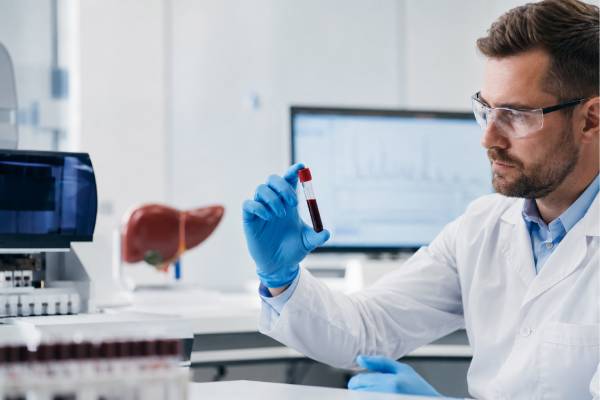
Phosphatidylethanol, usually called PEth, is a blood marker that shows recent alcohol exposure over days to weeks rather than the few hours captured by a blood alcohol level. It forms in red blood cell membranes only when ethanol is present, which makes it more specific for alcohol use than many indirect liver markers. A PEth result can help clinicians monitor abstinence, clarify alcohol-related liver risk, or compare reported drinking with a longer-term biological signal.
PEth is useful, but it is not a simple “yes or no” measure of how much someone drank. The number depends on recent pattern, dose, timing, red blood cell biology, and the laboratory method. A positive result supports alcohol exposure within the detection window, while the level gives only an approximate sense of drinking intensity.
- PEth measures recent alcohol exposure in whole blood, most often using the PEth 16:0/18:1 form.
- A PEth result below 20 ng/mL is often treated as negative or compatible with abstinence, depending on the lab’s reporting limit.
- PEth levels from 20 to 200 ng/mL usually suggest recent alcohol use, but they do not precisely count drinks.
- PEth levels above 200 ng/mL are commonly interpreted as repeated or heavier drinking, especially when confirmed on repeat testing.
- The usual detection window is about 2 to 4 weeks, and it can be longer after sustained heavy alcohol use.
- No fasting is needed, but the result should be interpreted with clinical context, liver tests, and any monitoring agreement.
Table of Contents
- What the PEth Blood Test Measures
- How PEth Forms in Blood
- PEth Levels and Result Ranges
- PEth Detection Window and How Long It Stays Positive
- When Clinicians Use PEth Testing
- PEth vs Other Alcohol and Liver Markers
- Limits, False Results, and Interpretation Pitfalls
- What to Do After a PEth Result
What the PEth Blood Test Measures
The PEth blood test measures phosphatidylethanol, a group of abnormal phospholipids that form in cell membranes after alcohol enters the bloodstream. In routine clinical testing, the most common target is PEth 16:0/18:1 in whole blood, although some labs also report PEth 16:0/18:2 or a combined value.
PEth is called a direct alcohol biomarker because it comes from alcohol metabolism itself. That makes it different from indirect markers such as GGT, AST, ALT, mean corpuscular volume, and carbohydrate-deficient transferrin. Those indirect markers may change with alcohol use, but they can also change because of fatty liver disease, medications, viral hepatitis, metabolic syndrome, anemia, inflammation, or other conditions.
A PEth result is usually ordered when a clinician wants to know whether alcohol exposure occurred over a recent period of days to weeks. It does not show current intoxication. For immediate intoxication, a blood alcohol or breath alcohol test is more appropriate. A separate ethanol blood test answers a different question: whether alcohol is present in the blood right now.
PEth also does not diagnose alcohol use disorder by itself. Alcohol use disorder is a clinical diagnosis based on symptoms, behavior, cravings, loss of control, tolerance, withdrawal, and life impact. PEth can support the conversation, but it cannot tell whether someone has dependence, why they drank, whether they were impaired, or whether drinking caused a specific liver problem.
The test is most useful when it is treated as one part of a pattern. A single PEth value can show likely recent alcohol exposure, but repeat values are better for monitoring change. Falling results usually support reduced intake or abstinence. Rising results suggest more recent or more frequent exposure.
How PEth Forms in Blood
PEth forms when ethanol is present and an enzyme called phospholipase D uses ethanol instead of water during a membrane reaction. The result is a phospholipid that would not normally be made in meaningful amounts without alcohol.
Most clinical PEth testing uses whole blood because PEth is found mainly in red blood cell membranes. This is one reason PEth lasts longer than alcohol itself. Ethanol clears from the bloodstream within hours, but red blood cells circulate for weeks, and PEth breaks down gradually after drinking stops.
Why PEth is considered highly specific
PEth is considered highly specific for alcohol exposure because ethanol is required for its formation. In plain language, PEth is not just a general “liver stress” marker. Fatty liver, high triglycerides, obesity, inflammation, viral hepatitis, and most medications do not create PEth on their own.
That specificity is the main reason PEth is often used when other markers are hard to interpret. For example, a person may have high GGT because of fatty liver or medication use, while PEth is more directly tied to ethanol exposure. A clinician may review PEth alongside GGT and ALT patterns when alcohol-related liver stress is part of the question.
Why PEth is still not a perfect drink counter
PEth rises with alcohol exposure, but the relationship is not exact enough to convert a result into a precise number of drinks. Two people can drink similar amounts and have different PEth levels. The timing of drinking matters too. Repeated drinking over several days tends to build PEth more than one isolated episode, especially if testing happens later.
Several factors can influence the result:
- Drinking amount and frequency
- Time since the last drink
- Binge pattern versus steady daily intake
- Individual metabolism and red blood cell turnover
- The PEth form measured by the lab
- Sample type, such as venous whole blood or dried blood spot
- The lab’s cutoff and reporting method
Because of this, PEth works better as a marker of recent exposure and trend than as a precise calculator.
PEth Levels and Result Ranges
Most PEth results are reported in ng/mL. Some research studies and some laboratories use µmol/L, so the unit matters when comparing results. The same number in different units does not mean the same thing.
Many clinical and forensic settings use two common interpretation points: 20 ng/mL and 200 ng/mL for PEth 16:0/18:1 in whole blood. These are not universal medical laws, but they are widely used reference points. Laboratories may define negative, low positive, moderate, or high results differently.
| PEth 16:0/18:1 result | Common interpretation | Important caution |
|---|---|---|
| Not detected or below lab cutoff | No PEth detected, or level too low to report | Very recent drinking may not have produced a measurable level yet |
| Less than 20 ng/mL | Often interpreted as negative or compatible with abstinence | Depends on lab reporting limit and monitoring context |
| 20 to 200 ng/mL | Suggests recent alcohol exposure | Does not precisely separate light, moderate, or episodic drinking |
| More than 200 ng/mL | Often suggests repeated, sustained, or heavier drinking | One value should still be interpreted with timing and clinical context |
| Very high results | Stronger evidence of frequent or heavy recent intake | Cannot prove impairment at a specific time |
A result just above 20 ng/mL should be handled carefully. It may represent relatively limited recent exposure, declining PEth after previous drinking, or a low-level positive in a monitoring program. A result far above 200 ng/mL usually carries stronger evidence for repeated or heavier alcohol use in the recent detection window.
Still, exact interpretation should come from the lab report and the clinician using the test. Some laboratories provide their own categories. Others simply report the number and leave interpretation to the ordering clinician.
Why one result may not match the drinking history exactly
A person who drank heavily several weeks ago and then stopped may have a falling but still positive PEth. Another person who had a recent binge after a long period of abstinence may have a detectable result that does not look as high as expected. A third person who drinks small amounts repeatedly may build a measurable level even without obvious intoxication.
This is why trend matters. A PEth series can show whether alcohol exposure is increasing, decreasing, or staying stable. A single PEth value is more limited.
PEth Detection Window and How Long It Stays Positive
PEth is usually detectable for about 2 to 4 weeks after drinking, but the actual window varies. After sustained heavy alcohol use, PEth may remain detectable longer. After a small or isolated exposure, it may be detectable for a shorter time or may not cross the lab’s cutoff.
The half-life of PEth is often described in the range of several days to around 1 to 2 weeks, depending on the person and study conditions. Half-life means the time it takes for the level to fall by about half after alcohol exposure stops. Because PEth falls gradually, a person can have no current alcohol in the bloodstream and still have a positive PEth.
The detection window depends on three main timing issues:
- How much PEth formed. More repeated alcohol exposure usually creates a higher starting level.
- How long it has been since drinking stopped. PEth declines over time after abstinence.
- Where the lab cutoff sits. A higher cutoff shortens the practical detection window, while a lower cutoff may detect smaller residual amounts.
PEth does not behave like an instant intoxication test. It cannot show whether a person drank at 8 p.m. last night, whether they were impaired while driving, or what their exact blood alcohol level was at a specific time. It gives a longer-term signal.
Can one drink cause a positive PEth?
A single low-dose drinking event is less likely to produce a clearly positive PEth result, especially above commonly used cutoffs. However, no article can promise that one drink will never matter. Sensitivity depends on the dose, timing, lab method, and prior alcohol exposure. In strict abstinence monitoring, even low-level positives may be taken seriously, so the safest interpretation is program-specific.
Repeated drinking is more likely to raise PEth than one isolated drink. Drinking several days in a row, binge drinking, or heavy intake within the prior few weeks increases the chance of a positive result.
When Clinicians Use PEth Testing
PEth testing is used when alcohol exposure over the past several weeks is clinically important. It may be ordered in routine care, liver disease evaluation, transplant settings, addiction treatment, occupational monitoring, or legal and forensic contexts. The meaning of the result depends heavily on the setting.
Liver disease and abnormal liver enzymes
Clinicians may order PEth when alcohol could be contributing to abnormal liver enzymes, fatty liver, hepatitis, fibrosis, or cirrhosis risk. Alcohol can raise GGT, AST, and ALT, but those markers are not specific. A person with metabolic fatty liver disease can have similar enzyme patterns without heavy alcohol use.
PEth can help clarify whether recent alcohol exposure is part of the picture. It may be reviewed with a liver function tests panel, imaging, platelet count, bilirubin, albumin, INR, and fibrosis scores. When AST is higher than ALT and GGT is elevated, clinicians may also consider AST/ALT ratio and GGT patterns, but PEth gives more direct evidence of alcohol exposure.
Treatment and recovery monitoring
In alcohol treatment programs, PEth can help monitor abstinence or reduced drinking. It may support honest discussion, identify relapse earlier, or document progress when self-report is uncertain. A falling PEth level can be encouraging when it matches the person’s recovery plan.
PEth should be used carefully in treatment. A result should not replace a supportive conversation. People are more likely to benefit when testing is transparent, consent-based, and paired with help for cravings, withdrawal risk, mental health, sleep, nutrition, and social support.
Transplant and high-stakes monitoring
PEth may be used in liver transplant evaluation or follow-up when alcohol abstinence is required. These settings can be stressful because a test result may affect eligibility, trust, or care plans. In high-stakes situations, clinicians should confirm which PEth form was tested, what cutoff applies, whether repeat testing is needed, and whether any sample or medical factor could affect interpretation.
Pregnancy and other sensitive settings
PEth has also been studied in pregnancy and other settings where underreported alcohol exposure can affect care. These uses require extra care because the result can have social, legal, or emotional consequences. Testing should be explained clearly, and results should be used to guide safety and support rather than shame.
PEth vs Other Alcohol and Liver Markers
PEth is one of several alcohol-related tests. Each test answers a different timing question. Choosing the right test depends on whether the clinician needs to know about current intoxication, drinking in the past few days, drinking over recent weeks, or long-term liver effects.
| Marker | Sample | Typical window | Best use | Main limitation |
|---|---|---|---|---|
| Ethanol | Blood, breath, urine | Hours | Current intoxication or recent drinking | Clears quickly |
| EtG/EtS | Urine or blood | Usually 1 to 3 days, sometimes longer depending on cutoff | Recent alcohol exposure | Can be affected by incidental exposure at low cutoffs |
| PEth | Whole blood | Usually 2 to 4 weeks | Recent repeated drinking or abstinence monitoring | Not an exact drink counter |
| CDT | Blood | Often reflects heavier drinking over weeks | Chronic heavy alcohol exposure | Less sensitive in some groups and affected by some conditions |
| GGT | Blood | Weeks | Liver or bile duct stress, alcohol pattern clues | Not specific to alcohol |
| AST/ALT | Blood | Days to weeks | Liver cell injury pattern | Many liver and non-liver causes |
Carbohydrate-deficient transferrin, or CDT, is another alcohol-related blood marker. It is more associated with sustained heavy drinking than with small or isolated intake. A CDT test for alcohol use may be useful in some settings, but PEth often detects a wider range of recent exposure.
GGT, AST, and ALT are liver-related markers, not direct proof of drinking. They help assess possible liver injury, bile duct stress, fatty liver, medication effects, and alcohol-related patterns. PEth adds a more direct alcohol-exposure signal when the clinical question requires it.
Limits, False Results, and Interpretation Pitfalls
PEth is a strong alcohol biomarker, but it is not immune to interpretation problems. The most common mistake is treating one number as a perfect timeline, a drink count, or a moral judgment. PEth is a laboratory result that needs context.
False positives are uncommon, but context still matters
Because PEth requires ethanol to form, true false positives from ordinary medical conditions are considered uncommon. Liver disease, fatty liver, inflammation, and high cholesterol do not directly create PEth.
However, a disputed or unexpected positive result should still be reviewed carefully. Questions may include:
- Was the sample venous whole blood or dried blood spot?
- Which PEth form was measured?
- What was the lab’s cutoff and limit of quantification?
- Was the result near the cutoff or clearly high?
- Was the chain of custody important and documented?
- Could there have been recent alcohol-containing medication, supplement, or product exposure?
- Was there a recent transfusion or unusual red blood cell condition?
- Does repeat testing show the same pattern?
Incidental alcohol exposure from hand sanitizer or mouthwash is far less likely to produce meaningful PEth than it is to affect some urine alcohol markers. Still, people in strict monitoring programs should follow the program’s written rules about alcohol-containing products.
False negatives can happen
A negative PEth result does not prove lifelong abstinence. It means PEth was not detected above that lab’s reporting threshold. Possible reasons for a negative result include no recent drinking, drinking outside the detection window, low exposure that did not reach the cutoff, or biological and analytical variation.
Very recent drinking may also be missed if the blood draw happens before enough PEth has formed. For suspected immediate intoxication, ethanol testing is more appropriate.
PEth cannot prove impairment
A positive PEth does not prove that someone was intoxicated at work, while driving, during an accident, or at a specific appointment. It supports alcohol exposure within the detection window. For impairment at a specific time, clinicians or legal authorities need time-specific evidence such as breath alcohol, blood ethanol, observed behavior, timing, and documentation.
Cutoffs are not the same as health risk thresholds
A PEth cutoff is a testing interpretation point, not a safe-drinking guideline. A level below 20 ng/mL does not mean alcohol is healthy for that person. A level above 20 ng/mL does not automatically mean alcohol use disorder. For someone with cirrhosis, pancreatitis, pregnancy, medication interactions, or a transplant requirement, any alcohol exposure may be medically important.
What to Do After a PEth Result
The next step depends on the result, the reason for testing, and the person’s health situation. The most useful response is practical: confirm the lab details, compare the result with the timeline, and decide whether repeat testing or medical follow-up is needed.
If PEth is negative
A negative PEth usually supports no meaningful recent alcohol exposure above the lab’s cutoff. If the test was done to monitor abstinence, a negative result may be reassuring. If there is still concern about very recent drinking, another marker such as ethanol or urine EtG/EtS may be more appropriate depending on timing.
A negative result should not delay care if symptoms suggest withdrawal, liver disease, pancreatitis, depression, or another urgent problem.
If PEth is low positive
A low positive result, especially near the cutoff, deserves careful interpretation. Review the exact number, unit, sample type, and timing. If the result conflicts with the drinking history, repeating the test after a defined abstinence period may be more useful than arguing from one value.
For monitoring programs, the written policy matters. Some programs treat any confirmed positive as alcohol exposure. Others interpret low positives differently from high positives.
If PEth is high
A high PEth result usually supports repeated or heavier recent alcohol exposure. In a medical setting, the next step is often to discuss alcohol intake honestly and check for related risks. This may include liver enzymes, bilirubin, INR, albumin, platelet count, kidney function, blood pressure, mental health screening, and medication review.
People who drink heavily every day should not stop suddenly without medical advice if they have withdrawal risk. Alcohol withdrawal can cause tremor, agitation, high blood pressure, seizures, hallucinations, and delirium tremens. Urgent medical care is needed for confusion, seizures, severe vomiting, chest pain, black stools, vomiting blood, jaundice, severe abdominal pain, or thoughts of self-harm.
How to talk with a clinician about PEth
A helpful PEth discussion is specific and non-defensive. Bring the lab report and ask:
- Which PEth form was measured?
- What cutoff does this lab use?
- Is the result in ng/mL or µmol/L?
- Does the number fit my timeline?
- Should we repeat the test to look for a trend?
- Are other liver or alcohol markers needed?
- What health decision depends on this result?
If alcohol is affecting health, the safest next step is not just another test. Treatment options can include counseling, mutual-help groups, medications for alcohol use disorder, supervised withdrawal care, sleep support, nutrition support, and liver-focused follow-up. PEth can measure progress, but the care plan is what changes outcomes.
References
- Consensus for the use of the alcohol biomarker phosphatidylethanol (PEth) for the assessment of abstinence and alcohol consumption in clinical and forensic practice (2022 Consensus of Basel) 2022 (Consensus)
- Dose–Response Characteristics of the Alcohol Biomarker Phosphatidylethanol (PEth)—A Study of Outpatients in Treatment for Reduced Drinking 2019 (Clinical Study)
- Phosphatidylethanol Compared with Other Blood Tests as a Biomarker of Moderate Alcohol Consumption in Healthy Volunteers: A Prospective Randomized Study 2015 (Clinical Study)
- Monitoring of the Alcohol Biomarkers PEth, CDT and EtG/EtS in an Outpatient Treatment Setting 2012 (Clinical Study)
- Phosphatidylethanol in Blood as a Marker of Chronic Alcohol Use: A Systematic Review and Meta-Analysis 2012 (Systematic Review)
- A Molecular Target for an Alcohol Chain-Length Cutoff 2019 (Mechanistic Study)
Disclaimer
PEth results should be interpreted by a qualified clinician or testing professional who can review the laboratory method, cutoff, timing, and medical context. This article is for general education and cannot determine whether a specific PEth result proves drinking, abstinence, relapse, impairment, or alcohol use disorder. Seek urgent medical care for severe alcohol withdrawal symptoms, jaundice, vomiting blood, severe abdominal pain, confusion, seizures, or thoughts of self-harm.