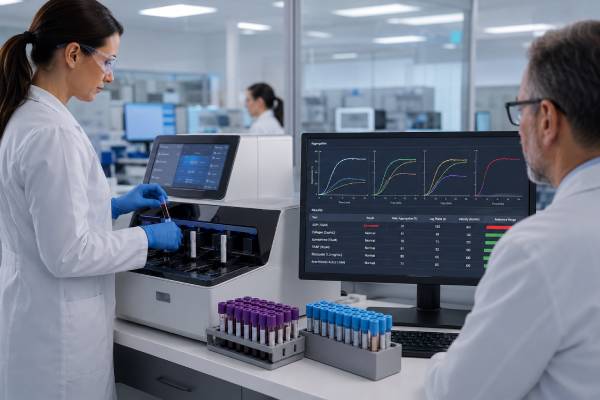
A platelet function test checks how well platelets work, not just how many platelets are present. Platelets are tiny blood cell fragments that help stop bleeding by sticking to an injured blood vessel, activating, releasing chemical signals, and clumping together to form a plug. A person can have a normal platelet count but still bleed too easily if the platelets do not respond properly.
These tests are most useful when bleeding symptoms point to a “platelet-type” problem: easy bruising, frequent nosebleeds, gum bleeding, heavy menstrual bleeding, or prolonged bleeding after dental work, surgery, or minor cuts. Results need careful interpretation because aspirin, ibuprofen, clopidogrel, low platelet count, anemia, kidney disease, liver disease, sample handling, and recent illness can all affect platelet function. An abnormal result does not name one disorder by itself; it helps guide the next step.
- A platelet function test measures platelet performance, including adhesion, activation, aggregation, and sometimes granule release.
- Abnormal results usually mean platelets are not forming a plug normally, but the cause can be inherited, medication-related, illness-related, or sample-related.
- Normal platelet function test results do not fully rule out a bleeding disorder, especially when symptoms are strong or intermittent.
- A normal platelet count does not prove normal platelet function; count and function answer different questions.
- Aspirin and many NSAIDs can alter results, so medication history matters before testing.
- Urgent care is needed for uncontrolled bleeding, black stools, blood in vomit or urine, severe headache after head injury, or heavy menstrual bleeding with dizziness or weakness.
Table of Contents
- What a Platelet Function Test Measures
- When the Test Is Ordered
- Normal and Abnormal Results
- Common Causes of Abnormal Results
- Bleeding Risk and Warning Signs
- Preparation and Result Interference
- Follow-Up Tests and Next Steps
- Key Takeaways
What a Platelet Function Test Measures
A platelet function test measures how platelets behave during the early stage of clot formation. This early stage is called primary hemostasis. It starts when a blood vessel is injured and platelets move to the damaged area, stick to the vessel wall, become activated, release chemical signals, and clump together.
A routine platelet count tells how many platelets are in the blood. A platelet function test asks a different question: do those platelets work properly?
Platelet function includes several linked steps:
- Adhesion: platelets stick to damaged blood vessel lining, helped by von Willebrand factor.
- Activation: platelets change shape and turn on surface receptors.
- Secretion: platelets release chemicals such as ADP and serotonin from storage granules.
- Aggregation: platelets clump together through fibrinogen bridges and platelet receptors.
- Clot support: platelets help create a stronger fibrin clot with the coagulation system.
Different platelet function tests examine different parts of this process. No single test captures every platelet problem.
| Test type | What it checks | Common use |
|---|---|---|
| Platelet aggregation testing | How platelets clump in response to agonists such as ADP, collagen, epinephrine, arachidonic acid, or ristocetin | Detailed evaluation of suspected platelet function disorders |
| Closure time testing | How quickly platelets plug a tiny opening under high-shear conditions | Screening for platelet dysfunction, von Willebrand disease patterns, or drug effect |
| Lumiaggregometry | Platelet aggregation plus ATP release from dense granules | Suspected storage pool or secretion defects |
| Flow cytometry | Platelet surface proteins and activation markers | Bernard-Soulier syndrome, Glanzmann thrombasthenia, low platelet count situations |
| Viscoelastic testing such as TEG or ROTEM | Whole-blood clot formation and clot strength | Surgery, trauma, liver disease, major bleeding care |
| Point-of-care antiplatelet tests | Drug-related platelet inhibition | Selected patients on aspirin, clopidogrel, or similar drugs |
The classic specialized test is platelet aggregation testing, especially light transmission aggregometry. In this test, platelet-rich plasma is exposed to substances that normally trigger platelets to clump. The lab measures how strongly the platelets respond.
A PFA-100 or PFA-200 closure time test uses whole blood and measures how long it takes platelets to block a small aperture coated with platelet-activating materials. A longer closure time suggests impaired platelet plug formation, but it does not diagnose a specific disorder by itself.
Bleeding time, an older test that involved making small skin cuts and timing bleeding, is rarely used now because it performs poorly as a screening test and lacks reliability compared with modern laboratory methods.
When the Test Is Ordered
A platelet function test is ordered when bleeding symptoms suggest a problem with platelet activity, especially when the platelet count is normal or only mildly abnormal. It is also used in selected hospital settings before or during complex surgery, trauma care, cardiac procedures, or antiplatelet medication monitoring.
The most typical reason is mucocutaneous bleeding. This means bleeding from skin or moist surfaces such as the nose, mouth, uterus, urinary tract, or digestive tract. Platelet-related bleeding often appears early after injury because platelets act in the first minutes of clot formation.
Common reasons for testing include:
- Easy bruising that seems out of proportion to injury
- Frequent or prolonged nosebleeds
- Gum bleeding, especially with dental cleaning or brushing
- Heavy menstrual bleeding, flooding, or large clots
- Prolonged bleeding after tooth extraction
- Bleeding after surgery, childbirth, circumcision, or minor procedures
- Petechiae, which are tiny red or purple pinpoint spots under the skin
- A family history of abnormal bleeding
- Suspected aspirin, NSAID, clopidogrel, or other antiplatelet drug effect
- Bleeding symptoms despite a normal platelet count
The test is also useful when a clinician suspects a functional platelet disorder after initial testing. Initial testing often includes a complete blood count, blood smear, PT/INR, aPTT, fibrinogen, and testing for von Willebrand disease. A broader coagulation panel helps separate platelet-type bleeding from clotting factor problems.
Platelet testing is not a routine screening test for everyone before surgery. It is most useful when the person has a personal or family bleeding history, takes platelet-affecting medicines, or has a condition known to disturb platelet function.
Platelet-type bleeding versus clotting-factor bleeding
Platelet problems usually cause surface bleeding: bruising, nosebleeds, gum bleeding, heavy periods, and immediate bleeding after cuts or procedures. Clotting factor deficiencies, such as hemophilia, more often cause deep tissue bleeding, delayed bleeding after procedures, large muscle bleeds, or bleeding into joints.
This pattern is not perfect, but it helps guide testing. A person with heavy menstrual bleeding and easy bruising often needs platelet and von Willebrand testing. A person with swollen painful joints after minor trauma often needs clotting factor evaluation.
Normal and Abnormal Results
A normal platelet function test means the platelets responded within the laboratory’s expected range for that method. An abnormal result means the platelets did not respond normally under the test conditions. The exact meaning depends on the test type, the agonists used, the platelet count, the hematocrit, medications, sample handling, and the patient’s bleeding history.
There is no single universal “normal range” for all platelet function tests. Results are method-specific. A closure time result is reported in seconds. Aggregometry is often reported as a percentage of aggregation, curve pattern, lag time, secretion response, or response to each agonist. Flow cytometry reports receptor levels or activation markers.
| Result pattern | Practical meaning | Common next question |
|---|---|---|
| Normal platelet count and normal platelet function | No major abnormality found in tested pathways | Are symptoms due to von Willebrand disease, vessel fragility, factor deficiency, anemia, gynecologic causes, or a mild defect not captured by the test? |
| Normal platelet count and abnormal function | Platelets are present but not responding normally | Is the cause aspirin/NSAIDs, clopidogrel, kidney disease, liver disease, inherited platelet disorder, or sample issue? |
| Low platelet count and abnormal function | Too few platelets, and testing may be harder to interpret | Is thrombocytopenia the main cause, or is there an inherited disorder with large or abnormal platelets? |
| Prolonged closure time | Platelet plug formation is delayed in the test cartridge | Is there aspirin effect, low hematocrit, low platelet count, von Willebrand disease, or true platelet dysfunction? |
| Abnormal aggregation to several agonists | Stronger evidence for a platelet function disorder | Which response pattern fits the suspected disorder? |
| Isolated abnormal response to arachidonic acid | Often fits aspirin-like COX-1 pathway inhibition | Did the person take aspirin or an NSAID recently? |
| Abnormal ristocetin response | Points toward von Willebrand factor or platelet GPIb-related problems | Are von Willebrand tests abnormal? Are platelets giant or low? |
A prolonged closure time is not the same as a diagnosis. It means the sample took longer than expected to form a platelet plug in that testing system. Low red blood cell mass, low platelet count, aspirin, some NSAIDs, von Willebrand disease, and sample handling problems all prolong closure time.
Aggregation tests provide more detail. For example, absent or severely reduced aggregation with most agonists but preserved response to ristocetin suggests a pattern seen in Glanzmann thrombasthenia. Poor response to ristocetin points toward von Willebrand disease or Bernard-Soulier syndrome, depending on platelet size, count, and von Willebrand results. Reduced secretion with impaired second-wave aggregation suggests a dense granule or secretion problem.
A normal result still needs clinical context. Mild platelet disorders are sometimes missed, especially when symptoms are intermittent, the sample is delayed, the wrong test method is used, or the abnormal pathway is not included in the test panel.
Common Causes of Abnormal Results
Abnormal platelet function results fall into two broad groups: acquired causes and inherited causes. Acquired causes are more common. Inherited platelet disorders are rarer but important because they affect procedure planning, family counseling, pregnancy care, and long-term bleeding risk.
Medication-related platelet dysfunction
Medicines are among the most common reasons for abnormal platelet function results. Aspirin blocks platelet cyclooxygenase-1, which reduces thromboxane A2 production and weakens platelet activation. Because platelets do not have a nucleus, the aspirin effect lasts for the life of the exposed platelet, often around 7 to 10 days.
NSAIDs such as ibuprofen and naproxen also affect platelet function, though their effects are usually shorter than aspirin. Clopidogrel, prasugrel, ticagrelor, and similar P2Y12 inhibitors reduce ADP-driven platelet activation. Some antibiotics, antidepressants, antihistamines, valproic acid, chemotherapy drugs, and herbal or supplement products also influence platelet function in some people.
A medication effect is not always a “bad” result. If the test is being used to check antiplatelet therapy, platelet inhibition is expected. If the test is being used to diagnose unexplained bleeding, recent platelet-affecting medicines can create a false impression of a platelet disorder.
Acquired medical causes
Several medical conditions weaken platelet function even when the platelet count looks acceptable.
Important acquired causes include:
- Kidney failure or uremia: retained waste products interfere with platelet adhesion and activation.
- Liver disease: platelet number, platelet function, clotting factors, and fibrinogen may all be abnormal.
- Myeloproliferative neoplasms: very high platelet counts can coexist with poor platelet function.
- Myelodysplastic syndromes: platelets may be abnormal in number and function.
- Severe infection, inflammation, or critical illness: platelet activation and exhaustion can distort results.
- Cardiopulmonary bypass, ECMO, and major surgery: mechanical and inflammatory stress can impair platelets.
- Anemia or low hematocrit: fewer red blood cells change how platelets move toward vessel walls and can prolong closure time.
- Alcohol use disorder: alcohol and liver injury can reduce platelet production and function.
A low platelet count can also affect function test interpretation. Some inherited platelet disorders include thrombocytopenia, so low platelets do not rule out a function disorder. It does make some aggregation tests less reliable.
Inherited platelet function disorders
Inherited platelet disorders are genetic conditions that affect platelet adhesion, activation, secretion, aggregation, or platelet structure. Symptoms often start in childhood, but mild disorders sometimes remain unnoticed until dental extraction, childbirth, surgery, or a major injury.
Examples include:
- Glanzmann thrombasthenia: platelets cannot aggregate normally because the GPIIb/IIIa fibrinogen receptor is absent or defective.
- Bernard-Soulier syndrome: platelets cannot attach normally to von Willebrand factor because the GPIb-IX-V receptor complex is abnormal; platelets are often large and the count may be low.
- Storage pool disease: platelets have too few dense granules or cannot release granule contents normally.
- Platelet secretion defects: platelets activate but fail to release enough chemical signals.
- Aspirin-like defects: inherited pathway problems mimic some effects of aspirin exposure.
- MYH9-related disorders: large platelets and low platelet count occur with variable bleeding risk and possible kidney, hearing, or eye findings.
A platelet morphology blood smear helps because some inherited disorders cause giant platelets, tiny platelets, platelet clumping, or abnormal granules. Flow cytometry and genetic testing become important when the aggregation pattern or smear points toward a specific inherited condition.
Von Willebrand disease also belongs in this conversation because it disrupts platelet adhesion. It is not primarily a platelet defect, but it often produces platelet-type bleeding and abnormal closure time or ristocetin-related results. A von Willebrand disease panel is usually part of the workup when bruising, nosebleeds, heavy menstrual bleeding, or procedure bleeding is unexplained.
Bleeding Risk and Warning Signs
Bleeding risk is judged from the whole picture, not from one platelet function result. A person with a mildly abnormal test and no bleeding history may have low practical risk. Another person with a borderline test but repeated surgical bleeding, heavy menstrual bleeding, or family history may need specialist planning before procedures.
The most useful bleeding-risk clues come from real events:
- How long bleeding lasted after dental work or surgery
- Whether bleeding restarted after it seemed controlled
- Whether bruises appear without clear injury
- Whether nosebleeds last longer than 10 to 15 minutes despite pressure
- Whether menstrual bleeding causes iron deficiency, clots, flooding, or missed activities
- Whether blood transfusion, iron treatment, cautery, packing, tranexamic acid, desmopressin, or platelet transfusion was needed
- Whether close relatives have similar symptoms
Platelet-type bleeding tends to happen right away. For example, a person may ooze during a dental extraction or bleed through dressings soon after surgery. Delayed bleeding hours or days later can still occur, but it raises the need to check other parts of clotting too.
Seek urgent medical care for:
- Bleeding that does not slow after firm pressure for 10 to 15 minutes
- Vomiting blood or material that looks like coffee grounds
- Black, tarry stool or large amounts of red blood in stool
- Blood in urine
- Severe headache, confusion, weakness, vision changes, or vomiting after a head injury
- Large, rapidly spreading bruises or swelling after trauma
- Heavy menstrual bleeding with dizziness, fainting, chest pain, shortness of breath, or soaking through a pad or tampon every hour
- Bleeding in pregnancy or after delivery
- New widespread petechiae or purpura, especially with fever or illness
Platelet disorders do not always cause constant bleeding. Some people bleed only after a major trigger, such as surgery, childbirth, dental extraction, aspirin exposure, kidney failure, or infection. This is why an old history of “I always bleed after dental work” matters even when current blood tests look near normal.
Preparation and Result Interference
Good preparation improves the accuracy of platelet function testing. These tests are sensitive to medication exposure, sample timing, blood draw technique, platelet count, hematocrit, and transport conditions.
Do not stop prescription antiplatelet or anticoagulant medicine on your own. Stopping aspirin, clopidogrel, warfarin, apixaban, rivaroxaban, or similar drugs without medical guidance can raise the risk of heart attack, stroke, stent clotting, pulmonary embolism, or other serious clotting events. The ordering clinician should decide whether the goal is to measure drug effect or to test baseline platelet function.
Before testing, tell the clinician and laboratory about:
- Aspirin use, including low-dose daily aspirin
- Ibuprofen, naproxen, diclofenac, ketorolac, or other NSAIDs
- Clopidogrel, prasugrel, ticagrelor, dipyridamole, or cilostazol
- Warfarin, heparin, direct oral anticoagulants, or injectable anticoagulants
- SSRIs or SNRIs
- Valproic acid and other seizure medicines
- Antibiotics taken recently
- Chemotherapy, immunosuppressants, or cancer therapy
- Herbal products, fish oil, garlic pills, ginkgo, turmeric, and other supplements
- Recent transfusion or platelet transfusion
- Recent infection, fever, major exercise, surgery, or pregnancy
Many labs prefer testing when the person is clinically stable, not during an acute illness unless the test is needed urgently. Some platelet function tests require fresh blood processed within a short time, often within a few hours. Delayed transport can change platelet responsiveness.
Food is usually less important than medication and sample handling. Fasting is not always required unless the lab or clinician gives specific instructions. A very lipemic sample after a heavy fatty meal can interfere with some optical methods, so following the lab’s instructions matters.
The blood draw itself matters. Platelets activate easily. A traumatic draw, difficult venipuncture, underfilled citrate tube, clotted sample, hemolysis, or prolonged tourniquet time can create misleading results. The sample should be mixed gently and handled according to the laboratory’s platelet testing protocol.
Some results are limited by the platelet count. Light transmission aggregometry works best when there are enough platelets in platelet-rich plasma. Very low counts make aggregation curves harder to interpret. In thrombocytopenia, specialized approaches such as flow cytometry or modified aggregometry may give more useful information.
Follow-Up Tests and Next Steps
An abnormal platelet function test usually leads to a stepwise review, not an instant diagnosis. The first step is to confirm that the result fits the person’s symptoms and that no obvious interference explains it.
A practical follow-up plan often includes:
- Review the bleeding history. The clinician asks about childhood bleeding, dental work, surgeries, childbirth, menstrual bleeding, bruising, nosebleeds, and family history.
- Review medicines and supplements. A recent aspirin or NSAID exposure explains many abnormal results.
- Check platelet count and smear. Platelet number, size, clumping, and granules shape the interpretation.
- Check basic clotting tests. PT/INR, aPTT, fibrinogen, and sometimes thrombin time help rule in or rule out other clotting problems.
- Test for von Willebrand disease. This is a common cause of platelet-type bleeding and needs specific testing.
- Repeat platelet function testing when needed. Repeat testing helps confirm a true abnormality, especially when the first sample had possible interference.
- Use specialized testing. Lumiaggregometry, flow cytometry, electron microscopy for dense granules, or genetic testing may be needed for rare disorders.
If PT or aPTT is abnormal, the workup may shift toward coagulation factor testing. For example, a prolonged aPTT result can point toward factor VIII, IX, XI, XII problems, lupus anticoagulant patterns, heparin effect, or von Willebrand disease through low factor VIII.
Treatment depends on the cause and the situation. A person with aspirin-related dysfunction may need medication timing adjusted before a procedure. A person with kidney-related platelet dysfunction may need treatment of uremia, anemia, or dialysis optimization. A person with von Willebrand disease may need desmopressin, von Willebrand factor concentrate, or antifibrinolytic medication for procedures. A person with a severe inherited platelet disorder may need a hematologist-led plan, avoidance of platelet-affecting medicines, emergency documentation, and procedure-specific therapy.
For heavy menstrual bleeding, the plan often needs both hematology and gynecology input. Iron deficiency is common when bleeding is chronic, so ferritin and hemoglobin testing often matter as much as the platelet result. Correcting iron deficiency improves symptoms and helps show how much bleeding remains after treatment.
For surgery or dental work, the key is planning before the procedure. The care team may choose local hemostatic measures, tranexamic acid, desmopressin trial results, platelet transfusion, factor or von Willebrand therapy, medication holds, or hospital-based monitoring depending on the diagnosis and bleeding history.
Key Takeaways
A platelet function test is most useful when it answers a focused question: are platelets working normally enough to form an early clot? It is different from a platelet count and often needs several related tests for a clear answer.
The most important points are:
- A normal platelet count does not guarantee normal platelet function.
- Abnormal platelet function results need medication, illness, platelet count, hematocrit, and sample handling review.
- Aspirin, NSAIDs, clopidogrel, kidney disease, liver disease, anemia, thrombocytopenia, and inherited platelet disorders are common explanations.
- Platelet-type bleeding usually affects skin and mucous membranes: bruising, nosebleeds, gum bleeding, heavy periods, and immediate procedure bleeding.
- Platelet function tests help guide risk and next steps, but bleeding history remains central.
- Normal results do not fully rule out mild platelet disorders or von Willebrand disease.
- A hematologist is usually the right specialist for persistent unexplained bleeding, strong family history, abnormal aggregation patterns, or procedure planning.
The best interpretation connects the lab result to the real-life bleeding pattern. A test result alone rarely tells the full story. The safest approach is to confirm abnormal findings, identify reversible causes, rule out von Willebrand disease and coagulation factor problems, and create a clear plan before surgery, dental work, pregnancy, or antiplatelet medication changes.
References
- Platelet Tests: MedlinePlus Medical Test 2024 (Official Page)
- Platelet Disorders Causes and Risk Factors 2025 (Official Page)
- Functional Platelet Disorders 2025 (Clinical Guidance)
- Physiology, Platelet 2023 (Review)
- Consensus on Aggregometry for platelet function testing in thrombocytopenic patients : Communication from the SSC of the ISTH 2026 (Position Statement)
- Light transmission aggregometry for platelet function testing 2024 (Position Statement)
Disclaimer
This article is for educational purposes only and does not replace medical advice, diagnosis, or treatment from a qualified healthcare professional. Platelet function test results need interpretation with your bleeding history, medicines, platelet count, and other clotting tests. Seek urgent care for uncontrolled bleeding, symptoms after head injury, black stools, blood in vomit or urine, or heavy bleeding with weakness, dizziness, chest pain, or shortness of breath.