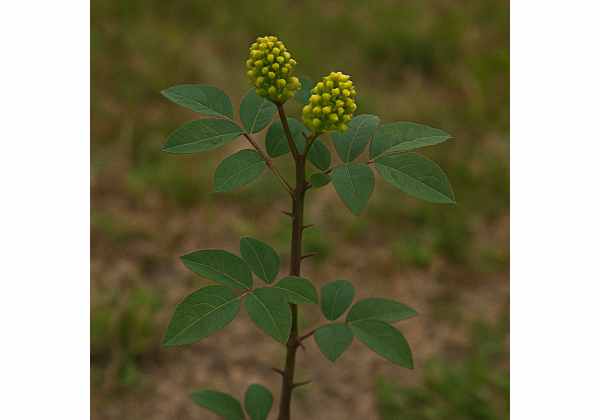
Prickly ash is a warming North American medicinal tree and shrub best known for the striking tingling and numbing feeling its bark and berries can produce in the mouth. Most herbal discussions focus on Zanthoxylum americanum and Zanthoxylum clava-herculis, two closely related species traditionally used for tooth and gum discomfort, sluggish digestion, low peripheral circulation, and a general sense of coldness or stagnation. In older American herbal practice, it was valued less as a daily tonic and more as a sharp, stimulating remedy that “wakes up” tissues and secretions.
What makes prickly ash interesting today is the way its traditional sensory effects line up with modern phytochemistry. Its bark contains alkylamides, alkaloids, coumarins, and other compounds linked to local anesthetic, antimicrobial, antioxidant, and circulation-supporting actions in laboratory research. Still, the modern evidence base is much stronger in test tubes and animal models than in human trials. That means prickly ash is best approached as a focused traditional herb with plausible mechanisms, not as a proven cure-all. Used thoughtfully, it can be practical and memorable. Used carelessly, it can be too stimulating for the wrong person.
Quick Overview
- Prickly ash is traditionally used for short-term tooth and gum discomfort because it creates a fast tingling and numbing sensation.
- It is often chosen in herbal practice to stimulate saliva, digestion, and peripheral circulation rather than to calm inflammation on its own.
- Traditional adult use commonly falls around 0.5 to 1 mL tincture or 1 to 3 g bark decoction per dose, up to three times daily.
- Avoid medicinal use during pregnancy, with active ulcers or mouth sores, or when high blood pressure is already poorly controlled.
Table of Contents
- What Prickly Ash Is and How the Two Main Species Are Used
- Key Ingredients in Prickly Ash and Why the Mouth Tingle Matters
- Prickly Ash Health Benefits and What the Evidence Actually Supports
- Traditional Uses for Oral, Digestive, and Circulatory Support
- Prickly Ash Dosage, Preparations, and Best Timing
- How to Choose Products and Avoid Common Mistakes
- Safety, Side Effects, Interactions, and Who Should Avoid It
What Prickly Ash Is and How the Two Main Species Are Used
Prickly ash refers mainly to two North American species, Zanthoxylum americanum and Zanthoxylum clava-herculis. The first is often called northern prickly ash, while the second is commonly known as southern prickly ash or Hercules’ club. Both belong to the citrus family, Rutaceae, and both have a long record in North American herbalism. They are thorny plants with aromatic bark and fruit, and they share the feature that made them famous: when the bark or berry is tasted, it produces a strong tingling, sialagogue effect followed by numbness.
That sensory profile is not a side note. It tells you a great deal about how the herb has traditionally been used. Older practitioners reached for prickly ash when tissues seemed sluggish, secretions were low, circulation felt poor, and the body seemed cold or inactive rather than hot and irritated. In practice, that led to its use for toothache, sore gums, dry mouth, weak digestion, constipation linked to poor tone, and low peripheral circulation.
The medicinal part most often used is the bark, especially branch bark or root bark, though the berries also appear in traditional and modern practice. The species are usually treated as broadly interchangeable in herbal literature, but that does not mean every product on the market is identical. Some preparations emphasize bark, others fruit, and some give little detail at all. That matters because bark-based products tend to match traditional North American use more closely than culinary prickly ash powders modeled after Asian pepper species.
Another common source of confusion is the broader Zanthoxylum genus. The same genus includes culinary and medicinal species used in Asia, especially those associated with Sichuan pepper. These relatives share certain tingling alkylamides, but they are not all the same herb in the same form. A prickly ash capsule made from North American bark should not be treated as interchangeable with a spice jar of Sichuan pepper husks.
A grounded way to understand prickly ash is to think of it as a stimulating sensory herb rather than a generic wellness supplement. Its history is strongest in short-term oral, digestive, and circulatory use. That distinguishes it from gentler everyday herbs and helps explain why it remains memorable to nearly everyone who tastes it. Even before modern chemistry enters the conversation, the plant announces its likely role with the first bite.
Key Ingredients in Prickly Ash and Why the Mouth Tingle Matters
Prickly ash is chemically interesting because its traditional uses track closely with its most noticeable physical effect. The tingling and numbing feeling in the mouth is linked largely to alkylamides, often discussed in the genus as sanshool-type compounds and related amides. These molecules interact with sensory nerve pathways and help explain why prickly ash has been used for tooth and gum discomfort, mouth stimulation, and local sensory change.
That does not mean one single compound explains the whole herb. Prickly ash also contains alkaloids, coumarins, lignans, volatile compounds, and other secondary metabolites that may contribute antimicrobial, antioxidant, anti-inflammatory, and circulation-related effects. Among the better-known compounds discussed in the genus are chelerythrine, nitidine, magnoflorine, and various coumarins and furanocoumarins. Some of these have shown interesting activities in preclinical studies, but their presence can also complicate safety, potency, and product consistency.
A practical way to think about prickly ash chemistry is to group the actions into three main lanes:
- Sensory and local anesthetic activity, which explains the tingling, salivation, and mild numbing effects.
- Stimulant and secretory activity, which fits traditional use for sluggish digestion, poor salivary flow, and “cold” digestive states.
- Antimicrobial and antioxidant activity, which helps support its folk use for oral care and topical or infection-related formulas.
The mouth tingle matters because it is not just a novelty. It acts almost like a built-in quality test. Fresh, well-prepared prickly ash usually produces a noticeable warming, buzzing sensation. If a tincture or bark powder tastes flat and does nothing in the mouth, the herb may be old, weak, mislabeled, or overprocessed. That sensory response is one reason prickly ash has such a strong herbal identity.
Still, chemistry should not tempt readers into oversimplifying the plant. Prickly ash is not a natural lidocaine, not a botanical antibiotic substitute, and not a guaranteed circulation booster in every case. It is a complex herb whose best-known effects come from a blend of compounds rather than a single pharmacologic action. That is also why product form matters. Bark decoctions, tinctures, powders, and topical preparations may not behave exactly the same way.
Compared with a better-known pain herb such as white willow for pain relief, prickly ash works less like a systemic anti-inflammatory and more like a pungent, local, stimulating botanical. That distinction helps keep expectations realistic. Its chemistry supports its traditional identity, but it does not justify treating every prickly ash preparation as a modern evidence-backed analgesic.
Prickly Ash Health Benefits and What the Evidence Actually Supports
The strongest way to talk about prickly ash benefits is to separate traditional credibility from modern proof. The herb has a coherent historical use pattern, and modern research on the wider Zanthoxylum genus supports several plausible mechanisms. At the same time, high-quality human trials on Zanthoxylum americanum and Zanthoxylum clava-herculis remain scarce. That means benefits should be framed carefully.
The most believable benefits are these:
- Temporary oral comfort. The bark’s tingling and numbing effect makes prickly ash one of the most distinctive traditional herbs for tooth and gum discomfort.
- Stimulation of saliva and digestion. The herb has long been used when digestion feels slow, secretions seem low, and the mouth or gut feels dry or inactive.
- Support for peripheral circulation. Traditional herbalists often describe it as warming and moving, especially in formulas for cold hands, cold feet, or poor tissue tone.
- Antimicrobial potential. Laboratory work on American and southern prickly ash has shown activity against fungi and resistant bacteria, though this does not automatically translate into clinical treatment.
- Antioxidant and anti-inflammatory potential. Review articles on the genus describe these effects broadly, but the evidence is mostly preclinical.
The oral use case is probably the easiest for modern readers to understand. When people chewed the bark for toothache, they were responding to a real sensory effect, not simply repeating folklore. That is also why prickly ash is sometimes compared with clove for oral discomfort, although the two plants are not chemically identical and should not be treated as substitutes in every formula.
The weaker zone is broad systemic promise. Some review papers on Zanthoxylum species discuss anticancer, antimicrobial, metabolic, and neuroprotective possibilities, but that does not mean prickly ash has proven clinical benefit in cancer, diabetes, dementia, or serious infection. In many cases the evidence comes from cell studies, isolated compounds, or animal work. Those findings are valuable, but they are not the same as safe, validated human treatment.
That is the right lens for readers and writers alike. Prickly ash deserves respect as a focused traditional herb with biologically active constituents. It does not deserve inflated marketing that turns a pungent dental and digestive stimulant into a cure for everything from chronic pain to immune dysfunction. The most honest summary is that prickly ash likely has real local sensory, digestive, and stimulant value, while many broader claims remain preliminary and product-dependent.
Traditional Uses for Oral, Digestive, and Circulatory Support
Prickly ash makes the most sense when matched to the kinds of problems traditional herbalists actually used it for. Its classic pattern is not “any pain” or “any stomach issue.” It is the colder, slower, more stagnant picture: poor salivation, dull tooth pain, sluggish digestion, low tissue tone, flat appetite, weak circulation, and constipation linked more to inactivity than to dryness alone.
For oral use, prickly ash bark was often chewed or applied briefly to aching teeth and gums. The goal was not long-term treatment but short-term numbing and stimulation. In modern terms, it can be thought of as a symptom-relief herb for temporary dental discomfort while waiting for proper care. It may also stimulate saliva, which can be useful when the mouth feels dry and inactive rather than inflamed and ulcerated.
For digestion, prickly ash has traditionally been used as a pungent bitter-warming stimulant. It fits best when digestion feels weak, secretions are low, and meals seem to sit heavily. That is different from using it for reflux, acute gastritis, or an already irritated stomach. In those settings it may be too sharp. In formulas for sluggish digestion, its role often overlaps with warming herbs such as ginger for digestive stimulation, though prickly ash is generally more numbing and more locally stimulating in the mouth.
Circulatory use is another distinctive feature. Older herbals often describe prickly ash as moving blood toward the surface and improving capillary or peripheral flow. That language reflects a traditional framework, not a modern vascular trial result, but it helps explain why the herb became associated with cold extremities, tissue torpor, and slow recovery from states of low vitality.
Common traditional applications include:
- chewing bark briefly for tooth and gum discomfort,
- taking tincture before meals for poor appetite or sluggish digestion,
- using decoctions in formulas for low circulation and atonic constipation,
- and applying stimulating liniments externally in some older practices.
What prickly ash is not well suited for is just as important. It is not usually the best herb for hot, inflamed, ulcerated mucosa. It is not a gentle daily tea for most people. It is not a first-line solution for chronic dental disease, major digestive pathology, or cardiovascular disease. And it is not a soothing herb in the way marshmallow, chamomile, or linden can be.
Its best traditional role is sharper and more targeted: briefly wake up a system that feels dull, cold, underactive, or poorly perfused. That narrower identity is exactly what makes the herb useful when chosen well.
Prickly Ash Dosage, Preparations, and Best Timing
Prickly ash dosage is best presented as a traditional adult range rather than a clinically standardized prescription. There is no strong modern consensus dose based on high-quality human trials. Instead, herbal practice relies on preparation type, practitioner tradition, and the person’s sensitivity to stimulating herbs.
Common traditional adult ranges include:
- Tincture: about 0.5 to 1 mL, up to three times daily
- Decoction: about 1 to 3 g of bark simmered in 250 mL water for one dose, up to three times daily
- Capsules or powdered bark: roughly 500 to 1000 mg, up to three times daily, when using plain bark products
These are best understood as short-term, moderate-use ranges for adults, not a reason to push the herb harder. Prickly ash is potent in a sensory way, and many people do not need large amounts to feel its action.
Preparation matters. A tincture is often the most practical modern form because it is easy to dose in small quantities. Bark decoction fits traditional use well, but it is less convenient and more intense in taste. Powder and capsules are available, though quality is uneven and the lack of obvious mouth tingling can make weak products harder to spot.
Timing also depends on the goal:
- Before meals may make sense when the goal is appetite and digestive stimulation.
- As needed for short-term oral discomfort is more appropriate than scheduled long-term use.
- In divided doses through the day may fit circulatory or digestive formulas better than one large dose.
A useful rule is to start low, especially with tincture. If a small amount already produces mouth warmth, salivation, or digestive stimulation, more is not automatically better. Escalating the dose may simply bring more irritation, nausea, or overstimulation.
Duration should also stay modest. Prickly ash is usually not treated as a herb for months of unsupervised daily use. It makes more sense as a short-course botanical or as a small part of a practitioner-designed formula. If a person needs constant digestive stimulation or ongoing tooth pain relief, the bigger question is why those symptoms persist.
For readers who mainly want gentle daily digestive support, a milder herb such as peppermint for digestive comfort may be easier to tolerate. Prickly ash belongs to a more stimulating category. That does not make it better or worse. It simply means it should be matched to the right constitution, the right complaint, and the right time horizon.
How to Choose Products and Avoid Common Mistakes
Prickly ash is easy to misuse because the herb’s dramatic mouthfeel can make people assume it is stronger, broader, or more universally helpful than it really is. Good product selection and a few simple guardrails make a big difference.
Start with label clarity. A worthwhile product should name the species, the plant part, and the preparation type. A label that says only “prickly ash extract” without telling you whether it contains bark, fruit, or a broader Zanthoxylum blend is less trustworthy. For a traditional North American herbal use profile, bark-based preparations usually make the most sense.
Freshness matters too. Because prickly ash is valued partly for its tingling sensory effect, weak old material often announces itself by doing very little. That does not mean every strong-tasting product is excellent, but it does mean a completely flat product deserves suspicion. Tinctures should come from reputable makers with alcohol percentage or herb-to-solvent ratio listed when possible.
The most common mistakes include:
- Using culinary relatives as if they were the same herb. Sichuan pepper and American prickly ash are related, not identical.
- Treating local numbing as proof of healing. A numb gum is not the same as a resolved dental problem.
- Using it on already damaged tissues. If the mouth has open sores or the stomach is acutely inflamed, prickly ash may aggravate the area.
- Expecting it to act like a modern painkiller. Its best effects are local, stimulating, and short term.
- Ignoring constitution and context. A cold, sluggish pattern is a better fit than an overheated, irritated, hyperacid one.
Combination formulas also deserve thought. Prickly ash is often used in small amounts to sharpen or “wake up” a broader formula rather than to dominate it. In that role, it can complement gentler herbs. It is less often used alone for long stretches.
A helpful mental model is to treat prickly ash the way you would treat a concentrated warming spice, only more medicinal. You would not pour large amounts of it into every tea, every gut formula, or every pain blend and expect balance. In that sense it is closer to a strong tool than a general tonic.
If the goal is soothing an irritated gut or inflamed mucosa, a calmer herb such as chamomile for digestion and irritation often makes more sense. Prickly ash earns its place when the body seems underactive, not when tissues are already overly reactive.
Safety, Side Effects, Interactions, and Who Should Avoid It
Prickly ash is not usually described as a highly dangerous herb, but it is a stimulating one, and that changes the safety conversation. The most common adverse effects are local burning, excess salivation, mouth and throat irritation, nausea, and digestive upset. These may appear even at normal doses in sensitive people, especially if the herb is strong or taken on an empty stomach.
Certain people should avoid prickly ash or use it only with qualified guidance:
- Pregnant or breastfeeding people, because safety data are insufficient.
- People with active ulcers, hyperacidity, or very inflamed digestive tracts, because the herb may worsen irritation.
- People with open sores in the mouth or throat, since the pungent bark can aggravate already damaged tissue.
- People with poorly controlled high blood pressure or strong heat signs, because a warming circulatory stimulant may not be an ideal fit.
- Children, unless a trained clinician specifically recommends it and adjusts the dose carefully.
Documented herb-drug interactions are limited, which sounds reassuring but mostly means the herb has not been well studied in that area. A cautious view is still appropriate. Because prickly ash may stimulate gut transit and secretions, it could theoretically alter how some medicines are tolerated or absorbed. Extra caution also makes sense when combining it with other strong stimulants or warming botanicals.
Topical and oral misuse is another issue. Repeatedly rubbing a pungent bark tincture onto painful gums can mask symptoms while increasing irritation. The numbing sensation can make a preparation feel helpful even while the underlying problem worsens. That is one reason prickly ash should not replace dental evaluation, especially when there is swelling, fever, drainage, or persistent pain.
Human clinical evidence is limited enough that long-term safety is not well defined. The practical solution is simple: use prickly ash in conservative doses, for focused purposes, and for shorter periods unless a knowledgeable practitioner is supervising. Treat it as a traditional stimulant herb, not as a benign daily supplement.
When used this way, prickly ash can be a distinctive and useful botanical. When used indiscriminately, it is more likely to irritate than to help. That balance is important, especially for readers drawn to the herb because its effects are so immediate and dramatic.
References
- Pharmacological activities of Zanthoxylum L. plants and its exploitation and utilization 2024 (Review)
- Alkamides in Zanthoxylum Species: Phytochemical Profiles and Local Anesthetic Activities 2024 (Review)
- Therapeutic Potential of the Genus Zanthoxylum Phytochemicals: A Theoretical ADME/Tox Analysis 2023 (Review)
- Zanthoxylum Species: A Comprehensive Review of Traditional Uses, Phytochemistry, Pharmacological and Nutraceutical Applications 2021 (Review)
- Zanthoxylum spp (Yarnell) – BOT MED ROCKS 2022 (Professional Monograph)
Disclaimer
This article is for educational purposes only and is not a substitute for medical or dental advice, diagnosis, or treatment. Prickly ash has a long history of traditional use, but modern human evidence remains limited, and the herb may not be appropriate for everyone. Do not use it to delay care for severe tooth pain, infection, gastrointestinal bleeding, persistent digestive symptoms, or circulatory problems. If you are pregnant, breastfeeding, take prescription medication, or have ongoing digestive or cardiovascular conditions, speak with a qualified healthcare professional before using prickly ash medicinally.
If this article helped you, please consider sharing it on Facebook, X, or another platform you use so more readers can find careful, practical information about prickly ash.