Red osier dogwood, Cornus sericea, is a bright-stemmed North American shrub best known for its winter-red twigs, wetland habitat, and long cultural history. It is often discussed as an ornamental landscape plant, but that is only part of its identity. The bark, twigs, leaves, and sometimes berries have also been used in Indigenous and regional folk traditions for diarrhea, fever, sore throat, skin washing, ceremonial smoking mixtures, and general tonic use. In modern research, interest has shifted toward its polyphenols, antioxidant capacity, and low-level anti-inflammatory and antimicrobial effects.
That combination makes red osier dogwood fascinating, but it also calls for balance. The plant has meaningful ethnobotanical value and promising chemistry, yet human clinical evidence is still limited. Most of the strongest modern findings come from extract studies, cell models, and animal nutrition research rather than direct medical trials in people. So the most accurate way to view red osier dogwood is as a traditional bark-and-twig remedy with promising bioactive compounds, modest food use, and practical value that is strongest in gentle, supportive herbal contexts rather than aggressive self-treatment.
Essential Insights
- Red osier dogwood may offer antioxidant support through its high polyphenol content, especially rutin, gallic acid, ellagic acid, and related compounds.
- Traditional use and modern extract research suggest mild astringent, anti-inflammatory, and antimicrobial potential.
- No standardized clinical dose exists, but a cautious traditional-use range is about 1 to 2 cups (240 to 480 mL) daily of a weak bark or twig infusion.
- Pregnant or breastfeeding people, children, and anyone using concentrated extracts without guidance should avoid medicinal use.
Table of Contents
- What Red Osier Dogwood Is and What It Contains
- Potential Health Benefits and What the Evidence Shows
- Key Ingredients and Medicinal Properties
- Traditional and Modern Uses of Red Osier Dogwood
- How to Use Red Osier Dogwood in Preparations
- Dosage, Timing, and Practical Intake
- Safety, Side Effects, and Who Should Avoid It
What Red Osier Dogwood Is and What It Contains
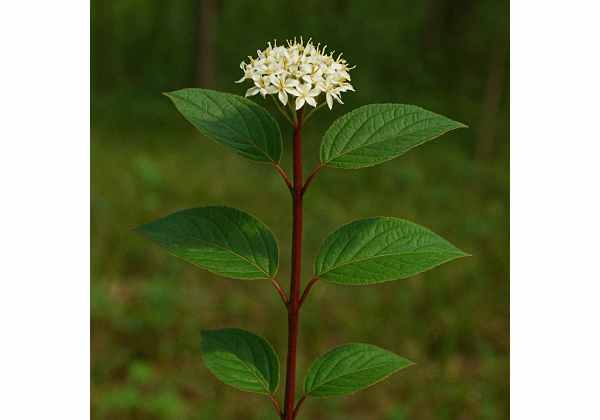
Red osier dogwood is a deciduous shrub native to much of North America, especially in moist woods, stream edges, marshy meadows, riparian corridors, and other damp habitats. It is one of those plants people often recognize before they know its name. The young stems turn a strong red in cooler seasons, the leaves are opposite and softly veined, the flowers are small and creamy white, and the fruits ripen into pale white or bluish-white berries. In botanical literature, older sources may also call it Cornus stolonifera, but Cornus sericea is the accepted modern name.
Medicinally, the shrub is not used in the same way as the better-known fruiting dogwoods of Asia and Europe. With red osier dogwood, the main traditional material is usually the inner bark, bark decoction, bark infusion, or twig preparation. Some traditions also used the leaves, roots, and berries, but bark-centered use is the clearest recurring theme. This matters because the chemistry is not evenly distributed across every part of the shrub.
Modern work on red osier dogwood plant material shows that leaves, stems, bark-rich fractions, and extracts contain a notable concentration of phenolic compounds. Among the better-described compounds are rutin, gallic acid, methyl gallate, ellagic acid, glucogallic acid, quercetin, and quercetin derivatives. These compounds are the main reason the plant is now being investigated for antioxidant and functional-food applications. In extract studies, they are linked with free-radical scavenging, inflammation-related signaling effects, and barrier-supportive properties in laboratory models.
Red osier dogwood also appears to have selective antimicrobial and gut-active potential in animal research. That does not mean the whole shrub functions like an antibiotic. It means the plant’s phenolic profile may influence microbial balance, which helps explain why it has drawn attention in animal nutrition science. In some studies, red osier dogwood extracts and polyphenol fractions have been tested in pigs and poultry as botanical alternatives to conventional feed additives.
One helpful way to understand the plant is to separate its cultural identity from its research identity. Culturally, it is a ceremonial, craft, dye, and medicinal shrub. Scientifically, it is a polyphenol-rich native plant with promising antioxidant and anti-inflammatory extracts. Those two identities overlap, but they are not identical. Traditional bark use does not automatically predict the exact behavior of a standardized lab extract.
In that sense, red osier dogwood belongs in the same broad discussion as polyphenol-rich botanicals whose value depends as much on chemistry and preparation as on the plant’s common name. It is more than a decorative shrub, but it also needs to be understood on its own terms rather than borrowed from other dogwood traditions.
Potential Health Benefits and What the Evidence Shows
The potential health benefits of red osier dogwood are real enough to deserve attention, but not strong enough to justify dramatic claims. The plant’s most convincing modern value lies in antioxidant and inflammation-related research, followed by selective antimicrobial and gut-support findings in animal models. Human clinical evidence remains limited, so the strongest language should stay with potential, not proof.
The first likely benefit is antioxidant support. Red osier dogwood extracts consistently show high total phenolic content and strong antioxidant capacity in laboratory testing. This is not surprising given the plant’s rutin, gallic acid, ellagic acid, and quercetin-related compounds. In practical terms, those compounds may help explain why the plant earned a reputation as a tonic and why modern researchers see value in concentrating its bark and leaf chemistry for nutraceutical or functional-feed use. Antioxidant activity alone does not prove a clinical benefit, but it gives the plant a clear biochemical basis for further study.
The second likely benefit is anti-inflammatory support. Cell-based studies using red osier dogwood extracts suggest that the plant can reduce inflammation-related signaling and lower the expression of inflammatory mediators in intestinal and vascular model systems. This is one of the more interesting research lanes because it may help explain some traditional bark uses for irritation, fever, and inflammatory discomfort. Still, the step from inflamed cells in a lab dish to meaningful symptom relief in a person is a large one. The evidence is promising, not definitive.
A third area of interest is gut health. In pig studies and animal nutrition reviews, red osier dogwood polyphenol extracts have been associated with microbiota shifts, increased Lactobacillus abundance, and better gut barrier-related outcomes. Broiler research also suggests possible effects on intestinal morphology and health markers under challenge conditions. These findings do not create a human digestive remedy on their own, but they do support the idea that red osier dogwood has more than simple folk value.
Traditional claims should also be read in the right frame. Historical sources connect the bark with diarrhea, sore throat, fever, skin eruptions, weakness, and a few urinary complaints. Those uses make sense for an astringent, bitter, polyphenol-rich shrub. But they are still traditional uses, not modern clinical indications.
The best practical summary is this:
- red osier dogwood appears antioxidant-rich
- it may have mild anti-inflammatory and selective antimicrobial effects
- it may support gut ecology in experimental systems
- it is not a proven medical treatment herb
That distinction matters. Someone looking for pain support, for example, will find a much clearer evidence base in better-studied bark remedies for pain relief than in red osier dogwood. The real strength of Cornus sericea lies in gentle traditional use, ethnobotanical value, and evolving polyphenol research, not in strong clinical claims.
Key Ingredients and Medicinal Properties
When people ask about the key ingredients in red osier dogwood, what they usually want to know is which compounds make the bark and twig extracts seem medicinal. The answer centers on polyphenols. While the plant contains many secondary metabolites, its phenolic profile is the clearest reason it appears in antioxidant and anti-inflammatory research.
Among the most frequently discussed compounds are rutin, gallic acid, methyl gallate, ellagic acid, glucogallic acid, quercetin, and quercetin derivatives such as quercetin 3-O-malonylglucoside. These are not minor details. They help explain why red osier dogwood extracts show measurable activity in laboratory models and why extraction methods matter so much. Different temperatures, solvents, and plant parts yield different concentrations, which means a leaf-and-stem spray-dried extract is not the same as a simple bark tea.
These compounds support several medicinal-property categories often associated with the plant:
- Astringent: Traditional bark use strongly suggests tissue-tightening and drying action, which fits with polyphenol-rich plant material.
- Antioxidant: This is the clearest modern category, supported by repeated extract and phenolic analyses.
- Mildly anti-inflammatory: Cell-model studies suggest that red osier dogwood extracts may reduce inflammatory signaling and support barrier integrity.
- Selectively antimicrobial: Animal-nutrition research and review articles discuss antimicrobial activity that appears more selective than broadly sterilizing.
- Tonic or restorative: This is a traditional word, but it fits the way the bark was historically used for weakness, fever, and general recovery.
One of the most important nuances is that red osier dogwood does not behave like a one-compound herb. It is not defined by a single marker in the way some herbal extracts are marketed. Its activity appears to come from a pattern of phenolic compounds working together. That can be a strength, but it also means crude home preparations are less predictable than laboratory fractions.
Another useful point is seasonal variation. Research on red osier dogwood plant material shows that phenolic concentrations and antioxidant capacity can shift by season and plant part. This matters if someone imagines that every bark strip or twig infusion will have the same activity. They will not. A shrub harvested at one time of year may not match the chemistry of plant material gathered under different conditions.
So what medicinal properties can be described responsibly? Red osier dogwood appears to have real antioxidant strength, plausible anti-inflammatory relevance, and a traditional astringent role that fits its chemistry. What should not be said is that it is a clinically proven treatment for infection, inflammatory bowel disease, fever disorders, or chronic pain. Those claims go well beyond the evidence.
For comparison, many readers find it helpful to think of red osier dogwood as closer to an active-compound herb with modest everyday use than to a standardized botanical medicine. Its chemistry is meaningful, but the clinical map is still incomplete.
Traditional and Modern Uses of Red Osier Dogwood
Red osier dogwood carries one of those medicinal histories that cannot be separated from culture. Indigenous peoples across North America used the shrub for medicine, ceremony, smoking mixtures, food, dye, tools, and basketry. Any modern discussion that treats it only as a supplement ingredient misses the larger reality of the plant. It has long been part of systems of knowledge, not just a list of “uses.”
Traditional medicinal use centered on the bark more than the fruit. The inner bark was prepared as an infusion or decoction for diarrhea, weakness, sore throat, eruptions caused by poison ivy, catarrh, sore eyes, and other complaints depending on region and community. Some groups used bark or leaves in smoking mixtures, sometimes in sacred pipe contexts. Others used berries as a tart tonic food, usually in small amounts or mixed with sweeter fruits rather than eaten as a standalone staple. These uses show how versatile the plant was, but they also show that medicinal use was not separate from daily life.
Modern herbal use is narrower. Today, red osier dogwood is not a mainstream commercial herb. It is better known in restoration ecology and ornamental gardening than in clinical herbalism. When it does appear in modern natural-health conversations, it is usually in one of three forms:
- a mild bark or twig tea inspired by traditional use
- a topical wash or external bark preparation
- a concentrated extract used in research, especially for antioxidant or animal-feed applications
This difference matters. Traditional bark tea and modern polyphenol extracts are not interchangeable. A person simmering bark at home is not reproducing the same chemistry as a study that uses measured phenolic fractions.
Another modern use is in animal nutrition research. Red osier dogwood has gained attention as a botanical feed ingredient because of its antioxidant content and possible influence on gut health, inflammation, and microbial balance in pigs and poultry. This is scientifically interesting, but it should not be oversold as proof of human benefit. It does, however, strengthen the case that the shrub has meaningful biological activity and not just historical charm.
There is also a practical modern use that is not medicinal at all: ecological landscaping and riparian restoration. Red osier dogwood is planted widely for soil retention, wetland restoration, wildlife cover, and erosion control. That broader ecological value often keeps the plant abundant and easy to notice, which may partly explain why its ethnobotanical life persisted so strongly.
For readers interested in how traditional shrubs move between food, medicine, and habitat value, red osier dogwood offers a richer case study than many better-known herbs. It is a reminder that plant medicine is often rooted in place, season, and community. Even so, if the goal is simple daily immune or berry use, most people will find something more practical in better-known berry-centered herbal traditions than in the tart and more specialized use of red osier dogwood.
How to Use Red Osier Dogwood in Preparations
If red osier dogwood is used at all in a modern herbal setting, it is usually used gently. The classic approach is a mild decoction or infusion made from inner bark, bark shavings, small twigs, or a bark-and-twig mixture. In some traditions, leaves were also decocted. Compared with more common herbal teas, red osier dogwood preparations tend to be more astringent, more bitter, and less obviously pleasant, which is one reason the herb never became a mainstream wellness beverage.
A simple traditional-style preparation begins with carefully identified, clean plant material from a safe harvesting site. The bark is usually taken from young stems or twigs rather than from aggressively stripping mature plants. That matters both ethically and practically. Overharvesting bark can damage shrubs, and red osier dogwood is far more valuable alive than casually stripped for one strong decoction.
Modern users generally choose one of these preparation styles:
- Weak bark or twig infusion
This is the gentlest starting point and best fits ordinary home use. - Short decoction
Slightly stronger than an infusion and more in line with older bark preparations. - Topical wash or compress
Used externally for non-serious skin discomfort or as an astringent wash. - Experimental extract
This belongs mostly to research or specialist product development rather than to ordinary household herbalism.
The most important practical rule is moderation. Red osier dogwood is not a plant that needs heavy extraction for casual use. Stronger is not automatically better, especially when the clinical evidence is thin. If someone is trying the plant for the first time, a mild tea-level preparation is the sensible route.
Preparation quality also matters. Bark and twigs collected from roadsides, flood debris, polluted drainage areas, or heavily sprayed land should not be used. Since the shrub often grows in wet habitats, contamination risk can be real. Clean source material is part of safe use, not an optional detail.
External use deserves its own note. Traditional accounts include washes for skin problems and sore tissues, and that makes sense for an astringent bark. But topical use should still be tested carefully on a small area first. Home-made plant washes and oils are not sterile, and even mild astringents can irritate sensitive skin.
In everyday terms, red osier dogwood works best as a small, deliberate herb rather than a daily staple. Readers who want a clearer, better-established topical astringent may find a more predictable option in topical plant astringents with clearer modern use. Red osier dogwood is useful, but it is more niche, more traditional, and more dependent on thoughtful preparation.
Dosage, Timing, and Practical Intake
This is the section where caution matters most. There is no well-established clinical dose for red osier dogwood in humans. No major guideline, monograph, or contemporary trial defines a standardized oral amount for bark, twigs, leaves, or berries. That means any dosage advice must be practical and conservative rather than presented as evidence-based medical dosing.
The safest way to frame intake is by traditional preparation strength, not by modern extract claims. In ordinary home use, red osier dogwood belongs in the mild-tea range, not in the concentrated-supplement range. A cautious practical range is:
- 1 to 2 cups daily
- 240 to 480 mL total per day
- prepared as a weak bark or twig infusion or short decoction
This is not a validated therapeutic dose. It is a modest traditional-style intake range that fits the plant’s actual use history better than capsules, strong tinctures, or aggressive extraction.
Timing depends on the goal. For occasional digestive astringency, a small serving after meals makes the most sense. For sore throat or mild mouth-throat irritation, sipping a cooled preparation slowly or using it as a gargle is more in line with traditional logic. For external use, timing is simply use as needed in brief applications rather than repeated all-day exposure.
Duration should stay limited. Red osier dogwood is not a herb that needs to be taken for months at a time. A few days to a couple of weeks of tea-level use is a more grounded pattern. If someone feels the need for long-term daily bark medicine, that usually suggests the problem is either chronic enough to need proper evaluation or better suited to a more established herb.
What should be avoided is improvising concentrated extracts. Research studies often use phenolic-rich fractions or precisely measured extract levels. Those conditions do not translate neatly into home use. A stronger homemade preparation may give more bitterness and astringency without giving the kind of controlled activity seen in lab work.
Berry use also deserves perspective. Some Indigenous groups ate the berries, usually in small amounts or mixed with other fruits, but the berries were not the main medicinal format. Anyone drawn to the fruit side of the plant should think of it as an occasional traditional food rather than as the core medicinal dose form.
So the practical message is simple:
- no standardized clinical dose exists
- gentle bark or twig tea is the most realistic form
- modest, short-term use fits the evidence best
- concentrated self-dosing is not justified
For people who want a more familiar daily herbal tea routine, milder everyday infusion herbs often make better long-term companions than red osier dogwood.
Safety, Side Effects, and Who Should Avoid It
Red osier dogwood does not appear to belong in the highly toxic herb category, but that should not be confused with a well-mapped safety profile. The plant has a long history of use, yet modern human safety data are limited. As a result, the safest position is moderate: likely reasonable in small traditional-style amounts, but not fully established for regular medicinal use, concentrated extracts, or special populations.
The most likely side effects are those expected from an astringent, phenolic-rich bark preparation:
- stomach tightness or mild gastrointestinal upset
- nausea if the tea is too strong or taken on an empty stomach
- mouth dryness or bitterness
- constipation or reduced bowel comfort if used too heavily for too long
These are not dramatic effects, but they matter because red osier dogwood is often described in older terms as tonic or anti-diarrheal. A plant that tends to tighten tissues and reduce looseness can become uncomfortable when overused.
Allergy is possible, though not commonly emphasized in the literature. Anyone with previous sensitivity to dogwood species or to unfamiliar bark preparations should begin cautiously or avoid the plant. Topical reactions are also possible, especially on broken or highly reactive skin.
Certain groups should avoid medicinal use unless guided by a qualified clinician:
- pregnant people
- breastfeeding people
- young children
- people with chronic digestive disease
- people using multiple medicines and hoping to combine them with concentrated plant extracts
The reason here is not a known crisis-level danger. It is the absence of clear evidence. When a plant lacks strong human dosage and interaction data, conservative avoidance in vulnerable groups is the sensible choice.
One important cultural point also belongs in a safety section: ceremonial smoking use should not be reframed as a general health recommendation. Traditional smoking mixtures involving inner bark belonged to specific cultural contexts. Pulling that use into casual wellness advice would be inaccurate and disrespectful.
Another safety issue is plant identity and harvest location. Red osier dogwood often grows in disturbed wet areas, ditches, roadsides, and restoration sites. These are not all appropriate harvest zones. Clean habitat matters, and so does accurate identification. A useful medicinal plant gathered from contaminated land is not a safe preparation.
The best overall conclusion is that red osier dogwood is a modestly safe traditional shrub when used lightly and intelligently, but it is still under-studied by modern clinical standards. People looking for a gentler, more thoroughly characterized astringent or bark herb often do better with alternatives that have clearer safety language and more familiar modern use patterns.
References
- Red osier dogwood extract versus Trimethoprim-sulfadiazine (Part 1). Effects on the growth performance, blood parameters, gut histomorphometry, and Salmonella excretion of broiler chickens orally challenged with Salmonella Enteritidis 2023
- Red osier dogwood and its use in animal nutrition: A review 2022 (Review)
- Dietary supplementation of red-osier dogwood polyphenol extract changes the ileal microbiota structure and increases Lactobacillus in a pig model 2021
- Red-Osier Dogwood Extracts Prevent Inflammatory Responses in Caco-2 Cells and a Caco-2 BBe1/EA.hy926 Cell Co-Culture Model 2019
- REDOSIER DOGWOOD 2002 (USDA Plant Guide)
Disclaimer
This article is for educational purposes only and does not replace medical advice, diagnosis, or treatment. Red osier dogwood has a meaningful traditional history and promising extract-based research, but modern human evidence remains limited. Its potential benefits should not be confused with proven clinical effectiveness. Do not use red osier dogwood as a substitute for care for persistent diarrhea, throat infection, inflammatory disease, or any serious medical condition. Speak with a qualified healthcare professional before using medicinal bark preparations, especially during pregnancy, breastfeeding, childhood, or while taking prescription medicines.
If you found this article useful, please share it on Facebook, X, or your preferred platform.