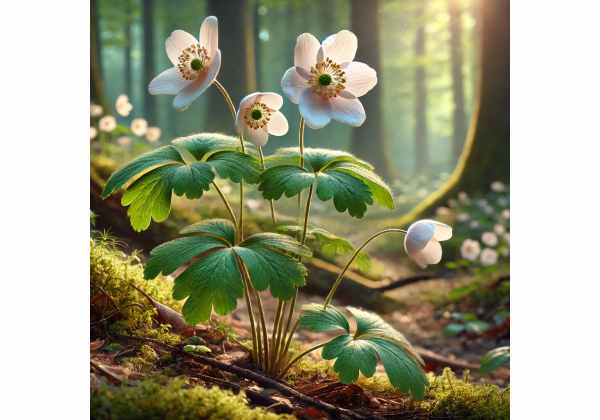
Rue Anemone is a delicate spring woodland wildflower native to eastern North America, admired far more often for its beauty than for any modern medicinal role. Botanically, it is Thalictrum thalictroides, a plant in the buttercup family that was once widely known as Anemonella thalictroides. Its airy white or pink-tinged flowers and tuberous root have given it a quiet place in regional plant lore, including a small record of traditional use. Yet this is exactly the kind of herb that benefits from careful, honest writing. Rue Anemone is not a well-established medicinal plant, it is not backed by human clinical research, and it is not considered a safe choice for self-treatment.
That does not make the plant uninteresting. It does mean its real value lies in botanical history, limited ethnobotanical notes, and the chemistry of the broader Thalictrum genus rather than in proven health applications. For most readers, the most useful questions are not “What does Rue Anemone cure?” but “What is actually known, what is only historical, and why is safety the main modern takeaway?”
Core Points
- No clinically proven health benefits have been established for Rue Anemone itself.
- Historical root use for diarrhea and vomiting has been recorded, but it is not validated or recommended today.
- One reported compound from the plant is the alkaloid magnoflorine, yet Rue Anemone is not standardized as a medicinal herb.
- No evidence-based oral dosage range in mg or g has been established for safe self-treatment.
- Children, pregnant or breastfeeding people, pets, and anyone considering internal use should avoid it.
Table of Contents
- What Rue Anemone Is and Why It Is Often Misunderstood
- Known Compounds and What Is Actually Known About Its Chemistry
- Historical Uses and Why They Do Not Equal Proven Benefits
- Rue Anemone Benefits and What Cannot Honestly Be Claimed
- Dosage, Preparation, and Why No Safe Internal Use Standard Exists
- Toxicity, Side Effects, and Who Should Avoid It
- How to Approach Rue Anemone Today
What Rue Anemone Is and Why It Is Often Misunderstood
Rue Anemone is a small perennial spring ephemeral that appears in rich deciduous woods, stream banks, and shaded slopes across much of eastern North America. Its accepted botanical name is Thalictrum thalictroides, though many gardeners and older field guides still use Anemonella thalictroides. That naming history alone can create confusion, especially for readers trying to understand whether this is the same plant as garden rue, meadow-rue, wood anemone, or other buttercup-family species. It is not.
The common name is partly to blame. “Rue” suggests a connection to true rue, a very different plant in the citrus-related rue family. “Anemone” suggests a connection to the anemones, which are closer botanically but still not the same thing in a modern taxonomic sense. In current classification, Rue Anemone sits in the genus Thalictrum, a group better known as meadow-rues. That means it belongs beside plants more often discussed for floral structure, alkaloid-rich chemistry, and taxonomic interest than for household tea use.
It is also important to separate botanical interest from medicinal status. Many plants in the buttercup family are beautiful, historically noted, chemically active, and potentially irritating or poisonous. Those traits do not automatically make them good herbal remedies. In fact, the reverse is often true. Some plants become more risky precisely because they contain potent defense compounds that were never standardized for safe home use.
Modern readers often assume that if a plant has a traditional name, a recorded folk use, and a family connection to other active plants, then it must have a place in present-day herbal medicine. Rue Anemone is a good example of why that shortcut fails. It is primarily known today as a native ornamental wildflower and a botanical subject of interest. It is not a mainstream herb sold with established monographs, standard consumer dosing, or meaningful human trial data.
That difference matters because search-driven herb writing often overreaches. A plant with a little ethnobotanical history can quickly be rewritten as a “natural remedy” even when the clinical record is missing and the safety picture is poor. Rue Anemone deserves a more careful treatment than that. Its real story is not one of hidden therapeutic fame. It is the story of a woodland plant whose names, family ties, and scattered historical notes can easily make it sound more medicinal than the evidence allows.
Seen clearly, Rue Anemone is most valuable as a native species, a spring ephemeral, and a reminder that not every intriguing plant belongs in the home apothecary.
Known Compounds and What Is Actually Known About Its Chemistry
The chemistry of Rue Anemone is one of the most interesting and one of the most easily overstated parts of its story. The broader Thalictrum genus has a substantial reputation in phytochemical research, especially for alkaloids. Reviews of the genus describe a wide range of benzylisoquinoline, aporphine, and related alkaloids across different species, along with flavonoids, phenols, glycosides, terpenoids, and other secondary metabolites. That sounds impressive, and it is. But it does not mean Rue Anemone itself has been fully profiled or validated as a medicinal herb.
For Thalictrum thalictroides specifically, the species-level chemistry available in accessible literature is thin. One published report identified the aporphine alkaloid magnoflorine from the plant. That is a meaningful fact because magnoflorine is a known natural alkaloid that appears in several medicinal plant discussions. Still, the presence of one isolated compound is not the same as a clinically relevant medicinal profile. It tells us the plant is chemically active, not that it is useful, safe, or standardized for human therapy.
This distinction becomes even more important in the buttercup family. Ranunculaceae plants are often chemically defensive. Across the family, many species are associated with irritant or toxic constituents and with fresh-plant reactions that can affect skin or mucous membranes. That broader family pattern should make readers more cautious, not more eager to experiment. Even when exact species-level constituent data are incomplete, a plant from a chemically active and sometimes toxic family deserves restrained language.
A second problem is extrapolation. Because other Thalictrum species have been investigated for antimicrobial, antitumor, hypotensive, and other pharmacologic effects, writers may assume Rue Anemone shares those properties in a meaningful way. That leap is not justified. A genus can be pharmacologically rich while one species remains poorly studied, differently constituted, or unsuited to self-care. This is especially true in large plant groups where roots, rhizomes, or aerial parts vary widely in compound balance.
In practical terms, what can honestly be said about Rue Anemone’s chemistry?
- It belongs to a genus known for alkaloid diversity.
- At least one alkaloid, magnoflorine, has been isolated from the species.
- The plant should be treated as chemically active rather than inert.
- That chemical activity does not translate into an established health use.
This is a useful lesson in herb writing. “Key ingredients” sounds like a clean marketing phrase, but some plants do not lend themselves to that format. Rue Anemone is one of them. Its known chemistry is interesting enough to justify scientific attention, yet not mature enough to support supplement-style claims. The safer and more accurate takeaway is that Rue Anemone has phytochemical relevance, but not the kind of well-defined, consumer-facing chemistry seen in established medicinal plants.
In other words, the chemistry invites caution and curiosity, not self-treatment.
Historical Uses and Why They Do Not Equal Proven Benefits
Rue Anemone does have a historical medicinal footnote, and that footnote is part of why modern readers search for it. One ethnobotanical record notes that Cherokee healers used infusions prepared from the roots of Thalictrum thalictroides for diarrhea and vomiting. This is a real and worthwhile detail, but it must be handled carefully. Historical use is not the same as proven benefit, and it is certainly not the same as modern safety approval.
Ethnobotanical records can be valuable for several reasons. They preserve cultural knowledge, show how people understood local plants, and sometimes guide future pharmacologic discovery. But they also have limits. A short record of use usually does not tell us the full dose, the preparation method, the exact plant age, the seasonal timing, the combination with other plants, the duration of use, or the diagnostic framework behind the remedy. Without that context, a historical note is incomplete.
That matters even more with a plant like Rue Anemone. Unlike better-established herbs, it did not move from local traditional use into mainstream herbal monographs, commercial standardization, or modern clinical testing. There is no strong chain of evidence showing that historical digestive use developed into a clear, reproducible therapeutic role. The gap between “used at one time” and “useful and safe today” is wide.
The broader Thalictrum genus deepens this tension. A genus review shows that many Thalictrum species have been used traditionally around the world for diverse complaints, including fever, pain, stomach problems, inflammation, and infections. But genus-level ethnomedicine is not species-level evidence. It tells us that meadow-rues as a group have attracted medicinal interest. It does not prove that Rue Anemone is an appropriate stand-alone remedy in a present-day home herbal context.
There is also a practical issue that modern readers sometimes miss: folk use and toxicity can coexist. A plant can have traditional medicinal use and still be risky. In fact, that is common in herbal history. Many potent historical remedies were effective only within a narrow therapeutic window, under experienced handling, or in a framework that modern self-care cannot safely reproduce.
So what should readers do with Rue Anemone’s historical use?
- Treat it as cultural history, not a dosage instruction.
- Recognize that the record is limited and not clinically validated.
- Avoid turning a brief historical note into a modern recommendation.
- Understand that scarcity of evidence is itself important information.
This is where honest herbal writing becomes more useful than enthusiastic herbal writing. It is tempting to turn every ethnobotanical note into a modern “benefit.” But doing so would mislead readers about both evidence and risk. Rue Anemone’s historical use deserves respect, not exaggeration. It tells us the plant was known, noticed, and used in at least one Indigenous medicinal context. It does not tell us that present-day internal use is safe, necessary, or evidence-based.
The most responsible reading of that history is to preserve it accurately while resisting the urge to transform it into a modern wellness claim.
Rue Anemone Benefits and What Cannot Honestly Be Claimed
This is the section where many herb articles drift into wishful writing. With Rue Anemone, the honest answer is simple: no clinically established health benefits have been demonstrated for the plant itself. There are no well-known human trials showing that Rue Anemone reliably helps digestion, inflammation, infection, sleep, pain, immunity, or any other common supplement target. That absence matters more here than any speculative benefit list.
The strongest benefit claim that can be mentioned at all is historical digestive use, specifically the recorded use of root infusions for diarrhea and vomiting. But even that should be described as a traditional use note, not as a proven health benefit. There is no clear modern evidence confirming effectiveness, safety, or reproducibility for those indications.
A second possible “benefit” sometimes inferred from the literature is chemical potential. Because the broader Thalictrum genus contains pharmacologically interesting alkaloids, and because magnoflorine has been isolated from Rue Anemone, it is fair to say the species has scientific relevance. Yet scientific relevance is not a benefit to the reader’s health. It means the plant may be of laboratory or phytochemical interest, not that someone should drink it, tincture it, or swallow capsules of it.
In truth, Rue Anemone’s most tangible present-day benefits are not medicinal at all. They are ecological, ornamental, and educational:
- It is a native woodland wildflower that contributes to spring biodiversity.
- It has value in shade gardens and native plant restoration.
- It offers botanical interest because of its taxonomic history and early-season life cycle.
- It is used in plant science as part of broader work on Ranunculales development and evolution.
These are real benefits, just not the ones implied by modern supplement marketing language.
That distinction is useful beyond this one plant. Herbal writing often assumes that every species deserves a conventional section on “top health benefits.” But some plants are better served by a different framework:
- what is known,
- what is only historical,
- what is chemically plausible,
- and what remains unproven or unsafe.
For Rue Anemone, the unproven category is the dominant one.
This does not make the plant unimportant. It makes it a good example of why evidence-based restraint matters. Some readers may find that disappointing, especially if they hoped to discover a forgotten herbal remedy. But disappointment is better than false confidence. A weak evidence base should narrow claims, not expand them.
So what cannot honestly be claimed?
- It cannot honestly be presented as a proven herbal digestive.
- It cannot honestly be sold as a safe wildcrafted remedy.
- It cannot honestly be described as a validated source of useful alkaloids for home use.
- It cannot honestly be given a consumer-friendly medicinal ranking beside established herbs.
What can be said is narrower and more useful: Rue Anemone has historical use, limited species-level phytochemical evidence, no meaningful clinical validation, and an important safety question. In a world full of inflated plant claims, that kind of clarity is its own benefit.
Dosage, Preparation, and Why No Safe Internal Use Standard Exists
Rue Anemone does not have an evidence-based oral dosage for self-treatment. That is the most important dosage fact to know. There is no accepted range in grams, milliliters, or milligrams that a reader can use with confidence, and there is no recognized modern monograph that turns its historical use into a safe home protocol.
This absence is not a minor technical gap. It changes the whole conversation. When an herb lacks a safe internal dosing standard, that usually means one of three things:
- it has not been studied enough,
- it is not used widely enough in modern practice to develop a standard,
- or its risk profile makes casual use inadvisable.
With Rue Anemone, all three concerns are relevant.
Readers sometimes assume that a dried-root tea or a low-dose tincture can be improvised if a plant has some traditional use. That assumption is especially risky here. We do not have a dependable contemporary range for root material. We do not have consumer-quality standardization around active constituents. We do not have a clear therapeutic window. And we do have a contemporary extension source stating that all parts of the plant are poisonous when ingested. That alone is reason enough not to invent a dose.
Preparation questions follow the same logic. There is no reliable modern reason to recommend:
- a Rue Anemone tea,
- a decoction,
- a powdered capsule,
- a fresh plant tincture,
- or any internal preparation meant for symptom relief.
Even external use is hard to justify. In the buttercup family, fresh plant material can sometimes irritate skin or mucous tissues, and in the absence of strong species-specific safety data, topical experimentation is not wise either.
The only “preparation” context that makes practical sense today is horticultural rather than medicinal. Gardeners may divide the tuberous root or handle the plant during propagation. In that setting, sensible caution applies:
- wear gloves if you have sensitive skin,
- keep plant material away from children and pets,
- and do not confuse propagation handling with herbal preparation.
For readers who want a firm answer to the dosage question, the safest answer is this: no medically supported internal dose has been established, and internal use should be avoided. That may feel unsatisfying in an herb article, but it is more useful than false precision. A made-up dose would sound helpful while increasing risk.
This is one place where “natural” and “traditional” do not rescue the plant from uncertainty. If anything, the lack of a dosage standard is the strongest practical sign that Rue Anemone does not belong in unsupervised self-care. When evidence, standardization, and safety do not line up, restraint is the dosage recommendation.
Toxicity, Side Effects, and Who Should Avoid It
Safety is the most important modern section in any discussion of Rue Anemone. A current university extension resource states clearly that all parts of Rue Anemone are poisonous when ingested. That statement should shape the rest of the conversation more than any historical use note or phytochemical curiosity.
The first implication is simple: Rue Anemone is not an appropriate self-treatment herb. It should not be brewed as a household tea, chewed fresh, made into a syrup, or taken as a foraged tonic. Plants in the buttercup family are not uniformly toxic, but many are chemically defensive, and that family background should lower a person’s willingness to experiment.
Because species-specific poisoning reports in modern literature are limited, it is better not to invent a dramatic symptom list. The responsible approach is to say what is known and what follows logically from that. What is known is that the plant is regarded as poisonous when ingested. What follows is that accidental or intentional ingestion should be treated seriously, particularly in children, pets, and anyone already medically vulnerable.
Groups who should clearly avoid Rue Anemone include:
- children,
- pregnant people,
- breastfeeding people,
- pets and livestock,
- anyone considering internal herbal use,
- and anyone with a history of plant sensitivity or foraging errors.
Gardeners should also use common-sense handling precautions. Rue Anemone is not a plant to put in places where young children routinely explore by tasting. It should be labeled clearly in native or woodland gardens. If roots or divisions are handled, washing hands afterward is prudent, and gloves are reasonable for people with sensitive skin.
Another risk is misidentification. Small spring woodland flowers are easy for casual foragers to confuse, especially when common names overlap. A reader looking for a “natural digestive root” could easily make several bad decisions in a row:
- trust a common name,
- assume historical use means safety,
- misidentify the plant,
- and prepare it without dosage guidance.
That chain of errors is exactly what careful herb writing should prevent.
If ingestion occurs, the safest response is not home experimentation with counter-remedies. It is to contact a poison center or local medical service promptly, especially if symptoms begin or the amount ingested is uncertain. Because the plant is not a recognized food or standardized herb, “watch and wait” is a poor default.
One of the most useful truths about medicinal plants is that some plants are best appreciated without being consumed. Rue Anemone belongs in that category. Its safety profile is defined not by a narrow list of mild side effects, but by the more important fact that ingestion is not recommended in the first place.
How to Approach Rue Anemone Today
The best modern use of Rue Anemone is not medicinal. It is observational, horticultural, and educational. This is a plant to admire in spring woods, protect in native habitats, and grow thoughtfully in shade gardens if conditions suit it. It is not a plant to elevate into a home remedy simply because it has an appealing name and a fragment of ethnobotanical history.
That may sound restrictive, but it is actually practical. Many readers looking up obscure herbs are not searching for romance. They are trying to decide whether a plant is worth taking, worth avoiding, or worth understanding. Rue Anemone becomes much clearer when approached through that lens.
A sensible modern approach looks like this:
- Learn the plant as a native woodland species first.
Understand its spring-ephemeral habit, habitat, and taxonomic history. - Treat the medicinal record as historical rather than actionable.
Respect the record without turning it into a current recommendation. - Do not infer safety from genus reputation.
Other Thalictrum species may be medicinally important without making Rue Anemone a wise self-care herb. - Do not infer benefit from chemistry alone.
An isolated alkaloid does not equal an herb you should take. - Let safety close the loop.
If the plant is poisonous when ingested and lacks an established dose, the discussion ends there for internal use.
There is also a broader lesson here about search-driven herbal culture. Not every plant belongs in the same template. Some plants are well-supported medicinal tools. Some are promising but under-studied. And some, like Rue Anemone, are primarily interesting because they reveal the limits of evidence and the importance of boundaries.
If a reader is seeking genuine digestive support, there are many better-studied options than Rue Anemone. If the goal is native planting, woodland beauty, or botanical curiosity, Rue Anemone becomes far more appropriate and rewarding. Matching the plant to the purpose is what keeps herbal interest responsible.
In that sense, Rue Anemone still offers something valuable. It teaches restraint. It reminds us that the most helpful herb article is not the one that forces benefits into every plant, but the one that tells the truth clearly enough for a reader to make a safe decision. For this species, the safest decision is usually not to use it medicinally at all.
That conclusion is not a dismissal. It is the clearest form of practical respect this plant can be given today.
References
- Ethnobotany, botany, phytochemistry and ethnopharmacology of the genus Thalictrum L. (Ranunculaceae): A review 2023 (Review)
- Native Plants for Georgia Part III: Wildflowers | CAES Field Report 2024
- SERNEC Portal – Thalictrum thalictroides 2026
- Grinding-Induced Polymorphism in the Aporphine Alkaloid Magnoflorine 1996
- A cornucopia of diversity—Ranunculales as a model lineage 2024
Disclaimer
This article is for educational purposes only and is not a substitute for medical advice, diagnosis, or treatment. Rue Anemone is not an established medicinal herb for self-care, and available information does not support internal use. Because the plant is described as poisonous when ingested and lacks a safe evidence-based dosage standard, it should not be used as a home remedy. If ingestion occurs or poisoning is suspected, contact a poison center or seek medical care promptly.
If this article helped you, please share it on Facebook, X, or another preferred platform so more readers can approach obscure plant medicines with clearer evidence and safer judgment.