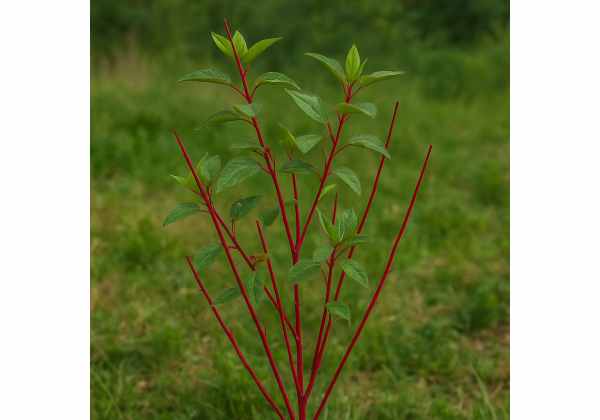
Red twig dogwood, also widely known as red osier dogwood, is a striking North American shrub valued for its vivid winter stems, white berries, and long traditional history. Botanically, it is Cornus sericea, a species that belongs to the dogwood family and has been used far more in ethnobotanical practice than in modern self-care herbalism. Its inner bark, twigs, leaves, and berries have all appeared in regional traditions, especially for teas, washes, poultices, and ceremonial smoking mixtures.
What makes red twig dogwood interesting today is not a large body of human clinical trials, because those do not really exist, but a combination of traditional knowledge and emerging phytochemical research. Studies on red osier dogwood extracts show meaningful levels of tannins, flavonoids, gallic and ellagic acid derivatives, rutin, quercetin compounds, and other antioxidant phenolics. These findings support its reputation as an astringent, topical, and inflammation-focused plant, but they do not justify exaggerated medicinal claims. The most useful way to understand red twig dogwood is as a traditional bark-and-leaf remedy with promising chemistry, modest modern evidence, and a clear need for cautious use.
Key Facts
- Red twig dogwood bark and leaves contain tannins and flavonoids that may support astringent and antioxidant activity.
- Traditional use also points to topical soothing value for minor skin irritation, sores, and compress-style applications.
- A cautious historical pattern was about 1 cup of mild bark decoction taken 1 to 2 times daily for short-term use, though no modern standardized oral dose exists.
- Pregnant or breastfeeding people, children, and anyone unsure of correct plant identification should avoid self-prescribing it.
Table of Contents
- What Red Twig Dogwood Is and How It Has Been Used
- Key Ingredients and Medicinal Properties of Red Twig Dogwood
- Potential Health Benefits and What the Evidence Supports
- Traditional Uses, Preparations, and Modern Applications
- Dosage, Timing, and Practical Use Guidelines
- Safety, Interactions, and Who Should Avoid It
What Red Twig Dogwood Is and How It Has Been Used
Red twig dogwood is a deciduous shrub native to much of North America, especially moist woods, riparian corridors, stream edges, and wet meadows. It is most recognizable in winter, when its smooth young stems turn vivid red to burgundy and create one of the most dramatic cold-season displays in the landscape. In botanical and ecological sources, the plant is also commonly called red osier dogwood, red willow, or redstem dogwood. Older literature may use the synonym Cornus stolonifera, but modern naming generally favors Cornus sericea.
Although many people know it first as an ornamental plant, its historical importance runs deeper. Indigenous communities across North America used red twig dogwood in a wide range of practical and ceremonial ways. The inner bark was prepared for smoking mixtures, especially in sacred or ritual settings. Bark infusions and decoctions were used medicinally, while stems served in basketry, tools, and crafts. Some communities also ate the berries or used the twigs for purposes such as toothbrushes, which shows how thoroughly the plant was woven into daily life rather than treated as a single-purpose remedy.
From a modern herbal perspective, the most important thing to understand is that red twig dogwood is not a heavily commercialized supplement herb. It does not occupy the same evidence-based niche as chamomile, ginger, or peppermint. Instead, it sits in a more traditional category: a regionally important plant with ethnobotanical credibility, useful chemistry, and relatively sparse human data. That makes it fascinating, but it also means people should resist the urge to present it as a proven medicine for every complaint listed in older folklore.
Its most commonly mentioned traditional applications include teas or decoctions for seasonal illness, feverish states, weakness, sore throat, stomach discomfort, and diarrhea, as well as topical uses for sores, poison ivy-like irritation, stings, and skin complaints. Some of these uses make sense in light of the plant’s tannins and phenolic compounds. Others remain harder to verify with modern standards. That does not erase the traditions; it simply means they should be interpreted respectfully rather than converted into firm therapeutic claims.
It is also helpful to keep the plant’s parts separate. The bark and inner bark carry most of the traditional medicinal reputation. The leaves and stems have been studied more for antioxidant-rich phenolics. The berries are the least straightforward part: some traditions used them as food, but they are sour, not widely consumed today, and are not the best place to start if someone is curious about the plant medicinally.
So the real value of red twig dogwood lies in the overlap between tradition, chemistry, and caution. It is a meaningful medicinal shrub in cultural history, but it is not a modern cure-all. That distinction keeps the rest of the conversation honest.
Key Ingredients and Medicinal Properties of Red Twig Dogwood
The chemistry of red twig dogwood helps explain why the plant developed a medicinal reputation even without a large body of modern human trials. Studies on red osier dogwood leaves, stems, and extracts consistently show a high load of phenolic compounds. Among the most frequently identified are glucogallic acid, ellagic acid, rutin, quercetin 3-O-malonylglucoside, and quercetin. Other analyses and reviews also point to gallic acid, additional flavonoids, anthocyanin-related pigments, and tannin-rich fractions that likely contribute to the plant’s astringency and topical usefulness.
These compounds matter because they fit the plant’s traditional pattern of use. Tannins and phenolic acids often bring astringent, antioxidant, and soothing properties to herbal preparations. Astringency can help explain why bark decoctions and washes were historically used for irritated tissue, minor skin complaints, or weepy conditions. Antioxidant and anti-inflammatory activity help explain why red osier dogwood extracts attract research interest in cellular models, especially where oxidative stress and inflammatory signaling are involved.
The best-supported medicinal properties of red twig dogwood are therefore not dramatic ones, but grounded ones:
- Astringent activity, especially from bark-based preparations
- Antioxidant potential, tied to its dense phenolic profile
- Preclinical anti-inflammatory activity, particularly in extract studies
- Mild antimicrobial interest, based more on laboratory and animal-feed research than on direct human treatment evidence
One useful detail is that red osier dogwood extracts are often described as phenolic-rich enough to rival or exceed some better-known plant materials in total phenolic concentration. That does not mean they are automatically better medicinal herbs. It means the plant has real biochemical weight, and that its traditional use was likely rooted in noticeable activity rather than pure folklore.
At the same time, it is important not to overread the chemistry. A plant can contain potent-looking molecules and still have limited clinical relevance in real people. This is especially true when most published work uses extracted leaves and stems in laboratory or agricultural settings rather than traditional bark teas used by humans. The gap between extract science and folk medicine is one of the most important themes in this article.
Another point worth stressing is that red twig dogwood should not be confused with other dogwood species whose fruits have drawn more direct health interest. The Cornus genus is broad, and not all dogwoods share the same edible, medicinal, or research profile. Borrowing claims from another species without saying so is one of the quickest ways to make a weak herbal article sound stronger than it is.
For readers used to more familiar astringent plants, the closest conceptual comparison is not another showy shrub but a tannin-centered herb such as witch hazel in topical astringent care. The comparison is not botanical equivalence, but it helps explain the kind of action red twig dogwood bark likely offers: tightening, drying, and soothing rather than strongly sedating, stimulating, or nutritive.
In short, the key ingredients of red twig dogwood support its reputation as an astringent, phenolic-rich medicinal shrub. They do not prove every historical claim, but they do provide a credible biochemical basis for why the plant remained useful in traditional practice.
Potential Health Benefits and What the Evidence Supports
When people search for the health benefits of red twig dogwood, they often expect a neat list of clinically proven effects. That is not what the current evidence supports. A more accurate answer is that red twig dogwood has credible traditional use, meaningful phytochemistry, and promising preclinical findings, but very limited direct human clinical evidence. Once that is clear, the possible benefits become much easier to understand.
The first likely benefit is topical and tissue-soothing support through astringency. This is where the plant’s bark tradition makes the most sense. Tannins can help tone tissue, reduce minor weeping or irritation, and support wash or compress preparations for superficial problems. This does not mean red twig dogwood is a guaranteed wound healer, but it does support its use as a traditional wash or external application herb.
The second likely benefit is antioxidant support. Extract studies show that red osier dogwood contains a dense phenolic spectrum, and some research has examined methods to concentrate those antioxidants. In simple terms, the plant contains compounds that may help reduce oxidative stress in laboratory settings. That makes it a plausible antioxidant plant, though not a uniquely proven one.
The third possible benefit is anti-inflammatory activity, but this is where precision matters. A 2019 study on red-osier dogwood extracts showed reduced inflammatory signaling in cell models, including suppression of IL-8, TNF-alpha-related pathways, IL-6, ICAM-1, VCAM-1, and COX-2 expression under experimental conditions. That is interesting and important. But it remains a laboratory result, not a clinical trial showing that red twig dogwood safely treats inflammatory disease in people.
A fourth area is mild antimicrobial and gut-focused interest, though most recent discussion comes from agricultural and animal-nutrition research rather than from human herbal medicine. Reviews describe red osier dogwood as rich in polyphenols with selective antimicrobial potential. That may eventually support broader therapeutic exploration, but at present it does not justify home treatment of infection.
So what can be said honestly?
- Red twig dogwood probably has real astringent and antioxidant value.
- It may have anti-inflammatory and antimicrobial relevance in extracted form.
- Traditional uses for colds, sore throat, diarrhea, and weakness are culturally meaningful, but not strongly validated in human trials.
- The best-supported modern claims are still preclinical, not clinical.
This is why it helps to compare the plant with better-studied food and tannin-rich berries. Some fruits and shrubs have enough human data to support clearer wellness claims. Red twig dogwood is not really there yet. Its benefits are more inferential and tradition-supported than trial-proven.
That does not make the plant unimportant. It simply means the most responsible wording is “may support,” “traditionally used for,” and “shows promise in preclinical studies,” rather than “treats,” “prevents,” or “proven to cure.” For readers who value honesty in herbal writing, that kind of language is not weaker. It is stronger, because it tells you exactly where confidence should stop.
The real takeaway is that red twig dogwood’s benefits likely cluster around mild astringency, topical use, and phenolic-driven antioxidant activity. Anything beyond that should be treated as provisional until species-specific human evidence catches up.
Traditional Uses, Preparations, and Modern Applications
Traditional use gives red twig dogwood much of its medicinal identity. In Indigenous and regional North American practice, it was not limited to one single remedy style. Bark, inner bark, twigs, leaves, and even berries or pith could all appear in different preparations depending on the community, the condition, and the intended outcome. This variety is important because it shows the plant was known as a versatile woodland resource rather than a narrowly defined herb.
Among the most repeated uses are bark teas or decoctions for cold-weather complaints, sore throat, stomach discomfort, diarrhea, fever, and weakness. These applications make broad sense in an ethnobotanical framework. A tannin-rich, aromatic, mildly bitter or drying bark could have felt useful when the body was loose, sluggish, irritated, or recovering from illness. Bark shavings and bark-based washes were also applied externally to wounds, sores, rashes, or inflamed skin. Some traditions describe warm bark preparations or poultice-style applications for swelling, discomfort, and skin complaints.
Red twig dogwood also had ceremonial and nonmedical roles. The inner bark was mixed into smoking blends, especially in sacred pipe traditions. Twigs were used in crafts, and stems were valued for their color, flexibility, and structure. This broader cultural role matters because medicinal use was rarely isolated from daily life. The plant belonged to a larger system of relationships and practices.
In modern herbal use, however, red twig dogwood is much less common. It is not usually found in mainstream supplements, and when it is mentioned, it is often in wildcrafting, ethnobotany, or regional herbal traditions rather than commercial product catalogs. That relative obscurity has one advantage: it reduces overhyped claims. But it also means dosage, preparation, and quality control are less standardized.
The most reasonable modern applications are:
- External wash or compress for minor skin irritation
- Short-term folk-style bark tea used conservatively
- Educational and ethnobotanical interest
- Research interest in antioxidant-rich extracts
This is also the place to draw a boundary. Modern application does not mean free rein to experiment with every part of the shrub. The berries are not a common wellness food. The smoking use is cultural and ceremonial, not a modern health recommendation. And concentrated extracts studied in laboratories are not the same as home bark tea.
For readers familiar with other traditional topical plants, red twig dogwood’s practical role can be compared, very cautiously, with traditional plantain-style washes and poultices. The two are not the same herb, but both fit the category of historically used surface-level, soothing, folk-preparation plants whose modern value often makes more sense externally than as aggressive internal remedies.
The most useful way to carry red twig dogwood into modern practice is therefore modestly. Think of it as a traditional bark-and-leaf shrub that may still have a place in careful, small-scale external care and historical herbal study. The farther one moves toward concentrated extracts, chronic internal use, or unverified disease claims, the less solid the ground becomes.
That is not a limitation unique to this plant. It is simply the right way to handle herbs whose strongest evidence still comes from cultural continuity and phytochemical promise rather than from large human trials.
Dosage, Timing, and Practical Use Guidelines
Dosage is the section where restraint matters most, because no modern standardized human oral dose has been established for red twig dogwood. That single fact should shape how the plant is used. Unlike a standardized supplement with clear clinical ranges, red twig dogwood remains mostly a traditional-preparation herb. That means any dosage advice must be labeled as historical, folk-based, or cautious rather than evidence-based.
Traditional oral use centered on mild bark decoctions or infusions, not concentrated capsules. A practical folk-style pattern is about 1 cup of bark decoction, taken 1 to 2 times daily for short-term use. Some herbalists would prepare such a decoction by simmering a small amount of dried inner bark or bark shavings in water for around 10 to 15 minutes, then straining and sipping. Because these measures were rarely standardized in the older literature, it is wiser to think in terms of mild strength rather than maximum extraction.
For external use, the same kind of mild decoction can be cooled and used as:
- A wash for minor irritated skin
- A compress for superficial soreness
- A short-term topical rinse for areas needing gentle drying support
The safest practical rule is to start with the weakest reasonable preparation and assess tolerance. Red twig dogwood is not a plant that benefits from “more is better” thinking. Stronger tannin-rich decoctions may irritate the stomach, dry tissues excessively, or simply be unpleasant to take.
A helpful framework looks like this:
- Choose bark or inner bark rather than random mixed plant material.
- Keep preparations mild and short-term.
- Use internal bark tea only for cautious trial use, not chronic daily supplementation.
- Favor topical use when the goal is local soothing or astringency.
- Stop if the preparation causes nausea, mouth dryness, abdominal discomfort, or any unusual reaction.
The berries should be treated differently. Even though some traditions used them as food, they are not widely regarded as a routine edible wellness berry today. Their tart, sour quality and variable tolerance make them a poor choice for self-directed medicinal dosing. If encountered in traditional or educational contexts, they are best understood as a minor and culturally specific use rather than the core medicinal part of the plant.
There is also an important difference between home use and extract research. Laboratory studies often examine concentrated extracts from leaves and stems with quantified phenolics such as rutin and quercetin compounds. These preparations are not equivalent to a household decoction. Trying to recreate laboratory-style outcomes with stronger homemade medicine is not a sound approach.
This is why red twig dogwood should be positioned far away from supplement-style thinking. It is not a plant with a polished retail dosage language of “take 500 mg twice daily.” It fits better into the category of cautious traditional herbs where the most honest dosage advice is partly about knowing when not to push it.
If a reader wants a more familiar benchmark, it helps to remember that many bark-based herbs, including better-known bark remedies, require more care in preparation and dosing than common leaf teas. Red twig dogwood belongs firmly in that more cautious category.
Safety, Interactions, and Who Should Avoid It
Red twig dogwood is not known as one of the more dangerous medicinal shrubs, but that should not be confused with having a robust modern safety profile. In reality, safety data are limited, and most current caution comes from the plant’s traditional use pattern, tannin-rich chemistry, and inconsistent treatment of its berries in horticultural and ethnobotanical sources.
The first safety principle is correct identification. Dogwoods are a diverse group, and anyone harvesting bark, twigs, or berries from the wild should be fully certain of species identity. Medicinal use should never begin with uncertainty about the plant itself. Because bark, twig color, habitat, leaves, and fruiting stage all change with season, identification should rely on multiple features, not just red winter stems.
The second safety principle is prefer short-term, low-intensity use. Red twig dogwood is best treated as a mild traditional remedy, not a long-term tonic. Internal use of tannin-rich bark preparations can cause stomach upset, constipation, nausea, or uncomfortable dryness in some people. This is especially true if a decoction is made too strong or used too often.
The third issue involves the berries. Some official and horticultural sources note that berries may be slightly toxic or may cause stomach upset in humans, while ethnobotanical records show that some communities did eat them. The most reasonable interpretation is not that the plant is dangerously poisonous, but that the berries are not reliable enough to recommend as a casual edible or wellness fruit. For most readers, that means avoiding berry experimentation unless the use is grounded in local traditional knowledge and confident identification.
Who should avoid self-prescribing red twig dogwood?
- Pregnant people
- Breastfeeding people
- Children
- Anyone with chronic gastrointestinal sensitivity
- Anyone with uncertain plant identification
- Anyone seeking long-term internal use without guidance
Known herb-drug interactions are not well characterized, which sounds reassuring but is actually a sign of sparse data, not of proven safety. Because bark preparations are tannin-rich, a cautious person would avoid taking them at the exact same time as mineral supplements or important oral medications. The issue is not that severe interactions are well documented, but that absorption questions and lack of data justify spacing them apart.
Skin use is generally the safer lane, but even then, patch testing makes sense. Astringent barks can sting or dry already damaged tissue if used too strongly. Topical preparations should stay dilute, especially on sensitive or compromised skin.
The final safety principle is philosophical as much as practical: do not ask this plant to do more than its evidence can support. Red twig dogwood is not the right herb for serious infections, persistent diarrhea, high fever, chest symptoms, or chronic inflammatory disease. It can be respected as a traditional plant without being promoted beyond its limits.
For readers comparing herbs, that measured caution is similar to how one should think about many partly studied folk barks and roots: interesting, useful in context, but not interchangeable with clinically established therapies. With red twig dogwood, wise use means small doses, short duration, clear purpose, and an easy willingness to stop.
References
- Red-Osier Dogwood Extracts Prevent Inflammatory Responses in Caco-2 Cells and a Caco-2 BBe1/EA.hy926 Cell Co-Culture Model 2019 (Preclinical Study)
- Red osier dogwood and its use in animal nutrition: A review 2022 (Review)
- Phenolic compounds profiling of nine dogwood species (Cornus L.) leaves 2025 (Phytochemical Study)
- Hydrothermal extraction, a promising method for concentrating phenolic antioxidants from red osier dogwood (Cornus stolonifer) leaves and stems 2020 (Phytochemical Study)
- REDOSIER DOGWOOD 2002 (Official USDA Plant Guide)
Disclaimer
This article is for educational purposes only and is not a substitute for medical advice, diagnosis, or treatment. Red twig dogwood is a traditional medicinal plant with limited modern human research, and its strongest evidence remains ethnobotanical and preclinical rather than clinical. Internal use should be cautious and short term, and pregnant or breastfeeding people, children, and anyone with uncertain plant identification should not self-prescribe it. Seek qualified guidance before using wild-harvested plants medicinally.
If you found this article useful, please share it on Facebook, X, or your preferred platform so more readers can learn about red twig dogwood in a careful and well-informed way.