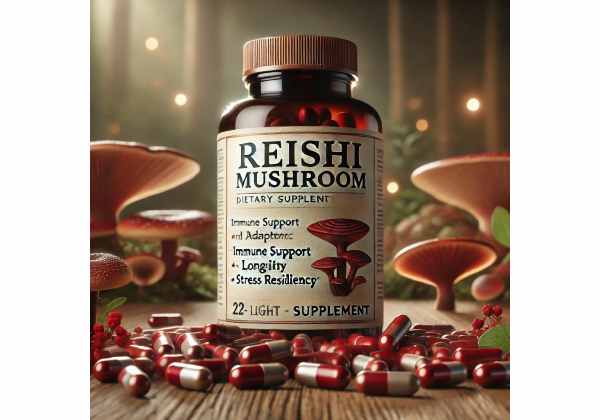
Reishi mushroom has a long history in East Asian medicine, where it is known less as an everyday food and more as a tonic associated with resilience, calm, and recovery. In modern supplements, it is often marketed for stress, sleep, immunity, and healthy aging. That combination makes it especially appealing to people interested in brain health and mental wellness. If a supplement seems to support rest, lower inflammatory stress, and help the body handle chronic strain, it is easy to see why the brain enters the conversation.
Still, reishi needs a careful reading. Its traditional reputation is broad, but the modern evidence is uneven. Some findings are promising, especially around fatigue, sleep-related complaints, stress physiology, and neuroprotective mechanisms. Human research, however, is still much smaller than the marketing suggests. This guide looks at what reishi mushroom is, how it may work, where its mental and cognitive benefits seem most plausible, how people use it, and what safety issues matter before taking it regularly.
Table of Contents
- What Reishi Is and Why People Use It
- How Reishi May Affect Brain and Mood
- Benefits Most Often Linked to Reishi
- What the Human Evidence Actually Supports
- Forms, Dosage, and How to Use It
- Safety, Side Effects, and Precautions
What Reishi Is and Why People Use It
Reishi mushroom usually refers to Ganoderma lucidum and closely related Ganoderma species, though naming can become complicated because traditional use, commercial labeling, and botanical classification do not always line up neatly. In supplements, the mushroom may also be called lingzhi, especially in products drawing from Chinese herbal traditions. Regardless of naming differences, reishi is generally positioned as a medicinal mushroom rather than a culinary one. Its taste is bitter, and it is more often consumed as an extract, powder, capsule, or tea-like preparation than as a standard food.
Part of reishi’s appeal comes from its chemistry. The mushroom contains several groups of compounds that are often highlighted in research and product marketing:
- polysaccharides, especially beta-glucan-rich fractions
- triterpenoids, including ganoderic acids
- sterols, peptides, and other minor constituents
These compounds are thought to contribute to reishi’s antioxidant, immunomodulatory, and anti-inflammatory effects. That combination is important because modern brain-health conversations often focus less on one single neurotransmitter and more on the wider conditions that support mental performance: sleep, inflammation, stress load, immune signaling, and recovery. Reishi fits that framework better than it fits the model of a classic nootropic.
This is also why people reach for it for different reasons. Some use reishi for evening calm or better sleep quality. Others use it for stress resilience, general wellness, fatigue, or “nervous system support.” Some are interested in healthy aging and neuroprotection. Those use cases overlap, but they are not identical. A supplement that mildly improves sleep may help mental clarity the next day without directly improving memory. A supplement that reduces stress burden may improve mood or endurance without being an antidepressant.
That distinction matters because reishi is often oversold. It is not best thought of as a fast-acting cognitive enhancer. Most people do not take it for a sharp burst of focus. Its more realistic niche is quieter and slower: support for recovery, stress tolerance, and the physiological background that allows the brain to function better over time.
There is also a practical point many readers miss: “reishi” on a label does not tell you which part of the mushroom was used, how it was extracted, or whether the product emphasizes polysaccharides, triterpenes, or simply powdered biomass. Those differences can affect both quality and expectations.
In the wider world of brain-support supplements, reishi sits closer to adaptogenic and restorative compounds than to stimulants. That is why it makes more sense when placed alongside broader discussions of what brain boosters really do rather than treated like a direct focus pill.
How Reishi May Affect Brain and Mood
Reishi’s possible mental and cognitive effects seem to come from several overlapping pathways rather than one clear mechanism. That makes it scientifically interesting, but it also makes simplistic claims less reliable.
One major theme is inflammation control. Chronic low-grade inflammation is linked with depression, fatigue, poorer sleep, age-related cognitive decline, and a general sense of mental heaviness. Reishi compounds, especially certain polysaccharides and triterpenoids, have shown anti-inflammatory and antioxidant actions in laboratory and animal studies. In theory, that could support a healthier brain environment by reducing oxidative stress and inflammatory signaling that interfere with neuronal function.
A second theme is immune modulation. Reishi is one of the best-known medicinal mushrooms in this area. That may sound unrelated to mental wellness at first, but the connection is real. Immune signaling and mood are closely linked, and the gut-brain axis has become an important framework for understanding how inflammatory tone, microbial balance, and systemic stress affect cognition and emotional regulation. Reishi has been studied for effects that may influence these interconnected systems.
A third theme involves sleep and nervous system calm. Traditional descriptions of reishi often emphasize tranquility, and some early modern data suggest it may help with fatigue, restlessness, and sleep-related complaints in certain groups. These effects are not fully established, but they fit with the broader idea that reishi may support recovery rather than stimulation.
Researchers have also explored direct neuroprotective mechanisms. In preclinical work, reishi and isolated components have been linked to effects on:
- neuroinflammation
- amyloid-related stress pathways
- acetylcholinesterase-related activity
- neuronal survival and synaptic function
- oxidative damage in brain tissue
This is where reishi starts to look relevant to long-term brain health rather than just bedtime routines. Still, most of this evidence comes from mechanistic or animal models, not from large, definitive human trials.
The best way to understand reishi is as a systems-level supplement. It may not work by “pushing” the brain harder. Instead, it may help by improving the background conditions that affect mental function:
- lowering inflammatory stress
- modulating immune activity
- supporting sleep and recovery
- reducing physiological wear from chronic stress
That profile explains why some people describe reishi as grounding rather than energizing. It is often used to restore balance, not to create a stimulant-like mental lift.
This also connects naturally with bigger lifestyle questions. If someone is overworked, underslept, inflamed, or constantly running on stress hormones, a restorative supplement may matter more than another alertness compound. That broader lens is useful when thinking about how stress affects focus and burnout, because reishi’s likely benefits fit much better within that story than within a promise of instant mental sharpness.
Benefits Most Often Linked to Reishi
When people search for reishi mushroom and mental wellness, they are usually asking about four things: stress relief, sleep, fatigue, and brain protection. Those are the areas where reishi has the most plausible relevance, but the strength of evidence differs from one to the next.
Stress and emotional strain are probably the most intuitive fit. Reishi is often described as calming or adaptogenic, and some users take it because they feel overstretched, wired at night, or physically depleted by chronic stress. This does not mean reishi is a proven treatment for anxiety disorders, but it may be a reasonable supplement for people looking for a gentler, non-stimulant support option.
Sleep is another common target. Reishi is not a classic sedative, and it should not be treated like a knockout sleep aid. Its likely role is subtler. It may help some people who sleep poorly because of nervous-system tension, fatigue without restoration, or low-grade stress overload. That is different from treating severe insomnia or a circadian problem. It is more about improving the conditions around sleep than forcing sedation.
Fatigue may actually be one of the most practical reasons people try reishi. Some human studies in specific populations, such as people with neurasthenia or fibromyalgia-related complaints, have explored fatigue, well-being, and mood-related outcomes. The results are not dramatic or universally positive, but they suggest reishi may be more relevant for worn-down, symptomatic individuals than for healthy people looking for a performance edge.
For long-term brain health, the strongest enthusiasm comes from preclinical work. Reishi compounds have shown neuroprotective and neurogenic potential in laboratory and animal studies, especially in relation to inflammation, amyloid stress, and neuronal injury. That makes reishi interesting in the context of healthy aging, but it is still too early to say it clearly prevents dementia or improves memory in healthy adults.
A realistic summary of where reishi may help looks like this:
- most plausible: stress burden, sleep-related recovery, fatigue
- possible but less proven: mood support through better stress and sleep regulation
- promising but still early: neuroprotection and cognitive aging
- weak claim: immediate focus or strong memory enhancement in healthy adults
That last point matters. Reishi is usually not the supplement people choose for fast concentration. Someone with a more direct goal of mental sharpness might compare it with ingredients such as lion’s mane for focus and memory, which is often marketed more directly for cognitive performance. Reishi has a different feel and a different likely role.
In practical terms, reishi makes the most sense when someone’s brain-health goals overlap with recovery. If the core problem is feeling depleted, sleeping lightly, and carrying too much stress, reishi may fit. If the main goal is sharp work output in the next two hours, it is probably not the first choice.
What the Human Evidence Actually Supports
This is where the conversation needs to slow down. Reishi has a strong traditional reputation and plenty of mechanistic research, but the human evidence for brain health and mental wellness is still limited and mixed.
One of the better-known clinical studies looked at a Ganoderma lucidum polysaccharide extract in patients with neurasthenia, a diagnosis historically associated with fatigue, irritability, sleep disturbance, and reduced well-being. The study suggested some symptom improvement and acceptable tolerability, which is part of why reishi is still discussed as a restorative mushroom rather than just an immune supplement.
Another human study in women with fibromyalgia examined mood and health-related quality of life. The results did not show strong statistically significant between-group differences, though there were some favorable trends within the reishi group. This is a good example of how reishi often looks in practice: promising enough to stay interesting, but not strong enough to justify certainty.
That pattern repeats across the literature. Reishi often has:
- a plausible biological rationale
- encouraging animal and cell data
- limited human trials
- heterogeneous products and dosing
- outcomes that are sometimes modest or inconsistent
For sleep, the mechanistic case is better than the clinical case. Traditional use and animal research suggest a tranquilizing or sleep-supportive role, but large modern randomized trials for ordinary insomnia are lacking. For cognition, the same issue appears. There are meaningful preclinical signals for neuroprotection, anti-inflammatory effects, and pathways relevant to Alzheimer’s disease, but there is not yet a strong body of human data showing that reishi reliably improves memory or prevents decline in real-world populations.
This does not make reishi irrelevant. It makes it a supplement that should be framed honestly. Reishi may be most appropriate when:
- the person has stress-linked fatigue or poor recovery
- sleep quality is part of the concern
- the goal is steady support, not immediate stimulation
- the user understands the evidence is still developing
It is less appropriate when someone expects it to work like a medication or a sharply acting nootropic.
This is especially important for sleep complaints. If trouble sleeping is driven by anxiety, late-night rumination, or a dysregulated routine, a supplement may help only a little unless the underlying pattern changes. That is why articles about sleep anxiety and nighttime worry are often just as relevant as supplement choice.
The fairest conclusion is that human evidence supports cautious interest, not strong promises. Reishi appears safe enough for many adults when used appropriately, and it may help in certain stress-and-fatigue-heavy situations. But it is still better described as a supportive adjunct than as a proven treatment for mood disorders, insomnia, or cognitive decline.
Forms, Dosage, and How to Use It
Reishi is sold in several forms, and this is one of the biggest reasons user experience varies. A person may think they are taking “reishi,” but the product could be a hot-water extract, an alcohol extract, a dual extract, a spore product, or simply ground mushroom powder. Each can differ in concentration, active compounds, and likely effect.
In general, hot-water extracts are usually emphasized for polysaccharides, while alcohol extracts tend to concentrate triterpenes more effectively. Dual extracts try to capture both. Whole mushroom powder may be less concentrated and harder to compare directly with research products.
The most practical label questions are:
- what form is used
- whether it is fruiting body, mycelium, or both
- whether extraction is specified
- whether beta-glucans or other markers are quantified
- how much actual extract is delivered per serving
This matters because dosing across studies and products varies widely. Some research has used several grams per day of whole mushroom material or powdered preparations, while many modern supplements use a few hundred milligrams to around 1,500 milligrams of an extract. There is no single universally accepted dose for “brain health,” because that outcome has not been standardized in clinical trials.
A cautious real-world approach often looks like this:
- Start with a low to moderate dose from a reputable extract.
- Take it consistently for at least two to four weeks before judging.
- Use evening dosing if your main goal is calm or sleep support.
- Use morning or split dosing if your main goal is general resilience and you do not feel sleepy from it.
- Avoid stacking multiple new calming supplements at once.
Reishi is not usually judged well after one serving. Its likely benefits, when they occur, tend to be cumulative and background-oriented. People may notice better sleep quality, less frazzled recovery, or improved endurance under stress rather than a sudden “effect.”
Product quality is especially important here. Reishi supplements can vary in purity and standardization, and vague labels are common. Third-party testing and clear extraction details are worth paying for.
It also helps to match the product to the goal. Someone interested mainly in sleep might combine reishi thoughtfully with sleep habits or compare it with more established options such as magnesium for anxiety and sleep. Someone interested in recovery from chronic stress might prefer once-daily use rather than a bedtime-only approach.
The main point is that reishi works best when used deliberately. Because the evidence is moderate at best and product forms vary so much, thoughtful selection matters more than chasing the biggest dose on the label.
Safety, Side Effects, and Precautions
Reishi is often described as safe, and for many healthy adults that is broadly true when it is used in reasonable amounts from a reputable product. But “generally safe” does not mean risk free, especially with long-term use, concentrated extracts, or poor-quality supplements.
The most common side effects are usually mild and may include:
- stomach upset
- dry mouth or throat
- nausea
- rash or itching
- dizziness
- digestive discomfort
Some people also feel too relaxed or slightly heavy from reishi, especially when they take it during the day. Others notice nothing at all. Individual response depends partly on dose, extract type, and the person’s baseline stress or sensitivity.
There are also higher-stakes precautions. Reishi may affect platelet activity and immune signaling, so caution is reasonable for people taking anticoagulants, antiplatelet drugs, or immunosuppressive medication. It may also not be a smart casual add-on before surgery. Anyone with a mushroom allergy should obviously avoid it.
Use added caution if you:
- take blood thinners or antiplatelet drugs
- have a bleeding disorder
- are preparing for surgery
- take immunosuppressive medication
- are pregnant or breastfeeding
- have a complex autoimmune or liver-related condition
There have also been occasional safety concerns with poorly characterized products, including issues related to contamination, adulteration, or heavy reliance on mycelium-grown biomass instead of clearly labeled extract. This is another reason transparent sourcing matters.
Reishi also should not delay proper evaluation. If someone has persistent insomnia, worsening depression, marked cognitive decline, unexplained fatigue, or major anxiety symptoms, a mushroom supplement is not enough. At that point, the more important question is what is driving the symptoms. In many cases, the real issue may be sleep apnea, burnout, thyroid problems, depression, medication effects, or another medical condition.
A simple safety framework helps:
- choose a reputable, clearly labeled product
- start with a modest dose
- avoid combining it immediately with many calming supplements
- review medications if you take any regularly
- stop if you develop side effects or unusual bruising, rash, or persistent digestive issues
This cautious mindset matters in any supplement category, but especially in restorative products. It is easy to blame every problem on “stress” and keep adding more calming compounds instead of asking what is actually going on. Reishi may be useful, but it belongs in the bigger context of daily mental health habits rather than as a replacement for them.
References
- Neuroprotective, neurogenic, and anticholinergic evidence of Ganoderma lucidum cognitive effects: Crucial knowledge is still lacking 2023 (Review)
- Therapeutic potential of the medicinal mushroom Ganoderma lucidum against Alzheimer’s disease 2024 (Review)
- Immunomodulatory Effects of Ganoderma lucidum Bioactive Compounds on Gut–Brain and Gut–Liver Axis Disorders 2025 (Review)
- Ganoderma lucidum Effects on Mood and Health-Related Quality of Life in Women with Fibromyalgia 2020 (RCT)
- A randomized, double-blind and placebo-controlled study of a Ganoderma lucidum polysaccharide extract in neurasthenia 2005 (RCT)
Disclaimer
This article is for educational purposes only and is not medical advice. Reishi mushroom supplements are not approved to diagnose, treat, cure, or prevent anxiety disorders, depression, insomnia, dementia, or other medical conditions. Research on reishi for brain health and mental wellness is promising in some areas, but much of the strongest evidence is still preclinical, and human results are mixed. Speak with a qualified healthcare professional before using reishi if you are pregnant, breastfeeding, have a medical condition, or take prescription medications, especially blood thinners, immunosuppressants, or drugs that affect bleeding risk. Seek prompt medical care for severe insomnia, significant mood changes, suicidal thoughts, confusion, or worsening memory problems.
If you found this article helpful, consider sharing it on Facebook, X, or another platform you prefer so others can find balanced information about reishi mushroom.