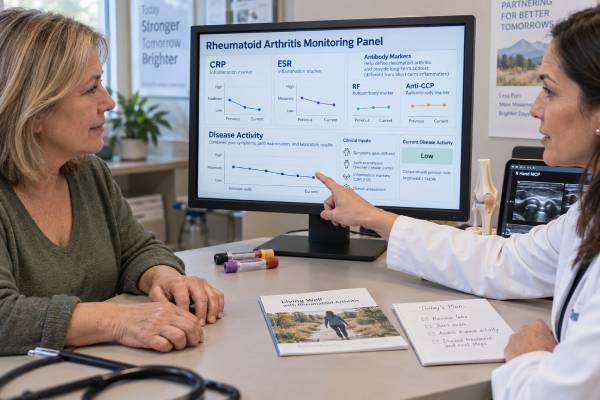
A rheumatoid arthritis monitoring panel can help show whether inflammation is improving, stable, or worsening, but its components do not all serve the same purpose. CRP and ESR may change with current inflammatory activity. Rheumatoid factor (RF) and anti-CCP antibodies mainly describe the disease’s serologic type and prognosis; they often remain positive even when treatment is working and usually should not be repeated at every visit.
Effective monitoring is broader than blood work. Rheumatology teams combine swollen- and tender-joint counts, patient symptoms, physical function, medication effects, and a composite activity score. Safety tests such as a complete blood count and liver and kidney panels may be more important than RF or anti-CCP for deciding whether a medication can be continued safely. The goal is a treat-to-target plan: adjust therapy until remission or low disease activity is reached, then confirm that control is sustained. A normal CRP does not cancel visible synovitis, and an elevated ESR does not automatically mean an arthritis flare.
- CRP and ESR can help track inflammation, but either may be normal during active rheumatoid arthritis.
- RF and anti-CCP are usually baseline diagnostic/prognostic tests, not routine treatment-response markers.
- Disease activity should be measured with joints, symptoms, function, and a validated score—not blood results alone.
- Active disease often needs review every one to three months; stable disease can usually be monitored less often.
- A sudden inflammation-marker spike with fever or new symptoms should prompt evaluation for infection before assuming a flare.
Table of Contents
- What Rheumatoid Arthritis Monitoring Is Trying to Achieve
- Using CRP to Follow Inflammation
- Using ESR and Understanding Its Confounders
- Why RF and Anti-CCP Usually Are Not Repeated
- How Blood Tests Fit Into Disease-Activity Scores
- Medication Safety Tests That Belong in Follow-Up
- Monitoring Schedules and What to Do With Results
What Rheumatoid Arthritis Monitoring Is Trying to Achieve
Monitoring is not simply checking whether laboratory values fall inside a reference range. It is a repeated decision process designed to answer four practical questions:
- Is inflammatory arthritis active now?
- Is the current treatment moving the patient toward remission or low disease activity?
- Is medication causing toxicity or creating infection risk?
- Are pain and disability coming from active inflammation, existing damage, or another condition?
Modern rheumatoid arthritis care uses a treat-to-target strategy. The clinician and patient agree on a target—usually remission, or low disease activity when remission is not realistic—and reassess often enough to change treatment if the target is missed. Improvement alone is not always enough. A person can feel 30% better yet still have several swollen joints and ongoing damage risk.
A useful monitoring visit includes more than laboratory review. It may cover:
- Swollen- and tender-joint counts
- Morning stiffness, pain, fatigue, and sleep
- Grip, walking, work, self-care, and other functions
- Patient and clinician global assessments
- CRP or ESR when these markers are informative
- Medication adherence, dose, and adverse effects
- Infection, vaccination, pregnancy, surgery, and cardiovascular risk
- New nodules, eye symptoms, lung symptoms, neuropathy, or other extra-articular features
The relative importance of each item changes over time. Early after diagnosis or a medication change, disease activity and toxicity need close attention. Once remission is stable, visits can be less frequent, but annual review still matters because rheumatoid arthritis affects bone, cardiovascular health, lungs, infection risk, and quality of life.
The panel named in this article—CRP, ESR, RF, and anti-CCP—is therefore only one layer of the monitoring dashboard. A monitoring panel is most useful when each result has a defined role rather than being ordered automatically.
Using CRP to Follow Inflammation
C-reactive protein is made by the liver in response to inflammatory cytokines, especially interleukin-6. It can rise within hours and often falls quickly when inflammation resolves. Standard CRP is generally reported in milligrams per liter (mg/L). The upper reference limit commonly falls between about 3 and 10 mg/L, but the laboratory’s own range controls interpretation.
In rheumatoid arthritis, CRP may help:
- Establish a baseline before treatment
- Support evidence of active systemic inflammation
- Track response after starting or adjusting a disease-modifying antirheumatic drug
- Contribute to composite scores such as DAS28-CRP or SDAI
- Identify an unexpected inflammatory change that needs investigation
A falling CRP that parallels fewer swollen joints and better function is reassuring. A persistently high CRP despite therapy may signal uncontrolled synovitis, but infection, obesity, smoking, tissue injury, periodontal disease, and other inflammatory disorders can also raise it.
CRP has important blind spots. Some people with rheumatoid arthritis produce little CRP even during active synovitis. Medications that block interleukin-6 signaling or Janus kinase pathways can suppress CRP strongly, sometimes faster than all joint inflammation resolves. In these settings, a low CRP may overstate disease control if it is considered alone.
The reverse problem occurs when CRP is high but the joints look quiet. Before escalating immunosuppression, the clinician should look for fever, respiratory or urinary symptoms, skin infection, dental disease, recent surgery, trauma, inflammatory bowel disease, or another source. The detailed CRP test for rheumatoid arthritis guide explains these interpretation issues further.
High-sensitivity CRP is designed to detect small concentrations for cardiovascular-risk assessment. Although it measures the same protein, it is not interchangeable with the standard CRP used to assess active inflammatory disease. The report should identify which assay was ordered.
Using ESR and Understanding Its Confounders
The erythrocyte sedimentation rate measures how far red blood cells settle in a vertical tube over one hour, reported in mm/hr. Inflammation increases plasma proteins that make red cells form stacks and fall faster. ESR therefore reflects the indirect physical effects of the acute-phase response rather than measuring one inflammatory molecule.
ESR can support disease-activity assessment, especially when it historically tracks well for a particular patient. It is part of DAS28-ESR, one of the most familiar rheumatoid arthritis scores. Because ESR changes more slowly than CRP, it may remain elevated after a flare begins to improve.
Many factors can raise ESR without active rheumatoid synovitis:
- Older age
- Anemia
- Pregnancy
- Kidney disease
- High immunoglobulin levels
- Infection or malignancy
- Some technical and specimen-handling conditions
Polycythemia, unusual red-cell shapes, and marked leukocytosis can lower or distort ESR. Reference intervals often differ by age and sex, which makes a universal cutoff misleading.
When ESR and CRP disagree, neither automatically wins. A high ESR with normal CRP may reflect anemia, age, immunoglobulins, or a slower residual inflammatory signal. A high CRP with relatively normal ESR may occur early in an acute process. Comparing the pattern with prior results and the joint examination is more useful than trying to force both numbers to match.
For a patient whose ESR has never reflected disease activity, repeated ESR testing may add little. For another patient, ESR may consistently rise before swollen joints worsen. Personalized monitoring means learning which markers are reliable for that individual while keeping their limitations in view. The ESR test for rheumatoid arthritis article covers age, anemia, and other confounders in more depth.
Why RF and Anti-CCP Usually Are Not Repeated
RF and anti-CCP answer a different question from CRP and ESR. They are autoantibodies used mainly to support diagnosis and define seropositive disease. Their presence can also indicate a higher average risk of erosive or extra-articular disease, particularly at high titers and when both are positive.
These antibodies often persist for years. Treatment may lower titers in some patients, but the change is inconsistent and does not reliably correspond to remission. A person can have excellent control while RF and anti-CCP remain strongly positive. Another can have active disease with negative antibodies.
Routine repetition can cause several problems:
- A persistent high result may create needless concern despite clinical remission.
- A modest fall may be mistaken for proof that treatment is adequate.
- A negative conversion may be overinterpreted as cure.
- Repeated testing adds cost without changing management.
RF may be repeated when the original result is uncertain, the diagnosis is being reconsidered, or a new condition such as Sjögren syndrome is suspected. Anti-CCP may occasionally be repeated if an early borderline result used an uncertain assay or if the initial evaluation occurred before persistent arthritis developed. These are targeted exceptions rather than routine monitoring.
At baseline, antibody status remains valuable. High-positive RF or anti-CCP can influence prognosis, help distinguish rheumatoid arthritis from mimics, and support a more ambitious remission target in a patient at risk of radiographic progression. But once the diagnosis is secure, disease control should be measured with current findings.
| Marker | Changes with activity? | Typical repeat role |
|---|---|---|
| CRP | Often, but not in every patient | Regularly during active disease or treatment adjustment |
| ESR | Often, but affected by many non-RA factors | Regularly when it contributes useful activity information |
| RF | Not reliably | Usually baseline; repeat only for a specific clinical reason |
| Anti-CCP | Not reliably | Usually baseline; routine serial titers are unnecessary |
How Blood Tests Fit Into Disease-Activity Scores
Composite scores reduce the risk of making decisions from one symptom or laboratory value. They combine several dimensions of disease into a standardized result.
DAS28-ESR or DAS28-CRP uses tender and swollen counts from 28 joints, a patient global assessment, and ESR or CRP. Common DAS28 thresholds are:
- Above 5.1: high disease activity
- Above 3.2 to 5.1: moderate disease activity
- 2.6 to 3.2: low disease activity
- Below 2.6: remission by the traditional DAS28 threshold
These cutoffs do not mean every joint is normal. DAS28 excludes feet and ankles, and a patient may meet a numerical remission threshold while one important joint remains swollen. CRP- and ESR-based versions also produce somewhat different distributions and should not be swapped casually when following a trend.
SDAI, the Simplified Disease Activity Index, combines 28-joint tender and swollen counts, patient and clinician global assessments, and CRP. CDAI, the Clinical Disease Activity Index, uses the same clinical components without a laboratory value. CDAI is useful when results are not immediately available or when CRP is artificially suppressed by therapy.
A score should guide conversation, not replace it. Fibromyalgia can increase tenderness and patient global scores even when synovitis is controlled. Joint damage can cause pain and limited movement without current inflammation. Conversely, a patient with few symptoms may still have power Doppler synovitis or swollen joints.
Ultrasound or MRI is not required at every visit. Targeted imaging can help when the score and examination conflict, when a deep joint is difficult to assess, or when treatment tapering is being considered in apparently stable disease. Imaging should answer a clinical uncertainty rather than become an automatic panel component.
Medication Safety Tests That Belong in Follow-Up
Monitoring rheumatoid arthritis also means monitoring treatment. The necessary safety tests depend on the drug, dose, comorbidities, and stage of therapy.
A complete blood count can detect low white cells, low platelets, or anemia. Liver enzymes are important with methotrexate, leflunomide, and several targeted treatments. Creatinine and estimated glomerular filtration rate help assess renal function, which affects methotrexate handling and medication choice. Lipids may be checked with Janus kinase inhibitors and some biologic therapies.
Before or during immunosuppressive treatment, clinicians may screen for:
- Tuberculosis
- Hepatitis B and C
- Pregnancy when relevant
- Vaccination gaps
- Recurrent or serious infection
- Medication interactions
The testing interval is not the same for everyone. Methotrexate safety laboratories are often checked more frequently after initiation or dose increase and less frequently once the dose and results are stable. Package labeling, local protocols, specialty guidelines, and individual risk determine the schedule.
Safety results and activity results can point in opposite directions. A patient may need stronger disease control but develop elevated liver enzymes or low blood counts. The correct response may be dose adjustment, a different medication, investigation of another cause, or specialist advice—not simply continuing or stopping treatment based on one value.
Patients should know which symptoms require contact between scheduled visits: fever, persistent cough, painful urination, shingles, unusual bruising, mouth ulcers, severe nausea, jaundice, shortness of breath, or possible pregnancy. Laboratory monitoring cannot replace symptom reporting.
Monitoring Schedules and What to Do With Results
Monitoring frequency should match disease activity and the pace of treatment decisions. Guidance commonly recommends assessment every one to three months during active disease. Some systems use monthly CRP and composite disease-activity measurement until remission or low disease activity is reached. Medication safety tests may be even more frequent early in treatment.
Once the target is achieved, a follow-up around three to six months can confirm that control is sustained. Stable patients may then have less frequent specialist visits, with rapid access if symptoms worsen and a comprehensive annual review. People receiving high-risk medications or living with kidney, liver, lung, or blood-count problems may need closer laboratory follow-up even when joints are quiet.
Use trends consistently:
- Compare results from the same laboratory when possible.
- Note medication changes, infections, steroid use, and vaccination near each test.
- Pair CRP or ESR with the joint examination and activity score.
- Separate disease-activity tests from drug-safety tests.
- Act on persistent, clinically meaningful patterns rather than tiny fluctuations.
A rise in CRP or ESR with more swollen joints, longer morning stiffness, and declining function supports a flare or inadequate control. A rise without joint findings should trigger a search for infection or another inflammatory source. Normal markers with clear swelling require clinical action despite the reassuring numbers.
Before tapering medication, sustained remission matters more than one good visit. Guidelines generally advise caution and shared decision-making because complete withdrawal can lead to flare. The patient’s history of erosions, antibody status, prior flares, comorbidities, preferences, and ability to regain control all influence the decision.
Urgent medical assessment is appropriate for fever with a hot swollen joint, severe infection symptoms, chest pain, new shortness of breath, neurologic deficits, or rapidly worsening illness. Immunosuppressed patients may have muted fever or CRP responses, so symptoms and examination remain essential.
The best monitoring panel is not the largest one. It is the smallest set of reliable measures that repeatedly answers whether rheumatoid arthritis is controlled, treatment is safe, and the next decision is clear.
References
- EULAR recommendations for the management of rheumatoid arthritis with synthetic and biological disease-modifying antirheumatic drugs: 2022 update 2023 (Guideline)
- 2021 American College of Rheumatology Guideline for the Treatment of Rheumatoid Arthritis 2021 (Guideline)
- Recommendations | Rheumatoid arthritis in adults: management | Guidance | NICE 2024 (Guideline)
- 2022 EULAR points to consider for remote care in rheumatic and musculoskeletal diseases 2022 (Position Statement)
- Treat-to-target in rheumatoid arthritis: a real-world study of the application and impact of treat-to-target within the wider context of rheumatoid arthritis management 2022 (Clinical Study)
- Biomarkers in the diagnosis, prognosis and management of rheumatoid arthritis: A comprehensive review 2024 (Review)
Disclaimer
This article is for general education and does not replace a personalized rheumatoid arthritis monitoring plan. Test frequency and treatment decisions depend on disease activity, medication, organ function, infection risk, and local guidance. Contact a clinician promptly for infection symptoms or medication toxicity, and seek urgent care for fever with a hot swollen joint or severe systemic illness.