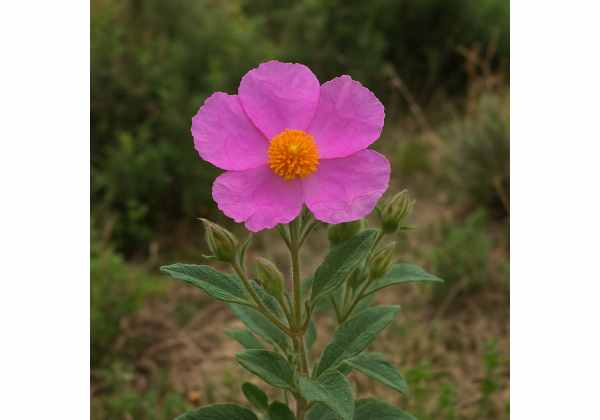
Rock rose refers to several aromatic Mediterranean shrubs from the Cistus genus, especially Cistus incanus, Cistus creticus, and Cistus ladanifer. These plants are prized for their sticky resin, fragrant leaves, and unusually rich polyphenol content. In everyday herbal use, rock rose is most often prepared as a tea or decoction for coughs linked with colds, sore-throat comfort, and general mucosal support. In topical products, especially those involving Cistus ladanifer and its resin known as labdanum, it is also valued for its astringent, antioxidant, and skin-protective potential.
What makes rock rose appealing is not a single dramatic effect, but a layered profile: tannin-rich leaves, flavonoids, phenolic acids, and aromatic terpenes that together suggest antimicrobial, anti-inflammatory, and antioxidant activity. Still, the evidence is mixed. Some laboratory findings are impressive, and a few human studies are encouraging, but the best-supported modern use remains fairly narrow. Rock rose is more credible as a traditional cough-and-cold herb, oral-care rinse, and polyphenol-rich tea than as a broad “immune cure.” A balanced guide should therefore explain both its promise and its limits.
Key Insights
- Rock rose is best supported for relief of cough associated with cold and for short-term mouth and throat care.
- Its polyphenol-rich preparations also show antioxidant, astringent, and antimicrobial activity in laboratory and product-specific studies.
- A traditional medicinal decoction uses 10 g herb in 200 mL water, taken 1 to 3 times daily.
- Pregnancy, breastfeeding, and use in children and adolescents under 18 are not recommended for medicinal use.
- Resin, tea, extract, and essential oil preparations are not interchangeable.
Table of Contents
- What rock rose is and why the species names can be confusing
- Key ingredients and medicinal properties of rock rose
- Potential health benefits and what the evidence really says
- How rock rose is used in tea oral care and topical products
- Rock rose dosage timing and duration
- Safety side effects interactions and who should avoid it
- Common mistakes and practical tips for better results
What rock rose is and why the species names can be confusing
Rock rose is a common name for several flowering shrubs in the Cistus genus, a group that thrives in the dry, sunny, often rocky landscapes of the Mediterranean basin. These plants are easy to admire in the wild: soft pink or white petals, wrinkled leaves, and a distinct resinous aroma that becomes stronger in heat. In herbal practice, however, rock rose is more than an ornamental shrub. Its leaves and flowering tops are used in teas, decoctions, mouth rinses, and extracts, while the resin of Cistus ladanifer has a long history in perfumery and traditional skin applications.
The confusion starts with names. Commercial products are often sold as Cistus incanus, yet some botanical and regulatory sources focus on Cistus creticus, and older literature sometimes uses these names in overlapping ways. To make things even less tidy, Cistus × incanus may refer to a hybrid. For everyday readers, the most useful point is not to memorize every taxonomic debate, but to understand that not all “cistus” products are identical. The leaf tea sold for cold-season use is not the same thing as the sticky labdanum resin from Cistus ladanifer, and neither should be treated as if they were standardized pharmaceuticals.
There are also practical differences among the species named in this article:
- Cistus creticus is the clearest official medicinal reference point in Europe for traditional cough-and-cold use.
- Cistus incanus is the name many teas and supplements use in commerce and in parts of the research literature.
- Cistus ladanifer is especially associated with aromatic resin, terpenes, and topical or cosmetic interest.
That species overlap partly explains why rock rose sometimes sounds more proven than it really is. A study on one extract, one preparation, or one species is often generalized to the whole genus. That is not always fair. A hot-water decoction used for a cold does not behave the same way as an alcohol extract used in a lab, and neither behaves like a resin-rich topical ingredient.
The best working definition is simple: rock rose is a polyphenol-rich, aromatic Mediterranean herb group used mainly for respiratory comfort, oral care, and topical support, with some species differences that matter in practice. Once that is clear, the rest of the topic becomes easier to judge. You can appreciate the plant’s medicinal tradition without assuming every cistus product delivers the same effect or deserves the same claims.
Key ingredients and medicinal properties of rock rose
Rock rose attracts herbal interest because it combines two useful chemical personalities. The leaf and herb preparations are especially rich in polyphenols, while the more resinous species, particularly Cistus ladanifer, contribute terpenes and aromatic resin compounds. That combination helps explain why rock rose appears in both tea-based herbal products and topical aromatic preparations.
The most important active groups in tea and decoction forms are:
- flavonoids such as quercetin derivatives, myricetin derivatives, rutin, hyperoside, and isoquercetin
- phenolic acids such as gallic acid, chlorogenic acid, and ellagic acid
- tannins, including proanthocyanidins and ellagitannins
- other non-flavonoid polyphenols that contribute to astringency and antioxidant effects
These compounds give rock rose its most believable medicinal traits. Polyphenols help account for the herb’s astringent, antioxidant, and surface-active antimicrobial behavior. Astringency matters more than it first sounds. In plain language, it means the herb can tighten and tone tissues, which is one reason it makes sense in throat, mouth, and mucosal care rather than as an all-purpose tonic.
In water infusions, ellagitannins and flavonols appear especially relevant. These compounds are often discussed as the reason rock rose tea is compared with other polyphenol-rich beverages such as green tea for antioxidant and tannin-related activity. The comparison is useful, but incomplete. Rock rose is not just “Mediterranean green tea.” Its chemistry leans more heavily into resinous shrubs, tannins, and aromatic defense compounds shaped by hot, dry conditions.
The chemistry changes somewhat with Cistus ladanifer. This species is famous for labdanum, a sticky resin produced by glandular trichomes. Labdanum contains labdane-type diterpenes and volatile aromatic molecules that make it valuable in fragrance, but also relevant in topical and cosmetic research. This is where rock rose begins to look less like a drinkable herb and more like a resinous skin and aroma ingredient.
Taken together, rock rose’s likely medicinal properties can be described as:
- astringent
- antioxidant
- antimicrobial
- inflammation-modulating
- mucosal soothing
- mild surface-protective or film-forming in the mouth and throat
That does not mean every rock rose preparation works internally, externally, and aromatically with equal strength. It means the plant family offers several overlapping activities depending on which part is used and how it is prepared.
One of the most helpful ways to think about rock rose is as a contact herb. Many of its plausible benefits make the most sense where the preparation directly touches tissue: the throat, the oral cavity, or the skin. That framework is more realistic than imagining rock rose as a deeply systemic herb with broad, drug-like effects throughout the body.
Potential health benefits and what the evidence really says
Rock rose has a strong reputation in herbal circles, but the evidence becomes clearer when the benefits are ranked by confidence rather than by marketing appeal.
The most grounded benefit is relief of cough associated with cold, especially for Cistus creticus prepared as a traditional decoction. This is the clearest officially recognized medicinal use. It does not mean rock rose cures viral infections or prevents every winter illness. It means the herb has enough traditional use and safety context to support a modest role in symptom relief, especially where the throat and upper airways feel irritated.
A second area with encouraging, though not definitive, human evidence is upper-respiratory symptom support. Some clinical work with standardized Cistus incanus extracts suggests reduced symptom burden in upper-respiratory tract infections. That is promising, but it still does not justify sweeping claims such as “broad antiviral shield” or “immune booster.” The human trials are relatively small, product-specific, and not strong enough to make rock rose the first-line herb for every cold. Readers seeking a more established cold-season comparison often look to echinacea in immune-support discussions, which shows how important it is to separate tradition, trials, and product marketing.
A third plausible benefit is oral health support. This may be one of rock rose’s most overlooked strengths. Small studies and oral-care experiments suggest cistus preparations can reduce initial bacterial adhesion in the mouth, while combination products containing Cistus × incanus have shown benefit in gingival symptoms. Again, this is not the same as proving that any rock rose tea will treat gum disease. It does suggest that the herb is well suited to the oral cavity, where polyphenols and tannins can act locally.
A fourth area is topical skin support, especially with Cistus ladanifer resin and extract. Here the story is mostly preclinical and cosmetic rather than clinical medicine. Antioxidant, astringent, and skin-protective effects look plausible, but the evidence is not strong enough to present labdanum as a proven treatment for eczema, wounds, or inflammatory skin disease.
What about the bigger claims?
- Broad antiviral activity: interesting in laboratory work, not broadly proven in people
- Immune strengthening: reasonable as a marketing shorthand, but too vague to be a clinical claim
- Anti-inflammatory whole-body benefit: plausible, yet mostly preclinical
- Metabolic or anti-aging use: far too early for confident real-world claims
The best summary is that rock rose seems most credible where it is used as a local-contact polyphenol herb: the mouth, throat, and upper airway. That is where both its chemistry and its human evidence line up most convincingly. The farther the claims move from those local uses, the more caution the reader should bring.
How rock rose is used in tea oral care and topical products
How you use rock rose should depend on which benefit you are actually looking for. The plant is versatile, but the preparations are not interchangeable.
The most traditional internal form is the decoction or strong tea. For Cistus creticus, this is the official medicinal style: the herb is boiled rather than merely steeped, which extracts its tannins and polyphenols more thoroughly. This form is most relevant for cough linked with cold, scratchy throat, and general upper-airway comfort. Compared with a light wellness tea, a medicinal decoction feels more serious, more astringent, and less like a casual beverage.
A second practical use is the gargle or mouth rinse. This is one of the most logical ways to use rock rose because the herb’s polyphenols directly contact the oral mucosa. Mouth rinsing also fits what we know about its astringent and anti-adhesive activity. A cooled tea or decoction can be swished and spat out after meals or during periods of throat irritation.
A third category is oral-care products, such as lozenges, mouthwashes, sprays, chewing gum, or extracts combined with other botanicals. These products may be more convenient than home tea, but they also raise a practical issue: results from one branded or standardized preparation cannot automatically be transferred to every cistus capsule or bagged tea on the market.
Then there is Cistus ladanifer, which moves the conversation toward labdanum resin and topical use. Labdanum has a long fragrance history and appears in some skin-care formulations because of its aromatic, film-forming, and antioxidant qualities. This makes rock rose somewhat unusual: one branch of the genus is mainly a tea herb, while another is strongly linked with resin and perfumery. For people mainly interested in astringent topical care, a better-known comparison is witch hazel in topical tissue-toning use, though rock rose offers a more resinous and aromatic profile.
In practical terms, the main preparation choices look like this:
- Decoction for cold-related cough and throat comfort
- Mouth rinse for short-term oral freshness and gum support
- Lozenges or sprays for portable local use
- Topical cosmetic products containing labdanum or cistus extract
- Essential oil or fragrant resin for aroma and cosmetic use, not routine internal use
That final point matters. Essential oils and resinous absolutes are far more concentrated than leaf tea. They should not be swallowed casually just because the plant itself is drinkable as a tea.
Rock rose works best when the form matches the goal. For mouth and throat issues, a local-contact preparation makes the most sense. For skin care, topical products are more logical than tea. For generalized “wellness,” the herb is better viewed as a polyphenol-rich traditional plant than as a cure-all.
Rock rose dosage timing and duration
Rock rose dosage is one place where a careful answer matters more than a broad one, because different species and product types vary a great deal. The clearest official dosing guidance comes from the European monograph on Cistus creticus herba, and that is the most reliable place to begin.
For traditional medicinal use, the monograph describes:
- 10 g of comminuted herbal substance
- in 200 mL of water
- prepared as a decoction
- boiled down until about 100 mL remains
- taken 1 to 3 times daily
That is a much stronger preparation than the casual cistus tea many people buy in tea bags. This distinction matters. A light beverage tea and a medicinal decoction are not the same intervention. If a product label uses a gentler preparation, follow the label rather than trying to force it into the monograph’s frame.
Timing depends on the goal:
- for cough or cold discomfort, use the decoction across the day in divided doses
- for throat and mouth care, use after meals or when symptoms are most noticeable
- for a mouth rinse, let the preparation cool first and use it locally rather than as a high-volume drink
Duration should also stay realistic. Traditional guidance suggests that if symptoms last more than about a week, medical advice is appropriate. Rock rose is not the right herb for prolonged self-treatment of persistent cough, fever, purulent sputum, or shortness of breath.
For lozenges, capsules, sprays, and combination products, there is no single universal dose that fits all cistus preparations. Product-specific standardization matters. A cistus extract used in a clinical study may have a very different polyphenol content from a loose herbal tea sold online.
A sensible dosage philosophy looks like this:
- Use the official medicinal decoction only when you intend a true traditional herbal intervention.
- Use label instructions for standardized products.
- Keep casual tea use separate in your mind from medicinal dosing.
- Do not assume that more tannic, stronger, or darker means better.
- Stop once the short-term goal has been reached.
For topical products based on Cistus ladanifer resin or cistus extracts, dosing is even less standardized. In that setting, frequency of application and concentration should follow the manufacturer or practitioner guidance, and patch testing is sensible.
Rock rose works best as a short, well-matched herbal measure. It is not a plant that benefits from vague, indefinite, or “just in case” dosing. Clear intention matters here more than daily quantity.
Safety side effects interactions and who should avoid it
Rock rose is generally viewed as a reasonably well-tolerated traditional herb when used in appropriate short-term ways, but that does not mean every form is automatically suitable for everyone.
For Cistus creticus medicinal decoction, the official safety picture is cautious rather than alarming. Serious adverse effects are not well documented, yet important gaps remain. In particular, adequate safety data are lacking for several groups, so avoidance is the safer choice.
Internal medicinal use is not recommended for:
- children and adolescents under 18
- pregnant people
- breastfeeding people
- anyone with known hypersensitivity to the herb
There are also symptom-based warnings. If a person using rock rose develops shortness of breath, fever, or purulent sputum, that is no longer a simple “tea and wait” situation. Medical assessment matters.
Side effects from ordinary tea-level use appear limited, but several practical issues deserve attention. Because rock rose preparations can be tannin-rich and astringent, some people may find them drying or irritating if taken too strong or too often. Very concentrated preparations may feel harsh on an empty stomach or on sensitive throats. This is one reason the herb is often better used as a short-course cold-season or oral-care plant rather than an everyday all-day beverage.
Interactions are not strongly established, and official sources note that none are clearly reported for the traditional medicinal preparation. Still, “none reported” is not the same as “impossible.” The real issue is that the herb is under-studied, especially in concentrated extracts and mixed supplements. Product complexity increases uncertainty.
Extra caution is sensible with:
- multi-herb immune formulas
- concentrated extracts with unclear standardization
- essential oils or resin-rich products intended for internal use
- fragrance-sensitive or allergy-prone individuals using topical labdanum products
Topical preparations deserve their own caution. Cistus ladanifer resin and aromatic extracts may be useful in cosmetic formulas, but resins and fragrant oils can also provoke irritation or contact sensitivity in susceptible people. Patch testing on a small skin area is a practical rule before wider use.
The most important safety insight is this: the gentlest and most traditional form is usually the safest one. A short-term decoction for cough comfort sits on firmer ground than an aggressive extract marketed for “detox,” “viral defense,” or daily high-dose immune support. With rock rose, the preparation often matters as much as the plant.
Common mistakes and practical tips for better results
Rock rose is easy to misuse because the plant lives at the border between tea herb, aromatic resin plant, and supplement ingredient. Most confusion comes from treating those categories as if they were the same.
The first mistake is assuming every cistus product is equivalent. A bagged herb labeled Cistus incanus, a regulated traditional Cistus creticus decoction, and a Cistus ladanifer resin cosmetic do not offer the same chemistry or the same intended use. The label matters, the preparation matters, and the plant part matters.
The second mistake is equating lab antiviral activity with proven clinical protection. Rock rose has interesting in vitro results, and those findings help explain its popularity. But a petri dish result is not the same as showing that a household tea prevents influenza, shortens every cold, or blocks viral transmission. A better approach is to treat rock rose as a supportive herb for local symptoms, not as a magic shield.
The third mistake is using the wrong herb for the wrong symptom. If your main problem is throat irritation or mild cold-season cough, rock rose may fit well. If your real issue is post-meal bloating or crampy digestion, something like peppermint for digestive and respiratory comfort may be the more direct match. Herbs work best when their style matches the complaint.
The fourth mistake is drinking strong preparations indefinitely. Rock rose is better suited to a defined purpose and time frame than to vague long-term use. A week of cold-season support is different from months of daily concentrated tea.
The fifth mistake is using resin or essential oil internally because the tea is drinkable. This is a classic category error. Aromatic concentrates are not beverages.
A few practical tips improve outcomes:
- choose a product with a clearly identified species and plant part
- use tea or decoction for throat, cough, and oral-mucosal purposes
- use mouth rinsing when the goal is oral freshness or gum support
- follow short-term dosing rather than escalating concentration
- treat persistent symptoms as a reason to reassess, not simply to brew stronger tea
Rock rose tends to reward realistic expectations. It is not at its best when asked to do everything. It is at its best when used as a focused traditional herb for local respiratory and oral support, and as a cautious topical ingredient where resin-rich preparations make sense. That narrower framing is not a weakness. It is what makes the herb credible.
References
- Final European Union herbal monograph on Cisti cretici herba – First version 2025. (Monograph)
- A Review on Cistus sp.: Phytochemical and Antimicrobial Activities 2021. (Review)
- Antioxidant and Antiglycation Effects of Cistus × incanus Water Infusion, Its Phenolic Components, and Respective Metabolites 2022. (Open study)
- Cistus incanus (CYSTUS052) for treating patients with infection of the upper respiratory tract. A prospective, randomised, placebo-controlled clinical study 2009. (RCT)
- Efficacy and Tolerability of a Scutellaria lateriflora L. and Cistus × incanus L.-Based Chewing Gum on the Symptoms of Gingivitis: A Monocentric, Randomized, Double-Blind, Placebo-Controlled Clinical Trial 2024. (RCT)
Disclaimer
This article is for educational purposes only and is not medical advice. Rock rose is a traditional herbal medicine with promising but uneven evidence, and its products differ widely by species, extraction method, and strength. It should not be used to self-treat persistent cough, fever, breathing difficulty, severe oral disease, or chronic inflammatory conditions without qualified care. Speak with a healthcare professional before using medicinal rock rose if you are pregnant, breastfeeding, under 18, immunocompromised, or taking prescription medicines.
If this guide helped you, please share it on Facebook, X, or your preferred platform so more readers can make careful, evidence-aware decisions about herbal products.