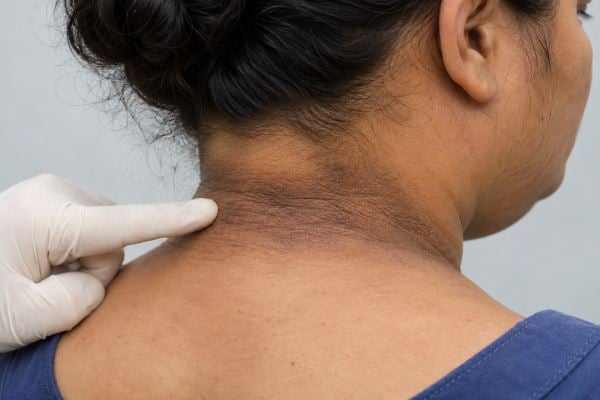
Your skin can sometimes signal that insulin levels have been running high, but no single change on the surface can diagnose insulin resistance by itself. The classic sign is acanthosis nigricans: darker, thicker, velvety patches of skin that commonly appear on the back or sides of the neck, in the armpits, or in other body folds. It is strongly associated with obesity, hyperinsulinemia, and metabolic syndrome, although it can also occur for other reasons.
Multiple skin tags may travel with the same metabolic pattern, but they are common in people without insulin resistance and far less specific. Other problems sometimes linked with insulin resistance—such as acne, excess facial hair in polycystic ovary syndrome, or recurrent skin infections when glucose is high—need their own evaluation rather than being lumped together as “insulin resistance skin.” The useful approach is to notice the pattern, check metabolic risk with appropriate blood tests, and treat both the underlying cause and the skin itself when needed.
Table of Contents
- Acanthosis nigricans: the classic skin sign
- Why insulin resistance can change the skin
- Skin tags and other possible clues
- What is not a reliable insulin resistance sign
- When skin changes need medical evaluation
- How insulin resistance is actually evaluated
- How to improve the skin and the metabolic cause
Acanthosis nigricans: the classic skin sign
Acanthosis nigricans, often shortened to AN, usually looks like a patch of skin that is darker than the surrounding area with a soft, thickened, or velvety texture. The borders may be poorly defined rather than sharply outlined. It commonly develops where skin folds or rubs together, especially:
- The back and sides of the neck
- The armpits
- The groin
- Under the breasts
- Around the waist or lower abdomen
- Less commonly, the knuckles, elbows, knees, or face
Texture is as important as color. AN is not simply “dark skin” or ordinary hyperpigmentation; it often feels thicker and may have accentuated skin lines or tiny papillated ridges. In darker skin tones, the color change can be easier to notice, but the condition occurs across all skin colors.
One practical clue is that it does not wash or scrub off. People are sometimes told their neck looks dirty and respond by scrubbing harder, which can cause irritation without removing the lesion. If a darkened neck patch has a velvety texture and persists despite normal washing, it is worth having a clinician look at it.
AN is one of the more useful visual clues to insulin resistance. A 2026 systematic review found a strong overlap between acanthosis nigricans and metabolic abnormalities, with insulin resistance among the most common. Other recent reviews likewise describe AN as a cutaneous marker that should prompt consideration of obesity, hyperinsulinemia, prediabetes, type 2 diabetes, and related metabolic conditions.
What can look similar?
Several common conditions can mimic part of the appearance. Friction can darken the neck or inner thighs without producing the classic velvety plaque. Post-inflammatory hyperpigmentation can remain after eczema, shaving irritation, or a rash. A condition called terra firma-forme dermatosis can create brown patches that look dirty but may wipe away with isopropyl alcohol during a clinician’s exam. Confluent and reticulated papillomatosis can cause brown, slightly scaly patches across the upper trunk or neck and may be mistaken for AN.
Those differences matter because the treatment is not the same. Scrubbing true acanthosis nigricans harder does not correct it, while treating presumed “insulin resistance” when the problem is eczema or another pigment disorder misses the cause. If the texture, location, or pattern is not typical, a primary care clinician or dermatologist can usually distinguish these conditions by examination and, occasionally, additional testing.
However, AN is a marker, not a diagnosis. Some people with insulin resistance never develop it, and some people with AN have other causes. Blood testing is still needed to determine whether glucose regulation is abnormal. For the broader metabolic picture, see insulin resistance causes, tests, and reversal strategies.
Why insulin resistance can change the skin
Insulin resistance means tissues such as muscle, liver, and fat do not respond to insulin as efficiently as they should. The pancreas often compensates by producing more insulin. That hyperinsulinemia can be present for years before blood glucose reaches the diabetes range.
At high concentrations, insulin can interact with insulin-like growth factor pathways and stimulate growth signals in skin cells. Keratinocytes in the outer skin and fibroblasts in the deeper skin may proliferate, contributing to the thickened, papillated texture of acanthosis nigricans. The dark appearance reflects a combination of epidermal thickening, pigmentation, and altered skin structure rather than simply “too much melanin.”
Obesity can amplify the process in several ways. More adipose tissue is associated with insulin resistance and chronic low-grade inflammation, while friction and moisture in body folds can make skin changes more visible. This helps explain why AN often appears at the neck or axillae in people with central obesity.
The relationship is also not perfectly linear. A darker or larger patch does not provide a reliable numeric estimate of fasting insulin or A1C. Skin can improve slowly even after metabolic markers get better, and cosmetic severity can be influenced by genetics, skin type, friction, and duration.
This is why you should not use photographs of your neck as a substitute for laboratory follow-up. Acanthosis nigricans can be a reason to check for metabolic disease, but standard tests are how prediabetes and diabetes are diagnosed. If you are concerned about silent glucose changes, the common warning patterns are covered in prediabetes symptoms and silent warning signs.
Skin tags and other possible clues
Skin tags, medically called acrochordons, are small, soft, flesh-colored or darker growths that often hang from a thin stalk. They commonly appear on the neck, armpits, groin, eyelids, and other areas of friction. They are benign and extremely common.
Studies have repeatedly found that people with multiple skin tags are more likely, on average, to have obesity, insulin resistance, metabolic syndrome, or diabetes. Recent reviews of dermatologic markers in obesity include both acanthosis nigricans and multiple acrochordons among findings associated with metabolic dysfunction. A 2025 clinical study also reported an association between skin tags and diabetes.
But skin tags are far less specific than acanthosis nigricans. Age, genetics, skin friction, pregnancy, and body weight can all contribute. One or two skin tags do not mean you have insulin resistance. Even numerous tags should be viewed as a reason to consider the rest of the risk picture, not as a diagnostic test.
Acne, oily skin, and excess facial hair
Insulin resistance can interact with androgen signaling and insulin-like growth factor pathways. In conditions such as polycystic ovary syndrome (PCOS), this may contribute to acne, oily skin, unwanted facial or body hair, and irregular menstrual cycles. But acne or hirsutism alone is not proof of insulin resistance.
If excess hair growth appears together with irregular periods, infertility, scalp hair thinning, or severe acne, ask about evaluation for PCOS or another androgen-related disorder. Insulin resistance is common in PCOS, but the condition has its own diagnostic criteria and treatment plan.
Intertrigo and skin-fold irritation
People with obesity may develop red, irritated skin where folds rub and trap moisture. This is called intertrigo. Insulin resistance does not directly cause every case, but obesity and diabetes can increase the likelihood of associated yeast or bacterial overgrowth. Persistent pain, odor, drainage, cracking, or spreading redness deserves medical assessment rather than repeated use of random over-the-counter creams.
Changes that are more related to diabetes than insulin resistance
Once blood glucose is chronically elevated, a wider range of skin problems becomes more common. Reviews of diabetes-associated skin disease describe recurrent bacterial or fungal infections, slow-healing wounds, diabetic dermopathy, dry itchy skin, foot ulcers, and other conditions. These are not good early “tests” for insulin resistance; they are more relevant to established hyperglycemia or diabetes complications.
If skin infections keep returning, cuts heal unusually slowly, or you have a foot wound that is not improving, check glucose and seek medical care. Those findings should not be managed as cosmetic insulin-resistance signs.
What is not a reliable insulin resistance sign
Social media often expands the list of “insulin resistance signs” until almost any skin or body feature qualifies. That creates unnecessary worry and can delay proper diagnosis.
The following are not specific enough to diagnose insulin resistance on their own:
- Ordinary acne
- A single skin tag
- Dark circles under the eyes
- Cellulite
- Dry skin
- Facial puffiness
- Hair loss
- Keratosis pilaris on the arms or thighs
- General skin darkening from sun exposure or friction
- Feeling that the neck is “dirty” without the velvety thickening typical of AN
Some of these features may coexist with obesity, hormonal disorders, diabetes, or metabolic syndrome, but association is not the same as diagnostic value. A 2026 review of skin as a metabolic organ specifically cautioned that most available data on dermatologic markers are observational and that skin findings should not be treated as independent metabolic risk-assessment tools.
The same caution applies to facial acanthosis nigricans. A 2024 review describes a facial variant associated with hyperinsulinemia and metabolic syndrome, often appearing as ill-defined brown-to-black pigmentation with textural change. But melasma, post-inflammatory pigmentation, friction, and other pigment disorders can look similar. A dermatologist may be needed when the appearance is atypical.
If your concern is metabolic health rather than the cosmetic diagnosis, focus on validated risk factors: family history, waist circumference, blood pressure, lipid profile, activity level, history of gestational diabetes, and laboratory glucose results. Skin can add context, but it should not dominate the assessment.
When skin changes need medical evaluation
Most acanthosis nigricans linked with insulin resistance develops gradually and is most obvious on the neck or other folds. A different pattern should raise more questions.
Seek medical evaluation if acanthosis-like skin changes:
- Appear suddenly or spread rapidly
- Are extensive despite no clear metabolic risk factors
- Begin for the first time in an older adult
- Involve the mouth or other mucosal surfaces
- Are accompanied by unexplained weight loss, reduced appetite, persistent gastrointestinal symptoms, or other systemic symptoms
- Start after a new medication or supplement
Rarely, sudden widespread acanthosis nigricans can be associated with an internal malignancy. That is uncommon, and most people with AN do not have cancer. The concern is mainly when onset is abrupt, severe, widespread, atypical, or accompanied by other red flags.
Medications can also trigger acanthosis nigricans in some people. Reported associations include certain hormones, high-dose niacin, glucocorticoids, and other drugs. Do not stop a prescription on your own; bring the medication list to the clinician who is evaluating the skin change.
A dermatologist can often diagnose classic AN by appearance. A biopsy is usually unnecessary unless the lesion is unusual or another skin disorder is being considered. The more important question is often what is driving the AN, which may require primary care or endocrinology follow-up.
How insulin resistance is actually evaluated
There is no single routine clinical test that perfectly measures insulin resistance in everyday practice. Research methods such as a hyperinsulinemic-euglycemic clamp can measure insulin sensitivity precisely, but they are not practical for ordinary screening.
Clinicians usually assess the consequences and risk factors instead. Common tests include:
- A1C
- Fasting plasma glucose
- Sometimes a two-hour oral glucose tolerance test
- Lipid profile, especially triglycerides and HDL cholesterol
- Blood pressure
- Weight, BMI, and waist circumference
- Liver tests when metabolic dysfunction-associated steatotic liver disease is a concern
Fasting insulin or HOMA-IR may be used in some settings, but cutoff values are not standardized enough to make them a universal diagnostic test. A normal fasting insulin also does not guarantee perfect insulin sensitivity.
The timing of screening should match the whole risk profile. A person with classic neck AN plus central obesity, high blood pressure, a strong family history of type 2 diabetes, and previous gestational diabetes has a stronger reason for prompt metabolic testing than someone with one small skin tag and no other risk factors. Conversely, a normal A1C today does not mean a person with substantial ongoing risk never needs to be retested. Follow-up intervals are individualized according to age, weight trajectory, prior results, medications, and other conditions.
If acanthosis nigricans is present, it is reasonable to discuss screening for prediabetes or diabetes, especially when there is overweight, central obesity, family history, previous gestational diabetes, PCOS, high triglycerides, high blood pressure, or other metabolic risk. Standard U.S. prediabetes ranges include A1C 5.7% to 6.4% and fasting plasma glucose 100 to 125 mg/dL. The article on fasting glucose ranges explains what an isolated morning result can and cannot tell you.
Children and adolescents can develop AN too, particularly with obesity and insulin resistance. A child with new AN should be assessed in the context of growth, puberty, family history, weight trajectory, and pediatric diabetes-risk guidelines rather than being placed on a restrictive adult diet.
How to improve the skin and the metabolic cause
The most important treatment is to address the underlying cause. When AN is driven by obesity and hyperinsulinemia, improving insulin sensitivity and reducing excess weight can gradually make the skin thinner and less dark. The degree of cosmetic improvement varies, and it may take months.
If weight loss is appropriate, even modest loss can improve insulin sensitivity. Sustainable calorie reduction, higher-fiber minimally processed foods, adequate protein, and regular exercise are more useful than “detoxes” or supplements marketed specifically for dark neck skin. For a practical metabolic plan, the step-by-step approach to reversing prediabetes covers weight, food, exercise, sleep, and follow-up.
Resistance training is particularly valuable because muscle is a major site for glucose disposal. Aerobic activity helps too, and the combination is generally stronger than relying on either alone. Improving sleep and treating sleep apnea when present can support appetite regulation and overall metabolic health.
Skin-directed treatment can help appearance
Even when the underlying cause is being treated, people may want faster cosmetic improvement. Recent systematic reviews of acanthosis nigricans trials support several dermatologist-directed options, including topical tretinoin, urea, adapalene, and selected chemical or laser treatments. These therapies aim to reduce thickness, texture, or pigmentation; they do not treat the metabolic cause.
Tretinoin and stronger acids can irritate skin, especially in folds. They also require special consideration during pregnancy. That is why it is better to get a diagnosis before applying high-strength exfoliating acids or prescription retinoids to the neck or armpits.
Avoid aggressive scrubbing, bleaching mixtures, lemon juice, baking soda, or abrasive tools. Friction and chemical irritation can worsen inflammation and post-inflammatory hyperpigmentation, making the area look darker.
Skin tags can be removed by a clinician through snipping, cautery, cryotherapy, or other procedures when they catch on clothing or are cosmetically bothersome. Removing them does not correct insulin resistance, and home cutting can cause bleeding, infection, or scarring.
The key distinction is simple: acanthosis nigricans and multiple skin tags can be clues to metabolic dysfunction, but the skin does not tell you your A1C. Use the clue to trigger appropriate screening, then treat the metabolic driver and the skin as two related but separate problems. That approach is more accurate—and more useful—than trying to diagnose insulin resistance from appearance alone.
References
- Is Acanthosis Nigricans a Marker for Metabolic Syndrome? A Systematic Review. 2026 (Systematic Review)
- Skin as a Metabolic Organ: Dermatologic Markers of Morbid Obesity and Their Role in Risk Stratification and Treatment Monitoring 2026 (Review)
- Review of facial acanthosis nigricans: Easy to diagnose and difficult to treat marker of hyperinsulinemia/metabolic syndrome 2024 (Review)
- Cutaneous manifestations of diabetes mellitus: a narrative review 2025 (Review)
- Systematic review of topical, laser, and oral treatments in acanthosis nigricans clinical trials 2024 (Systematic Review)
- A Clinico-Morphological Study of Acrochordons and the Association With Diabetes Mellitus 2025 (Clinical Study)
Disclaimer
This article is for general education and cannot diagnose a skin condition or insulin resistance. New, rapidly spreading, painful, infected, or otherwise unusual skin changes should be assessed by a healthcare professional, and sudden extensive acanthosis nigricans may require evaluation for causes other than metabolic disease. Do not start prescription skin treatments or stop medications without appropriate medical guidance.