A smart ring can track a surprising amount of physiology from your finger. It monitors heart rate, heart-rate variability, skin temperature trends, movement, and estimates of sleep quality. This breadth makes the leap to blood sugar seem small. If the ring already knows so much about your body, why can’t it simply tell you your glucose level too?
The answer is that glucose is a much harder signal to measure reliably without accessing blood or interstitial fluid. As of now, no consumer smart ring independently provides clinically validated, noninvasive blood glucose measurements. Some rings can display or combine data from a separate continuous glucose monitor (CGM), but the glucose reading comes from the CGM sensor, not the ring itself.
That distinction matters for safety, buying decisions, and how much trust to place in “metabolic” scores. This guide explains what smart rings actually measure, where glucose features fit in, why noninvasive sensing remains difficult, and how to use wearable data without mistaking an estimate for a medical measurement.
Table of Contents
- What Smart Rings Actually Measure
- Why Glucose Is Harder to Measure Without a Sensor
- “Glucose Tracking” Can Mean Different Things
- What Ring Data Can Tell You About Metabolic Health
- Accuracy and Common Limitations
- How to Use a Smart Ring With a CGM or Glucose Meter
- How to Evaluate Future Glucose Claims
What Smart Rings Actually Measure
Most smart rings rely on a small group of sensors that collect signals continuously or repeatedly from the finger. While the exact hardware varies by model, common measurements include optical pulse signals, skin temperature, movement, and sometimes blood oxygen estimates. Software then turns those raw signals into higher-level metrics such as resting heart rate, heart-rate variability, sleep duration, sleep stages, respiratory rate, activity, and recovery or readiness scores.
The finger is a useful location because it has a rich blood supply and can provide a strong optical pulse signal. A ring also tends to move less than a wristwatch during sleep. Those advantages make some overnight measurements surprisingly good, especially resting heart rate and heart-rate variability under stable conditions. But even a high-quality signal does not mean every derived metric is equally accurate. Sleep stages, stress scores, calorie estimates, and recovery scores depend on algorithms that infer a biological state from several indirect signals.
Blood glucose is different. A glucose value is not normally inferred from heart rate or skin temperature. It is a concentration of glucose in a body fluid. Standard home glucose meters measure glucose in a drop of capillary blood. Continuous glucose monitors use a tiny filament inserted under the skin to measure glucose in interstitial fluid, then convert that signal into a glucose estimate. Neither approach is truly noninvasive.
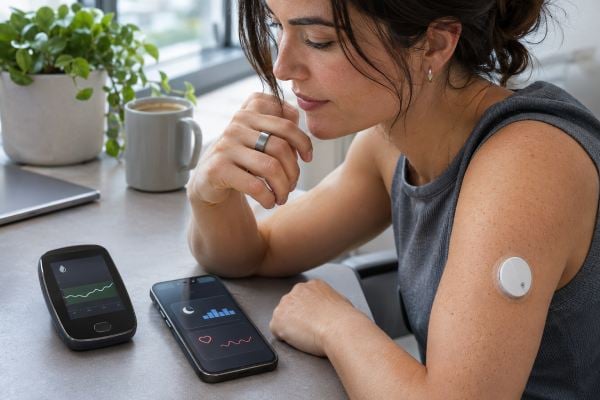
This distinction is easy to miss because wearable apps often place many metrics on the same dashboard. A ring may show sleep, activity, temperature, stress, and a glucose curve imported from another device in one screen. Visually, the data look as if they all came from the ring. Physiologically, they did not.
A smart ring can therefore be useful for understanding behaviors that influence glucose, but that is not the same as directly measuring glucose. The same principle applies to broad “metabolic scores.” They may summarize useful lifestyle signals, but they should not be treated as laboratory values. For more context on these composite scores, see what wearable metabolic scores actually mean.
Why Glucose Is Harder to Measure Without a Sensor
Researchers have been trying to measure glucose noninvasively for decades. The goal sounds straightforward: shine light through tissue, analyze a signal, and estimate how much glucose is present. In practice, the glucose signal is weak and easily confused by other biological and environmental factors.
Several technical problems make this difficult:
- Glucose is only one of many molecules in tissue. Water, proteins, fat, hemoglobin, and other substances can affect optical or electrical signals.
- Skin and tissue vary between people. Thickness, hydration, blood flow, temperature, pigmentation, and tissue composition can change the signal.
- Motion creates noise. Hand movement, exercise, loose fit, and pressure on the ring can distort sensor readings.
- Circulation changes quickly. Cold fingers, stress, caffeine, exercise, and illness can alter peripheral blood flow without a matching change in glucose.
- The device must work across a wide glucose range. It is not enough to be close on average. A glucose device must be dependable when readings are low, normal, or high, because treatment decisions may depend on those values.
- Calibration is a major challenge. A model that works after being calibrated to one person may perform poorly in another person or after physiology changes.
Noninvasive prototypes use techniques such as near-infrared spectroscopy, Raman spectroscopy, radiofrequency sensing, bioimpedance, microwave sensing, and combinations of multiple signals. Some research systems can detect glucose-related patterns under controlled conditions. Translating that into a small consumer ring that works day and night across different skin types, temperatures, activities, medications, and disease states is much harder.
There is also a difference between correlation and measurement. Glucose may rise after a poor night of sleep or during stress, while resting heart rate and temperature also change. An algorithm might learn that certain patterns often occur together. But a correlation cannot reliably tell whether a person’s glucose is 95 mg/dL or 165 mg/dL at a specific moment.
For that reason, claims of “needle-free glucose measurement” deserve careful scrutiny. A useful consumer wellness feature and a clinically trustworthy glucose value are not the same standard. If you need glucose values for diagnosis, medication dosing, hypoglycemia detection, or diabetes management, use an established glucose meter or an authorized CGM rather than an unvalidated ring estimate.
“Glucose Tracking” Can Mean Different Things
The phrase “glucose tracking” is broad enough to describe several very different products. Before assuming a ring measures glucose, look at where the glucose number actually comes from.
| Feature | Where the glucose data come from | What the ring is doing |
|---|---|---|
| Direct glucose measurement | The ring itself | This would require validated glucose-sensing technology; current consumer rings are not established replacements for meters or CGMs |
| CGM integration | A separate CGM worn on the body | The ring app may display, synchronize, or analyze glucose data |
| Manual glucose logging | Finger-stick meter or another app | The ring platform stores the number beside sleep or activity data |
| “Metabolic” or recovery score | Heart rate, HRV, temperature, sleep, activity, and algorithms | The score may reflect recovery context but is not a glucose concentration |
| Glucose prediction or risk estimate | Algorithm using indirect signals | An estimate that should not be confused with a measured glucose value |
A smart ring paired with a CGM can still be valuable. Combining sleep, activity, meal timing, exercise, and glucose data may make patterns easier to see. For example, you might notice that late meals are followed by a higher overnight glucose curve and poorer sleep, or that a short walk after dinner is followed by a smaller post-meal rise. The glucose information in that example is generated by the CGM, while the ring contributes context.
That setup can also help people learn why a CGM line sometimes seems surprising. CGMs measure interstitial glucose, not blood glucose directly, and they have normal lag and sensor artifacts. If a value does not match how you feel, understanding CGM lag time, compression lows, and false readings can prevent overreacting to a single number.
For people without diabetes, a CGM may reveal individual food and exercise patterns, but more data are not automatically better. It is possible to become overly focused on normal glucose fluctuations or to treat every rise as harmful. If you are considering a sensor mainly for self-experimentation, review the benefits and downsides of CGM use in people without diabetes first.
What Ring Data Can Tell You About Metabolic Health
A ring does not need to measure glucose directly to provide information that matters for blood sugar. Sleep, activity, recovery, and resting cardiovascular signals all interact with metabolic health. The key is to use them as context rather than as substitutes for glucose testing.
Sleep duration and regularity are especially useful. Short sleep and disrupted sleep can worsen insulin sensitivity and increase appetite. A ring can help you notice that bedtime has drifted later, total sleep has fallen, or sleep is repeatedly fragmented. The exact sleep-stage percentages are less important than consistent patterns you can act on.
Resting heart rate and heart-rate variability can reflect recovery load. Hard training, illness, alcohol, psychological stress, and insufficient sleep may all shift these metrics. Those same factors can influence glucose regulation. If both your recovery markers and glucose are unusual, the shared context may explain more than either metric alone.
Activity and sedentary time matter because muscle contractions help move glucose out of the bloodstream. Even short bouts of walking can reduce post-meal glucose exposure. A ring that reliably reminds you that you have been sitting for hours may be metabolically useful without ever displaying a glucose number. The effect can be very practical: a short walk after meals can sometimes change the glucose curve more predictably than chasing a proprietary readiness score.
Temperature trends can flag changes from your personal baseline. They may coincide with illness, menstrual-cycle changes, or recovery stress. These conditions can also alter glucose. Temperature should not be interpreted as a glucose proxy, but it can explain why your usual meal suddenly produces a different result.
The most productive way to use these metrics is to ask behavioral questions. Did consistent sleep improve morning glucose over several weeks? Do meals eaten after a long inactive day produce a different response than meals eaten after exercise? Does alcohol disrupt both sleep and next-day appetite? Those are better questions than asking whether one ring score is “good” or “bad.”
Remember that glucose responses are inherently individual. Meal composition, sleep, recent exercise, stress, medications, and insulin sensitivity all matter. That is why the same food can produce different glucose responses in different people.
Accuracy and Common Limitations
Wearables are most useful when you know which measurements are direct, which are estimates, and which are interpretations layered on top of estimates. A ring can perform well for one metric and less well for another.
Validation studies suggest that some consumer wearables can measure resting heart rate and heart-rate variability reasonably well, particularly during sleep. Performance can vary by device, firmware, activity type, and person. Movement generally makes optical sensing harder. Sleep duration may be useful for trends, while sleep-stage classification is less precise than a clinical sleep study.
Several everyday factors can affect ring data:
- A ring that is too loose or rotates on the finger
- Cold hands or reduced peripheral circulation
- Exercise involving gripping or vibration
- Tattoos, skin characteristics, sweat, or moisture
- Changes in firmware or algorithms
- Charging gaps and missing data
- Sleeping on the hand or applying pressure to the device
Derived scores introduce another layer of uncertainty. A readiness score may combine sleep, HRV, resting heart rate, temperature, and recent activity. The formula is proprietary and can change. Two brands may assign different scores to the same person on the same day. That does not make the score useless; it means the score should be treated as a coaching aid, not a diagnosis.
Glucose data have their own limitations even when they come from an actual CGM. Interstitial glucose can lag behind blood glucose, especially when levels are changing quickly. Pressure on a sensor can create falsely low readings. Hydration, sensor placement, and the first day of wear can affect performance. If you use an over-the-counter sensor, read the product’s intended-use instructions and understand what OTC CGMs can and cannot tell you.
The biggest error is mixing these levels of certainty. A ring’s measured pulse, an algorithm’s estimated sleep stage, a CGM’s interstitial glucose value, and an app’s metabolic score are four different kinds of information. They should not be interpreted as if they have identical accuracy or clinical meaning.
How to Use a Smart Ring With a CGM or Glucose Meter
If your goal is to understand glucose patterns, a ring can be a useful companion to a validated glucose device. The best approach is to use each device for what it measures well.
Start by deciding what question you are trying to answer. “What raises my glucose?” is too broad. A more useful experiment might be: Does a 15-minute walk after dinner reduce my usual two-hour post-meal rise? Or: Is my morning glucose higher after nights when I sleep less than six hours?
Then keep the experiment simple:
- Use a consistent glucose source. Compare CGM data with CGM data, or meter readings with meter readings. Do not treat a ring-derived estimate as interchangeable with either.
- Change one major behavior at a time. If you alter the meal, exercise, sleep, and supplements together, you will not know what caused the difference.
- Repeat the comparison. One meal can be affected by stress, prior exercise, illness, or measurement noise. Look for a repeated pattern across several similar days.
- Use trends, not isolated peaks. A single post-meal high does not define your metabolic health. Consider the meal size, starting glucose, duration of the rise, and the broader pattern.
- Confirm unexpected clinical values. If you use glucose-lowering medication or have symptoms of low or high glucose, follow your clinical plan and confirm questionable readings when appropriate.
For people with diabetes, a CGM may be part of treatment rather than a wellness experiment. In that case, alarms, medication decisions, hypoglycemia prevention, and clinician guidance take priority over ring-based insights. If you are unsure whether a CGM is appropriate for your situation, see who may benefit from continuous glucose monitoring and what it shows.
It also helps to separate useful pattern recognition from perfectionism. Glucose normally rises after eating carbohydrate. The goal is not to force a perfectly flat line. A balanced interpretation considers glucose targets appropriate to your health status, nutrition quality, physical activity, symptoms, and long-term markers such as A1C.
How to Evaluate Future Glucose Claims
Noninvasive glucose technology is advancing quickly, so the answer may change as better devices reach the market. Until then, evaluate a product by the evidence behind the exact glucose feature rather than by the sophistication of the ring as a whole.
A strong claim should answer several questions clearly:
- Is glucose actually measured by the ring? If the app requires a CGM, the ring is integrating glucose data rather than generating them.
- What regulatory status does the glucose feature have? Marketing language such as “wellness,” “insight,” or “metabolic tracking” is not the same as authorization for medical glucose measurement.
- Was the device tested against a recognized reference method? Accuracy should be compared with laboratory or validated blood-glucose methods, not with another unvalidated wearable.
- Was testing done in the people who will use it? Healthy volunteers in a controlled lab are not enough to establish performance in diabetes, hypoglycemia, exercise, illness, or everyday living.
- Does it work across the full glucose range? Average agreement can hide dangerous errors at low or high values.
- Is the study independent and peer reviewed? A company demonstration can be encouraging, but it is not equivalent to independent clinical validation.
- Are limitations easy to find? Trustworthy products state when readings may be unreliable and what users should do when results do not match symptoms.
The U.S. Food and Drug Administration has specifically warned consumers not to use smartwatches or smart rings that claim to measure blood glucose without piercing the skin. That warning is important because an inaccurate reading can lead someone to take too much insulin, miss a dangerous low, or delay needed care.
Smart rings can be excellent lifestyle and recovery trackers, and they may become increasingly useful when combined with glucose data from validated sensors. But a ring’s ability to measure heart rate, temperature, sleep, or movement does not prove that it can measure glucose. Until a specific noninvasive glucose feature has strong clinical validation and appropriate regulatory clearance, treat glucose claims as unproven and use established glucose-monitoring tools for medical decisions.
References
- Do Not Use Smartwatches or Smart Rings to Measure Blood Glucose Levels: FDA Safety Communication 2024 (Official Safety Communication)
- Smart Ring in Clinical Medicine: A Systematic Review 2025 (Systematic Review)
- Validation of nocturnal resting heart rate and heart rate variability in consumer wearables 2025 (Validation Study)
- Technological Advances of Wearable Device for Continuous Monitoring of In Vivo Glucose 2024 (Review)
- A Validation of Six Wearable Devices for Estimating Sleep, Heart Rate and Heart Rate Variability in Healthy Adults 2022 (Validation Study)
- Non-Invasive Technologies in Wearable Glucose Monitoring: A Structured Overview for the Future 2026 (Review)
Disclaimer
This article is for general education and does not replace medical advice or validated glucose testing. Do not use an unapproved smart ring or smartwatch glucose estimate to diagnose diabetes, detect hypoglycemia, or change insulin or other glucose-lowering medication. If a glucose reading conflicts with your symptoms or treatment plan, follow the confirmation steps recommended by your clinician or glucose-device instructions.