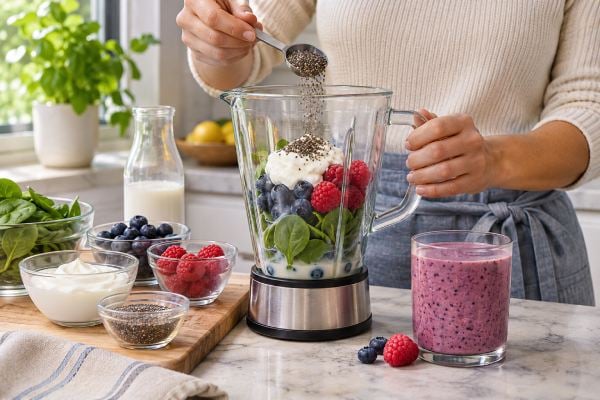
A smoothie can be a balanced meal or a fast dose of carbohydrate in a cup. The blender is rarely the problem. What matters is what goes into it, how much you use, and how quickly you drink it. A blend made with fruit juice, several servings of fruit, sweetened yogurt, honey, and a large portion size can deliver far more carbohydrate than you would normally eat at one sitting. Conversely, a smaller smoothie built around whole fruit, protein, fiber, and an unsweetened liquid produces a very different glucose response.
Research also challenges the simple claim that blending fruit automatically makes it “bad” for blood sugar. In small controlled studies, blended fruit has not consistently caused a larger glucose rise than the same fruit eaten whole. The practical goal is not to fear smoothies. It is to control the carbohydrate load, keep useful fiber, add enough protein, and choose a portion that fits your needs.
Table of Contents
- Why Some Smoothies Spike Glucose
- Does Blending Fruit Change Blood Sugar?
- How to Build a More Blood-Sugar-Friendly Smoothie
- Fruit Choices and Portions That Work Better
- Why Protein, Fiber, and Fat Matter
- Common Smoothie Mistakes to Avoid
- How to Test Your Own Smoothie Response
Why Some Smoothies Spike Glucose
A smoothie can look healthy while containing the carbohydrate load of a large meal. The biggest driver of the glucose response is usually the total amount and type of carbohydrate, not whether the drink is green, organic, homemade, or sold at a fitness café.
Consider a common combination: a banana, a cup of mango, orange juice, sweetened yogurt, and honey. Each ingredient may sound wholesome on its own, but together they create a drink with a high carbohydrate load and little chewing required. A person might finish it in five minutes and still eat breakfast beside it. That is very different from eating one piece of fruit alongside a protein-rich meal.
Several features tend to make a smoothie more likely to raise glucose quickly:
- Fruit juice as the liquid base. Juice removes most of the intact structure and fiber of whole fruit while concentrating naturally occurring sugar.
- Multiple large fruit servings. Two bananas plus berries plus dates can be much more carbohydrate than the person realizes.
- Added sweeteners. Honey, maple syrup, agave, flavored syrups, and sweetened protein powders all add to the glucose load.
- Low protein and low fiber. A fruit-and-juice smoothie may be absorbed faster and may not keep you full for long.
- Very large portions. A 20- to 32-ounce smoothie can contain several times the carbohydrate of a small homemade serving.
- Fast drinking. Liquid calories are easy to consume quickly, reducing the time over which carbohydrate enters the gut.
The easiest first step is to stop treating all fruit-based drinks as equivalent. Whole fruit and fruit juice have different structures and typical serving sizes. If juice is a regular smoothie base, review why whole fruit generally affects glucose differently from fruit juice.
A smoothie does not need to be extremely low in carbohydrate to be useful. It needs a carbohydrate amount that matches the person, the rest of the meal, medications, activity level, and glucose goals. Someone with normal glucose regulation may tolerate a larger fruit portion than someone with marked insulin resistance. The same person may also respond differently after exercise than after a sedentary day.
Does Blending Fruit Change Blood Sugar?
It is often said that blending fruit “destroys the fiber” and therefore guarantees a glucose spike. That statement is too simple. A household blender breaks the fruit into smaller particles, but it does not remove the fiber the way juicing does. If the entire apple, berries, or pear goes into the blender, most of its fiber is still in the drink.
Blending does change food structure. Smaller particles may be easier for digestive enzymes to reach, and a liquid meal can be consumed faster than solid food. Those factors could increase the rate of carbohydrate delivery in some situations. But fruit structure is complicated. Grinding seeds and cell walls may also release fiber or other compounds that change digestion.
A small 2022 crossover study in 20 healthy young adults compared whole apples and blackberries with the same fruits blended together. The blended fruit did not produce a larger glucose response; the measured peak and overall response were actually lower in that experiment. The study was small, involved healthy young adults, and used a specific fruit combination, so it should not be generalized to every smoothie. Still, it shows why “blended always spikes more” is not a reliable rule.
A 2025 randomized crossover trial also compared whole fruit, blended fruit, and commercial smoothies while measuring glucose with both continuous glucose monitors (CGMs) and capillary blood. One important finding was that the CGM could overestimate post-meal glycemia, and the amount of bias varied by food and person. That matters when people use a single CGM trace to declare one smoothie “good” and another “bad.”
The practical distinction is this:
Blending whole fruit is not the same as juicing it. A blender keeps the pulp and fiber unless you strain them out. A juicer separates much of that structure from the liquid.
Blending does not cancel portion size. Four servings of blended fruit are still four servings of fruit. Keeping the fiber does not make a very large carbohydrate load disappear.
Ingredients matter more than the machine. A smoothie with berries, plain Greek yogurt, chia seeds, and unsweetened milk is metabolically different from a smoothie made with juice, banana, dates, and honey, even though both are blended.
How to Build a More Blood-Sugar-Friendly Smoothie
A simple formula can make smoothies easier to balance. Start with an unsweetened liquid, choose a controlled amount of whole fruit, add a meaningful protein source, include fiber-rich ingredients, and use fat mainly for flavor and fullness rather than turning the drink into a calorie bomb.
A practical template is:
| Component | Useful choices | A practical starting amount |
|---|---|---|
| Liquid | Water, unsweetened dairy milk, unsweetened soy milk, unsweetened almond milk | 1/2 to 1 cup |
| Whole fruit | Berries, kiwi, apple, pear, peach, cherries, small banana portion | About 1/2 to 1 cup total |
| Protein | Plain Greek yogurt, skyr, cottage cheese, unsweetened protein powder, silken tofu | Enough to provide roughly 20–30 g protein for a meal smoothie |
| Fiber booster | Chia, ground flax, psyllium, oats in a modest amount | 1–2 tablespoons depending on ingredient and tolerance |
| Nonstarchy produce | Spinach, kale, cucumber, zucchini, cauliflower | 1 handful or more |
| Flavor | Cinnamon, cocoa, vanilla, ginger, mint | To taste |
The exact numbers are not prescriptions. A smaller person having a snack may need less, while an active person using a smoothie as a full meal may need more. The point is to build the drink intentionally rather than adding ingredients until the blender is full.
Start with the protein and liquid. Then add fruit. This reverses the common pattern of starting with several cups of fruit and trying to “balance” the smoothie afterward. If you want a sweeter taste, berries plus a small amount of banana can give sweetness without requiring a full banana and several dates.
For a simple breakfast example, try plain Greek yogurt, frozen berries, unsweetened milk, chia seeds, cinnamon, and ice. If the smoothie is only a snack, use a smaller portion. If it is replacing a meal, make sure it contains enough protein and energy to keep you satisfied rather than adding a second breakfast an hour later.
The same logic used for pairing fruit with protein and fat applies in a blender. Fruit does not have to be eaten alone, and a mixed meal can produce a different response than carbohydrate by itself.
Fruit Choices and Portions That Work Better
There is no single “best” fruit for blood sugar. Portion size, ripeness, preparation, and the rest of the smoothie all influence the result. Still, some fruit choices make it easier to keep carbohydrate moderate while preserving flavor and nutrients.
Berries are especially useful because they provide strong flavor, color, and fiber with a relatively modest carbohydrate load per typical serving. Frozen berries work well and do not require added sweetener.
Kiwi, peaches, plums, cherries, apples, and pears can also work. Keep the edible skin when appropriate because that preserves more of the fruit’s structure and fiber.
Bananas, mangoes, grapes, pineapple, and dates are not forbidden, but portions can become large quickly. These fruits are sweet and easy to overuse in a drink. Half a banana for texture may work better for your glucose than a whole banana plus mango and dates.
Very ripe fruit often tastes sweeter because some starches have been converted into sugars. That does not mean you must avoid ripe fruit, but it can be worth comparing portions if you notice a consistent difference in your response.
A good rule is to count total fruit servings before blending. If you would not normally sit down and eat a banana, two dates, a cup of mango, and a cup of berries at once, blending those ingredients does not magically turn them into a small snack.
Also look at what the fruit is replacing. If you remove juice and use whole berries instead, you are not merely changing the type of sugar; you are adding water, fiber, texture, and a more reasonable portion. If you replace fruit entirely with flavored syrup or sweetened yogurt, the smoothie may contain less produce without actually lowering the sugar much.
Individual responses vary. If one fruit repeatedly produces a larger rise for you, it may be more useful to reduce the portion or pair it differently than to ban the fruit. Personalized glucose responses to the same foods can vary considerably, especially with differences in sleep, exercise, insulin sensitivity, and meal context.
Why Protein, Fiber, and Fat Matter
Protein and fiber do more than make a smoothie “healthier.” They change how filling the drink is and can alter the glucose response to carbohydrate.
Controlled feeding research shows that adding protein to carbohydrate can reduce the post-meal glucose response in many situations, though the size of the effect differs by health status and protein type. Protein also stimulates insulin, so a lower glucose curve does not mean the carbohydrate disappeared. In people with type 1 diabetes, protein can influence glucose later and may require individualized insulin strategies.
For most meal smoothies, 20 to 30 grams of protein is a useful practical range. That might come from plain Greek yogurt, skyr, milk, soy milk, tofu, or a protein powder with little added sugar. If you prefer a plant-based powder, check the label for both protein and total carbohydrate because formulations vary widely.
Fiber can slow digestion and improve fullness. Whole fruit already contributes fiber, and additions such as chia, ground flax, oats, or a small amount of psyllium can increase it further. Viscous soluble fibers are particularly effective at changing the physical properties of a meal in the gut. However, rapidly increasing fiber can cause bloating, gas, or constipation, especially if fluid intake is low.
If you are trying to raise fiber across your entire diet, see which fiber types matter for blood sugar and how to get them. A smoothie can contribute, but it should not be the only place you eat fiber.
Fat can also slow gastric emptying and increase satiety, but more is not always better. Nut butter, nuts, seeds, avocado, and full-fat dairy can make a smoothie satisfying. They can also push calories very high when several are added together. One or two modest additions are usually enough.
Think of these ingredients as a structure: carbohydrate provides part of the fuel, protein supports fullness and muscle, fiber slows and adds bulk, and fat adds staying power and flavor. The goal is not to turn every smoothie into a nutritional chemistry experiment. It is simply to avoid drinking concentrated carbohydrate by itself.
Common Smoothie Mistakes to Avoid
Most smoothie problems are predictable. Fixing one or two often makes more difference than chasing a “blood-sugar-lowering” superfood.
Using juice as the default liquid. Orange, apple, grape, and pineapple juice add carbohydrate without much intact fiber. Water or an unsweetened milk keeps the drink easier to balance.
Adding sweeteners to already sweet fruit. Honey and maple syrup are still added sugars. Try cinnamon, vanilla, cocoa, or a small amount of a sweeter fruit first.
Choosing sweetened yogurt. Flavored yogurt can add substantial sugar before the fruit is even counted. Plain Greek yogurt or skyr gives more control, and you can add your own fruit for sweetness. A comparison of Greek yogurt and skyr for blood sugar can help if you use either frequently.
Assuming “protein” means low carbohydrate. Some protein powders, meal-replacement blends, and smoothie boosters contain maltodextrin, sugar, or a large amount of starch. Read total carbohydrate, added sugar, and serving size.
Stacking healthy extras. Oats, nut butter, chia, flax, avocado, yogurt, fruit, protein powder, and milk can all be nutritious, but putting all of them in one large drink may produce more energy than intended. A meal smoothie should replace a meal, not quietly become a meal plus a snack plus dessert.
Drinking the smoothie too fast. A large drink can disappear in a few minutes. Slowing down gives your appetite signals more time to catch up and spreads carbohydrate delivery over a longer period.
Chasing a perfectly flat CGM line. Normal people have a rise in glucose after eating. A flatter curve is not automatically healthier if it requires cutting nutritious foods unnecessarily. Look at repeated patterns, overall diet quality, A1C or other clinical markers when relevant, and how you feel.
How to Test Your Own Smoothie Response
If you monitor glucose, use your data to answer a specific question rather than to judge a smoothie from one graph. Start with a recipe you can repeat. Record the ingredient amounts, especially fruit, juice, milk, sweeteners, oats, and protein powder. Then compare similar conditions on more than one day.
For example, you could test your usual smoothie twice, then make one change: replace juice with unsweetened milk, or reduce fruit from two cups to one cup while keeping protein the same. A second useful test is to add a clear protein source without changing everything else. These comparisons teach you more than making six changes at once.
If you use a CGM, remember that it measures interstitial glucose and can differ from capillary blood, especially when glucose is changing quickly. Research in healthy adults has shown that CGM bias can vary by food and individual. Treat small differences between two smoothie traces cautiously. A difference of a few milligrams per deciliter may reflect sensor noise rather than a meaningful physiological effect.
People who use insulin or medications that can cause hypoglycemia should make food changes with their treatment plan in mind. A smoothie that contains less carbohydrate than expected can matter if medication dosing was based on the original recipe. Likewise, adding a high-fat or high-protein ingredient may shift the timing of the glucose response.
The best smoothie is not necessarily the one with the smallest possible peak. It is one that fits your nutrition needs, provides enough protein and fiber, uses a sensible carbohydrate portion, keeps you satisfied, and produces a glucose response that works with your health goals. If a recipe causes a consistently large rise, reduce the concentrated carbohydrate first: remove juice and added sweeteners, shrink the fruit portion, and add protein or fiber. Those changes are usually more useful than blaming the blender.
References
- Postprandial Glycemic Response to Whole Fruit versus Blended Fruit in Healthy, Young Adults 2022 (RCT)
- Diabetes-Specific Complete Smoothie Formulas Improve Postprandial Glycemic Response in Obese Type 2 Diabetic Individuals: A Randomized Crossover Trial. 2024 (RCT)
- Continuous glucose monitor overestimates glycemia, with the magnitude of bias varying by postprandial test and individual – a randomized crossover trial 2025 (RCT)
- The Effect of Adding Protein to a Carbohydrate Meal on Postprandial Glucose and Insulin Responses: A Systematic Review and Meta-Analysis of Acute Controlled Feeding Trials 2024 (Systematic Review)
- Effect of viscous soluble dietary fiber on glucose and lipid metabolism in patients with type 2 diabetes mellitus: a systematic review and meta-analysis on randomized clinical trials 2023 (Systematic Review)
Disclaimer
This article provides general nutrition education and is not a substitute for individualized medical or dietetic care. If you use insulin or another medication that can cause hypoglycemia, changing the carbohydrate content of a smoothie may affect medication needs. People with diabetes, kidney disease, digestive disorders, food allergies, or other nutrition-related conditions should adapt smoothie ingredients with a qualified clinician when needed.