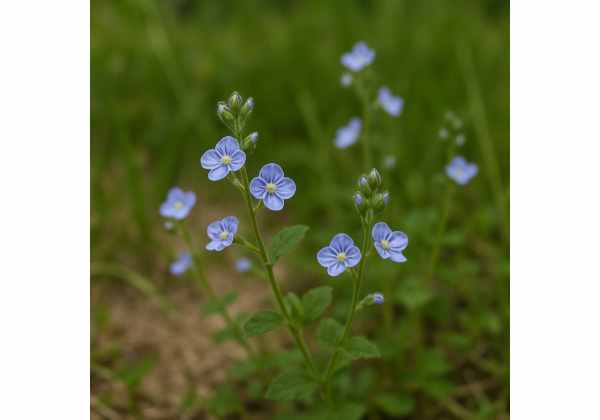
Slender speedwell, Veronica filiformis, is a delicate creeping plant with small blue flowers that many people know as a lawn spreader or ornamental escape rather than as a medicinal herb. Yet its place in the broader Veronica genus has drawn interest from herbal readers and phytochemistry researchers alike. Speedwells as a group contain flavonoids, phenolic acids, iridoid-related compounds, and other plant constituents that may help explain antioxidant, anti-inflammatory, and antimicrobial effects seen in laboratory research.
That promise, however, needs context. Slender speedwell is not one of the best-studied medicinal speedwell species, and many claims online blur the line between Veronica filiformis and better-known relatives such as Veronica officinalis. For that reason, the most helpful approach is a careful one. This article looks at what slender speedwell is, which compounds have actually been reported in the species, what medicinal properties are plausible, how traditional use differs from modern evidence, and why dosage and safety deserve extra caution. The result is a more realistic picture: an interesting plant with meaningful phytochemical potential, but only limited direct clinical support for self-treatment.
Core Points
- Slender speedwell contains flavonoid-type compounds and related phenolics with antioxidant potential.
- Research on the wider Veronica genus suggests anti-inflammatory and mild antimicrobial promise, but direct human evidence for Veronica filiformis is lacking.
- No validated oral dosage range in mg or g has been established specifically for medicinal use of slender speedwell.
- Avoid self-treatment during pregnancy, breastfeeding, childhood, or when plant identity or harvest quality is uncertain.
- Lawn-grown plants should not be used medicinally if they may have been exposed to herbicides, pesticides, or pet waste.
Table of Contents
- What slender speedwell is and why species identification matters
- Key ingredients and phytochemical profile
- Medicinal properties and potential health benefits
- Traditional context and realistic modern uses
- Slender speedwell dosage, forms, and why no standard dose exists
- Safety, side effects, and who should avoid it
- What the evidence really supports
What slender speedwell is and why species identification matters
Slender speedwell is a low, creeping perennial in the Plantaginaceae family. It spreads by slender stems that root at the nodes, which helps explain why it often forms mats in lawns, paths, and garden edges. Its leaves are small, rounded to kidney-shaped, and softly toothed, while its flowers are usually pale to bright blue with darker veins. In appearance it can look charming and almost fragile, but in the landscape it is persistent and adaptable.
From a health perspective, the first important fact is that Veronica filiformis is not the same thing as the better-known medicinal speedwell, Veronica officinalis. This distinction is more than botanical trivia. A great deal of speedwell folklore, herbal commerce, and pharmacological research centers on V. officinalis or on mixed Veronica species rather than on slender speedwell specifically. Once those lines blur, readers can easily assume that every speedwell shares the same traditional uses, the same chemistry, and the same safety profile. That is not a safe assumption.
This matters because the genus Veronica is large and chemically diverse. Some species have clearer records in Balkan, Austrian, Turkish, and broader European folk medicine for cough, catarrh, wound care, and diuretic use. Slender speedwell appears far less often in serious medicinal discussions. In many places it is better known as a weedy groundcover than as a remedy. That does not make it irrelevant, but it does mean that claims about “speedwell benefits” need to be checked against the actual species.
Another reason identification matters is product integrity. Research on commercial Veronica herbal products has shown that substitution and admixture within the genus can be common. That is a warning sign for anyone tempted to generalize from one species to another. Even when a preparation is labeled as a medicinal speedwell, the raw material may not always match what the label suggests. For a species like slender speedwell, which is already poorly represented in standardized herbal use, that uncertainty becomes even more important.
Botanically, it is also useful to remember that slender speedwell belongs to the same family as plantain, a Plantaginaceae herb with much clearer traditional medicinal use. The family connection helps explain why speedwells often contain iridoid and phenolic compounds of pharmacological interest. Still, family resemblance is not proof of equal usefulness.
A practical takeaway is that slender speedwell should be approached first as a clearly identified species and only second as a possible medicinal plant. If identification is weak, everything else becomes unreliable: the chemistry, the likely benefit, and the safety. For this plant in particular, the difference between “interesting genus member” and “established medicinal herb” should remain clear from the start.
Key ingredients and phytochemical profile
The strongest scientific interest in slender speedwell lies in its phytochemistry. This is where the plant becomes genuinely interesting. Although Veronica filiformis has not been studied as deeply as some other speedwells, researchers have identified at least one unusual flavone glycoside from the whole plant, and broader genus reviews help place that finding in context.
The most specific reported constituent for slender speedwell is a rare acylated flavone glycoside identified as an isoscutellarein derivative. This matters because unusual flavone glycosides are not just chemical curiosities. They often help explain antioxidant behavior, plant defense roles, and possible anti-inflammatory or antimicrobial actions in laboratory settings. In other words, the chemistry provides a plausible basis for future medicinal interest, even though it does not yet prove practical clinical value.
Beyond that species-specific finding, slender speedwell also fits into broader patterns seen across the genus. Reviews of Veronica species consistently highlight several major groups of compounds:
- flavonoids and flavone glycosides
- phenolic acids
- iridoid glycosides
- anthocyanidins and other pigments in floral tissues
- terpenoid or volatile fractions in some species
For V. filiformis itself, the petals have been reported to contain delphinidin, an anthocyanidin associated with blue and violet coloration. That is not just visually relevant. Pigmented flavonoid compounds often overlap with antioxidant and stress-response functions in plants. While flower color alone should never be read as medicinal proof, it does fit the broader picture of phenolic richness within the genus.
A careful way to describe the key ingredients in slender speedwell is to divide them into what is directly reported and what is inferred from close Veronica relatives:
More directly reported for the species
- a rare acylated flavone glycoside
- delphinidin in the petals
Commonly important in Veronica species overall
- apigenin- and luteolin-related flavonoid patterns
- phenolic acids such as caffeic-acid-type compounds
- iridoid glycosides that frequently shape Veronica pharmacology
This distinction matters because readers often want a neat ingredients list, but the evidence is not equally direct for every compound. In slender speedwell, the phytochemical profile is promising but still incomplete. That means the plant is better described as chemically interesting than as fully characterized.
From a medicinal-properties standpoint, these compounds matter because they support the most realistic claims that can be made for the plant: antioxidant potential, mild anti-inflammatory plausibility, and possible antimicrobial relevance. They do not yet justify stronger promises about circulation, hormones, immunity, or other popular supplement themes.
The real value of this chemistry is that it helps explain why slender speedwell belongs in scientific conversation at all. It is not a blank lawn weed. It is a biologically active species within a medicinally relevant genus. The challenge is that chemistry alone does not tell a person how much to take, whether it works clinically, or whether the plant is the best choice for a real-world health goal. Those questions require a higher level of evidence than phytochemical interest can provide.
Medicinal properties and potential health benefits
The phrase “health benefits” needs to be used carefully with slender speedwell. At present, the most honest position is that the plant has potential medicinal properties rather than proven human benefits. Most of what can be said comes from the chemistry of V. filiformis itself and from pharmacological work on other Veronica species.
The broader genus has shown several recurring activities in laboratory and preclinical research:
- antioxidant effects
- anti-inflammatory effects
- antibacterial and antifungal activity in selected extracts
- antiproliferative or cytotoxic effects in cell-based models
- enzyme-inhibiting activity in certain compounds or extracts
These findings do not all belong to slender speedwell specifically, but they do shape the most reasonable expectations for it. Since V. filiformis contains flavonoid-type compounds and belongs to a genus rich in iridoids and phenolics, it is plausible that it shares at least part of this bioactive profile.
The most realistic potential benefits
1. Antioxidant support
This is the easiest claim to defend at a preclinical level. Phenolic acids and flavonoids are well known for radical-scavenging behavior, and antioxidant potential is one of the most repeated themes in Veronica research. For slender speedwell, this should be understood as a laboratory property, not as a proven human anti-aging or disease-prevention result.
2. Mild anti-inflammatory potential
Several speedwell species show anti-inflammatory activity in cell and animal models. Those actions are often linked to phenolic compounds and iridoid glycosides. It is reasonable to consider slender speedwell a candidate for similar activity, but it would be misleading to present it as a clinically proven anti-inflammatory herb.
3. Possible mild antimicrobial relevance
Some Veronica extracts have demonstrated antibacterial or antifungal activity, although results vary widely by species, extraction method, and test organism. This supports future investigation, especially in topical or extract-based research, but not casual self-treatment of infections.
Benefits that are often overstated
The biggest risk with an under-studied plant is overinterpretation. People may see words like antioxidant, antimicrobial, or antiproliferative and assume that the plant is useful for immunity, cancer care, skin disease, or respiratory illness. That leap is too large. What the current evidence supports is plausibility, not clinical effectiveness.
A helpful rule is this:
- Plausible means the chemistry and early studies make an effect believable.
- Proven means human research has shown a consistent, meaningful outcome.
Slender speedwell belongs mostly in the first category.
This is also where species substitution becomes a real issue. A reader looking for a traditional mucosal or respiratory herb may accidentally land on slender speedwell because it shares a common name with more established Veronica remedies. That does not make the plant useless, but it does mean it is the wrong place to make strong, consumer-facing promises.
So, what can slender speedwell realistically offer? It offers a phytochemical basis for antioxidant and inflammatory research, along with enough genus-level support to justify careful scientific interest. What it does not yet offer is a clear set of clinically reliable health benefits for everyday self-care. That distinction may feel conservative, but it is what makes the guidance useful rather than merely optimistic.
Traditional context and realistic modern uses
Traditional herbal context can be helpful, but only when it is used precisely. In the case of slender speedwell, the historical picture is mixed. The Veronica genus has real ethnomedicinal depth. Across Europe and nearby regions, speedwells have been used for cough, catarrh, wound care, skin irritation, rheumatic complaints, mild urinary issues, and general “blood-cleansing” or restorative purposes. Yet those records do not always point clearly to Veronica filiformis.
That distinction matters because modern herb writing often takes traditional uses from one speedwell and spreads them across the entire genus. In practice, Veronica officinalis has the stronger medicinal reputation. It has been used in European traditions, sold as a commercial herbal product, and studied more directly. Slender speedwell appears much less consistently in serious medicinal sources, and when it does appear, it is often treated as one of several speedwells rather than as a standout remedy.
So what are the most realistic modern uses of slender speedwell?
Reasonable modern use categories
As a research-interest herb
This is its strongest current role. The plant is a legitimate subject for phytochemical and preclinical study.
As a cautiously explored folk herb
Some foraging and household traditions treat local speedwells more generally, especially as mild bitters or simple herb teas. Still, that practice is not the same as having a validated medicinal use profile.
As a topical or low-intensity traditional plant
If the species proves useful in the future, it may be more likely to find a role in mild external or supportive preparations than as a potent internal remedy. That is a cautious inference, not a settled conclusion.
Uses that should be framed carefully
- cough and catarrh support
- skin comfort or wound-washing traditions
- digestive bitterness or light tonic use
- mild diuretic or draining traditions
These are better described as genus-associated traditional themes than as direct, well-proven uses of slender speedwell itself.
This is where comparison can help. If someone is looking for a European herb with clearer traditional use for catarrhal irritation, eye-surface comfort, or upper-respiratory mucus states, eyebright offers a more established traditional example. Slender speedwell may overlap with that world loosely, but it does not occupy the same level of historical or modern clarity.
In modern herbal practice, the most responsible “use” of slender speedwell may actually be educational. It helps illustrate how a plant can sit at the edge of medicinal relevance: chemically active, taxonomically connected to better-known herbs, traditionally adjacent to healing practices, but still not solidly established as a go-to remedy.
That does not make the plant unimportant. It simply changes the right question. Instead of asking, “What is slender speedwell definitely used for?” it is more accurate to ask, “Where does this species fit within the wider medicinal story of Veronica?” The answer is that it belongs in that story, but in a supporting role rather than a leading one.
For readers, that translates into practical caution. Slender speedwell is not the best first-choice herb when the goal is reliable respiratory, skin, or digestive support. It is better understood as a species of emerging relevance whose most meaningful uses remain indirect, exploratory, and closely tied to genus-level knowledge.
Slender speedwell dosage, forms, and why no standard dose exists
Dosage is one of the clearest places where evidence gaps matter. For slender speedwell, there is no validated medicinal dosage range that can be responsibly recommended for general internal use. That may sound unsatisfying, but it is the most useful answer because it protects readers from false precision.
Why is there no standard dose?
The main reasons
1. There are no meaningful human clinical dose studies for this species
A plant cannot be responsibly assigned a therapeutic range without evidence on preparation, amount, tolerability, and intended use.
2. The species is often overshadowed by other Veronica herbs
Traditional speedwell teas, tinctures, and formulas usually refer to V. officinalis or mixed Veronica material, not clearly to V. filiformis.
3. The chemistry is interesting, but the formulation is not standardized
Knowing that the plant contains flavonoid-type compounds does not tell us how much raw herb equals a useful or safe intake.
4. Real-world plant material is highly variable
Plants gathered from lawns, roadsides, ornamental settings, or chemically treated ground are poor candidates for casual medicinal dosing.
Because of this, it would be misleading to give a tidy recommendation such as “1 to 2 g daily” or “one cup of tea twice a day” as though it were evidence-based for slender speedwell. It is not.
What about traditional forms?
In broader speedwell traditions, people have used:
- teas or infusions of aerial parts
- tinctures
- fresh herb preparations
- simple external washes or compresses
But again, those practices are usually tied to better-known speedwell species or to herbal traditions that do not sharply separate the genus into clinically distinct plants. That makes them historically interesting but not strong enough to convert into a modern dosing guide for V. filiformis.
A better framing is this: there are possible traditional forms, but no reliable species-specific medicinal dose.
This is especially important because many readers assume that weak evidence simply means “start low.” That approach is not always wise. Starting low only helps if the plant is reasonably understood in the first place. With slender speedwell, the problem is not only dose size. It is uncertainty about the right species, right plant part, right preparation, and right goal.
If someone wants a herb for gentle mucosal or throat support with a much clearer use tradition, marshmallow is a far better example of a soothing herb with established preparation logic. Slender speedwell does not yet offer that same clarity.
So what belongs in a practical dosage section for this plant? Three simple points:
- no validated human oral dose has been established
- no standardized medicinal extract is widely recognized for self-use
- self-dosing from garden or lawn material is not recommended
In other words, dosage is not merely unknown in a minor way. It is unknown in the exact places that matter most to safe self-treatment. Until better species-specific research exists, the honest dosage guidance for slender speedwell is restraint, not improvisation.
Safety, side effects, and who should avoid it
Safety deserves more attention than benefit claims in a plant like slender speedwell. The problem is not that the species is known to be dramatically dangerous. The problem is that direct safety data are limited, species confusion is possible, and people are most likely to collect it from places that make medicinal use less safe.
Across the broader Veronica genus, traditional use and selected experimental work suggest a fairly mild profile in many settings. Some reviews even note a lack of toxic or irritant gastric effects in studied Veronica contexts. That is somewhat reassuring, but it should not be stretched too far. Genus-level reassurance does not automatically become proof of safety for every species, every preparation, or every person.
The most realistic safety concerns
Uncertain species identity
If a person cannot confidently distinguish slender speedwell from similar speedwells or unrelated creeping plants, internal use becomes much harder to justify.
Contaminated harvest sites
This is one of the biggest practical issues. Slender speedwell often grows in lawns, park edges, path borders, and other places where herbicides, fungicides, pet waste, fertilizer salts, or roadside residues may be present.
Unknown interaction profile
Because the plant has not been developed as a standard medicinal herb, there is little reliable information about interactions with prescription medicines.
Allergy or gastrointestinal sensitivity
As with many herbs, mild stomach upset or allergic reactions are possible, especially in people sensitive to related plants or to bitter and phenolic-rich preparations.
Who should avoid self-use
- pregnant people
- breastfeeding people
- children
- people with significant chronic illness who are considering internal herbal self-treatment
- people taking multiple prescription medicines
- anyone uncertain of species identification
- anyone harvesting from treated lawns or other contaminated ground
A particularly important point is that “edible” and “medicinally advisable” are not the same thing. A plant may appear in foraging discussions without being a good choice for repeated internal use, especially when the plant material comes from unknown environments. Slender speedwell falls into that category of caution.
Topical exposure is usually less concerning than internal use, but even there, patch testing and common sense matter. If a plant causes redness, itching, or irritation, continued use is not wise.
Another overlooked safety issue is substitution by expectation. A person may believe they are using a classic medicinal speedwell when they are actually working with slender speedwell. That matters because the hoped-for effect may never materialize, while the uncertainties remain. In herbal practice, an ineffective herb can still be a risky herb if it delays more appropriate care.
The safest conclusion is not that slender speedwell is forbidden. It is that its safety profile is too underdefined for confident self-medication. A plant with weak dosage data, limited clinical evidence, uncertain commercial identity, and common exposure to lawn chemicals does not earn easy reassurance. In this case, caution is not excessive. It is proportionate.
What the evidence really supports
The clearest way to summarize slender speedwell is this: it is a botanically interesting and chemically promising species within a medicinally relevant genus, but it is not yet a well-established self-care herb. That conclusion may feel modest, but it is exactly what makes the evidence usable.
Here is what the evidence supports with reasonable confidence:
- the plant belongs to a genus rich in biologically active secondary metabolites
- Veronica filiformis itself contains at least one notable flavone glycoside and shares phenolic features with other speedwells
- the wider genus shows antioxidant, anti-inflammatory, antimicrobial, and other pharmacological signals in preclinical research
- species identification and product substitution are real issues in Veronica herbal use
- no validated medicinal dosage has been established for slender speedwell specifically
Here is what the evidence does not yet support strongly:
- a clear human therapeutic indication for V. filiformis
- a standard oral dose
- routine recommendation for cough, skin, wound, urinary, or digestive self-treatment
- broad claims about immunity, detox, chronic inflammation, or disease prevention
That does not make the plant unworthy of attention. It simply tells us what kind of attention it deserves. Slender speedwell is best approached as a research-interest species, not as a dependable home herbal remedy.
This perspective is useful because it protects readers from two extremes. One extreme is dismissing the plant entirely because it lacks clinical trials. The other is exaggerating early chemistry into ready-made wellness advice. Neither approach helps. A better middle ground is to recognize that the plant has genuine medicinal plausibility while also accepting that plausibility is not enough to justify confident dosing or broad therapeutic claims.
In practical terms, slender speedwell is most valuable today as:
- a species worth identifying correctly
- a contributor to the chemical and ethnobotanical story of Veronica
- a reminder that genus-level tradition does not always equal species-level evidence
For people actually seeking herbal support, this conclusion points toward clearer choices. If the goal is a dependable mucosal, respiratory, or soothing herb, better-established plants usually make more sense. Slender speedwell may one day gain a firmer place in phytotherapy, but at present it sits closer to the edge of the field than at its center.
That is not a weakness in the article or in the plant. It is simply the honest state of the evidence. And in herbal medicine, honesty about uncertainty is often more helpful than enthusiasm without boundaries.
References
- Genus Veronica—Antioxidant, Cytotoxic and Antibacterial Activity of Phenolic Compounds from Wild and Cultivated Species 2025 (Research Article)
- Identification of Phenolic Compounds Present in Three Speedwell (Veronica L.) Species and Their Antioxidant Potential 2024 (Research Article)
- Wild Species Veronica officinalis L. and Veronica saturejoides Vis. ssp. saturejoides—Biological Potential of Free Volatiles 2021 (Research Article)
- Veronica Plants—Drifting from Farm to Traditional Healing, Food Application, and Phytopharmacology 2019 (Review)
- Veronica officinalis Product Authentication Using DNA Metabarcoding and HPLC-MS Reveals Widespread Adulteration with Veronica chamaedrys 2017 (Research Article)
Disclaimer
This article is for educational purposes only and is not medical advice, diagnosis, or treatment. Slender speedwell is not a clinically established medicinal herb for routine self-use, and the available evidence does not support a validated oral dose. Speak with a qualified healthcare professional before using unfamiliar herbs internally, especially during pregnancy, breastfeeding, childhood, chronic illness, or while taking prescription medicines. Never use plants collected from chemically treated lawns or uncertain environments as medicinal material.
If you found this article useful, please share it on Facebook, X, or another platform you prefer so more readers can find careful, evidence-aware herbal guidance.