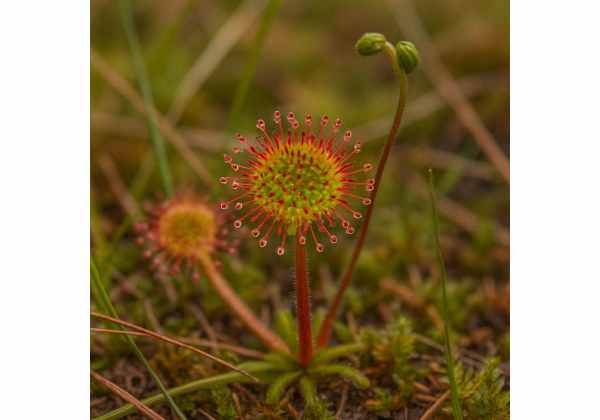
Sundew, or Drosera rotundifolia, is a small carnivorous bog plant with round, sticky leaves that trap insects, yet its long medicinal history has little to do with carnivory and much to do with the lungs. For centuries, round-leaved sundew has been used in European herbal practice for dry, irritating coughs, spasmodic coughs, and upper-respiratory complaints. Modern phytochemical and laboratory research helps explain why. The herb contains flavonoids, naphthoquinones, phenolic acids, and related compounds that have shown antispasmodic, anti-inflammatory, cilia-supporting, and antimicrobial activity in preclinical work.
Even so, sundew is not a modern first-line herb with strong human clinical trials behind it. Its best current support comes from traditional respiratory use, species-specific quality research, and experimental studies on airway smooth muscle and epithelial cells. That means the herb deserves interest, but also discipline. A helpful article on sundew should separate what is traditional from what is proven, explain why the exact species matters, and make clear that conservation and product quality are part of the safety story. Used thoughtfully, sundew remains an intriguing respiratory herb with real promise and real limits.
Quick Summary
- Sundew is best known as a traditional herb for dry, spasmodic, and irritating coughs.
- Its flavonoids and naphthoquinones help explain plausible antispasmodic and airway-supporting activity in laboratory studies.
- Older herbal monographs often describe about 3 g dried herb daily, but this is a traditional guide, not a modern standardized clinical dose.
- Avoid self-use during pregnancy, breastfeeding, or in children unless a qualified clinician recommends it.
- Choose cultivated, clearly identified Drosera rotundifolia rather than wild-harvested or vaguely labeled sundew products.
Table of Contents
- What sundew is and why species identity matters
- Key ingredients and how sundew may work
- Medicinal properties and possible health benefits
- Traditional uses, modern forms, and how sundew is taken
- Dosage, timing, and how long to use sundew
- Safety, side effects, and who should avoid it
- How to think about sundew realistically
What sundew is and why species identity matters
Round-leaved sundew is a small perennial carnivorous plant that grows in acidic bogs, poor fens, and other wet, nutrient-poor habitats. Its leaves form a low rosette and are covered with red-tipped glandular hairs that exude sticky droplets. These droplets trap insects, which the plant digests to compensate for the low nutrient content of its environment. That unusual biology makes sundew memorable, but in herbal medicine the focus is on the dried above-ground plant material used as Droserae herba.
Historically, sundew was collected from the wild and used as a remedy for coughs and pulmonary complaints. That use goes back centuries. It became especially associated with dry, spasmodic coughs, whooping-cough-like irritation, and bronchial tightness. In older phytotherapy, the herb was not usually framed as a broad tonic or general immune plant. It was a more focused respiratory herb.
One of the most important modern points is that species identity matters. “Sundew” is not one single plant in trade. Different Drosera species can appear under the same medicinal name, and they do not all have the same phytochemical profile or safety logic. Recent quality research has shown meaningful differences among sundew species in flavonoid and naphthoquinone content, along with differences relevant to toxicity and suitability for phytopharmaceutical use. That is why some modern researchers now recommend that only Drosera rotundifolia should be used as the medicinal starting material when a phytotherapeutic product is being developed.
This is more than a technical quality-control issue. If a person buys a sundew product that is labeled only as “Drosera” or “sundew herb,” they may not know whether it contains the species most associated with European respiratory use. They may also be buying plant material with a weaker flavonoid profile or a less appropriate safety profile. With a small, specialty herb like sundew, that uncertainty matters.
Conservation also matters. Wild populations of Drosera rotundifolia have declined in many places because of habitat loss, drainage, peat extraction, and historical overcollection. In much of Europe, the plant has been protected or at least treated with conservation caution for decades. That makes cultivated material the sensible choice. Wild harvesting is not only ecologically damaging, it also creates inconsistent quality.
A useful way to think about sundew is that it sits between two worlds: a fascinating carnivorous bog plant and a traditional respiratory herb. Its medicinal reputation is real, but it now depends on accurate species identification and responsible cultivation rather than romantic ideas about wild bog harvesting. That is one reason a modern sundew article has to start with the plant itself, not with the claims made for it.
Key ingredients and how sundew may work
Sundew’s medicinal relevance comes mainly from two compound groups: flavonoids and naphthoquinones. These groups appear again and again in the modern literature because they help explain why the plant has shown respiratory, anti-inflammatory, antimicrobial, and antioxidant activity in experimental settings.
Flavonoids
Flavonoids are probably the most important compounds for understanding sundew’s traditional respiratory use. Species-specific studies identify compounds such as:
- hyperoside
- isoquercitrin or isoquercetin
- quercetin
- 2″-O-galloylhyperoside
These are not minor details. Experimental work suggests that flavonoids may help relax airway smooth muscle, influence ciliary beat frequency, and contribute to the plant’s broader anti-inflammatory profile. In murine airway models, certain sundew flavonoids were specifically linked with increased ciliary beat frequency and antispasmodic activity. That matters because a plant used traditionally for dry, spasmodic cough becomes much more plausible when its constituents show airway-related effects in model systems.
Naphthoquinones
The second major group is naphthoquinones, especially compounds such as:
- plumbagin
- 7-methyljuglone
These are chemically potent compounds and part of the reason sundew has drawn scientific interest for antimicrobial and anti-inflammatory research. They are also a reminder that sundew is not just a gentle tea herb in the abstract. It is a plant with active secondary metabolites that deserve respect.
Phenolic acids and related compounds
Sundew also contains phenolic acids and other polyphenolic constituents, including ellagic-acid-related material in some studies. These compounds likely contribute to antioxidant effects and may support the broader anti-inflammatory character of the herb.
Why chemistry and species match matter
One of the most important lessons from recent research is that not all sundew species contain these compounds in the same amounts. Flavonoid content can vary widely across species and even across growing conditions. That is one reason genus-level labeling is not good enough for medicinal use. If the therapeutic rationale depends heavily on flavonoids, then a sundew with poor flavonoid content is not a small substitution. It may be a pharmacologically important one.
This is also where cultivation becomes relevant. Studies comparing field-grown and in vitro propagated Drosera rotundifolia found meaningful differences in metabolic profiles and biological activity. Field-grown material tended to show higher antioxidant potential and higher levels of several secondary metabolites. That does not mean cultivated sundew is useless. It means quality depends on how the plant is grown, handled, and dried.
For readers who think in herbal categories, sundew’s chemistry places it closer to a targeted respiratory herb than to a general soothing herb. It does not work like marshmallow, which is valued mainly for demulcent mucilage and tissue coating. Sundew is better understood as a flavonoid- and quinone-bearing herb with a sharper pharmacological profile.
Medicinal properties and possible health benefits
The most credible medicinal role for sundew is respiratory support, especially in the setting of dry, irritating, spasmodic cough. This is where traditional use, species-specific chemistry, and modern experimental work align best. That does not mean the evidence is complete. It means the herb’s main traditional claim is scientifically plausible in a way that many broader sundew claims are not.
1. Dry and spasmodic cough support
Sundew has been used for centuries in cough mixtures, bronchial remedies, and older whooping-cough formulas. The modern laboratory evidence fits this tradition surprisingly well. In ex vivo murine airway studies, Drosera rotundifolia extracts and selected flavonoids increased ciliary beat frequency and showed antispasmodic effects on airway smooth muscle. That combination helps explain why the herb has historically been associated with cough relief during colds and upper-respiratory irritation.
Still, this is not the same as large human trials proving that sundew works better than standard cough treatments. The evidence is strongest at the traditional and preclinical level, not the definitive clinical level.
2. Mild anti-inflammatory potential
Sundew has also shown anti-inflammatory effects in in vitro models. Older work demonstrated human neutrophil elastase inhibition and other anti-inflammatory-style actions. Newer studies continue to support the idea that the herb’s flavonoids and related compounds have inflammation-modulating potential. This matters for respiratory irritation because cough often involves more than mucus. It also involves irritated tissue and hyperreactive airways.
3. Airway epithelial support
A 2021 cell-based study found that low-dose Drosera rotundifolia extract influenced gene expression in human bronchial epithelial cells, with signals suggesting stimulation of epithelial repair-related and protective functions. That does not mean sundew is proven to heal damaged airways in people, but it does suggest the herb may interact with airway tissue in more complex ways than simple cough suppression.
4. Antimicrobial and antibiofilm interest
Laboratory work on sundew species also shows antimicrobial and antibiofilm promise. This is interesting, especially in an era of interest in resistant organisms, but it should not be inflated into a clinical claim. Sundew is not an antibiotic replacement, and current evidence does not justify self-treating infections with it.
What should be stated more cautiously
Some online material stretches sundew into an herb for asthma, infections, inflammation, immunity, or even cancer-related support. That is not where the evidence is strongest. Sundew’s main plausible zone remains cough and bronchial irritation. Even there, it is best framed as a traditional respiratory herb with experimental support rather than a well-validated modern first-line remedy.
If you want a more established respiratory herb for thick mucus and chest heaviness, great mullein has a clearer traditional framework for cough and throat support. Sundew, by contrast, is more specific to dry, irritable, spasm-like cough patterns and should be understood in that narrower, more credible way.
Traditional uses, modern forms, and how sundew is taken
Sundew has traditionally been taken as a tea, tincture, liquid extract, syrup ingredient, or compound respiratory preparation. Historically, it was not always used alone. It often appeared in cough mixtures with other herbs chosen for complementary actions. That still makes sense today because sundew’s role is fairly specific. It is not usually the whole formula by itself.
Traditional uses
Older European herbal practice associated sundew with:
- dry, paroxysmal, or spasmodic cough
- whooping-cough-style irritation
- bronchial tightness
- common cold symptoms with cough
- stubborn night cough
The emphasis was usually on irritation and spasm, not simply on mucus. That detail helps distinguish sundew from more strongly expectorant herbs.
Common modern forms
Tea or infusion
Tea is one of the most traditional forms. This suits dried herb use, though not every commercial sundew product is standardized the same way. A tea keeps the herb closer to its historical style of use.
Tincture or liquid extract
These are common in phytotherapy and easier to dose in small amounts. They also make it easier to blend sundew with other respiratory herbs.
Syrups and compound cough formulas
Sundew often appears alongside thyme, marshmallow, licorice, or similar herbs in cough remedies. That pairing is not accidental. Sundew brings spasmolytic and respiratory tradition, while other herbs may add soothing, expectorant, or flavor-balancing effects.
Homeopathic preparations
Sundew also appears in homeopathic products, especially for dry spasmodic cough. That is a separate therapeutic framework from herbal phytotherapy, and the two should not be confused. This article focuses on the herbal plant use rather than homeopathic dilution practice.
Practical form matching
A good rule is to match the form to the symptom pattern:
- Tea for gentle traditional use and mild respiratory irritation
- Liquid extract or tincture when precise small-volume dosing is preferred
- Compound syrup when the cough is dry and irritating but also benefits from soothing herbs
This is where combinations matter. Sundew can make sense in a formula with thyme when a cough has both spasm and mild expectoration needs, or with a more soothing herb when throat dryness dominates. But blended products also make it harder to know which herb is helping, so simple trials are often better than crowded formulas.
Another practical issue is sourcing. Because wild harvesting is ecologically problematic and species identity can vary, responsible modern use depends on cultivated, clearly labeled material. Sundew is not a plant where casual foraging is a good idea. It is too small, too habitat-sensitive, and too easy to overharvest badly.
Dosage, timing, and how long to use sundew
Sundew dosage is one of the least standardized parts of its modern use. There is no strong, universally accepted clinical dose for Drosera rotundifolia comparable to what you might see for some better-studied respiratory herbs. What exists is a mix of older monograph-style guidance, traditional practice, and product-specific dosing.
An older herbal reference point commonly cited for sundew herb is about 3 g of dried herb daily. Some traditional sources also describe a tincture range of 1 to 3 mL, 2 to 3 times daily, depending on extract strength. These numbers are useful as historical guideposts, but they should not be mistaken for modern, dose-confirming clinical evidence.
How to think about dose practically
The safest way to approach sundew is to let the preparation type guide the dose rather than assuming there is one universal amount.
Tea
A tea-based use is often the gentlest place to start because it stays close to traditional practice. It also makes it easier to stop if the herb feels irritating or ineffective.
Liquid extracts
These vary a lot. A small, well-labeled dose from a reputable manufacturer is more sensible than guessing. Since different extracts concentrate different compounds, two products with the same volume are not automatically equivalent.
Syrups and blends
These are often easier to tolerate but also harder to interpret. The symptom benefit may come partly from sundew and partly from the accompanying herbs.
Timing
Sundew is most often associated with cough patterns that worsen:
- at night
- in dry indoor air
- with irritation after a cold
- when the airway feels tight or ticklish rather than full of mucus
That means it often makes sense to use it:
- in divided doses through the day
- with one dose later in the evening if night cough is part of the pattern
- for short, clearly defined periods rather than indefinitely
Duration
Sundew is not a long-term tonic herb. It is better suited to short-term respiratory use, especially when the symptom pattern is clearly an irritating cough after a cold or mild upper-respiratory illness. A brief trial of several days is more reasonable than an open-ended routine.
If symptoms last, worsen, or include fever, shortness of breath, chest pain, wheezing, coughing up blood, or thick discolored mucus, the question is no longer how much sundew to take. The question is what is causing the symptoms.
For readers comparing traditional cough-herb logic, sundew often makes more sense as part of a respiratory pattern-based approach than as a stand-alone daily supplement. In that respect it pairs naturally with licorice in classic cough formulas where throat irritation and bronchial spasm overlap.
Safety, side effects, and who should avoid it
Sundew does not have a large, modern human safety literature, so the best safety stance is careful rather than casual. The herb contains biologically active constituents, including naphthoquinones, and recent research shows that different sundew species vary enough in content and toxicity that species selection matters. That alone argues against vague, poorly labeled products.
The most realistic safety concerns
Species confusion
This is one of the biggest issues. Sundew sold only as “Drosera” may not reliably mean Drosera rotundifolia. Because compound profiles differ, quality and safety can shift with species identity.
Pregnancy and breastfeeding
There is not enough good safety information to support medicinal use during pregnancy or lactation. Avoidance is the prudent choice.
Children
Sundew is often associated with whooping-cough traditions, which makes some people assume it is automatically child-friendly. That is not a safe conclusion. Children with significant cough need careful evaluation, and concentrated herbal use should not be improvised.
Gastrointestinal irritation
Like many aromatic or quinone-bearing herbs, sundew may irritate the stomach in larger amounts or in sensitive individuals. Nausea or digestive discomfort is a reasonable concern if the herb is overused.
Allergic sensitivity
Not common, but possible. Any herb can cause unexpected sensitivity, especially in concentrated extract form.
When extra caution is needed
Use extra caution or avoid self-treatment if:
- the cough is severe, persistent, or unexplained
- there is wheezing, shortness of breath, or chest pain
- there is fever or signs of infection
- blood is present in sputum
- you are using multiple cough or respiratory medicines
- the product does not clearly identify the species
A softer but still important safety point is ecological safety. Wild collection of sundew from bog habitats is not just a conservation issue. It can also mean inconsistent, contaminated, or poorly identified material. Cultivated, authenticated herb is the only sensible route for modern use.
If the goal is simple throat soothing rather than a more spasm-directed respiratory herb, a more established demulcent such as marshmallow for coating and calming irritated tissues may be easier to use safely. Sundew is more specialized and deserves more care.
How to think about sundew realistically
Sundew is a traditional herb with a credible story, but it is not a modern miracle. Its strongest case is still the narrow one: a historically respected herb for dry, irritating, spasmodic cough, supported by species-specific chemistry and experimental respiratory research. That is enough to make it worth knowing. It is not enough to justify broad claims about curing respiratory disease or acting like a modern cough drug.
This plant is also a good example of why old herbal reputations need updating, not discarding. In the past, sundew was collected from wild bogs and used because it seemed to help cough. Today we know more. We know that flavonoids likely matter. We know airway smooth muscle and ciliary activity may be relevant. We know species differences are significant. And we know wild harvesting is no longer an acceptable foundation for routine medicinal use.
A realistic understanding of sundew looks like this:
- it has a believable traditional place in cough remedies
- it shows interesting antispasmodic and airway-related effects in preclinical work
- it is chemically active enough to deserve respect
- it is not strongly validated by large human clinical trials
- it should be sourced carefully and used modestly
That balance matters because sundew is easy to romanticize. Its bog habitat, insect-trapping leaves, and long respiratory folklore make it sound more exotic than many herbs. But the real value is quieter than that. It is a niche respiratory plant with a historically focused use pattern and a modern research profile that partly supports that focus.
For many readers, the most sensible place to put sundew is not at the center of a whole respiratory program, but as a targeted traditional herb used thoughtfully when the symptom pattern fits. That is a much stronger position than trying to turn it into a broad all-purpose lung tonic.
In the end, sundew is best understood as a carefully sourced, species-specific cough herb with real heritage, promising mechanisms, and limited clinical certainty. That makes it interesting, useful in the right context, and definitely not a plant to overstate.
References
- Quality parameters for the medicinal plant Drosera rotundifolia L.: A new approach with established techniques 2024 (Research Article)
- Effects of Extracts and Flavonoids from Drosera rotundifolia L. on Ciliary Beat Frequency and Murine Airway Smooth Muscle 2022 (Preclinical Study)
- Field-Grown and In Vitro Propagated Round-Leaved Sundew (Drosera rotundifolia L.) Show Differences in Metabolic Profiles and Biological Activities 2021 (Research Article)
- Low-dose Drosera rotundifolia induces gene expression changes in 16HBE human bronchial epithelial cells 2021 (Research Article)
- Biology, ecology, use, conservation and cultivation of round-leaved sundew (Drosera rotundifolia L.): a review 2016 (Review)
Disclaimer
This article is for educational purposes only and is not medical advice, diagnosis, or treatment. Sundew is a specialized herbal medicine with limited modern clinical data, and it should not replace medical assessment for persistent, severe, or unexplained cough. Speak with a qualified healthcare professional before using sundew if you are pregnant, breastfeeding, taking prescription medicines, treating a child, or managing chronic respiratory disease. Use only clearly identified, responsibly cultivated Drosera rotundifolia products and avoid wild-harvested bog material.
If you found this article useful, please share it on Facebook, X, or another platform you prefer so more readers can discover careful, evidence-aware herbal guidance.